
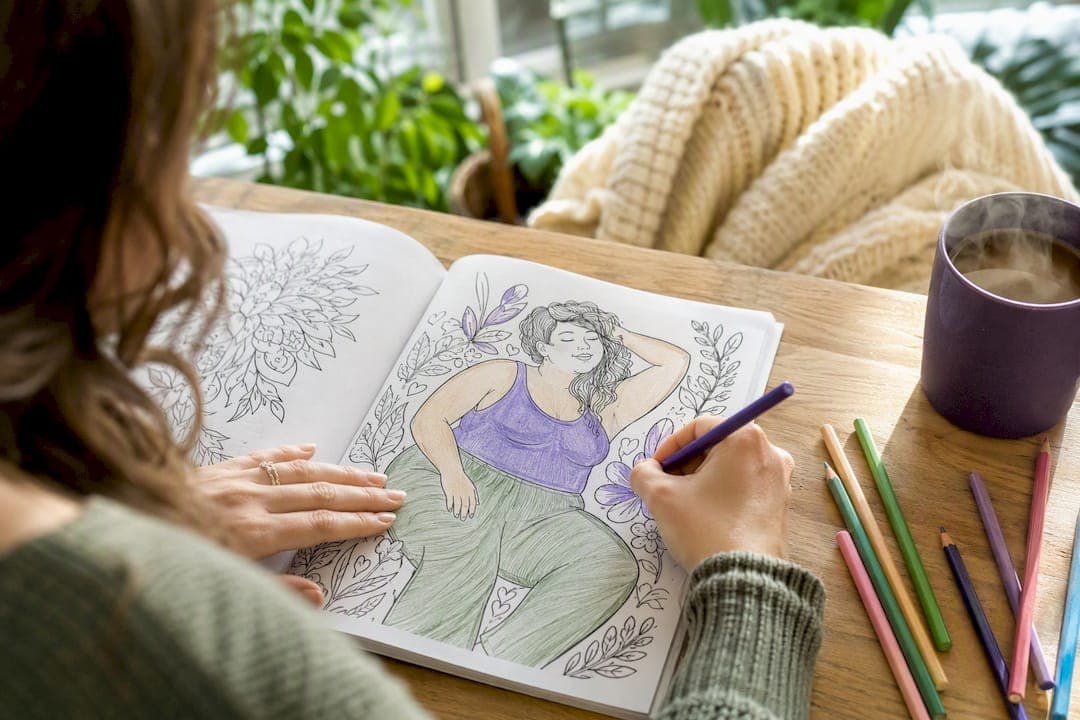
Skip the generic mandala books. For self-affirmation and relaxation, buy an affirmation-led, single-sided physical coloring book with inclusive artwork, not a printable pack or a novelty design collection. Here's why:
- Inclusive art matters. Illustrations that reflect real body sizes, ages, abilities, and skin tones help you actually see yourself in the page, not an idealized outline of a body you're told to want.
- Words do the heavy lifting. Affirmations and prompts printed alongside the art turn a coloring session into a repeatable self-affirmation practice, not just a way to kill twenty minutes.
- Paper quality decides whether you finish the book. Heavier stock and single-sided pages mean no bleed-through, no ruined art on the flip side, and no reason to abandon it halfway.
If you want something in hand this week, MunkterProducts' curated coloring book catalog is built around exactly this combination. If you need practice material tonight, printable pages are a reasonable stopgap, though they trade durability and permanence for speed.
Key Takeaways
Affirmation-led, single-sided physical coloring books with inclusive artwork deliver the most reliable self-affirmation and relaxation results for adult buyers.
| Point | Details |
|---|---|
| Choose affirmation-led books first | Text paired with art reinforces self-affirmation better than decorative-only designs. |
| Check production specs before buying | Confirm single-sided printing and paper weight to avoid bleed-through and ruined pages. |
| Match format to your goal | Use hybrid journals for reflection, printables for instant single-topic practice. |
| Treat coloring as support, not therapy | Pair it with breathing or journaling, and seek professional care for diagnosed conditions. |
| Munkterproducts curates to this checklist | Its confidence and body-positive titles combine printed affirmations, inclusive art, and quality paper. |
Table of Contents
- What Makes a Coloring Book Genuinely Body Positive?
- Why Each Feature Actually Changes How the Book Works
- Which Type of Body-Positive Coloring Book Fits Your Goal
- Does Coloring Actually Help With Self-Affirmation, or Is It Just Relaxing?
- Buying and Caring for Your Coloring Book
- Where to Buy a Body-Positive Coloring Book That Actually Delivers
- Sources
What Makes a Coloring Book Genuinely Body Positive?
Plenty of coloring books slap "body positive" on the cover and deliver the same thin-bodied line art with a pastel filter. A real body-positive coloring book is judged on specifics, not marketing copy. Run any candidate through this checklist before you buy.
- Check the artwork's actual range. Look for bodies of different sizes, skin tones, ages, hair textures, and visible disabilities across the whole book, not just one token page near the back.
- Read the text, not just the pictures. Strong titles pair each illustration with an affirmation, a short prompt, or a line of empowering text; that pairing is what separates a body-positive colouring book from a plain adult coloring book with a flattering title.
- Confirm the artist is credited. Books built with input from artists who draw diverse bodies as their focus, rather than as an afterthought, tend to hold up better under scrutiny.
- Inspect production specs before checkout. Single-sided pages, paper weight around 60 to 100 gsm or heavier, and a binding that lies flat all affect whether the book survives real use.
- Decide between a physical book and a printable pack. A physical book gives you permanence, better paper, and something to keep on a shelf as a small reminder; printable pages give you instant access but usually run on thinner home-printer paper and rarely include the same depth of prompts.
Before buying, ask the seller directly whether the paper is single-sided and what the gsm rating is. If a listing dodges that question, or if the "diversity" claim rests on a single plus-size figure in an otherwise uniform book, treat that as a red flag and keep looking. For more on evaluating single-book purchases without getting locked into a subscription, buying single coloring books online is worth a quick read first.
Pro Tip: Search the book's preview pages (most listings show three or four) for text, not just art. If every page is silent, the book is decorative. If several pages carry a short affirmation, it's built for the practice you actually want.
Why Each Feature Actually Changes How the Book Works
A checklist only helps if you understand why each item earns its spot. Affirmations and prompts aren't decoration. Pairing an image with a written statement gives your brain something to repeat while your hands are busy, which is closer to a mantra practice than a craft project, and it's the mechanism self-affirmation coloring books rely on.
Artist diversity works on a similar principle. Seeing a body that resembles yours, rendered with the same care as any other figure in the book, makes the affirmation on the page feel like it's actually addressed to you rather than to some other reader.
Line weight and art style determine which tools will look good on the page:
- Bold, thick outlines hold up well with alcohol-based markers, which tend to bleed past thin lines.
- Fine, detailed line art suits colored pencils or fine-tip gel pens better than broad markers.
- Single-sided printing stops color and ink from ghosting through to the next page, which matters most with markers and watercolor pencils.
- Extras like journaling space, color swatches, or perforated edges add practical value: swatches help you plan a palette before committing ink, and perforations let you frame a finished page without destroying the book's spine.
Single-sided printing sounds like a minor spec until you've ruined the back of a page you hadn't even started. It's one of the clearest markers of a publisher who thought about how the book gets used, not just how it photographs on a product page.
Which Type of Body-Positive Coloring Book Fits Your Goal
Not every body-positive coloring book serves the same purpose, and matching the format to your goal saves you from buying the wrong one twice.
- Affirmation-led books work best for a repeatable daily or weekly practice. Pick one page, read the affirmation aloud before you start coloring, and let the fifteen or twenty minutes of coloring reinforce the statement instead of racing through it.
- Representation-focused titles matter most if you've struggled to find art that reflects your specific body or identity. Titles built around specific communities, such as self-care coloring books centered on Black women's experiences, show what identity-focused curation looks like in practice.
- Self-care hybrid journals combine coloring pages with guided prompts and reflection space, turning a single session into a habit rather than a one-off. The Awesomely Authentic Self-Care Coloring Book is a good example of this format done well, pairing patterns and prompts to structure reflection rather than leaving it open-ended.
- Printable pages suit instant, single-topic practice, useful if you want to test whether affirmation-led coloring works for you before committing to a full book.
Body-positive coloring books work best when the art and the affirmation are doing the same job at the same time: reminding you that the body on the page, and the one holding the pencil, was never the problem.
Munkterproducts' confidence-themed adult coloring books are built around this checklist directly: curated illustrations, printed affirmations, and paper chosen for repeated use rather than a single sitting. If you're deciding between the hybrid journal format and a straight coloring book, pairing coloring with journaling prompts is a reasonable next step once you've finished your first few pages.
Does Coloring Actually Help With Self-Affirmation, or Is It Just Relaxing?
Both, but not equally, and it helps to be clear about which one you're getting. Coloring genuinely lowers stress for a lot of people, and combining it with a written affirmation gives that relaxed state something specific to attach to instead of just passing time quietly.

What it isn't is a replacement for professional care. Mental health professionals have pushed back on treating adult coloring books as therapy, pointing out that the craze often gets marketed alongside clinical language like DBT (dialectical behavior therapy) without the structure, trained guidance, or accountability that actual therapy provides. Coloring can support a mindfulness routine. It cannot diagnose, treat, or manage a mental health condition on its own.
Used with realistic expectations, though, it's a solid low-cost tool:
- Keep sessions short and consistent. Ten to twenty minutes a few times a week tends to build a habit better than one long session that feels like a chore.
- Pair coloring with a breathing exercise or a few minutes of journaling before or after, especially if the book includes reflection prompts.
- Treat the affirmation as the point, and the coloring as the delivery method, not the other way around.
- If you're dealing with a diagnosed condition, use coloring alongside professional support, not instead of it.
Munkterproducts' own coverage of the research behind adult coloring for stress relief goes deeper into what the evidence does and doesn't support, if you want the fuller picture before deciding how much weight to put on the practice.
Buying and Caring for Your Coloring Book
Match your tools to your paper before you start, not after you've bled through six pages.
- Match tool to paper weight. Thin paper handles colored pencils fine but smears or wrinkles under alcohol markers; heavier stock (90 gsm and up) can usually take water-based markers without warping.
- Test before you commit. Color a small corner of the first page with your intended tool and check the back for bleed-through before working through the rest of the book.
- Protect finished pages. If the book includes perforated edges, remove pages carefully along the crease, and store loose pages in a protective sleeve if you plan to frame or gift them.
- Check delivery and return terms before ordering. Confirm estimated delivery windows and the return policy on physical book orders, especially around holidays when shipping slows down.
Pro Tip: If a listing doesn't state the paper weight in gsm, email the seller before ordering. A publisher who can't answer that question in one line probably hasn't tested the book with real coloring tools.
Why We Curate These Books the Way We Do
I've spent years watching coloring book trends come and go, and the pattern is always the same: books that pair strong affirmations with genuinely inclusive art outlast the ones chasing a trend hashtag. That's the standard behind every title Munkterproducts adds to its coloring book catalog. If something doesn't fit, our support team sorts out returns without a fight.
— Mark
Where to Buy a Body-Positive Coloring Book That Actually Delivers
Independent listings and marketplace search results can leave you guessing about paper weight, page count, or whether the "affirmations" are anything more than a subtitle. Munkterproducts built its coloring book line to answer those questions before you ask them: single-sided pages, printed affirmations paired with inclusive illustrations, and paper chosen to survive markers and colored pencils alike.

If you've read this far and want a book that checks every box on the list above without you having to cross-reference five listings, the Munkterproducts storefront is where to start. Browse the confidence and body-positive titles, pick the format that matches your goal, whether that's daily affirmation practice or a slower hybrid journal, and check out with postage already included. Your next coloring session could start with a book that was actually built for it.
Sources
- Why therapists are wary about the adult coloring book craze | The Guardian
- This Body-Positive Colouring Book Will Remind You 'Your Body Is Not Wrong, Society Is' — HuffPost UK