

The global book publishing market exceeds $152 billion in 2026, with digital and direct-to-consumer channels accounting for over 42% of trade book revenue. This massive shift transforms how consumers discover, purchase, and engage with books online, creating both opportunities and challenges for e-commerce entrepreneurs and publishers. Understanding the mechanics of book publishing in the digital age is no longer optional for those operating in online retail markets. This guide explores how book publishing impacts e-commerce, from platform strategies and metadata management to automation and consumer behavior patterns that drive sales in 2026.
Table of Contents
- The Rise Of Digital Publishing And Its E-Commerce Impact
- Key Platforms And Strategies Authors Use To Succeed In E-Commerce
- Why Metadata Management And Automation Are Game Changers In Book E-Commerce
- Practical Implications For E-Commerce Entrepreneurs And Publishers
- Explore Munkterproducts.com For Your Publishing And E-Commerce Needs
Key takeaways
| Point | Details |
|---|---|
| Digital dominance | Digital channels account for over 42% of trade book revenue in 2026, reshaping consumer buying habits |
| Competitive landscape | Most self-published authors earn under $500 annually, highlighting the need for strategic distribution |
| Tri-platform success | Top earners use Amazon for discovery, IngramSpark for reach, and Shopify for retention |
| Metadata precision | Accurate metadata determines discoverability and directly impacts sales performance |
| Automation advantage | Publishing automation saves 70–90% of manual time and reduces costly errors |
The rise of digital publishing and its e-commerce impact
The book publishing industry has undergone a fundamental transformation that mirrors broader e-commerce trends. Digital channels now generate 42% of trade book revenue, fundamentally changing how consumers discover and purchase books. This shift represents more than just a new sales channel. It signals a complete restructuring of the value chain, from manuscript to reader.
The book e-commerce platform market reached $8.07 billion in 2024 and is projected to hit $22.69 billion by 2032, growing at a 15.91% compound annual growth rate. This explosive growth stems from three converging factors:
- Wider accessibility through mobile devices and reading apps that eliminate geographic barriers
- Direct consumer purchases that bypass traditional bookstore gatekeepers
- Streamlined distribution systems that reduce time from publication to purchase
For e-commerce entrepreneurs, this growth creates opportunities in niche markets that traditional publishers overlook. Self-published authors can now reach global audiences without intermediaries, while established publishers leverage data analytics to predict consumer preferences with unprecedented accuracy. The democratization of publishing tools means anyone with expertise can package knowledge into digital or print products and distribute them worldwide.
"The book publishing market's digital transformation mirrors the broader shift in consumer behavior toward online discovery and purchase, making it a bellwether for e-commerce trends across product categories."
This transformation also influences consumer behavior beyond books. Shoppers who discover products through content marketing, reviews, and educational materials expect the same seamless experience they get when buying books online. The sophisticated recommendation engines, personalized marketing, and frictionless checkout processes pioneered by book retailers set standards that all e-commerce businesses must meet in 2026.
Key platforms and strategies authors use to succeed in e-commerce
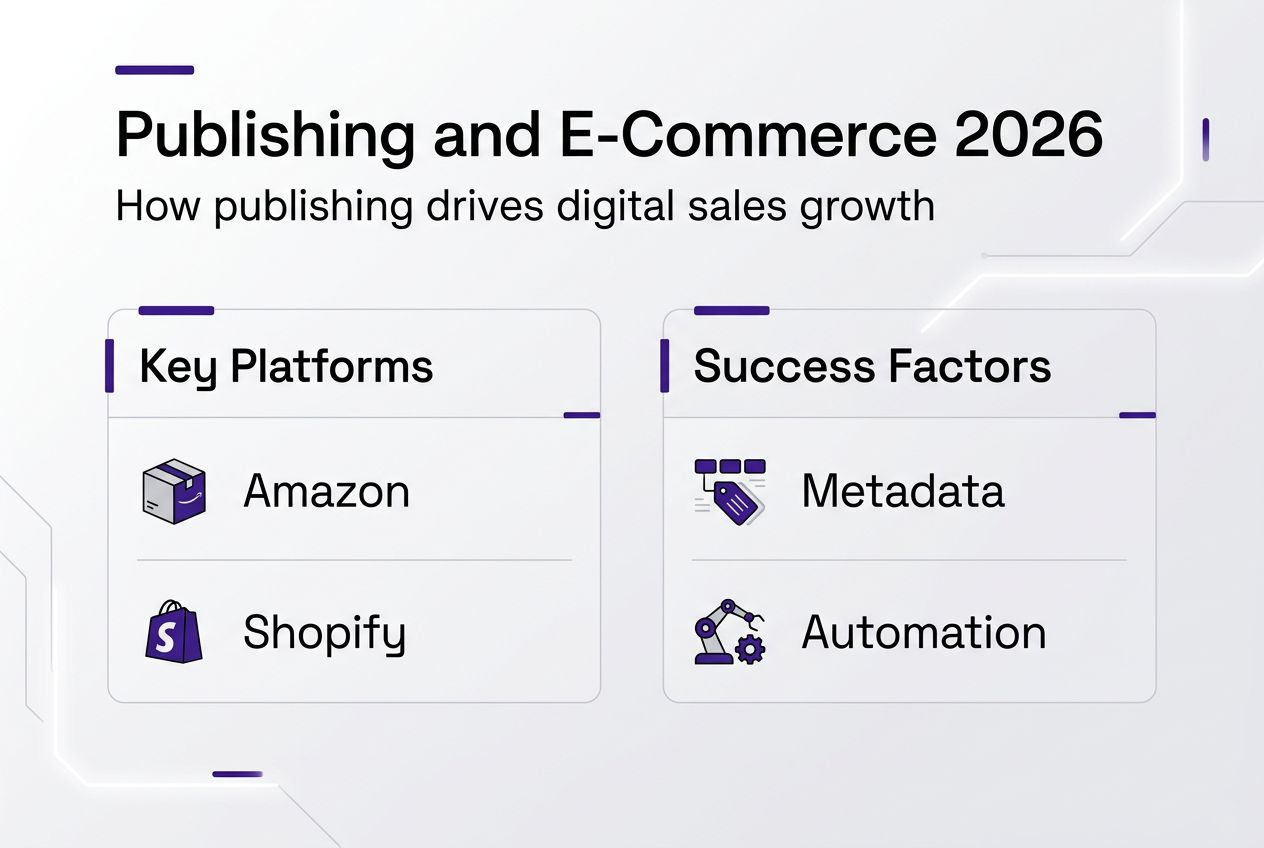
Successful book publishing in 2026 requires a sophisticated multi-platform approach. Authors earning over $50,000 annually consistently use a tri-platform distribution strategy that balances discovery, reach, and retention. This approach recognizes that different platforms serve distinct functions in the customer journey.
Amazon dominates as the primary discovery channel, capturing readers actively searching for books in specific categories. Its massive audience and sophisticated recommendation algorithm make it essential for initial visibility. However, relying solely on Amazon creates dangerous dependency and limits direct customer relationships.
IngramSpark expands reach by distributing books to over 40,000 retailers, libraries, and schools worldwide. This platform bridges the gap between digital-first publishing and traditional retail channels, ensuring books appear in physical stores and library catalogs. The credibility boost from library presence translates directly into online sales velocity.
Shopify stores enable customer retention through direct engagement, email marketing, and exclusive offers. Authors who build their own storefronts capture customer data, create bundle offers, and develop recurring revenue streams through subscription models. This direct relationship proves invaluable for launching new titles and cross-selling related products like educational books focused on personal growth.
The tri-platform approach works because each channel amplifies the others:
- Amazon drives initial discovery through search and recommendations
- IngramSpark builds credibility through library and bookstore placement
- Shopify captures high-value customers who want direct relationships with authors
- Cross-platform presence creates multiple touchpoints that reinforce brand recognition
- Data from all three platforms informs marketing decisions and content strategy
Pro Tip: Start with Amazon to validate demand, add IngramSpark once you have proven sales, and launch your Shopify store when you have at least 500 email subscribers. This sequence minimizes upfront investment while building the foundation for sustainable growth.
The platform strategy extends beyond just distribution channels. Successful authors treat each platform as part of an integrated ecosystem where pricing, promotions, and content work together to maximize lifetime customer value. They use Amazon's visibility to drive initial purchases, IngramSpark's reach to build authority, and Shopify's flexibility to create premium experiences that command higher prices.
Why metadata management and automation are game changers in book e-commerce
Behind every successful book sale lies a complex data infrastructure that most readers never see. Book discoverability is primarily a data structure problem, not an editorial or marketing function. The quality of metadata determines whether a book appears in search results, recommendation engines, and curated lists that drive the majority of online book sales.

Metadata encompasses far more than just title and author name. It includes subject categories, keywords, age ranges, reading levels, series information, publication dates, and dozens of other data points that algorithms use to match books with readers. A single error in category classification can render a book invisible to its target audience, causing lost sales without any immediate feedback to the publisher.
The challenge intensifies when publishing across multiple platforms, each with unique metadata requirements and formatting standards. Manual data entry creates bottlenecks and introduces errors that compound across distribution channels. This is where automation transforms publishing operations.
Publishing automation removes repetitive uploads and lets authors publish the same title to Amazon KDP, Kobo, Apple Books, Draft2Digital, and Ingram from one control panel. The time savings are dramatic, cutting 70–90% of manual effort while eliminating transcription errors that plague manual workflows.
| Aspect | Manual Publishing | Automated Publishing |
|---|---|---|
| Time per platform | 45–60 minutes | 5–10 minutes |
| Error rate | 15–25% metadata errors | Under 2% error rate |
| Update speed | 2–3 days across platforms | Same-day synchronization |
| Scalability | Limited to 10–15 titles/month | 50+ titles/month possible |
The benefits extend beyond efficiency. Automated systems maintain metadata consistency across platforms, ensuring readers see accurate information regardless of where they shop. They also enable rapid testing of different keywords, categories, and descriptions to optimize discoverability. Publishers can experiment with metadata variations and measure results within days rather than months.
Pro Tip: Invest in metadata hygiene and automation tools before publishing your third book. The upfront cost pays for itself through time savings and improved discoverability, especially when managing educational content across multiple formats.
The strategic advantage of automation becomes clear when launching new titles or running promotions. Publishers can coordinate price changes, update descriptions, and refresh keywords across all platforms simultaneously, maximizing the impact of marketing campaigns. This synchronization ensures consistent messaging and prevents the confusion that arises when different platforms show conflicting information.
Practical implications for e-commerce entrepreneurs and publishers
Translating book publishing insights into actionable e-commerce strategies requires understanding how platform dynamics and consumer behavior intersect. Multi-platform presence doesn't just increase visibility; it creates algorithmic advantages that amplify sales velocity across all channels.
Library distribution through platforms like OverDrive and Libby generates surprising benefits beyond direct library sales. Books appearing in OverDrive improve their Amazon ranking within 11 days, demonstrating how cross-platform presence signals quality to recommendation algorithms. This effect occurs because library placement validates a book's appeal to professional curators, triggering algorithmic promotion on retail platforms.
Focus on engagement velocity metrics rather than vanity metrics like page views or social media followers. Algorithms in 2026 prioritize books that generate rapid engagement after publication: reviews, purchases, and reading completion rates matter far more than raw traffic numbers. A book with 100 highly engaged readers outperforms one with 1,000 passive browsers in algorithmic rankings.
Avoid the common pitfall of uploading manuscripts directly to Amazon KDP without establishing master distribution first. This approach locks content into a single platform and complicates future expansion. Instead, maintain a master file repository and use distribution services that push content to multiple platforms while preserving your ability to make universal updates.
Here's a step-by-step checklist for publishing and promoting books successfully in e-commerce:
- Create master files with complete metadata before uploading to any platform
- Validate metadata accuracy using ONIX standards and ISBN management tools
- Establish distribution through IngramSpark to access library and retail channels
- List on Amazon KDP with optimized keywords and category selections
- Build a Shopify store with email capture and exclusive content offers
- Launch coordinated promotions across all platforms simultaneously
- Monitor engagement velocity metrics and adjust metadata based on performance
- Collect email addresses from all sales channels to build direct relationships
E-commerce entrepreneurs can apply these publishing principles to other product categories. The emphasis on metadata quality, multi-platform distribution, and engagement velocity translates directly to selling educational materials and creative products online. The same algorithmic factors that determine book discoverability influence how Amazon, Etsy, and other marketplaces rank all products.
The most successful publishers in 2026 treat each book as a product line rather than a one-time release. They create complementary products like workbooks, journals, and courses that extend the value of core content. This approach mirrors how e-commerce brands build product ecosystems around hero items, maximizing customer lifetime value through strategic cross-selling.
Consider how your existing products could benefit from the publishing model's emphasis on discoverability, metadata precision, and multi-platform presence. The tools and strategies that drive book sales work equally well for other information products, educational materials, and creative goods sold online.
Explore MunkterProducts.com for your publishing and e-commerce needs
Applying these book publishing insights to your e-commerce strategy becomes easier with the right tools and guidance. MunkterProducts.com offers handcrafted books, journals, and educational materials designed for entrepreneurs and publishers building their online presence. The platform specializes in products that combine educational value with practical application, perfect for those implementing the strategies outlined in this guide.

Whether you're launching your first book, expanding into educational products, or optimizing your existing e-commerce operations, MunkterProducts.com provides resources tailored to your publishing journey. Explore the catalog to discover how quality educational materials and strategic publishing approaches work together to build sustainable online businesses in 2026.
FAQ
What platforms should e-commerce entrepreneurs consider for selling books?
Top platforms include Amazon for discovery due to its massive audience and recommendation engine, IngramSpark for extended reach through bookstores and libraries, and Shopify for customer retention through direct relationships. Choosing platforms should align with your specific business goals: use Amazon if you need immediate visibility, add IngramSpark when you want credibility through traditional channels, and launch Shopify when you have enough traffic to justify building your own storefront.
How does metadata impact book sales on e-commerce sites?
Accurate metadata ensures books appear in relevant search results and recommendation algorithms that drive most online sales. Poor metadata can make books effectively unsearchable, causing lost sales without any warning to publishers. The challenge intensifies across multiple platforms because each has unique metadata requirements, making consistency critical for maximizing discoverability.
What are the benefits of automating book publishing workflows?
Automation cuts 70–90% of manual time required to publish across multiple platforms while reducing human errors that plague manual data entry. It enables same-day synchronization of updates across all channels, ensures metadata consistency, and allows publishers to scale from managing 10–15 titles monthly to 50+ titles without proportionally increasing workload. The time savings and error reduction typically pay for automation tools within three months for publishers managing more than five titles.
Why do successful authors use multiple distribution platforms?
Multiple platforms expand audience reach, improve algorithmic discovery, and enhance customer retention through different touchpoints in the buyer journey. Combined use of Amazon for discovery, IngramSpark for reach, and Shopify for control balances exposure with direct customer relationships. Cross-platform presence also creates algorithmic advantages, as library placement through IngramSpark improves Amazon rankings within 11 days, demonstrating how platforms amplify each other's effectiveness.