

You've probably heard that reading makes you smarter, more empathetic, and better at navigating life's challenges. But what if that's only partly true? Recent psychological research reveals that simply picking up any book won't automatically transform your social skills or emotional intelligence. The relationship between reading and personal growth is far more nuanced than popular wisdom suggests. This guide cuts through the misconceptions to show you exactly how books contribute to self-improvement, which reading strategies actually work, and how to pair your reading habits with practical tools that amplify real, measurable growth in your life.
Table of Contents
- Key takeaways
- The science behind reading and self-improvement
- Developing the right mindset to maximize reading benefits
- How to read intentionally for personal growth
- Using journaling and creative tools to enhance self-improvement
- Explore tools and books to boost your self-improvement journey
- Frequently asked questions about the role of books in self-improvement
Key Takeaways
| Point | Details |
|---|---|
| Reading alone not enough | Simply reading any book will not automatically improve empathy or social skills in the short term. |
| Exposure to diverse books | Over the long term, exposure to diverse books correlates with more positive social outcomes like empathy and perspective-taking, though correlation does not prove causation. |
| Iterative mindset with reading | An iterative mindset reframes reading as a cycle of trying ideas, testing them in real life, reflecting on results, and adjusting your approach. |
| Challenging books foster resilience | Engaging with challenging or disagreeable books helps build intellectual resilience by pushing you to rethink assumptions. |
| Journaling enhances growth | Journaling helps translate reading insights into actionable self improvement. |
The science behind reading and self-improvement
The popular narrative around reading and personal development often oversimplifies a complex relationship. While many self-help gurus promise that reading the right books will revolutionize your life, fiction reading shows no causal improvement in social outcomes after just four weeks of exposure. This doesn't mean books are useless for growth. It means we need to understand what reading actually accomplishes and what it doesn't.
Research distinguishes between short-term experimental effects and long-term correlational patterns. Studies tracking readers over decades find that lifetime exposure to fiction correlates positively with social outcomes like empathy and perspective-taking. However, this correlation doesn't prove causation. People who naturally gravitate toward fiction may already possess traits that support better social functioning. The evidence remains weak for claiming that reading directly causes these improvements.
Not all reading contributes equally to personal growth. Quality and engagement matter far more than quantity. Skimming airport bestsellers while distracted produces different outcomes than deeply engaging with challenging literature that pushes your thinking. The book publishing impact analysis shows how content quality varies dramatically across genres and publishers.
Understanding these limitations prevents misguided expectations. If you expect a single self-help book to solve your problems in a week, you'll likely feel disappointed. But if you view reading as one component of a broader personal development strategy practiced consistently over time, you set yourself up for realistic progress.
Key factors that determine reading's impact on self-improvement:
- Active engagement with challenging material rather than passive consumption
- Consistent exposure over months and years, not days or weeks
- Integration of reading insights with real-world practice and reflection
- Selection of diverse perspectives that challenge existing beliefs
- Combination of reading with complementary practices like journaling or discussion
Scientific insights help you tailor reading habits toward effective self-improvement. Instead of hoping books magically transform you, you can design a reading practice that genuinely supports growth when paired with the right mindset and supplementary tools.
"The value of reading for personal development lies not in the act itself, but in how we process, reflect on, and apply what we encounter on the page."
Developing the right mindset to maximize reading benefits
Reading becomes exponentially more valuable when you pair it with an iterative mindset. This approach treats personal growth as a cycle of practice, reflection, learning from failure, and adjustment. Rather than expecting instant transformation, you view each book as providing raw material for experimentation in your own life.

Research demonstrates that an iterative mindset relates to weight loss success, self-efficacy, and overall well-being. When applied to reading-based self-improvement, this mindset shifts your focus from consuming information to actively testing and refining ideas. You read a concept, try implementing it, observe what happens, reflect on the results, and adjust your approach.
The reading habit mastery guide explores how consistent practice builds deeper engagement over time. Combining this consistency with an iterative approach creates a powerful framework for sustained growth.
Step-by-step process for adopting an iterative mindset with reading:
- Select one specific insight or technique from your current book
- Define a concrete experiment to test this idea in your daily life
- Implement the experiment for a defined period (one to two weeks works well)
- Journal observations about what worked, what didn't, and why
- Adjust your approach based on these reflections and repeat
- Return to the book with new questions informed by your real-world experience
This process emphasizes action beyond passive reading. You're not just collecting knowledge. You're building practical wisdom through direct experience. Each cycle deepens your understanding and reveals nuances that remain invisible when you simply read without application.
Pro Tip: Set aside 10 minutes after each reading session to write three specific ways you could apply what you just read. Choose one to experiment with immediately, even in a small way.
The iterative mindset also builds resilience when facing setbacks. If an approach from a book doesn't work for you, that's valuable data rather than failure. You learn what doesn't fit your context, which helps you refine your strategy. This perspective keeps you engaged with personal growth as an ongoing process rather than a destination you either reach or miss.
How to read intentionally for personal growth
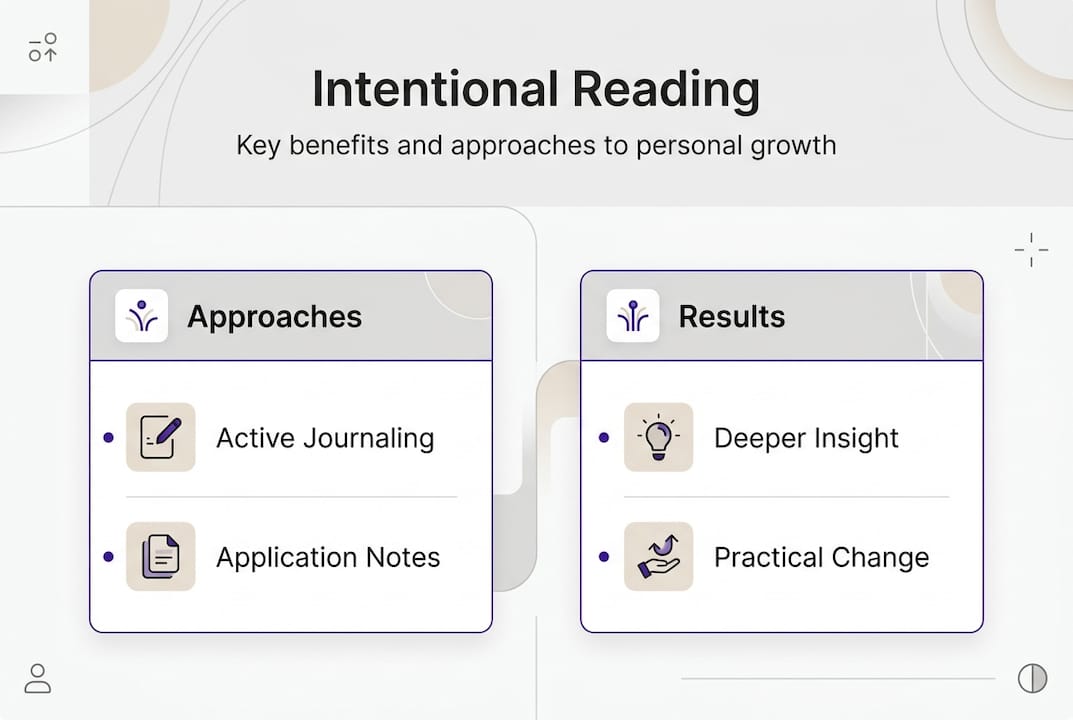
Intentional reading differs fundamentally from passive consumption. Passive readers move through books without pausing to question, challenge, or connect ideas to their lives. Intentional readers actively engage with material, treating each book as a conversation partner rather than an authority delivering truth.
One powerful distinction involves choosing between agreeable and disagreeable books. Agreeable books confirm your existing beliefs and provide comfort. They're easy to read and often feel inspiring. Disagreeable books challenge your assumptions, present opposing viewpoints, and create intellectual discomfort. Both serve different purposes in personal growth.
| Reading approach | Primary benefits | Best used when |
|---|---|---|
| Agreeable books | Motivation, reinforcement of positive habits, emotional validation | Building confidence, maintaining momentum, recovering from setbacks |
| Disagreeable books | Critical thinking, intellectual humility, perspective expansion | Avoiding echo chambers, testing beliefs, building cognitive flexibility |
| Mixed approach | Balanced growth combining comfort and challenge | Sustained long-term development across multiple dimensions |
Reading disagreeable books builds empathy, critical thinking, and resilience. When you engage seriously with perspectives that contradict your beliefs, you develop the ability to hold multiple viewpoints simultaneously. This cognitive flexibility proves essential for navigating complex personal and professional challenges. The reading against the grain expert guide offers specific techniques for engaging productively with difficult material.
Businesspeople and high performers increasingly recognize reading as a competitive edge precisely because it develops this kind of intellectual agility. The educational books for growth article explores how strategic book selection accelerates development.
Tactics for engaging effectively with challenging material:
- Annotate margins with questions and counterarguments as you read
- Summarize the author's strongest points in your own words before critiquing
- Identify one idea that genuinely shifts your perspective, even slightly
- Discuss the book with someone who disagrees with it to test your understanding
- Write a response essay arguing both for and against the book's central thesis
Pro Tip: When reading a book you disagree with, force yourself to write down three points where the author might be right before listing your objections. This practice builds intellectual honesty and prevents defensive reading.
Intentional reading requires slowing down. You might finish fewer books, but you'll extract far more value from each one. The goal isn't to maximize your annual book count. It's to genuinely integrate insights that shift how you think and act.
Using journaling and creative tools to enhance self-improvement
Journaling transforms reading from a passive activity into an active self-improvement practice. When you write about what you read, you process ideas more deeply, clarify your thinking, and create a record of your intellectual journey. This practice solidifies learning in ways that reading alone cannot achieve.
Creative stationery serves more than aesthetic purposes. Quality journals, planners, and writing tools can motivate consistent practice and help organize your self-improvement routines. The physical act of writing by hand engages your brain differently than typing, often leading to deeper reflection and better retention.
Journaling techniques mapped to reading outcomes:
- Reflection journaling: Write about how book concepts connect to your personal experiences and what they reveal about your patterns
- Goal-setting journaling: Translate book insights into specific, measurable objectives with defined timelines
- Progress tracking: Document experiments inspired by reading, noting what you tried, what happened, and what you learned
- Question journaling: Record questions that arise while reading, then research and answer them over time
- Integration journaling: Connect ideas across multiple books to build your own frameworks and models
Different journaling styles support different aspects of growth. A bullet journal excels at tracking habits and tasks derived from reading. A reflective journal captures emotional responses and personal insights. A goal tracker maintains focus on specific outcomes you're working toward.
| Journal type | Structure | Best for | Time investment |
|---|---|---|---|
| Bullet journal | Modular pages with rapid logging, collections, and trackers | Habit formation, task management, quantitative progress | 5-10 minutes daily |
| Reflective journal | Free-form narrative entries exploring thoughts and feelings | Emotional processing, self-awareness, pattern recognition | 15-20 minutes daily |
| Goal tracker | Structured templates with objectives, milestones, and metrics | Accountability, measuring outcomes, maintaining motivation | 10 minutes weekly |
| Reading journal | Book summaries, quotes, and personal responses | Retaining insights, building knowledge base, connecting ideas | 10-15 minutes per book |
Setting realistic goals based on reading insights requires specificity. Instead of "be more confident," translate a book's advice into "initiate one difficult conversation per week for the next month." This specificity makes progress measurable and actionable.
Record actionable insights immediately after reading sessions. Write down one to three specific actions you could take based on what you just read. This practice prevents the common problem of finishing books feeling inspired but taking no concrete steps.
Explore tools and books to boost your self-improvement journey
You've learned how reading contributes to personal growth when paired with the right mindset, intentional engagement, and reflective practices. Now it's time to equip yourself with the physical tools that support this process. Quality journals designed for self-reflection, planners that help you translate insights into action, and carefully curated books across genres all play crucial roles in sustained development.

MunkterProducts.com offers a thoughtfully selected range of self-help journals, educational books, and creative stationery that facilitate deeper engagement with your reading practice. Whether you need a structured goal tracker to measure progress, a reflective journal for processing insights, or books that challenge your thinking across multiple domains, you'll find resources designed specifically for readers committed to genuine personal growth. The straightforward purchasing process and included postage make it easy to build your self-improvement toolkit without hassle.
Frequently asked questions about the role of books in self-improvement
What types of books are most effective for self-improvement?
Books that challenge your existing beliefs and require active engagement produce the strongest growth outcomes. Mix practical how-to guides with philosophical works, biographies of people different from you, and fiction that explores complex human experiences. Diversity across genres and perspectives matters more than staying within a single category.
How much reading per day is recommended to see benefits?
Quality trumps quantity in reading for self-improvement. Spending 20 to 30 minutes daily reading intentionally with reflection produces better results than rushing through multiple books without processing them. Focus on deep engagement rather than page counts or annual book totals.
Can reading alone improve emotional intelligence?
Reading provides raw material for developing emotional intelligence but doesn't directly cause improvement. You must actively apply insights through real-world practice, reflect on your experiences, and adjust your approach over time. Pairing reading with journaling and intentional social experiments yields the best results.
Is it helpful to read books you disagree with?
Reading disagreeable books builds critical thinking, intellectual humility, and cognitive flexibility. These books force you to understand opposing viewpoints seriously, which strengthens your ability to navigate complexity. Aim to read at least one book per quarter that challenges your core beliefs.
How can I track progress from reading-based self-improvement?
Maintain a reading journal documenting specific insights, experiments you conduct based on those insights, and observed outcomes. Set measurable goals derived from your reading and review them monthly. Track both quantitative metrics (habits completed, goals achieved) and qualitative shifts (perspective changes, improved relationships). This creates accountability and reveals patterns over time.