

You might think book publishing is a relic of the past, overtaken by streaming services and social media. The truth is more surprising. Book publishing remains a cornerstone of cultural preservation, educational excellence, and personal development in 2026. While digital formats grow, print books still command the market and deliver cognitive benefits that screens cannot match. This guide reveals why publishing continues to shape how we learn, think, and connect with our shared humanity, and why dismissing it as outdated misses the profound impact it has on society today.
Table of Contents
- How Book Publishing Preserves Culture And Shapes Society
- The Educational Impact Of Literature And Print Books
- Market Dynamics And Evolving Trends In Book Publishing
- Challenges And Opportunities Shaping Modern Publishing
- Explore More With Munkterproducts.com
- Frequently Asked Questions
Key takeaways
| Point | Details |
|---|---|
| Cultural preservation | Book publishing archives human experiences and shapes public discourse, sustaining heritage across generations. |
| Educational superiority | Literature builds critical thinking and empathy while print books enhance comprehension compared to digital reading. |
| Market dominance | Print holds 73% of the US book market despite digital growth, proving enduring reader preference. |
| Cognitive benefits | Paper and audio reading reduce anxiety and improve focus better than screen-based formats. |
| Social influence | Platforms like BookTok drive youth engagement and reshape how readers discover books. |
How book publishing preserves culture and shapes society
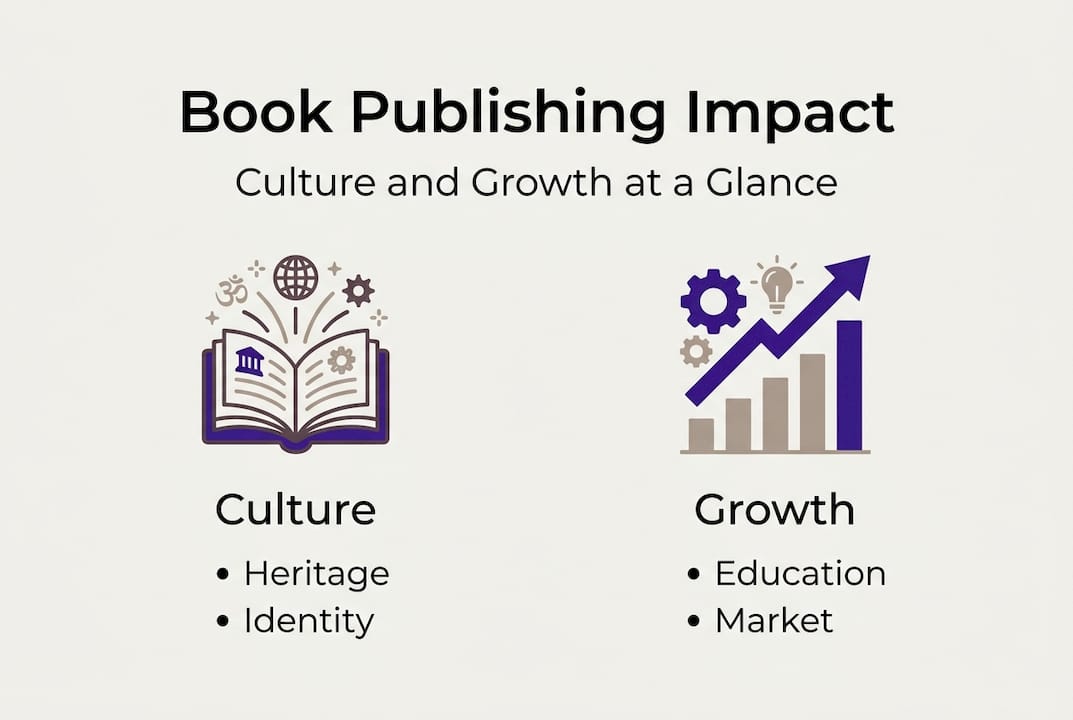
Publishing preserves cultural heritage, shapes public opinion, and fosters national identity by archiving human thought and experiences in books. Every published work becomes a permanent record of ideas, struggles, and triumphs that define civilizations. Without this systematic documentation, cultural memory fades within a generation. Publishers act as gatekeepers and curators, selecting which voices and narratives reach the public sphere and influence collective understanding.
The mechanics of publishing extend far beyond printing pages. Editors refine raw manuscripts into polished works that communicate clearly and powerfully. Distribution networks ensure books reach diverse audiences across geographic and economic barriers. Marketing teams amplify important voices that might otherwise remain unheard. This entire ecosystem transforms individual expression into shared cultural assets that spark conversations, challenge assumptions, and build bridges between communities.
Book bans reveal publishing's cultural power through an unexpected paradox. When authorities attempt to suppress books, circulation increases by 12% as social media amplifies awareness and readers rush to access forbidden content. Lesser-known authors benefit most from this visibility boost. The Streisand effect proves that censorship often backfires, demonstrating how deeply readers value access to diverse perspectives and controversial ideas.
Artificial intelligence introduces both promise and peril for cultural preservation. AI tools can democratize publishing by reducing production costs and accelerating translation, making more voices accessible worldwide. However, these same technologies threaten intellectual property rights and could flood markets with derivative content that lacks human insight. The challenge for 2026 and beyond involves harnessing AI's efficiency while protecting the authentic human experiences that give published works their cultural value.
"Books are the carriers of civilization. Without books, history is silent, literature dumb, science crippled, thought and speculation at a standstill." This observation captures why publishing remains essential despite technological disruption.
Pro Tip: Support publishers who prioritize diverse voices and rigorous editorial standards, as they safeguard cultural richness against homogenization and ensure future generations inherit a complete record of human experience.
Key cultural functions of book publishing:
- Documenting historical events and social movements for posterity
- Providing platforms for marginalized communities to share their stories
- Creating shared reference points that enable cross-generational dialogue
- Challenging dominant narratives and expanding collective understanding
- Building national identity through literature that reflects shared values
The educational impact of literature and print books
Literature enhances education by developing critical thinking, communication skills, empathy, and cultural understanding in ways that other media cannot replicate. Reading literary fiction specifically improves theory of mind, the ability to understand others' mental states and perspectives. This cognitive skill underlies successful collaboration, conflict resolution, and leadership. Students who engage deeply with literature demonstrate stronger analytical abilities and more nuanced communication compared to peers who consume primarily visual media.
The format matters as much as the content. Print books improve reading comprehension over digital screens, especially under time constraints and for informational texts, with meta-analysis showing a Hedge's g effect size of negative 0.21 favoring paper. Readers retain more information and make better connections when engaging with physical pages rather than scrolling through screens. This advantage becomes critical in educational settings where deep comprehension determines academic success.
Cognitive benefits extend beyond comprehension. Paper and audio reading improve cognitive function and reduce anxiety and depression better than digital or video formats. The tactile experience of turning pages and the absence of screen glare create conditions for sustained focus and emotional regulation. Students report less mental fatigue after reading print books compared to e-readers or tablets. These findings challenge the assumption that digital formats represent progress in every dimension.
| Reading Format | Comprehension Score | Cognitive Benefits | Drawbacks |
|---|---|---|---|
| Print books | Highest retention | Reduced anxiety, improved focus | Less portable, higher cost |
| E-readers | Moderate retention | Convenience, adjustable text | Screen fatigue, lower comprehension |
| Audio books | Good for multitasking | Accessibility, reduced eye strain | Requires auditory processing |
| Tablets/phones | Lowest retention | Immediate access, multimedia | Maximum distraction, poorest focus |
Educational skills fostered through regular reading of published literature:
- Critical analysis of arguments and evidence evaluation
- Sophisticated vocabulary acquisition in context
- Understanding of narrative structure and storytelling techniques
- Cross-cultural awareness through exposure to diverse perspectives
- Emotional intelligence through character identification and empathy building
Pro Tip: Encourage students to read physical books for subjects requiring deep comprehension while reserving digital formats for reference materials and quick lookups, maximizing the cognitive advantages of each medium.
The connection between educational books and personal growth extends throughout life, not just formal schooling. Adults who maintain reading habits report higher life satisfaction and better problem-solving abilities. Published books provide structured learning experiences that self-directed digital browsing cannot match, offering curated knowledge paths that build expertise systematically rather than fragmenting attention across disconnected content.
Market dynamics and evolving trends in book publishing
The publishing industry generated $28.10 billion in US revenue during 2023, with print holding approximately 73% market share despite predictions of digital dominance. This resilience surprises industry observers who expected e-books to overtake physical books by now. Print sales demonstrate remarkable stability, particularly in categories like children's books, literary fiction, and illustrated works where the physical object enhances the reading experience. Digital formats grow steadily but remain complementary rather than replacement technologies.

Digitization reduced print sales in adult fiction but showed less impact in nonfiction, with post-iPad effects actually favoring smaller publishers who could reach niche audiences more efficiently. Large publishers faced greater disruption as their blockbuster model became less predictable. Independent presses gained market share by cultivating direct relationships with readers through social media and email lists. This democratization shifted power dynamics, allowing more diverse voices to find commercial success without traditional gatekeepers' approval.
Social media platforms transformed book discovery and purchasing patterns. BookTok and Bookstagram drive increased youth book consumption with massive influencer reach, turning obscure titles into bestsellers overnight. Young readers trust peer recommendations over professional reviews, creating viral marketing opportunities that bypass traditional publicity channels. Publishers now allocate significant budgets to influencer partnerships and social media campaigns, recognizing these platforms' power to shape reading trends.
| Market Segment | Print Advantages | Digital Opportunities | 2026 Challenges |
|---|---|---|---|
| Adult fiction | Collectibility, gifting | Lower prices, instant access | Competition from streaming |
| Nonfiction | Reference value, credibility | Searchability, updates | Misinformation concerns |
| Children's books | Illustration quality, durability | Interactive features | Screen time limits |
| Academic publishing | Citation standards, archiving | Global distribution | Open access pressure |
The relationship between book publishing and ecommerce continues evolving as direct-to-consumer models gain traction. Authors increasingly bypass traditional publishers entirely, using print-on-demand services and online marketplaces to reach readers. This disintermediation reduces costs but also eliminates professional editing and marketing support that established publishers provide. The result is a more diverse but less curated marketplace where quality varies dramatically.
Key market trends shaping publishing in 2026:
- Hybrid models combining print and digital offerings
- Subscription services providing unlimited reading access
- Author-direct sales through personal websites and newsletters
- International co-publishing to share translation costs
- Audiobook growth outpacing other digital formats
Reader preferences continue favoring print for leisure reading while accepting digital for convenience situations like travel or commuting. This pattern suggests both formats will coexist indefinitely rather than one replacing the other. Publishers who embrace format flexibility and meet readers where they are will thrive, while those clinging to outdated distribution models face continued pressure.
Challenges and opportunities shaping modern publishing
The publishing industry exhibits significant biases including extreme whiteness and underrepresentation of diverse voices, limiting the range of perspectives available to readers. Geographic concentration in major cities creates cultural blind spots that exclude rural and regional experiences. Economic barriers prevent working-class authors from accessing the unpaid internships and networking events that launch publishing careers. These structural inequities perpetuate homogeneous content that fails to reflect society's actual diversity.
Censorship attempts paradoxically amplify the very content authorities seek to suppress. Book bans increase circulation by 12% as social media spreads awareness and readers actively seek forbidden titles. Lesser-known authors gain unexpected visibility when their works appear on banned book lists, transforming controversy into marketing opportunity. This dynamic demonstrates readers' resistance to intellectual control and their hunger for challenging ideas that expand rather than confirm existing worldviews.
Artificial intelligence disrupts traditional publishing workflows while raising thorny intellectual property questions. AI tools can generate cover designs, suggest editorial improvements, and even produce entire manuscripts based on prompts. These capabilities lower barriers to entry but risk flooding markets with derivative content that lacks originality. Publishers must balance efficiency gains against quality standards, ensuring AI enhances rather than replaces human creativity and judgment.
Industry challenges requiring urgent attention:
- Addressing racial and socioeconomic barriers to author representation
- Protecting intellectual property in the age of generative AI
- Competing with free digital content and entertainment alternatives
- Maintaining editorial quality amid cost pressures
- Adapting to rapidly changing reader preferences and discovery methods
Steps publishers can take to build more inclusive and sustainable practices:
- Implement blind submission processes to reduce unconscious bias in manuscript selection
- Establish mentorship programs connecting emerging authors with industry professionals
- Invest in translation and international partnerships to expand global reach
- Develop clear AI usage policies that protect author rights and creative integrity
- Create alternative career pathways that don't require unpaid labor or geographic relocation
- Partner with libraries and schools to ensure economically disadvantaged readers maintain access
The tension between commercial viability and cultural mission defines modern publishing. Books that challenge readers intellectually often struggle to find large audiences, while formulaic content dominates bestseller lists. Publishers who successfully balance artistic merit with market appeal create sustainable businesses that enrich culture rather than merely extracting profit from it. This balance requires patient capital and long-term thinking increasingly rare in contemporary business environments.
Opportunities emerge from disruption for publishers willing to experiment. Direct reader relationships through email and social media enable sustainable niche publishing that traditional distribution economics couldn't support. Global digital distribution allows specialized content to aggregate worldwide audiences. Crowdfunding platforms let authors test market interest before committing resources. These innovations democratize publishing while creating new quality control challenges that the industry must address thoughtfully.
Explore more with MunkterProducts.com
Understanding why book publishing matters is just the beginning. MunkterProducts.com offers curated collections of handcrafted books, journals, and educational materials that embody the principles discussed throughout this article. Whether you're seeking children's educational books that build critical thinking skills, adult coloring books that provide screen-free relaxation, or science fiction novels that expand imagination, the site connects print media enthusiasts with products designed to enrich culture and support personal growth.

Explore categories featuring the latest book trends, from artistic word search books to self-help journals that facilitate reflection and development. Each product represents publishing's ongoing commitment to creating tangible, meaningful experiences that digital alternatives cannot replicate. Discover how curated print materials can enhance your reading life and support the publishing ecosystem that preserves our shared cultural heritage.
Frequently asked questions
What role does book publishing play in preserving culture?
Book publishing archives human experiences, ideas, and artistic expression in permanent form, creating cultural memory that survives across generations. Publishers curate and distribute diverse voices that shape public discourse and national identity. Without systematic publishing, societies lose connection to their intellectual heritage and the ability to learn from past experiences.
Why do print books improve comprehension more than digital?
Physical books reduce cognitive load by eliminating screen distractions and providing spatial memory cues through page turning and physical location of text. Research shows readers retain more information from print, especially under time pressure, with measurable comprehension advantages. The tactile experience and lack of blue light also reduce mental fatigue compared to screen reading.
How has social media changed book publishing trends?
Platforms like BookTok and Bookstagram transformed book discovery by prioritizing peer recommendations over professional reviews, creating viral marketing opportunities for obscure titles. Young readers trust influencer opinions, leading publishers to invest heavily in social media campaigns. This shift democratized bestseller creation but also made success less predictable and more dependent on algorithm-driven visibility.
What impact do book bans have on reading habits?
Book bans paradoxically increase circulation by approximately 12% as social media amplifies awareness and readers seek forbidden content. Censorship attempts often backfire through the Streisand effect, giving banned books greater visibility than they would have achieved otherwise. Lesser-known authors benefit most from this unintended publicity, demonstrating readers' resistance to intellectual control.
How is AI affecting the publishing industry?
AI tools reduce production costs and accelerate processes like cover design, editing suggestions, and translation, potentially democratizing access to publishing. However, generative AI raises intellectual property concerns and risks flooding markets with derivative content lacking human insight. Publishers must balance efficiency gains against quality standards while developing policies that protect author rights and creative integrity.