

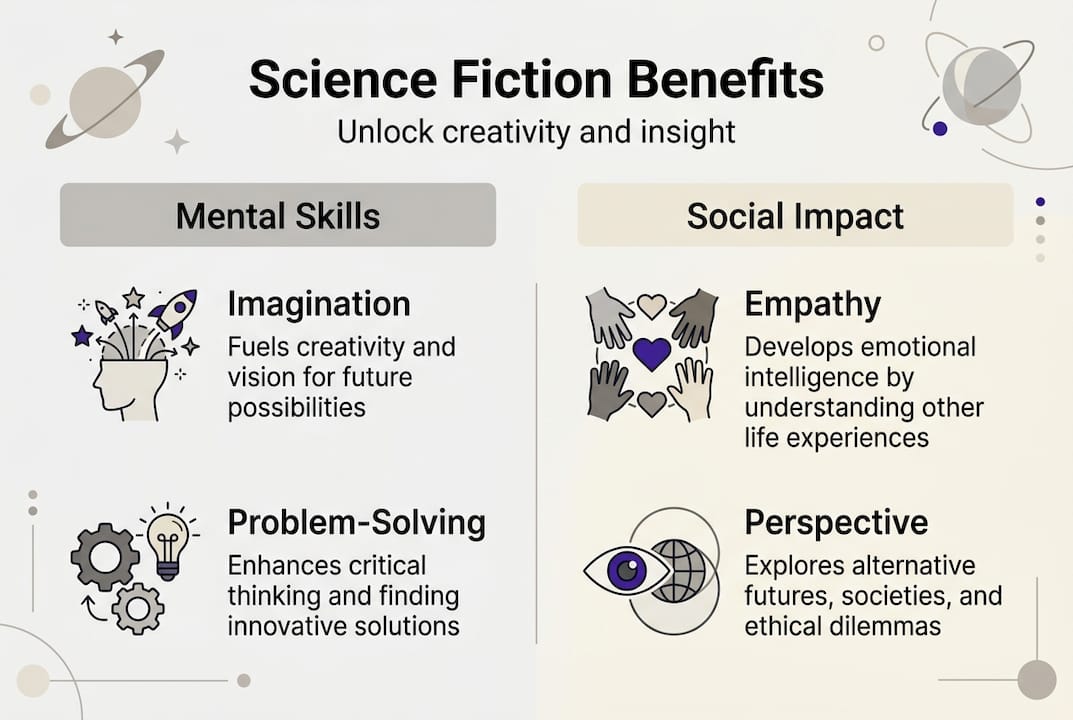
Most people dismiss science fiction as escapist entertainment, but research reveals it actively reshapes how you think, empathize, and understand society. Reading science fiction strengthens your creativity, expands your moral imagination, and deepens your connection to humanity as a whole. Far from simple entertainment, sci-fi serves as a laboratory for exploring alternative futures, ethical dilemmas, and the consequences of technological change. This article examines why engaging with science fiction offers profound personal and social benefits that extend well beyond the page.
Table of Contents
- Key takeaways
- How science fiction enhances your creativity and imagination
- Science fiction as a catalyst for empathy and global perspective
- Exploring alternative futures: sci-fi's role in social commentary and imagination
- How engaging with science fiction media deepens creativity and moral imagination
- Explore sci-fi inspired products at MunkterProducts.com
- FAQ
Key Takeaways
| Point | Details |
|---|---|
| Creativity boost | Reading science fiction strengthens creativity by improving originality, idea fluency, and cognitive flexibility as readers imagine new possibilities. |
| Practical skills | The research shows sci fi translates into practical abilities for problem solving, innovation, and adaptive thinking by encouraging questioning of assumptions and extrapolating trends. |
| Global empathy | Science fiction evokes awe that expands moral concern beyond local groups and fosters identification with humanity as a whole across cultures and time. |
| Active engagement | Active strategies such as writing speculative scenarios, sketching alternative histories, designing fictional societies, and discussing concepts deepen learning and creative development. |
How science fiction enhances your creativity and imagination
Science fiction doesn't just entertain, it fundamentally alters how your brain generates and connects ideas. Experimental research with middle school students demonstrated that reading science fiction enhances creativity, producing statistically significant improvements across three key dimensions. Students who engaged with sci-fi texts showed enhanced originality in generating novel solutions, increased fluency in producing multiple ideas, and greater flexibility in shifting between conceptual frameworks.
These cognitive shifts happen because science fiction presents scenarios that violate everyday expectations. When you encounter faster-than-light travel, artificial consciousness, or radically different social structures, your brain must construct new mental models. This process strengthens the neural pathways responsible for creative thinking. Unlike realistic fiction that reinforces familiar patterns, sci-fi forces you to imagine possibilities that don't yet exist.
The benefits extend beyond abstract thinking. Readers develop practical creative skills applicable to problem-solving, innovation, and adaptive thinking. You learn to question assumptions, extrapolate from current trends, and envision multiple pathways forward. This mental flexibility proves valuable whether you're tackling professional challenges, personal decisions, or complex social issues.
Pro Tip: Read across diverse sci-fi subgenres to maximize creative benefits. Hard science fiction builds analytical thinking, space opera expands narrative imagination, and cyberpunk challenges assumptions about technology and society.
To deepen these creative gains, try active engagement strategies:
- Write your own speculative scenarios based on current technologies
- Sketch alternative timelines for historical events
- Design fictional societies with different values and structures
- Discuss sci-fi concepts with others to explore multiple interpretations
These exercises transform passive reading into active creative development, strengthening the cognitive muscles that generate original ideas. The more you practice thinking speculatively, the more naturally creative solutions emerge in everyday situations.
"Science fiction is the most important literature in the history of the world, because it's the history of ideas, the history of our civilization birthing itself." — Ray Bradbury
Science fiction as a catalyst for empathy and global perspective
Beyond creativity, science fiction fundamentally reshapes how you relate to other people and humanity as a whole. Recent psychological research found that science fiction evokes awe, which increases identification with all humanity rather than narrow tribal groups. This sense of cosmic perspective helps you recognize shared human experiences across cultural, national, and temporal boundaries.

The mechanism works through a specific emotional pathway. When you encounter vast scales of time and space in sci-fi narratives, you experience awe, a feeling that temporarily diminishes your sense of individual importance. This ego reduction paradoxically expands your circle of moral concern. You begin identifying with humanity as a species facing collective challenges rather than competing groups pursuing narrow interests.
Meta-analyses reveal that fiction reading produces small positive effects on social cognition, the ability to understand others' mental states and perspectives. However, the picture grows more nuanced when examining durability. A rigorous four-week randomized controlled trial found no causal benefit on social outcomes, suggesting initial empathy boosts may fade without sustained engagement.
This research highlights an important distinction between immediate emotional responses and lasting behavioral change. Reading a single powerful sci-fi novel might temporarily expand your empathy, but building durable social awareness requires consistent engagement. The good news is that science fiction's inherently engaging nature makes sustained reading more likely than with dry educational materials.
Pro Tip: Engage deeply and repeatedly with science fiction to build lasting empathetic benefits. Join book clubs, reread favorite works, and discuss themes with others to transform temporary emotional impacts into permanent perspective shifts.
To maximize empathy development through sci-fi:
- Choose stories featuring diverse protagonists from different cultures and time periods
- Reflect on how alien perspectives illuminate human behavior patterns
- Consider how future scenarios reveal present-day ethical blind spots
- Discuss character motivations with others to practice perspective-taking
These practices help you build what psychologists call theory of mind, the ability to recognize that others have mental states different from your own. Science fiction provides a safe laboratory for this practice because fictional scenarios remove the defensive reactions that real-world differences often trigger. You can explore an essential sci-fi checklist to find works that challenge your assumptions and expand your empathetic range.
"The function of science fiction is not always to predict the future but sometimes to prevent it." — Frank Herbert
Exploring alternative futures: sci-fi's role in social commentary and imagination
Science fiction serves as society's primary tool for systematic exploration of possible futures. Award-winning novels construct PESTLE-based future scenarios that examine political, economic, social, technological, legal, and environmental dimensions simultaneously. These multi-layered projections help you understand how changes in one domain ripple through entire civilizations.
Researchers analyzing acclaimed sci-fi works identified four dominant scenario types that authors use to critique present society. Solar System Expansion scenarios explore humanity spreading across planets, examining questions of governance, resource distribution, and cultural evolution. Cyber High-Tech futures investigate how advanced artificial intelligence and digital integration reshape human identity and social organization. Post-Contraction scenarios depict societies rebuilding after collapse, revealing which values and structures prove most resilient. Dystopian futures extrapolate current negative trends to their logical extremes, serving as warnings about paths to avoid.
Each scenario type enables specific forms of social commentary. Solar System narratives question nationalist thinking and explore post-scarcity economics. Cyber futures examine surveillance, privacy, and the boundaries of consciousness. Post-Contraction stories reveal which aspects of civilization matter most when everything else strips away. Dystopias expose how small compromises compound into oppressive systems.
| Scenario Type | Key Elements | Social Commentary Focus |
|---|---|---|
| Solar System Expansion | Multi-planet civilization, space travel, resource abundance | Governance models, cultural evolution, post-scarcity economics |
| Cyber High-Tech | Advanced AI, digital integration, technological singularity | Identity, consciousness, privacy, human-machine boundaries |
| Post-Contraction | Societal collapse, resource scarcity, rebuilding | Resilience, essential values, sustainable systems |
| Dystopian | Authoritarian control, environmental degradation, inequality | Power dynamics, social justice, consequences of inaction |
Authors construct these scenarios through a systematic process:
- Identify current trends in technology, politics, economics, and environment
- Extrapolate these trends forward, considering acceleration and interaction effects
- Imagine how societies adapt or fail to adapt to resulting conditions
- Populate scenarios with characters whose choices reveal ethical dimensions
- Use narrative tension to explore consequences of different response strategies
This methodology transforms science fiction from entertainment into analytical tool. When you read these scenarios, you're essentially running thought experiments about civilizational choices. You can examine how different value systems perform under stress, which institutions prove robust or fragile, and where current trajectories lead if unchanged.
The relationship between book publishing and e-commerce ensures these speculative scenarios reach wide audiences, enabling collective reflection on possible futures. Science fiction becomes a form of participatory foresight, allowing millions of readers to mentally test drive alternative worlds before committing to policies that create them.
How engaging with science fiction media deepens creativity and moral imagination
While books provide the foundation for sci-fi's benefits, television and film extend these advantages through different cognitive pathways. Research on sci-fi TV exposure effects reveals that engaged viewers experience significant boosts in both creativity and moral imagination compared to those watching realistic programming. The key factor is engagement level, passive viewing produces minimal benefits while active attention generates substantial cognitive gains.
Science fiction television uniquely stimulates moral imagination by presenting complex ethical dilemmas in unfamiliar contexts. When you watch characters navigate questions about artificial consciousness, genetic modification, or first contact protocols, you exercise moral reasoning muscles without the defensive reactions that real-world controversies trigger. The speculative distance allows you to consider principles more objectively than when immediate tribal loyalties activate.
Realistic television fails to produce comparable effects because familiar scenarios reinforce existing mental patterns rather than challenging them. Your brain processes realistic content using established frameworks, requiring minimal creative effort. Science fiction forces constant adaptation as you encounter novel situations, technologies, and social structures that demand fresh thinking.
The creativity boost from sci-fi media works through similar mechanisms as reading but adds visual and auditory dimensions. Watching alien worlds, futuristic technologies, and alternative societies provides concrete imagery that enriches your mental library of possibilities. This expanded visual vocabulary enhances your ability to imagine and communicate novel concepts.
Pro Tip: Select science fiction shows that emphasize ethical complexity and detailed world-building rather than pure action. Series like The Expanse, Black Mirror, and Star Trek prioritize moral questions and societal implications, maximizing cognitive benefits.
To maximize gains from sci-fi media consumption:
- Watch actively, pausing to consider implications and alternative choices
- Discuss episodes with others to explore multiple interpretations
- Research the scientific concepts underlying fictional technologies
- Compare how different series approach similar themes
- Create content inspired by shows, from fan fiction to artwork
Repeated viewing and discussion compound benefits over time. Each engagement deepens your understanding and strengthens creative neural pathways. You can explore an essential sci-fi checklist covering both written and visual media to build a comprehensive speculative diet that challenges your thinking from multiple angles.
Explore sci-fi inspired products at MunkterProducts.com
Now that you understand how science fiction enhances creativity, empathy, and critical thinking, you might want to deepen your engagement with the genre. MunkterProducts.com offers a curated selection of science fiction novels, including the Noah series, alongside journals and creative tools designed to capture the ideas and insights your reading generates.

Whether you're building a personal sci-fi library, searching for gifts that inspire imagination, or looking for journals to document your own speculative ideas, MunkterProducts.com provides handcrafted and thoughtfully selected items that extend your science fiction experience beyond passive consumption into active creative practice.
FAQ
What makes science fiction distinct from other genres?
Science fiction focuses on speculative futures grounded in scientific possibility rather than magic or historical events. It explores how technology, scientific discoveries, and social changes might reshape human civilization. This emphasis on plausible extrapolation distinguishes sci-fi from fantasy's supernatural elements and historical fiction's documented past.
How does reading science fiction improve creative thinking?
Science fiction exposes you to scenarios that violate everyday expectations, forcing your brain to construct new mental models. Experimental studies show readers experience significant gains in originality, fluency, and flexibility. These improvements transfer to real-world problem-solving and innovation.
Can science fiction help me understand real-world social issues?
Science fiction provides distance that allows objective examination of controversial topics without triggering defensive reactions. By exploring political, technological, and environmental challenges in fictional contexts, you develop frameworks for analyzing current issues. The speculative scenarios reveal long-term consequences of present-day choices.
Is watching sci-fi TV as beneficial as reading the books?
Both formats offer distinct advantages for engaged audiences. Television provides visual richness and accessibility while books allow deeper detail and personal interpretation. Research confirms that sci-fi TV boosts creativity and moral imagination when viewers actively engage rather than passively consume. Combining both formats maximizes cognitive benefits.