

Pick A5 for anything you're carrying daily. It slides into a bag or coat pocket and covers most journaling, planning, and quick-note needs. Pick B5 when you want real writing room for long-form notes, sketches, or diagrams without stepping up to a full A4 pad. The tradeoff is simple: A5 wins on portability, B5 wins on space.
TL;DR:
- A5 notebooks are highly portable, fitting easily into pockets and small bags, making them ideal for daily carry during commutes or travel.
- B5 offers significantly more writing space than A5, supporting detailed sketches, diagrams, and wider margins, which benefit creative or technical work.
- Most retailers stock A5 widely and at lower cost due to economies of scale, whereas B5 is typically more expensive and less available.
- For most users, starting with an A5 notebook is safer, as it balances portability and usability, with B5 better suited to those needing more room for extensive notes or drawings.
- Paper weight and binding quality affect usability, with higher GSM paper reducing bleed-through and sewn bindings offering better durability for larger B5 notebooks.
Table of Contents
- A5 vs B5 Size Comparison: The Exact Dimensions
- How Does Notebook Size Change the Way You Actually Write?
- Which Notebook Size Fits Your Daily Routine?
- What Printing and Production Details Should You Know?
- How Do You Choose Between A5 and B5? A Buying Checklist
- Why Munkterproducts Understands This Trade-Off
- The Real Question Isn't A5 vs B5, It's What You'll Actually Carry
- Find Your Fit in the Munkterproducts Journal Collection
- Sources
A5 vs B5 Size Comparison: The Exact Dimensions
A5 measures 148 × 210 mm, or 5.8 × 8.3 inches. B5 measures 176 × 250 mm, or 6.9 × 9.8 inches, according to the international standard paper size chart. That's not a small jump. B5 gives you significantly more surface area than A5, which in practical terms means extra lines of writing space per page and noticeably wider margins for notes or sketches.
Both sizes come from the same family of logic. The ISO 216 standard builds the A-series around a fixed aspect ratio of the square root of 2, so every size in the series halves cleanly into the next one down. A4 folds into A5, A3 folds into A4, and so on. B-series sizes exist as a bridge between A sizes, giving you an intermediate format when A5 feels cramped but A4 feels bulky.
Here's how the two stack up side by side:
| Spec | A5 | B5 |
|---|---|---|
| Width x height (mm) | 148 x 210 | 176 x 250 |
| Width x height (in) | 5.8 x 8.3 | 6.9 x 9.8 |
| Approx. area | 31,080 sq mm | 44,000 sq mm |
| Aspect ratio | 1:√2 | 1:√2 |
Both sizes share the same aspect ratio, so a B5 page just feels like a scaled-up A5 rather than a differently shaped one. That consistency matters if you're switching between notebook sizes for different tasks. The visual layout of your handwriting stays proportional even when the page grows.
How Does Notebook Size Change the Way You Actually Write?
Numbers on a spec sheet only tell half the story. What matters more is how a size feels in your hand, on your desk, or balanced on your knee during a commute.
Portability is where A5 pulls ahead decisively. It fits into most tote bags, backpack front pockets, and even some coat pockets. B5 is not pocket-friendly by any stretch. You're carrying it in a bag, and a full one at that, since the extra 4 centimeters in height and width adds up when you're also packing a laptop or lunch.
Handwriting comfort shifts more than people expect. On A5, lines run shorter, roughly 13 centimeters across a typical margin setup, which suits people who write small or want faster page turns. B5 gives you closer to 15 to 16 centimeters per line, letting your hand move more naturally if you write larger or tend to sprawl your thoughts out before editing them down.
Layouts and sketches benefit heavily from the extra B5 real estate. Two-column note-taking, side-by-side diagrams, or annotated sketches all need breathing room that A5 simply doesn't offer. Architecture students, urban sketchers, and anyone doing Cornell-style notes tend to gravitate toward B5 or larger for exactly this reason.

Perceived heft is a factor few reviews mention. A5 notebooks feel light and low-commitment, almost disposable in a good way, which encourages you to actually use one rather than treat it like a precious object. B5 books, especially hardbound ones, carry more visual and physical weight. That can feel more serious and less casual, which some planners and long-form journal users actively prefer.
Paper weight matters just as much as page size. Higher GSM stock resists bleed-through and ghosting regardless of format, but the effect is more noticeable on A5 pages simply because you're writing closer to the page edges more often.
Pro Tip: Before buying either size, write a full sentence on a piece of paper cut to that exact size. If your handwriting feels cramped or your hand drags off the edge, that's your answer, no spec sheet required.
- A5 fits pockets, small bags, and single-hand use on trains or in queues.
- B5 suits desks, study tables, and situations where you'll actually lay the notebook flat.
- Line length on A5 runs shorter, which favors compact handwriting styles.
- B5's extra width supports diagrams, two-column notes, and wider margins.
- Heavier GSM paper reduces show-through on both sizes, but matters most where writing sits close to the edge.
Which Notebook Size Fits Your Daily Routine?
Matching notebook size to how you actually use it saves you from buying the wrong thing twice.
- Commuters and travelers should default to A5. It survives being stuffed into a daypack, pulled out on a train, and scribbled in standing up. The LeafletFrog paper size guide notes A5 is the more travel-friendly and widely stocked format for exactly this reason.
- Bullet journal and pocket planner users lean A5 almost universally because weekly spreads, habit trackers, and quick to-do lists don't need much horizontal room.
- Students taking dense lecture notes often outgrow A5 fast. B5 gives enough width for diagrams next to text, which matters in subjects like biology, engineering, or law where you're sketching alongside writing.
- Designers and sketch-first thinkers benefit from B5's layout room. A notebook aimed at creative use needs page space that supports both freehand marks and annotation without cramming.
- Fieldwork and meeting note-takers sit in a gray zone. If you're standing or moving between locations, A5 wins on handling. If you're seated at a table for an hour-long session, B5's writing area pays off.
- People who genuinely need both exist, and it's not overkill. A slim A5 for carry, paired with a B5 desk journal for deep work, covers more scenarios than forcing one size to do everything.
The honest answer for most buyers: start with A5 unless you already know your notes run long or visual. It's the safer default, and Munkterproducts' travel journal in a compact 6 x 9 inch format is a good example of that A5-adjacent sizing done well.
What Printing and Production Details Should You Know?
Size affects more than how a notebook feels. It shapes cost, availability, and how well a notebook plays with the rest of your paperwork.
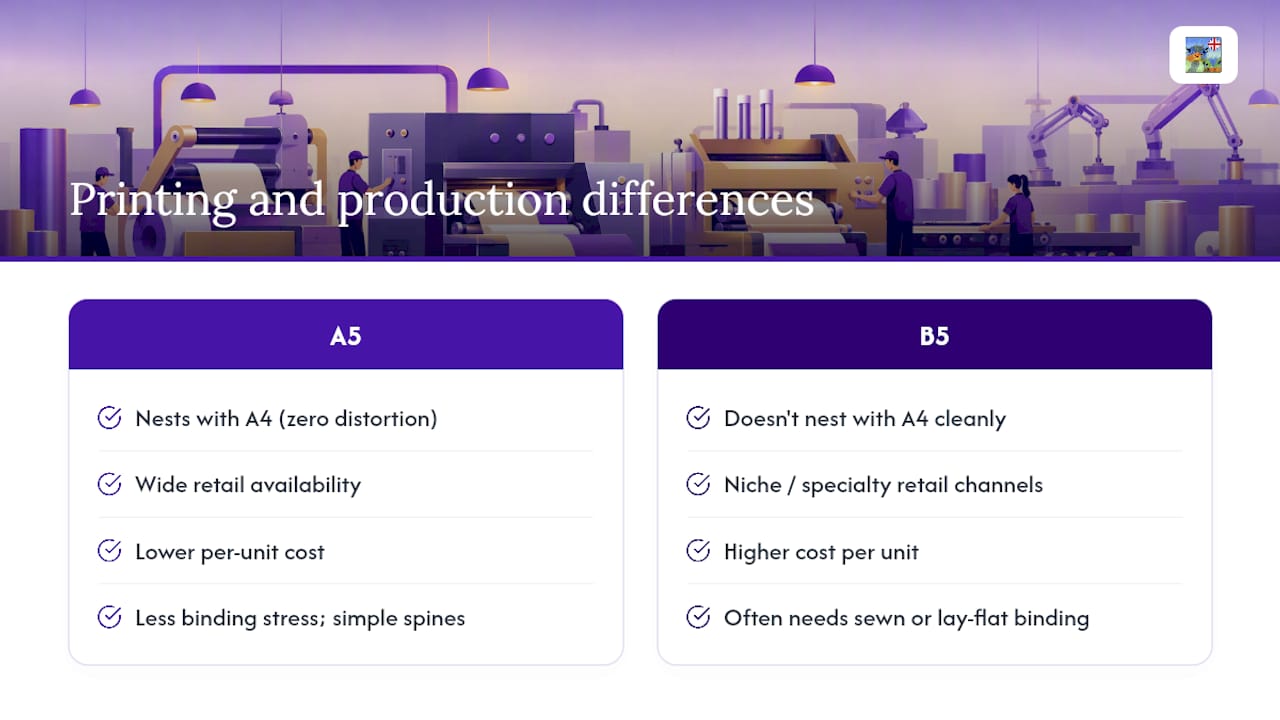
A5's biggest practical advantage is its relationship with A4. Since both sizes share the same ISO aspect ratio, an A4 sheet folds or trims into A5 with zero distortion. That's why photocopied handouts, printed itineraries, or scanned documents scale down cleanly to fit inside an A5 notebook if you're the type who glues in reference material. B5 doesn't share that clean relationship. Resizing an A4 sheet to fit B5 leaves you with awkward margins or wasted space, since the proportions don't nest the same way.
Retail availability tips heavily toward A5. Walk into most UK stationery shops and you'll find shelves stacked with A5 notebooks in every ruling, cover material, and price point imaginable. B5 exists, but it's positioned closer to a specialty or imported item, often found through Japanese and Korean stationery brands rather than mainstream UK retailers, a pattern the LeafletFrog size guide also points out.
That scarcity affects cost. A5 uses less paper stock per unit, which keeps manufacturing and shipping costs lower, and high production volume pushes retail prices down further.
Binding also behaves differently at scale. Larger B5 pages put more stress on saddle-stitch or perfect-bound spines, which is why quality B5 notebooks more often use sewn or lay-flat binding to prevent pages from curling at the gutter. Shipping costs scale with size too. A case of B5 notebooks weighs and packs bulkier than the same count in A5, which matters if you're ordering in bulk for a classroom, office, or gift run.
How Do You Choose Between A5 and B5? A Buying Checklist
Run through these questions before you commit to a size, and you'll skip the buyer's remorse that comes from guessing.
Ask yourself first:
- Where will this notebook actually live: a bag, a desk drawer, a coat pocket?
- Is your handwriting small and tight, or does it need room to breathe?
- Will you ever paste in A4 handouts, receipts, or printed photos?
- How many pages do you realistically fill before switching notebooks?
Then check the spec sheet:
- Confirm the exact size in millimeters, not just "A5" or "B5" printed on the cover, since some budget brands round loosely.
- Check the ruling style. Dotted, lined, and blank grids all change how usable a page feels at either size, a point worth weighing through this dotted vs lined comparison.
- Look for GSM listed on the product page. Anything under 80 GSM risks bleed-through with fountain pens or heavy markers.
- If lay-flat use matters to you, check whether the binding is described as lay-flat, sewn, or spiral, since standard perfect-binding rarely opens fully flat.
Quick shopping actions that actually work:
- Hold the notebook against your phone or a paperback book to get a real sense of scale before checking out.
- Request or check for sample page photos to judge paper texture and ruling darkness.
- Write one full line by hand on a similarly sized scrap to test comfort.
Pro Tip: If a product listing shows page photos with visible ink bleed-through or curling at the spine, treat that as a red flag regardless of how good the cover looks. Paper quality and binding matter more long-term than cover design.
Why Munkterproducts Understands This Trade-Off
Munkterproducts builds its stationery catalog around exactly this size logic, not as an afterthought but as a design decision. The 6 x 9 inch travel journal with 120 lined pages sits close to A5 territory, sized deliberately for people who want a notebook that survives a backpack, a coat pocket, or a daily commute without becoming dead weight.
That sizing philosophy runs through the wider catalog too. Journals, planners, and self-help notebooks in the Munkterproducts range lean toward compact formats because that's what gets used, not shelved. A notebook that sits in a drawer because it's too bulky to carry isn't doing its job, no matter how nice the cover looks.
If you want to see the reasoning behind why physical notebooks earn their keep over digital notes at all, the brain science behind handwriting breaks down why the format you choose actually shapes how well you retain what you write. Browse product pages directly to compare page counts, ruling styles, and dimensions before you buy.
The Real Question Isn't A5 vs B5, It's What You'll Actually Carry
Most advice on this topic gets stuck comparing specs as if the "better" notebook exists in a vacuum. It doesn't. The size that wins is the one that's still in your bag three months from now, not the one that looked most impressive on a shelf.
Conventional wisdom overrates B5 as the "serious" choice for students and creatives, as though more space automatically means more productive notes. In practice, plenty of B5 notebooks end up half full because carrying one consistently is harder than people admit to themselves when buying. A5's real advantage isn't just size, it's the psychological ease of grabbing something small enough to bring everywhere without a second thought.
If you're genuinely torn, default to A5 first. It's the lower-risk choice, and you'll know within two weeks of daily use whether you need more room. Buying B5 first and hoping you'll carry it consistently is the more common mistake.
— Mark
Find Your Fit in the Munkterproducts Journal Collection
If the A5 case made the most sense for how you actually move through your day, Munkterproducts' travel-sized notebooks are built around exactly that use pattern. Rather than a generic pocket notebook, you're getting 120 lined pages in a format sized for daily carry, whether that's a commute, a trip, or a bag you're never without.

Beyond the travel journal, the full journals, notebooks, and planners collection covers a range of formats and ruling styles if B5-style spacing turns out to be the better fit once you've tested your handwriting against it. Each product page lists exact page counts and specs so you're not guessing at dimensions the way you might on a generic marketplace listing. Check the current lineup and pick the size that matches what you actually decided above, then place your order directly through the collection page.
Sources
The dimensions and aspect-ratio explanations in this guide come from the international standard paper size reference and the ISO 216 standard documentation, both of which define how A and B series sizes relate to each other. Practical use-case comparisons drew on the A5 vs B5 paper size guide and the detailed B5 vs A5 breakdown, which both cover layout and publishing considerations in more depth. For notes on how paper weight affects writing feel, see this overview of paper density, and for surface-related note-taking comparisons, this guide to paperlike alternatives is worth a look.
- International standard paper sizes — Wikipedia
- ISO 216 standard overview — ISO
- A5 vs B5 Paper Size Guide — LeafletFrog
Recommended
- Dotted vs Lined Notebook: Which One Actually Fits You?
- 6 unique notebooks for creative expression in 2026
- Why Write in Notebooks: Brain Science and Real Benefits
- 6" x 9" Travel Journal – 120 Lined Pages The perfect balance of portability and writing space. Size: 6 x 9 Inches Generous enough to write freely, compact enough to go anywhere. Fits easily in purses, daypacks, laptop sleeves, and water bottle pockets. No