

TL;DR:
- Writing in notebooks activates deeper brain connections than typing by engaging motor, sensory, and cognitive processes. This effortful handwriting improves memory, focus, and creative thinking, especially when raw and unstructured. Combining notebooks for thinking with digital tools for editing maximizes productivity and insight.
Writing in notebooks is defined as the deliberate practice of putting thoughts, ideas, and reflections onto paper by hand, and research confirms it activates the brain more deeply than typing ever can. The question of why write in notebooks has a clear answer rooted in neuroscience: handwriting engages motor planning, sensory feedback, and cognitive processing simultaneously, creating memory traces that digital input simply cannot match. Whether you want to sharpen your creativity, organize your thinking, or build a more focused daily practice, a notebook delivers advantages that go far beyond convenience. This article breaks down the science, the practical habits, and the real-world workflows that make pen and paper worth your time in 2026.
Why write in notebooks? What your brain is actually doing
Handwriting creates widespread brain connectivity that typing cannot replicate. EEG studies show increased alpha, beta, and gamma wave activity during handwriting, all linked to sensorimotor engagement and deep learning. That combination of brainwave patterns signals that your mind is working harder, encoding information more durably, and building stronger conceptual connections.
The reason comes down to what researchers call effortful encoding. When you write by hand, the physical friction of forming each letter forces your brain to filter, compress, and reframe information actively. Typing is fast enough that your brain can transcribe without truly processing. Handwriting is slow enough that it demands genuine understanding before the pen moves.
"Writing by hand engages motor planning, kinesthetic feedback loops, and sensory processing circuits unavailable in typing. This multisensory engagement links movement, touch, and cognition in a way no keyboard can replicate."
This multisensory engagement is the core notebook writing advantage. Your hand, eye, and brain work together as a single system. That coordination is why students who take handwritten notes consistently outperform those who type on tests of conceptual understanding, not just recall.
Pro Tip: If you want the full cognitive benefit, resist the urge to write in shorthand or abbreviations. Full sentences force your brain to construct meaning, not just capture it.
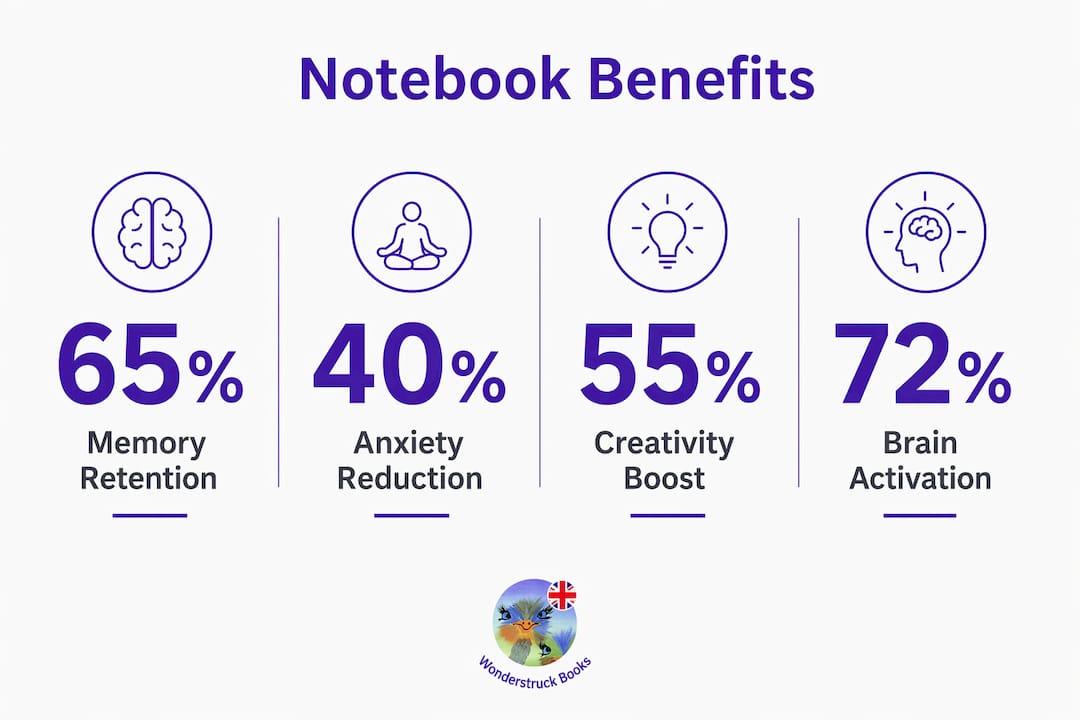
Key practical benefits of writing in notebooks
The benefits of writing in notebooks extend well beyond memory. A notebook removes every digital distraction the moment you open it. No notifications, no browser tabs, no autocomplete suggestions pulling your attention sideways. That absence of digital noise creates the conditions for genuine focus and creative flow.
The physical constraints of paper also work in your favor. A blank page does not suggest, autocorrect, or auto-format. You decide what matters. That constraint forces prioritization in a way that an open document never does. Writers, planners, and thinkers who use notebooks consistently report that the act of choosing what to write sharpens their thinking before a single word appears.
Here are the most common and effective uses for a notebook in daily practice:
- Journaling: Writing about your day, your emotions, or your goals. Studies published in JMIR Mental Health confirm that expressive handwriting reduces anxiety and improves well-being more effectively than typed journaling.
- Quick writes: Uninterrupted handwriting sessions of 3–10 minutes lower mental pressure and sharpen task focus. They work as a warm-up before any demanding cognitive work.
- Brainstorming: Notebooks let ideas exist in a half-formed state without the pressure of digital performance. Unlike a word processor, a notebook never asks you to finalize a thought before you are ready.
- Thought organization: Mapping out a problem, a project, or a decision by hand creates a visual and spatial record that a screen rarely matches.
The role of notebooks for creativity is not just about output. It is about creating a private space where thinking can happen without an audience.
Pro Tip: Keep your notebook open on your desk during work hours, not stored in a drawer. Visibility is a cue. You will use it far more often when it is already in front of you.
How to use a notebook effectively
Effective notebook use starts with one counterintuitive rule: avoid over-organizing early. Most people treat their notebooks as records, writing only finished thoughts in neat lines. That approach kills the creative power of the tool. Raw, messy, unstructured writing is where real cognition unfolds.
Follow these steps to build a notebook practice that actually works:
- Start without a structure. Open to a blank page and write whatever is in your head. Do not plan the entry. The goal is to capture thinking, not to perform it.
- Use quick writes daily. Set a timer for 5 minutes and write without stopping. This builds the habit and trains your brain to access ideas without self-censorship.
- Allow half-formed thoughts. Write incomplete sentences, questions, and contradictions. A notebook is not a finished document. It is a thinking space.
- Build an index from the back. Start a glossary or index from the last pages of your notebook. When a concept or idea recurs, note the page number. This creates retrieval practice and connects ideas across weeks of writing without interrupting your flow.
- Schedule a weekly review. Set aside 10 minutes once a week to reread recent entries. Patterns, insights, and connections surface during review that you will miss in the moment of writing.
Notebooks also function as cognitive partners over time, creating a visible record of your thought patterns and growth. Reviewing old notebooks is one of the fastest ways to recognize how your thinking has evolved.
Pro Tip: Number your pages from day one. It takes two seconds per entry and makes your back-of-book index actually usable.

Notebooks vs. digital tools: which one wins?
The honest answer is that neither wins outright. They serve different cognitive tasks, and the most productive writers and thinkers in 2026 use both deliberately.
Using notebooks for synthesis and original thought is the leading productivity strategy for deep work, with digital tools reserved for fast, transactional tasks. That distinction matters. Analog tools offer a competitive advantage precisely because they slow you down in the right moments.
| Task | Best tool | Why |
|---|---|---|
| Brainstorming and ideation | Notebook | No autocomplete, no distraction, full creative freedom |
| Drafting long documents | Digital | Speed, editing, and formatting efficiency |
| Reflection and journaling | Notebook | Deeper emotional processing, better well-being outcomes |
| Research and data collection | Digital | Search, storage, and retrieval at scale |
| Planning and goal setting | Notebook | Spatial thinking, prioritization, and commitment |
| Collaboration and sharing | Digital | Real-time access and version control |
A practical workflow looks like this: use your notebook for the thinking phase, then move to a digital tool for the execution phase. Write your ideas, arguments, and plans by hand first. Then type the polished version. The science behind stationery and creativity confirms that the handwriting step produces better raw material, not just a warmer feeling.
Key Takeaways
Writing in notebooks activates deeper brain connectivity than typing, making it the most effective tool for memory retention, creative thinking, and focused reflection.
| Point | Details |
|---|---|
| Handwriting engages the brain more | EEG studies show alpha, beta, and gamma activity during handwriting that typing does not produce. |
| Effortful encoding improves memory | The slower pace of handwriting forces your brain to process and reframe information, not just record it. |
| Notebooks remove digital distractions | No notifications or autocomplete means deeper focus and more original thinking. |
| Raw, unstructured writing works best | Avoiding early organization lets genuine cognition unfold and preserves creative momentum. |
| Analog and digital tools complement each other | Use notebooks for thinking and planning, digital tools for drafting and sharing. |
Notebooks changed how I think, not just what I write
I spent years treating notebooks as backup storage for ideas I would eventually type up properly. That was the wrong frame entirely. The notebook was not a draft. It was where the actual thinking happened.
The shift came when I stopped writing finished thoughts and started writing questions. Half a sentence. A contradiction I could not resolve. A feeling I did not have words for yet. The deliberate slowing down that handwriting enforces is not a limitation. It is the mechanism. You cannot think faster than you can write by hand, and that constraint is exactly what produces clarity.
What surprised me most was the self-awareness that builds over time. Rereading three months of notebook entries shows you your own patterns with a precision that no app dashboard can match. You see which problems you keep circling, which ideas keep returning, and which fears you dress up as practical concerns. That kind of honest feedback is rare.
My practical advice: do not wait until you have something worth writing. The notebook is not for finished thoughts. It is for the messy, uncertain, half-awake thinking that happens before clarity arrives. Write that. The good stuff follows.
— Mark
The right notebook makes the habit stick
Choosing a notebook that fits your style is not a small decision. The texture of the paper, the size of the page, and the weight of the cover all affect how often you reach for it.

Munkterproducts carries a curated selection of notebooks and planners designed for writers, thinkers, and creatives who take their practice seriously. From self-help journals built around reflection prompts to clean, unlined notebooks for freeform thinking, the range covers every style of handwriting practice. If you want to explore formats before committing, the unique notebooks for creative expression guide is a practical starting point. Good tools do not create the habit, but they make it easier to keep.
FAQ
Why is writing by hand better than typing for memory?
Handwriting forces effortful encoding, meaning your brain must actively process and reframe information rather than transcribe it. EEG research shows this produces stronger, more durable memory traces than typing.
How long should a daily notebook writing session be?
Quick writes of 3–10 minutes are enough to build the habit and reduce cognitive load. Consistency matters more than length, so a short daily session outperforms a long weekly one.
Can notebooks really reduce anxiety?
Studies published in JMIR Mental Health confirm that expressive handwriting reduces anxiety and improves well-being more effectively than typed journaling. The physical act of writing appears to process emotion differently than typing does.
Should I use a structured or unstructured notebook format?
Start unstructured. Avoid organizing your notebook too early, since raw and messy writing captures the most authentic thinking. Add a back-of-book index later if you want to connect recurring ideas.
How do notebooks and digital tools work together?
Use your notebook for the thinking and planning phase, then switch to a digital tool for drafting, editing, and sharing. The two tools serve different cognitive tasks and work best when used in sequence.