

There's no single best choice between a dotted and a lined notebook. Dot grid wins if you mix writing with diagrams, trackers, or sketches. Lined wins if you write in long, continuous sentences and want zero friction getting words onto the page.
That's the short version. The longer version depends on how you actually use a notebook day to day:
- Choose dot grid if you bullet journal, sketch, mix text with tables, or want structure that stays out of the way.
- Choose lined if you journal in prose, take fast meeting notes, or write letters and drafts longhand.
- Skip ahead to the choosing checklist below if you want a fast decision instead of the full case for each.
Key Takeaways
Dot grid works as the flexible default for mixed writing and visuals, while lined paper remains the faster choice for continuous longhand prose.
| Point | Details |
|---|---|
| No universal winner | Match the ruling to your main use rather than picking based on trend or habit. |
| Dot grid handles mixed content | Text, tables, and sketches share a page more cleanly on 5mm dot spacing. |
| Lined paper wins on speed | Continuous prose and meeting notes flow fastest on standard 5–6mm rulings. |
| Check GSM before buying | Aim for 90+ GSM if you use fountain pens or markers to avoid bleed-through. |
| Munkterproducts lists specs upfront | Handcrafted notebooks on the shop state ruling, GSM, and spacing per product. |
Table of Contents
- Dotted vs Lined Notebook: The Case for Dot Grid
- Dotted vs Lined Notebook: The Case for Lined Paper
- How to Choose Between Dotted and Lined
- Paper Weight and Pen Compatibility: What GSM Actually Tells You
- Sizes and Spacing: Matching the Notebook to How You Work
- An Author's Take on Setting Up One Notebook for Everything
- Where Dotted and Lined Notebooks Actually Came From
- Notebook Options Worth Knowing for Each Ruling
- Keeping a Dotted or Lined Notebook in Good Shape
- Mixing Dots and Lines in One Notebook
- My Honest Recommendation After Weighing Both
- Munkterproducts: Matching Our Notebooks to Your Ruling
- Sources
Dotted vs Lined Notebook: The Case for Dot Grid
Dots give you a faint grid, usually spaced 5mm apart, without the visual weight of a printed line. That subtlety is the whole point. You get enough structure to keep handwriting level and diagrams proportional, but the page still reads as close to blank.
That flexibility is why dot grid became the default layout for bullet journaling, where a single page might hold a habit tracker, a to-do list, and a rough sketch of a floor plan. The Bullet Journal system was built around dot grid specifically because lines fight with tables and lines resist columns.
Dots also make room for the kind of unplanned mark-making that helps you think. Research summarized by Harvard Health suggests doodling can support focus and idea generation, and dotted pages let a doodle sit next to notes without looking like a mistake.
- Handles mixed content: text, tables, charts, and sketches on the same page
- Keeps straight lines straight for anyone drawing boxes or trackers freehand
- Reads as closer to blank paper, which suits visual thinkers
The tradeoff shows up with pure prose. Some writers find the dots distracting when they're just trying to write a page of longhand, and there's a small learning curve if you've never planned a layout without a printed line to anchor each row.
Pro Tip: Test dot grid on a page where you deliberately mix a paragraph, a small table, and a rough diagram. If that page still looks organized, dot grid will work for almost everything you throw at it.
Dotted vs Lined Notebook: The Case for Lined Paper
Lined paper is still the fastest format for continuous writing. There's nothing to think about. You write on the line, you start a new line, you never pause to judge spacing.
Standard rulings run 5 to 6mm apart, which suits most handwriting sizes, though narrower college rule and wider legal rule both exist for people who write smaller or larger than average. That range matters more than it sounds. Someone with large, looping handwriting will feel cramped on a narrow ruling long before the page runs out.
- Fastest option for longhand journaling, letters, and first drafts
- Zero decisions about layout, which speeds up meeting and lecture notes
- Familiar to almost every writer since grade school, so there's no adjustment period
Where lined paper struggles is anything visual. Freehand tables fight the horizontal lines. Sketches look out of place crossing them. Diagrams that need vertical alignment, like a comparison chart or a rough wireframe, are genuinely harder to draw straight on ruled paper than on a dotted page. If your notebook is strictly for words, this rarely matters. If it's not, you'll notice the friction within a few pages.
How to Choose Between Dotted and Lined
Stationery writers who've tested both formats generally agree there's no universal winner. The right call comes down to what you're actually going to do with the page, which is why Time & Ink's comparison frames it as choosing by workflow rather than by preference.
Run through this before you buy:
- What's the primary use? Long-form writing points to lined. Planning, sketching, or mixed content points to dot grid.
- What pen do you actually use? Fountain pens and brush markers need heavier paper regardless of ruling; ballpoints are more forgiving.
- How will you carry it? A5 fits a bag; A4 stays on a desk. Spacing preference (5mm dots and lines are the norm) should match how small or large you naturally write.
Three quick questions settle most indecision:
- Do I sketch, table, or track things on the same page as my notes? If yes, dot grid.
- Do I mostly write sentences and paragraphs with nothing else? If yes, lined.
- Am I switching between both often enough that I'd rather buy two notebooks than compromise on one?
That third question has a real answer, and it's not a cop-out: plenty of people keep a lined notebook for journaling and a dotted one for planning, because forcing one format to do both jobs usually means resenting it for one of those tasks.
Paper Weight and Pen Compatibility: What GSM Actually Tells You
GSM (grams per square meter) measures paper thickness, and it matters more than ruling style for anyone who's dealt with ink bleeding through to the next page.
For ballpoints and pencils, 70 to 90 GSM is usually fine. Fountain pens, gel pens, and markers need heavier stock, generally 90 GSM or above, or you'll get feathering (ink spreading along paper fibers) and ghosting (shadows on the reverse side).
- Write a few lines with your actual pen before committing to a notebook, not just a pen you own but rarely use
- Check the back of the page immediately after writing; visible shadowing means the paper is too thin for that ink
- Cross-hatch a small area to test for feathering, since a single line can hide spreading that a filled shape won't
Paper finish changes how ink looks, too; for insights on paper-like surfaces and pen compatibility, see some of the best paperlike alternatives. Bright white paper makes colored inks pop but shows every smudge, while cream or ivory paper is easier on the eyes for long sessions and hides minor smearing better.
Statistic Callout: Product guides consistently flag 90+ GSM as the threshold where fountain pen ink stops bleeding through on most notebook stock, making it the number worth checking before you buy for that pen type.
Sizes and Spacing: Matching the Notebook to How You Work
A5 is the size most people should default to. It's small enough to carry daily, large enough to write comfortably, and it's the size most dot-grid and lined notebooks are actually designed around. A4 makes sense if the notebook lives on a desk and never leaves the house, since the extra page width helps with tables, long-form drafts, or reference notes you want to see at a glance. Pocket sizes work for quick capture but cramp anything more complex than a to-do list.
Spacing follows the same logic as GSM: check it against your handwriting before you buy. 5mm is the standard for both dots and lines, and it fits most handwriting sizes without wasting page space.
- Add a running index on the first pages so you can find old entries without flipping through the whole notebook
- Number pages as you go if the notebook doesn't come pre-numbered
- Leave a consistent margin, even on dot grid, so notes don't run edge to edge and become hard to scan later
An Author's Take on Setting Up One Notebook for Everything
You don't need three notebooks to cover writing, planning, and sketching. A single dot-grid A5 handles most of it if you set up the layout once and stick to it.
The setup that holds up over months, not just the first week, is simple: daily pages on the left side of a spread, a weekly tracker running down the right margin, and a small corner reserved for sketches or diagrams that spill out of the day's notes. Nothing fancy. It just respects that a page rarely does only one job.
Label sections as you go and keep a running index at the front. That habit alone saves more time than any layout trick, because the whole point of a notebook is finding what you wrote three weeks ago in under a minute.
For more layout ideas built around this kind of dot-grid setup, see six unique notebooks for creative expression and the case for why notebooks matter for creativity in the first place.
Pro Tip: Reserve the last few pages of every notebook as a running index. Add to it as you fill sections instead of trying to build it after the notebook is full.
Where Dotted and Lined Notebooks Actually Came From
Lined paper has the longer, more mundane history. Ruled paper became standard in schools and offices through the 19th and 20th centuries because it enforced consistent handwriting and made mass-produced ledgers, exercise books, and stationery predictable to manufacture. It solved a practical problem: legibility at scale, long before anyone cared about journaling aesthetics.
Dot grid is a much newer invention, and its rise tracks almost exactly with the bullet journal movement that took off in the 2010s. Before that, dotted paper existed mostly in technical and drafting contexts, useful for anyone sketching diagrams who needed alignment without a heavy grid. What changed was demand from a different kind of user: people who wanted to plan, track habits, and sketch on the same page without lines boxing them in.
That history explains the split you still see in notebook aisles today. Lined paper carries the institutional, get-it-done legacy of school notebooks and office pads. Dot grid carries the flexible, design-it-yourself legacy of planners and bullet journals. Neither format is "better" in some absolute sense. They were built to solve different problems a century apart, and both problems still exist for different people. Understanding that origin makes the choice less about trend and more about which problem you're actually trying to solve on any given page.

Notebook Options Worth Knowing for Each Ruling
Dot grid saw its biggest push into the mainstream through the bullet journaling movement, and notebooks built specifically for that system remain a reliable reference point. The Leuchtturm1917 A5 dot-grid notebook is a common example readers cite when comparing specs, since its listing spells out dot spacing, page count, and paper weight in one place, which is exactly the information you should be checking before any dot-grid purchase.
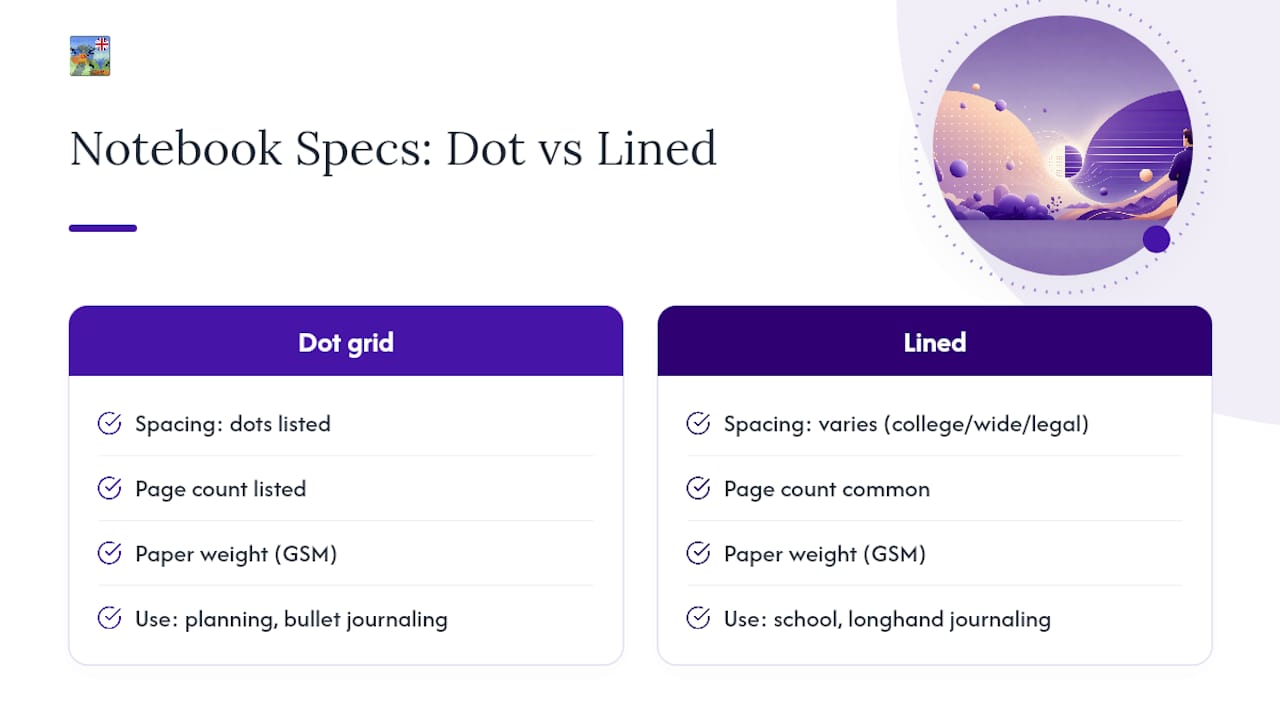
Lined notebooks have a much wider, more generic footprint since ruled paper has been standard in school and office supplies for over a century. Most stationery lines carry a lined option as their baseline product, with college rule as the narrower default and legal or wide rule for larger handwriting.
Handcrafted and curated notebooks, like the ones Munkterproducts carries, take a different approach than mass-market lines. Instead of one ruling stamped across dozens of near-identical covers, each notebook is chosen or made with a specific use in mind, whether that's a dot-grid layout suited to planning or a lined format built for longhand journaling. That curation matters more than it sounds, because the biggest complaint people have with mass-market notebooks isn't the ruling itself. It's discovering after a few pages that the paper weight or spacing doesn't match how they actually write.
Whatever brand or maker you land on, the two specs worth checking before checkout are the same every time: dot or line spacing, and paper weight in GSM.
Keeping a Dotted or Lined Notebook in Good Shape
Dot-grid paper tends to show smudging more visibly than lined paper, mostly because the layout invites more freehand drawing and shading, which puts more ink and graphite on the page surface. Let sketched or heavily inked pages dry fully before closing the notebook, especially with fountain pen ink or markers, or you'll get transfer onto the facing page.
Lined notebooks used for dense note-taking wear differently. The spine and page edges take the most damage, particularly in notebooks carried daily in a bag. A few habits protect both formats:
- Store notebooks flat or upright rather than jammed spine-down in a bag, which stresses the binding over time
- Keep a blotting sheet or spare page handy for fountain pen or marker use, regardless of ruling
- Avoid overstuffing a notebook with loose inserts, which strains the spine and can crack lay-flat bindings
- Wipe covers with a dry cloth rather than anything wet, since many handcrafted covers use materials that don't tolerate moisture well
Lay-flat binding, common in better dot-grid notebooks built for planning, needs a light touch when new. Forcing a brand-new lay-flat notebook fully open on the first use can stress the spine before it's broken in. A few gentle openings across the first several pages does more good than one hard crease down the middle.
Mixing Dots and Lines in One Notebook
You don't have to pick one ruling for the whole notebook. Plenty of handcrafted and curated notebooks now build in both formats deliberately, with a dot-grid section up front for planning and a lined section further back for journaling or notes.
If your notebook doesn't come split that way, you can build the split yourself. A few practical approaches:
- Reserve the first or last quarter of a lined notebook as a dot-grid insert page for diagrams, using a printed grid sticker or a self-drawn light grid in pencil
- Use tabs or a divider page to separate a planning section from a writing section, even within a single ruling
- Choose a notebook with perforated or removable pages if you want to swap ruling styles as needs change month to month
- Keep a second, smaller dot-grid notebook purely for sketches and diagrams alongside a primary lined journal, rather than forcing one format to do both jobs
The paper finish matters here too. If you're combining fountain pen sketches with ballpoint notes in the same notebook, check that the GSM supports the heavier ink use throughout, not just in the section you expect to use most. A notebook that bleeds on the sketch pages but holds up fine on the lined pages is still a notebook you'll end up frustrated with.
My Honest Recommendation After Weighing Both
If you're still on the fence, default to dot grid. It handles more situations without asking you to think about layout, and it's the format that fails gracefully, since a dot-grid page used for pure prose still works, even if a lined page pressed into sketching duty rarely does.
If you already know you're a longhand writer who never sketches or tables anything, lined paper will serve you better and you shouldn't overthink it. Test a single page before committing to a full notebook. Write a paragraph, draw a rough box, add a quick list. Whichever format felt natural on that one page will feel natural for the next two hundred.
Munkterproducts carries curated notebooks across both rulings if you want to compare the real thing before deciding.
— Mark
Munkterproducts: Matching Our Notebooks to Your Ruling
Munkterproducts is the alternative to guessing at a mass-market rack. Every handcrafted notebook we carry lists its actual ruling, paper weight, and spacing upfront, so you're not left testing a page after checkout to find out it bleeds with your pen.

If you lean dot grid, look for our A5 planning-style notebooks built with the 5mm spacing and heavier paper weight that fountain pen and marker users need. If you write longhand, our lined journals use standard rulings sized for daily writing without cramping. Each product listing on the shop states GSM, dot or line spacing, and page count directly, the same specs this guide walks through, so you can check compatibility with your pen before you buy rather than after.
Browse the current notebook collection at Munkterproducts and pick the ruling that matches how you actually write.
Sources
Citations used: Harvard Health on doodling, Time & Ink's format comparison, and Pen Heaven's paper guide.
For setup ideas, see why notebooks matter for creativity and what makes a notebook artistic.
- The thinking benefits of doodling — Harvard Health Blog
- Dot grid vs lined vs blank: choosing for how you work — Time & Ink
- Which journal paper is right for you? Lined vs grid vs blank — Pen Heaven