

For most adults with ADHD, the single best starting point is a structured paper planner with one visible daily page, a top-3 priority list, and a brain dump section. Munkterproducts' ADHD-friendly planner fits that description and ships with included postage, making it easy to get started without hunting through a dozen storefronts.
If paper isn't your style, two alternatives worth considering.
- Minimal paper planner (low-clutter, single-page layout): Works best for time blindness and task initiation. One page per day means you can't hide tasks across multiple spreads. Look for carry-forward fields and a "tiny first step" prompt.
- ADHD-first digital or hybrid workflow: Pair a simple digital calendar (Google Calendar or Apple Calendar) with a paper brain dump notebook. Digital wins on reminders and drag-and-drop rescheduling. Paper wins on the tactile satisfaction of crossing things off. Together, they cover both.
Why these three? ADHD brains struggle most with three things: knowing how much time has passed (time blindness), getting started on tasks (initiation), and feeling so overwhelmed by a long list that nothing gets done at all. A single visible page forces prioritization. A brain dump clears mental clutter before it paralyzes you. A tiny first step lowers the activation energy to near zero.
Key Takeaways
The most effective planner for ADHD adults combines a single visible daily page, a top-3 priority limit, a brain dump section, and a carry-forward field, used consistently with a fixed daily planning session of around 10 minutes.
| Point | Details |
|---|---|
| Single visible page wins | One day per page reduces overwhelm and prevents tasks from disappearing across spreads. |
| Top-3 and brain dump are non-negotiable | Limiting priorities to three and offloading everything else reduces list paralysis and increases follow-through. |
| Habit beats format | A consistent 10-minute daily planning session, as CHADD recommends, matters more than which planner you buy. |
| Match format to your ADHD profile | Time-blind remote workers need digital reminders; tactile thinkers benefit from paper; most adults land on a hybrid setup. |
| Munkterproducts planner | Handcrafted, low-clutter daily planners with included postage, available at munkterproducts.com. |
Table of Contents
- Which planner for ADHD adults actually works?
- What actually makes a planner ADHD-friendly?
- Paper vs. digital vs. hybrid: which format fits your ADHD brain?
- How to set up a planner habit that actually sticks in 30 days
- What clinicians and recent tools say about planning for ADHD
- Quick checklist: how do you pick the right planner for your ADHD profile?
- How we picked and evaluated the shortlist
- A perspective on planners and ADHD that most articles miss
- Munkterproducts' ADHD-friendly planner is worth a look
- Sources
Which planner for ADHD adults actually works?
The shortlist below covers the options that consistently show up in ADHD planning conversations, organized by the job they do best. Price shapes are U.S. retail estimates; most are available on Amazon, the brand's own site, or specialty stationery retailers.
| Best for | Format | Ease of use | Key ADHD features | Price shape | Integrations | Durability |
|---|---|---|---|---|---|---|
| Daily capture + brain dump | Paper, single-page daily | Very low learning curve | Top-3 must-dos, brain dump, carry-forward | $20 one-time | None (standalone) | Moderate; softcover |
| Timeboxing + scheduling | Paper, weekly layout | Low to moderate | Hourly time blocks, priority column, buffer zones | $30 one-time | None | High; hardcover |
| Professionals on the go | Hybrid (paper + app) | Moderate | Digital reminders + paper capture, cloud backup | $30 + app | App syncing, cloud | High; refillable |
| Budget-conscious beginners | Paper, undated daily | Very low | Minimal layout, open capture, carry-forward sticker | Under $25 | None | Low to moderate |
| Digital-first ADHD workflow | Digital app | Low (if familiar with apps) | Timeboxing, drag-and-drop, AI initiation prompts | Free to $10/month | Full app ecosystem | N/A (cloud) |
| Creative + visual thinkers | Paper, dot-grid or themed | Low | Open layout, color-coding, sticker rewards | $15–$30 | None | Moderate |
A few quick notes on who each format actually serves:
- Planner Pad uses a funnel layout that breaks projects into tasks and tasks into daily actions. It's one of the few paper planners designed around task hierarchy, which maps well onto ADHD executive function challenges.
- Happy Planner is disc-bound and refillable, so you can pull out pages you don't need and reduce visual noise. The customization is a double-edged sword: it's great once set up, but the setup itself can become a hyperfocus trap.
- Rocketbook is a reusable smart notebook that scans pages to cloud storage. For ADHD adults who lose paper but think better by hand, it's a practical middle ground.
- TUL System uses a disc-bound format similar to Happy Planner, available at Office Depot. Refillable inserts keep costs down over time.
- Full Focus Planner is built around quarterly goals broken into weekly and daily priorities. It works well for ADHD adults who respond to structured goal frameworks, though the daily ritual is more involved than a minimal layout.
- Ink & Volt emphasizes intentional goal-setting with a clean, low-clutter design. The weekly layout gives enough structure without overwhelming.
- Creator's Friend targets creative professionals and includes project planning pages alongside daily layouts, useful for ADHD adults juggling multiple creative projects.
- FlowADHD is a digital app built specifically for ADHD, with timeboxing, task initiation prompts, and body-doubling features. It's one of the few tools designed from the ground up for ADHD brains rather than adapted from general productivity software.
- Ravi is an AI-assisted planning tool that generates a daily schedule from your task list, reducing the decision fatigue that often stalls ADHD adults before they even start.
- Munkterproducts offers handcrafted planners and journals with clean, minimal layouts suited to ADHD-friendly single-page daily use, available directly online with included postage.
What actually makes a planner ADHD-friendly?
The difference between a planner that collects dust and one you actually use comes down to a handful of specific design choices. Add short must-do lists, brain dumps, and breaking tasks into startable first steps as the features that most reliably help ADHD adults organize and follow through.
Here's what to look for:
- Single visible page or dashboard: One day per page, or one week visible at a time. More than that and tasks disappear into the spread, which is how things get missed.
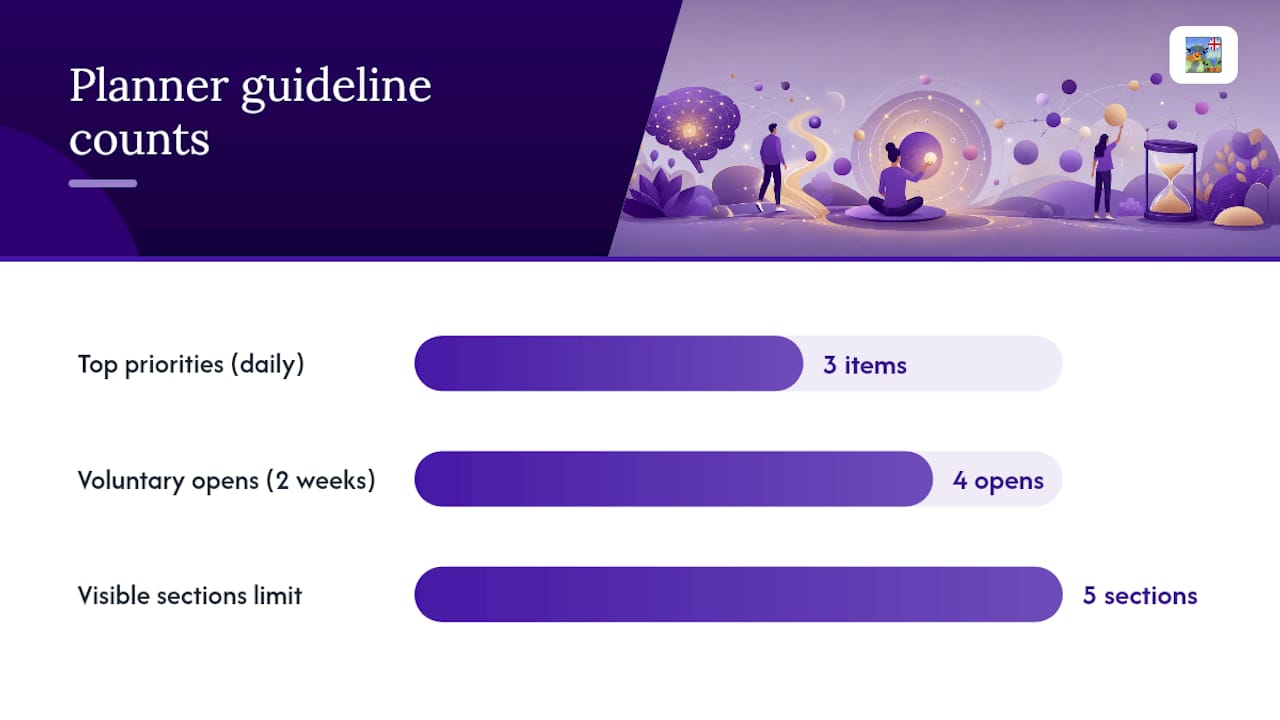
- Top-3 must-dos: Not a full task list. Three items, maximum. Everything else goes in the brain dump.
- Brain dump area: An unstructured space to offload every thought, worry, and task rattling around your head before you start planning. It clears working memory so you can actually focus on the day.
- Tiny first-step prompts: A field that asks "What's the first 2-minute action?" next to each priority. This is the single most underrated feature in ADHD planning.
- Visible time blocks with buffers: Hourly or half-hourly slots with transition time built in. ADHD time blindness makes back-to-back scheduling brutal; buffer zones absorb the overruns.
- Done list or rewards section: A place to log what you did complete, not just what you planned. This provides the dopamine hit that keeps the habit alive.
- Medication and energy tracking: A simple row for noting when meds kicked in and how energy feels at different points in the day. Scheduling high-focus tasks during peak windows, and forgiving yourself for afternoon dips, changes the relationship with the planner entirely.
- Carry-forward field: A dedicated spot to move unfinished tasks to tomorrow without rewriting the whole list.
A printable single-page ADHD daily layout that includes all of these elements, including a brain dump, top-3 must-dos, tiny first steps, visible time blocks with transition buffers, and a done list, is one of the most practical templates available for testing what works before committing to a paid planner.
Pro Tip: Keep the planner open on your desk at all times. A closed planner is an invisible planner. If it's out of sight, it's out of mind, and for ADHD brains, that's not a metaphor.
Minimizing visual clutter matters as much as the features themselves. A planner with too many sections, too many colors, or too many prompts becomes something to avoid rather than use. Start with the fewest fields that cover your core needs, then add only what you actually use after two weeks.
Paper vs. digital vs. hybrid: which format fits your ADHD brain?
There's no universally right answer here, but there are clear patterns based on ADHD traits.
| Format | Sensory/habit fit | Initiation ease | Reminders | Syncing | Best for |
|---|---|---|---|---|---|
| Paper | High tactile satisfaction, visible progress | Very low friction | None (external alarm needed) | None | Externalizing thought, crossing off tasks |
| Digital | Low tactile, screen fatigue risk | Moderate (notification overload risk) | Built-in, customizable | Full cloud sync | Rescheduling, reminders, remote work |
| Hybrid | Best of both | Low to moderate | Digital side handles it | Partial (scan or photo) | Most ADHD adults long-term |
Paper works because it externalizes thought physically. Writing by hand slows you down just enough to process what you're committing to. The risk: pages get lost, the planner gets buried under mail, and there are no reminders when you forget to check it. Pairing a paper planner with a single recurring phone alarm at your planning time solves most of that.
Digital planners and apps win on flexibility. Drag a task to tomorrow in two seconds. Set a reminder that fires at the exact moment you need to start. The problem is that digital tools live inside the same device as every other distraction. Notification overload is real, and many ADHD adults find that a screen-based planner gets buried under tabs and apps within a week.
Hybrid setups are what most experienced ADHD adults land on. A common workflow: brain dump and daily priorities on paper in the morning, then sync the top-3 to a digital calendar with time blocks and reminders. Body-doubling slots get scheduled in the digital calendar so they show up as appointments. The paper planner stays open on the desk as a visual anchor; the phone handles the alerts.
How to set up a planner habit that actually sticks in 30 days
The goal isn't to use a planner perfectly from day one. The goal is to make the habit so small it's nearly impossible to skip. CHADD recommends scheduling a regular daily planning session and checking the planner multiple times per day, treating it as a fixed appointment rather than an optional task.
Here's a 30-day micro-action plan:
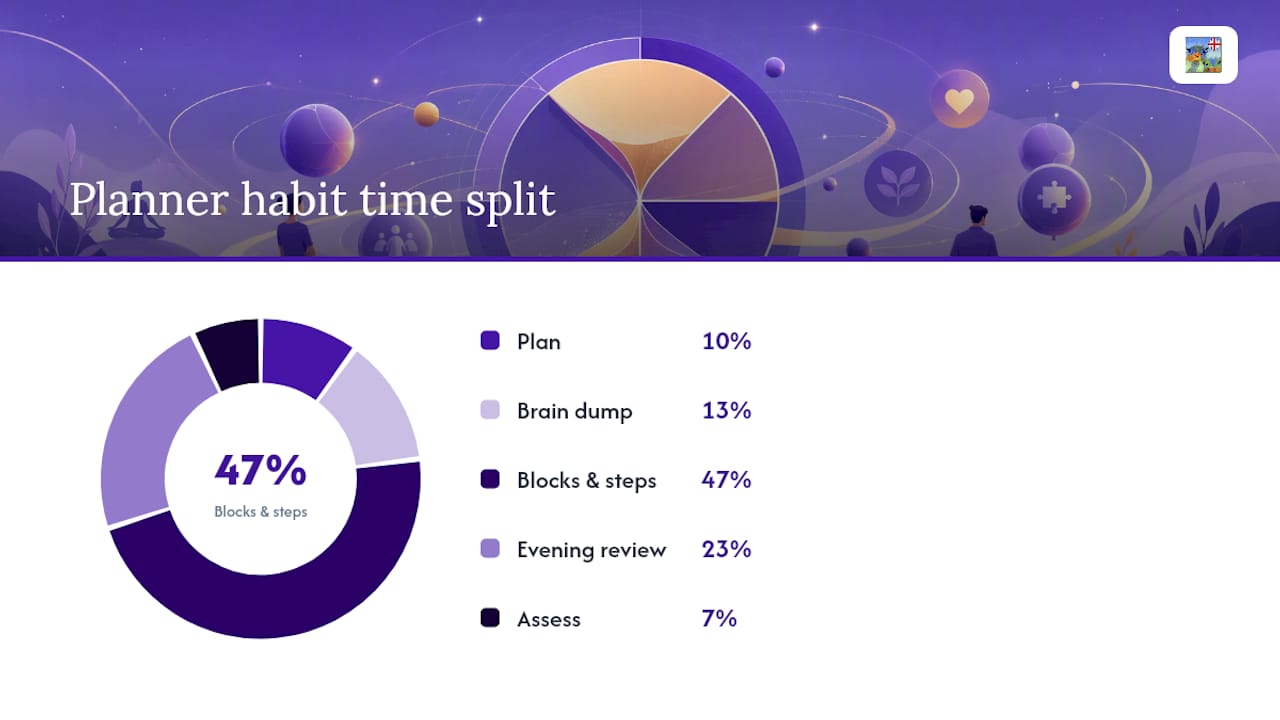
- Days 1–3: Set one recurring alarm labeled "Plan." Open the planner. Write three things you want to do today. Nothing else required.
- Days 4–7: Add a brain dump before writing your top-3. Spend two minutes offloading everything on your mind first.
- Days 8–14: Add time blocks. Assign each of your top-3 a specific time slot. Include a 15-minute buffer after each one.
- Days 15–21: Add a tiny first step next to each priority. "Email draft" becomes "Open Gmail and type subject line." That's the whole first step.
- Days 22–28: Add an evening review. Two minutes before bed: check off what got done, carry forward what didn't, write one thing you're glad you did.
- Days 29–30: Assess. Is the planner open on your desk every morning? Are you checking it at least twice a day? If yes, the habit is forming. If not, simplify further.
Timing chart for scheduling hard tasks:
| Time of day | Energy/focus level | Best task type |
|---|---|---|
| About 30 min after waking | Rising (pre-meds or natural peak) | Light planning, brain dump |
| 60–120 min after meds kick in | Peak focus | Top-priority, high-effort tasks |
| Early afternoon | Dip | Admin, emails, low-stakes tasks |
| Late afternoon | Second wind (for some) | Creative work, meetings |
| Evening | Low | Review, carry-forward, tomorrow's top-3 |
Track your medication window and energy level for the first two weeks. Most ADHD adults discover their peak focus window is narrower than they assumed, usually about one to two hours. Protecting that window for the hardest task of the day is one of the highest-leverage changes you can make.
For task initiation specifically: write the 2-minute first step the night before, not the morning of. When initiation is hardest, having a pre-written micro-action removes one decision from the moment you're most likely to stall.
What clinicians and recent tools say about planning for ADHD
The case for structured external planning tools isn't anecdotal. Peer-reviewed research on attention and executive function supports the use of external time cues and task segmentation to offset the timing and initiation difficulties associated with ADHD. The underlying mechanism is straightforward: ADHD affects the prefrontal cortex's ability to regulate time perception and sequence actions. A planner with visible time blocks and broken-down tasks essentially performs that function externally.
Clinical and neuroscience literature also documents that ADHD-related time blindness, the sense that time is either "now" or "not now," makes hourly-only planners brittle. Visual time blocks with transition buffers, and the option to mark flexible zones rather than strict start/stop times, address this directly. A DOI-registered clinical paper on neural timing and attention supports the broader finding that structural external supports can offset attentional timing deficits.
Body doubling, scheduling a slot to work alongside another person, appears consistently in ADHD support resources as one of the most reliable initiation strategies. Building it into the planner as a scheduled appointment, rather than an informal arrangement, makes it far more likely to happen.
Quick checklist: how do you pick the right planner for your ADHD profile?
Match your primary ADHD challenge to the planner feature that addresses it directly:
- Time blindness + remote work: Choose a format with visible hourly time blocks and pair it with digital calendar reminders. FlowADHD or a hybrid setup works well here.
- Task initiation struggles: Prioritize planners with a "tiny first step" field and a top-3 limit. The fewer decisions required to start, the better.
- Overwhelm from long lists: Single-page daily layout, brain dump section, and a hard limit of three priorities. Happy Planner or a minimal paper layout.
- Forgetfulness + losing things: Go digital or hybrid. Rocketbook lets you write by hand and scan to cloud storage. FlowADHD keeps everything in one app.
- Creative or visual thinker: Dot-grid or themed planner with color-coding space. Ink & Volt or a customizable disc-bound format.
- Goal-oriented, needs structure: Full Focus Planner or Creator's Friend, both of which connect daily actions to longer-term goals.
- Budget-conscious: Start with a printable ADHD planner template before spending on a premium product. Test the layout for two weeks first.
Decision rules to keep it simple:
Start with the smallest possible planner that covers your core needs. A single-page daily layout beats a multi-section system every time for ADHD adults who are just building the habit. Prefer carry-forward and tiny-step fields over elaborate goal-tracking sections. If a planner has more than five sections visible at once, it's probably too complex to use consistently.
When to return it and try something else: If you haven't opened the planner voluntarily at least four times in the first two weeks, the format isn't working. That's not a willpower problem; it's a fit problem. Switch formats (paper to digital, or vice versa) before concluding that planners don't work for you.
For ADHD adults who want an external perspective on planner approaches and reset strategies, the ADHD Reset resource at Atlas Kings covers practical planner frameworks designed specifically for adults with ADHD.
How we picked and evaluated the shortlist
The planners and tools on this list were evaluated against criteria that reflect real ADHD challenges, not general productivity preferences:
- ADHD-specific features: Does it include a brain dump, top-3 limit, carry-forward field, and tiny-step prompt? These are non-negotiable for ADHD use.
- Ease of use and learning curve: A planner that requires a 30-minute setup every Sunday is one most ADHD adults will abandon by week two.
- Price shape and refillability: One-time cost vs. subscription, and whether inserts are available so the system doesn't need to be replaced entirely each year.
- Real-user signals: Consistent appearance in ADHD community discussions, advocacy group recommendations (CHADD, ADD.org), and practitioner guidance.
- Format flexibility: Whether the planner supports paper, digital, or hybrid use, and how well it adapts to different ADHD profiles.
- Visual clutter: Fewer visible sections is better. A planner that looks overwhelming on day one rarely gets used on day thirty.
Sources consulted include CHADD's time management guidance, ADD.org's planner recommendations, peer-reviewed executive function research, and practitioner-oriented ADHD planning resources. Promotional claims from any single vendor were not used as evaluation criteria.
A perspective on planners and ADHD that most articles miss
Most ADHD planner content focuses on features. Which sections to include, which layout to buy, which app to download. That's useful, but it misses the deeper issue.
The reason most ADHD adults cycle through planners isn't that they haven't found the right one. It's that they're treating the planner as a solution rather than a scaffold. A planner doesn't fix time blindness or task initiation. It creates an external structure that makes those challenges slightly more manageable, every single day, as long as you use it. The moment you stop, the scaffold disappears.
That's why the 30-day habit plan matters more than the planner itself. A mediocre planner used consistently outperforms a perfect planner used twice a week. The research from CHADD makes this explicit: it's the daily session, the multiple check-ins, the fixed alarm, that builds the habit. Not the paper quality or the disc-bound system.
There's also a shame dynamic worth naming. Many ADHD adults have tried and abandoned multiple planners, and they carry that history into every new purchase. The instinct is to buy something more elaborate, more structured, more "foolproof." The evidence points the other way. Less visible complexity, fewer fields, one page at a time. The adult planner organization tips that actually stick are almost always the simplest ones.
One more thing: the done list is not optional. For ADHD brains that run on dopamine, logging what you did complete is as important as planning what you intend to do. It's not a nice-to-have. It's the feedback loop that keeps the whole system running.
Munkterproducts' ADHD-friendly planner is worth a look
If you've read this far and you want a physical planner that covers the core ADHD features without requiring you to build a system from scratch, Munkterproducts offers handcrafted planners and journals with clean, low-clutter layouts designed for daily use.

The planners include single-page daily layouts, space for top priorities and brain dumps, and a minimal design that keeps visual noise low. They ship with included postage, so there's no separate shipping calculation at checkout. For ADHD adults who want a physical product that's ready to use on day one, without customizing a disc-bound system or downloading another app, it's a practical starting point.
Browse the current planner and journal range at Munkterproducts and pick the layout that matches your daily planning style.
Sources
- Time Management and ADHD: Day Planners - CHADD
- ADHD Planners for Adults: Tools for Organization & ...
- PubMed entry relevant to ADHD and executive function (24411642)