

TL;DR:
- A daily planner helps organize tasks, reduce stress, and improve productivity by externalizing commitments.
- Using a planner minimizes decision fatigue and counteracts the Zeigarnik effect, freeing mental resources.
A daily planner is a structured tool that helps you organize tasks, set priorities, and manage your time to increase productivity and lower stress. The core reason to keep one is simple: your brain was not built to hold every task, deadline, and commitment without cost. Research shows that writing down tasks reduces cognitive load by externalizing them, which directly relieves the low-level anxiety caused by unfinished items sitting in working memory. This psychological phenomenon is known as the Zeigarnik effect, and a daily planner is one of the most direct ways to counter it. Planners also build the habit of prioritization, which is the single skill most linked to meaningful work completion.
Why keep a daily planner: the core benefits
Keeping a daily planner gives you a clear, external record of what matters most each day. That clarity alone changes how you work.
- Improved prioritization. Focusing on 3–5 high-priority tasks per day produces significantly more meaningful output than working from an open-ended list. Shorter lists force better decisions about what actually deserves your time.
- Reduced decision fatigue. Every choice you make draws on a finite pool of mental energy. Pre-planning your day the night before or each morning means you spend that energy on real work, not on figuring out what to do next.
- Built-in accountability. A written plan creates a visible record of commitments. Checking off completed tasks gives you concrete feedback on your progress, which reinforces motivation.
- Mental clarity. Externalizing your task list frees your working memory. You stop mentally rehearsing what you need to do and start actually doing it.
- Flexibility within structure. A planner does not lock you into a rigid schedule. It gives you a foundation to adapt from when the day shifts unexpectedly.
Pro Tip: Write your top three priorities the night before. When you wake up, your first decision is already made, and you can start working immediately.
The advantages of keeping a planner extend beyond productivity. Planners reduce the reactive, scattered feeling that comes from an unstructured day. Consistent planner use builds a proactive relationship with your time, which is a measurable shift in how you experience your workday.

How does the science behind daily planning explain its effectiveness?
The Zeigarnik effect is the brain's tendency to fixate on incomplete tasks. Psychologist Bluma Zeigarnik identified that unfinished work occupies mental bandwidth until it is either completed or recorded somewhere trustworthy. Writing a task into a planner signals to your brain that the item is captured, which releases the mental loop.
Planning is less about rigid schedules and more about creating context and adaptable frameworks for your daily work. The act of planning itself provides structure that reduces anxiety, even when the plan changes. — Christine Carter
Decision fatigue is a second, equally important factor. The brain treats every decision as a small expenditure of cognitive energy. Pre-planning conserves that energy by front-loading choices. A 5-minute planning session done either the night before or first thing in the morning eliminates the need to decide what to work on throughout the day.
The neuroscience of executive function also supports daily planning. The prefrontal cortex, which handles attention, prioritization, and impulse control, performs better when it works from a clear external reference. A planner functions as an extension of that system. It holds the structure so your brain can focus on execution rather than organization.
Complementary stress relief techniques work on the same principle: external anchors reduce the mental effort required to manage anxiety. A planner is one of the most practical versions of that concept.
What are the best practices for effective daily planning?
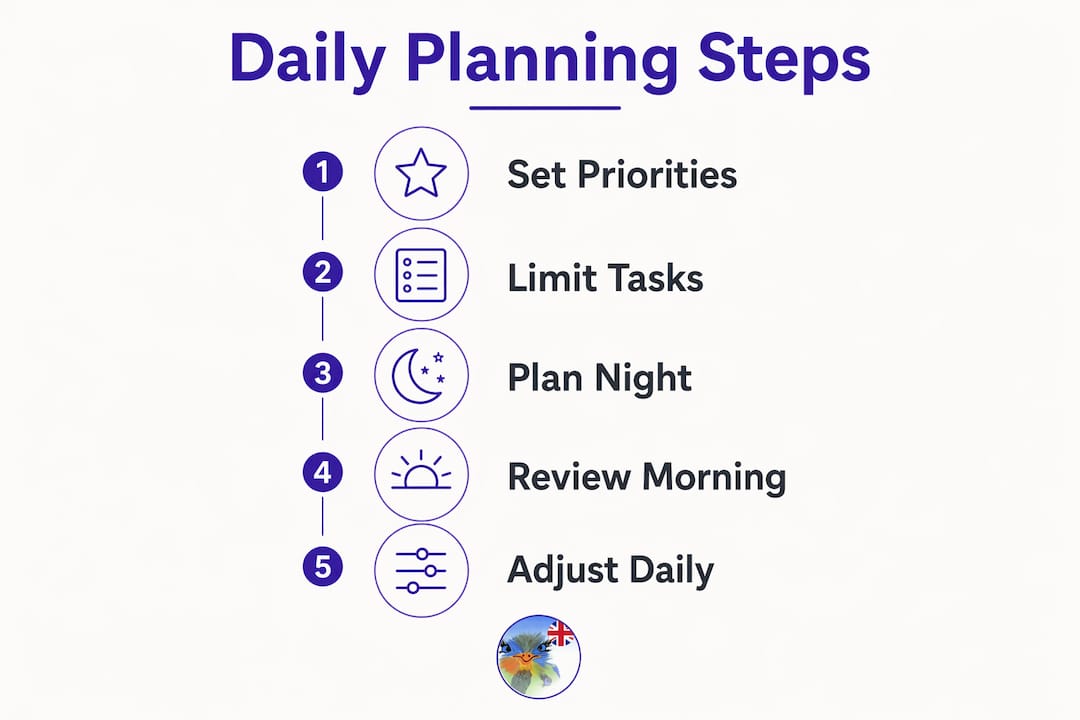
Effective daily planning follows a repeatable structure. The specific steps below reflect expert recommendations current as of 2026.
- Plan the night before or first thing in the morning. Night-before planning lets you start the next day with full momentum. Morning planning works better when you need updated information before committing to priorities.
- Limit your daily task list to 3–5 items. Limiting your priorities focuses your energy on the most impactful work and reduces burnout from overloaded lists.
- Use time blocking. Assign specific time slots to each task rather than keeping a loose list. This makes your plan concrete and easier to follow.
- Build in buffer time. Scheduling buffers of 5–15 minutes between tasks handles overruns and unexpected demands without collapsing your entire schedule.
- Take intentional breaks. Incorporating planned breaks sustains attention across the full day. A 10-minute break after 90 minutes of focused work is a widely supported interval.
- Review your plan at midday. A quick check-in between activities keeps you anchored to your priorities and prevents drift toward lower-value tasks.
- Do a 5-minute end-of-day review. Reviewing completed and rolled-over tasks at day's end closes mental loops and feeds directly into the next day's plan.
| Planning Element | Recommended Practice | Why It Works |
|---|---|---|
| Task limit | 3–5 priorities per day | Prevents overload and sharpens focus |
| Planning time | 5 minutes, morning or evening | Eliminates decision fatigue during the day |
| Buffer time | 5–15 minutes between tasks | Absorbs interruptions without schedule collapse |
| Midday review | One check-in between activities | Keeps priorities visible and prevents drift |
| End-of-day review | 5 minutes to close and plan ahead | Reduces lingering anxiety and prepares next day |
Pro Tip: If a task rolls over three days in a row, ask whether it belongs on your list at all. Either schedule it with a firm time block or remove it.
How do you choose and use a daily planner that fits your life?
The right planner format depends on how you work and what keeps you consistent. Both paper and digital options have real advantages, and neither is universally better.
Paper planners provide physical cues that digital tools cannot replicate. The act of writing by hand reinforces memory and commitment. Paper planners reduce digital distractions and tend to improve planning adherence for people who find screens counterproductive. A physical planner also stays visible on your desk, which serves as a constant, low-effort reminder of your priorities.
Digital planners and apps integrate with calendars, set reminders, and sync across devices. They work well for people who spend most of their day on a computer or phone and need their plan to connect with existing digital workflows. The trade-off is that digital tools sit inside the same environment as email, social media, and other distractions.
A few practical tips for choosing and using your planner:
- Match the format to your environment. If you work at a desk, a paper planner is always accessible. If you travel or work across locations, a digital option may be more practical.
- Personalize your planner to increase engagement. Adding color coding, motivational prompts, or a weekly theme makes the habit more sustainable. Personalized stationery consistently improves motivation and daily use.
- Integrate your planner with your calendar. Use the calendar for fixed appointments and the planner for flexible daily priorities. The two tools complement each other rather than compete.
- Review your plan at multiple points during the day to stay anchored. A single morning review is not enough. Brief midday and end-of-day check-ins make the difference between a plan you wrote and a plan you followed.
The most important factor is consistency. A simple planner used every day outperforms a sophisticated system used occasionally.
Key Takeaways
A daily planner works because it externalizes your task list, reduces cognitive load, and gives your brain a clear structure to work from rather than improvise around.
| Point | Details |
|---|---|
| Limit daily priorities | Focus on 3–5 tasks per day to maximize meaningful output and reduce burnout. |
| Plan in 5 minutes | A short morning or evening session eliminates decision fatigue throughout the day. |
| Use buffer time | Schedule 5–15 minutes between tasks to absorb interruptions without losing structure. |
| Review three times daily | Morning, midday, and end-of-day check-ins keep your plan active rather than decorative. |
| Choose your format deliberately | Paper planners reduce distraction; digital planners integrate with existing workflows. |
What I have learned from years of keeping a daily planner
The biggest mistake I see is treating a planner like a to-do list with a date on it. That approach leads to 15-item days, constant rollover, and the slow erosion of confidence in the system itself.
What actually works is treating the planner as a decision made in advance. When I write down three priorities the night before, I am not just organizing. I am making a commitment that removes the need to negotiate with myself the next morning. That negotiation is where most productive time disappears.
The second pitfall is rigidity. A plan that cannot flex is a plan that fails by 10:00 AM and gets abandoned. The goal is not to follow the plan perfectly. The goal is to return to it after every interruption. Consistency beats perfection every time, and a planner that you use imperfectly is worth far more than one you use perfectly for three days and then ignore.
Start with two weeks of a stripped-down approach: three priorities, one time block each, and a five-minute evening review. That alone will change how your days feel.
— Mark
Planners and journals from Munkterproducts

Munkterproducts offers a range of handcrafted planners, self-help journals, and novelty stationery designed for people who take their daily organization seriously. Each product is built to support the kind of consistent, focused planning that this article describes. Whether you prefer a structured daily layout or a more open journal format, the collection at Munkterproducts includes options for both. Postage is included with every order, and the purchasing process is straightforward. If you are ready to move from a scattered day to a structured one, a quality planner is the most direct first step.
FAQ
Why keep a daily planner instead of a digital app?
Paper planners reduce digital distractions and provide physical cues that reinforce planning habits. Many people report stronger adherence with a physical planner because it stays visible and does not compete with notifications.
How many tasks should I write in my daily planner?
Productivity experts recommend limiting your daily list to 3–5 high-priority tasks. Shorter lists produce more meaningful work completion than open-ended task inventories.
What is the Zeigarnik effect and how does a planner help?
The Zeigarnik effect is the brain's tendency to fixate on unfinished tasks. Writing tasks into a planner signals to your brain that they are captured, which releases the mental loop and reduces background anxiety.
When is the best time to fill out a daily planner?
Either the night before or first thing in the morning works well. Night-before planning gives you a head start; morning planning lets you incorporate the latest information before committing to your priorities.
How long does daily planning actually take?
A focused planning session takes about five minutes. That brief investment eliminates decision fatigue for the rest of the day and reduces the time lost to figuring out what to work on next.