

TL;DR:
- Motivational journals are structured tools that enhance goal achievement by fostering self-awareness and intrinsic motivation. They improve focus and mental resilience through daily reflection, specificity, and pattern recognition. Consistent, honest journaling connected to core values sustains long-term personal growth.
A motivational journal is a structured writing practice designed to increase self-awareness, clarify goals, and sustain the internal drive needed to achieve them. Unlike a standard diary, which records events passively, a motivational journal actively shapes how you think about your future. Research by psychologist James Pennebaker at the University of Texas established that expressive writing produces measurable improvements in both mental and physical health. Tools like Mindsera and practices endorsed by Sanford Health have since built on that foundation. The role of motivational journals sits at the intersection of cognitive science, behavioral psychology, and daily habit formation, making them one of the most accessible personal development tools available.
How do motivational journals improve motivation and goal achievement?
Motivational journaling produces results through three distinct mechanisms: cognitive offloading, affect labeling, and prefrontal cortex activation. When you write a goal down, your brain stops using working memory to hold it in place. That freed capacity goes directly toward planning and execution. The effect is immediate and measurable.

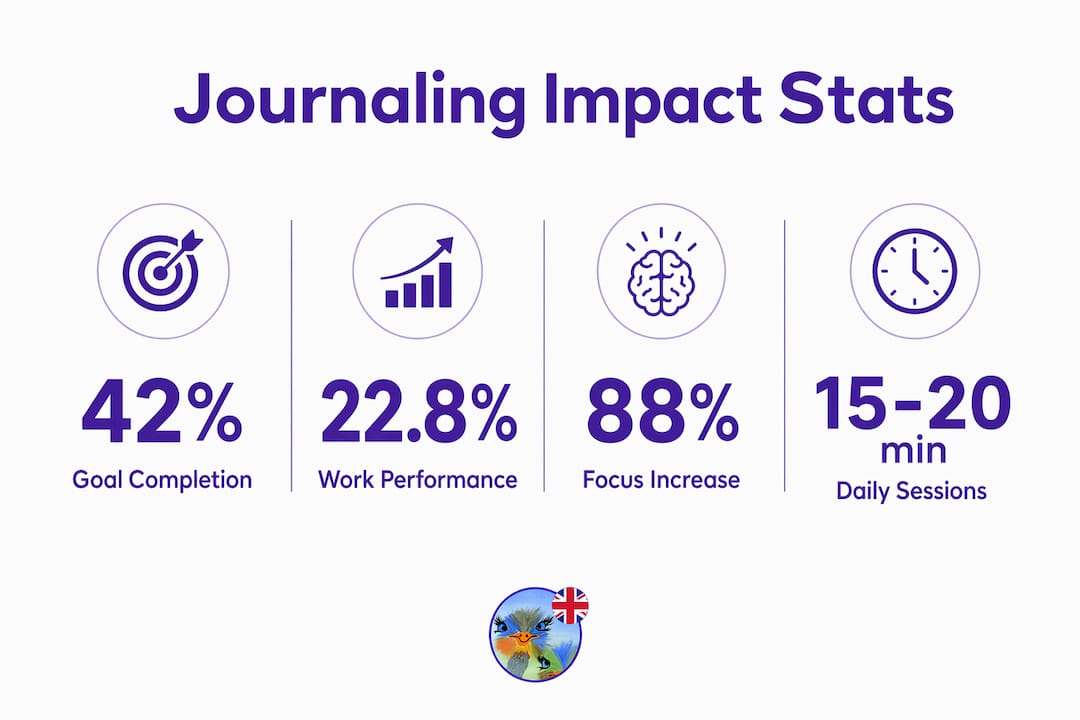
Active journaling boosts goal completion by 42%, improves work performance by 22.8%, and enhances focus for 88% of users. Those numbers reflect a compounding process, not a one-time spike. Each session builds on the last, reinforcing neural pathways associated with goal-directed behavior.
The brain science behind this is specific. Regular journaling strengthens prefrontal cortex function and reduces amygdala reactivity, which is the part of the brain responsible for fear and impulsive reactions. When the prefrontal cortex leads, you make decisions based on values and long-term thinking rather than short-term anxiety. Journaling is, in effect, a daily workout for the part of your brain that keeps you on track.
Journaling also converts vague intentions into concrete plans. Writing "I want to be healthier" is a wish. Writing "I will walk 20 minutes after lunch on Monday, Wednesday, and Friday" is a plan. The act of writing forces specificity, and specificity is where motivation becomes behavior. Pattern recognition follows naturally. After two weeks of entries, you start to see which days you feel most energized, which situations drain you, and what conditions produce your best work.
Pro Tip: Write your top goal at the top of every journal entry before you write anything else. This primes your brain to filter the day's events through the lens of that goal, which accelerates pattern recognition.
What are the best motivational journal prompts to boost mindfulness?
Prompt quality determines the depth of your journaling practice. A weak prompt produces surface-level answers. A strong prompt pulls out the thinking you didn't know you needed to do.
The most effective motivational journal prompts fall into three categories:
- Gratitude prompts: "What three specific things went right today, and why did they happen?" Gratitude journaling for 14 days can reduce depressive symptoms comparable to antidepressants for mild to moderate depression. The key word is "specific." Generic gratitude produces generic results.
- Future-self scripting: "Describe your life one year from now as if it has already happened." Writing intentions and letters to oneself works like a placebo effect by instilling self-belief that directly influences success. This is not wishful thinking. It is a neurological priming technique.
- Third-person analytical prompts: "What would an objective observer say about how [your name] handled today's challenge?" Writing from a third-person perspective creates psychological distance, which reduces emotional reactivity and promotes clearer thinking.
Three structured techniques stand out for daily motivational writing:
- The Daily Three: Record one win, one lesson, and one intention for tomorrow. This takes under five minutes and covers the full motivational cycle.
- The Weekly Review: Every Sunday, scan the previous seven entries for patterns. Note what moved you forward and what stalled you. This is where self-reflection in journaling produces its most durable insights.
- The Stream of Consciousness Sprint: Set a timer for eight minutes and write without stopping or editing. This technique bypasses your internal critic and surfaces subconscious priorities.
One critical pitfall to avoid: pure venting. Venting without analytical framing can increase emotional reactivity rather than reduce it. If you find yourself writing the same frustration repeatedly, shift to a third-person prompt or ask "What is this situation trying to teach me?"
Pro Tip: Morning journaling sessions tap into peak neuroplasticity windows, producing deeper installation of motivational intentions. If mornings are not realistic, even five minutes before bed outperforms skipping entirely.
How do motivational journals compare with other personal development tools?
Motivational journals occupy a unique position in the personal development toolkit. They are not therapy, not a to-do list, and not a mindfulness app. Understanding what they do and do not replace helps you use them more effectively.
| Tool | Primary function | Limitation | How journaling compares |
|---|---|---|---|
| To-do list | Task tracking | No emotional context | Journaling adds the "why" behind the task |
| Therapy | Clinical mental health support | Requires a professional | Journaling complements but does not replace therapy |
| Mindfulness meditation | Present-moment awareness | No goal-tracking component | Journaling captures insights from meditation sessions |
| Motivational journal | Goal clarity, self-reflection, motivation | Requires consistency | Combines emotional depth with strategic planning |
The most important distinction is between passive documentation and active self-monitoring. A to-do list tells you what to do. A motivational journal tells you why it matters and whether you are still aligned with that reason. Motivational journaling is most effective when it connects goals to core values, which sustains intrinsic motivation long after initial enthusiasm fades. This finding comes directly from Motivational Interviewing research, a clinical framework developed by psychologists William Miller and Stephen Rollnick.
Mindfulness practices and journaling are natural partners. Meditation builds present-moment awareness. Journaling captures and extends that awareness into goal-directed thinking. Using both together produces results that neither achieves alone. The handmade journals for mindful creativity approach recognizes this connection explicitly, treating the physical act of writing as part of the mindfulness practice itself.
Therapy and journaling also complement each other well. Many therapists assign journaling as homework between sessions because it extends the reflective work beyond the therapy room. Journaling is not a substitute for clinical support when clinical support is needed. It is, however, a powerful daily practice that makes every other personal development effort more effective.
How to effectively use motivational journals daily for lasting impact
Consistency produces more benefit than any single technique. Daily journaling sessions of 15 to 20 minutes provide consistent benefits through cumulative, compounding effects on self-knowledge and motivation. Frequency matters more than session length. A ten-minute daily session outperforms a two-hour weekly session every time.
Here is a practical daily framework for lasting impact:
- Open with your top goal. Write it in one sentence at the top of the page. This anchors the session before you write anything else.
- Check your energy and emotional state. Rate both on a scale of one to ten. Tracking energy levels and motivation shifts over time creates an early warning system for burnout that most people never develop.
- Apply one prompt. Choose from gratitude, future-self scripting, or third-person analysis depending on what the day calls for. Do not use the same prompt every day. Variety prevents the practice from becoming mechanical.
- Close with one intention. Write one specific action you will take tomorrow that moves you toward your goal. This is the bridge between reflection and behavior.
- Review past entries weekly. Scan for patterns in your language, energy ratings, and recurring obstacles. The insights that emerge from this review are often more valuable than any single entry.
Two common pitfalls derail otherwise solid journaling habits. The first is skipping tough days. Those are precisely the days when journaling produces the most insight. The second is writing for performance rather than honesty. Research highlights the power of an implied audience to raise journaling honesty and quality. Write as if a trusted mentor will read your entry. That single mental shift changes the depth of what you produce.
Pro Tip: If you miss a day, do not try to reconstruct it. Simply start fresh and note what you observed about your resistance. That observation is itself a valuable entry.
Key takeaways
Motivational journals work because they combine cognitive offloading, emotional regulation, and values-based goal tracking into a single daily practice that compounds over time.
| Point | Details |
|---|---|
| Goal completion improves measurably | Active journaling raises goal completion by 42%, driven by specificity and consistent self-monitoring. |
| Prompt quality determines depth | Gratitude, future-self scripting, and third-person prompts each target different motivational mechanisms. |
| Journaling complements, not replaces | Motivational journals work best alongside therapy and mindfulness, not as substitutes for either. |
| Consistency beats intensity | Daily sessions of 15 to 20 minutes produce stronger long-term results than infrequent marathon sessions. |
| Values connection sustains motivation | Linking goals to core values, as Motivational Interviewing research shows, maintains drive beyond initial enthusiasm. |
What I've learned from years of watching people journal
Most people start a motivational journal expecting it to feel inspiring from day one. It rarely does. The first week usually feels awkward and slightly pointless, which is exactly why most journals end up abandoned by week two.
What I've observed is that the real shift happens around day ten or twelve, when you read back over your early entries and notice something you couldn't see while you were writing it. A pattern in your language. A recurring fear dressed up as a practical concern. A goal you wrote down that you clearly don't actually want. That moment of recognition is what motivational journaling is actually for. Not the writing. The reading.
I've also noticed that people who treat their journal as a performance document, writing what sounds good rather than what is true, get almost nothing from the practice. The personalized journals approach matters here. When the journal feels like yours, physically and conceptually, you write more honestly. A generic spiral notebook from a gas station sends a subtle signal that this practice isn't worth investing in.
The other thing conventional advice gets wrong is the emphasis on positivity. Positive thinking journals have their place, but the most productive journaling sessions I've seen are the ones where someone writes through a genuinely difficult emotion with analytical curiosity rather than forced optimism. Honesty first. Reframing second. That sequence produces real change. Reversing it produces performance.
— Mark
Start your journaling practice with the right tools
The quality of your journal shapes the quality of your practice. A well-made journal signals to your brain that this time is worth taking seriously, and that signal matters more than most people expect.

Munkterproducts carries a curated selection of self-help journals, planners, and notebooks designed for exactly this kind of intentional daily writing. Whether you are building a gratitude practice, tracking long-term goals, or working through a structured reflection system, the right physical journal makes consistency easier to maintain. Browse the journals and planners at Munkterproducts to find a format that fits your practice. You can also explore motivational canvas art to reinforce your intentions in your writing space.
FAQ
What is the role of motivational journals in personal development?
Motivational journals serve as structured tools for clarifying goals, tracking progress, and sustaining intrinsic motivation by connecting daily actions to core values. Research shows they improve goal completion by 42% and work performance by 22.8%.
How long should a daily journaling session be?
Daily sessions of 15 to 20 minutes produce consistent benefits, with frequency mattering more than length. A short daily session outperforms a long weekly session in building lasting self-knowledge and motivation.
What are the most effective motivational journal prompts?
Gratitude prompts, future-self scripting, and third-person analytical writing are the three most research-supported prompt types. Each targets a different cognitive mechanism, from mood regulation to goal visualization to emotional distance.
Can journaling replace therapy or mindfulness meditation?
Journaling complements therapy and mindfulness but does not replace either. It extends the reflective work of therapy between sessions and captures insights from meditation, making both practices more effective over time.
How do you avoid the venting trap in journaling?
Shift from pure emotional venting to analytical framing by adopting a third-person perspective or asking what a situation is teaching you. Writing from a third-person viewpoint aligns with CBT principles and reduces emotional reactivity rather than amplifying it.