

TL;DR:
- Most people abandon journaling because their journals do not fit their natural rhythms or emotional needs. Personalized journals, with customizable prompts and layouts, foster deeper engagement and support mental health by matching individual thinking patterns. Using brief, mood-specific entries and quality materials increases the likelihood of forming lasting journaling habits.
Most people who quit journaling blame themselves. They call it laziness or lack of discipline when the real problem is that the journal never fit them in the first place. This is exactly why personalized journals matter. Unlike generic notebooks with their one-size-fits-all weekly grids and empty lined pages, custom journals align with how you actually think, feel, and create. Whether you're chasing better mental wellness, setting meaningful goals, or carving out space for creative expression, the right journal design can be the difference between a habit that sticks and one that collects dust.
Key takeaways
| Point | Details |
|---|---|
| Generic journals often fail users | Mismatched layouts and rigid formats cause skipped entries and abandoned habits. |
| Personalization boosts mental health | Custom prompts and expressive writing reduce stress and support emotional regulation. |
| Handwriting deepens engagement | Writing by hand engages the brain more deeply than typing, improving reflection and memory. |
| Custom formats support goal-setting | Future-self reflection techniques in personalized journals measurably improve goal achievement. |
| Flexibility makes habits stick | Brief, mood-matched entries are more sustainable than rigid daily performance journaling. |
Why personalized journals outperform generic ones
The phrase "personalized journal" is the everyday term most people search for, but in therapeutic and behavioral research, the practice is called expressive writing or structured reflective journaling. Knowing both names helps you get more from the science and more from your shopping decisions.
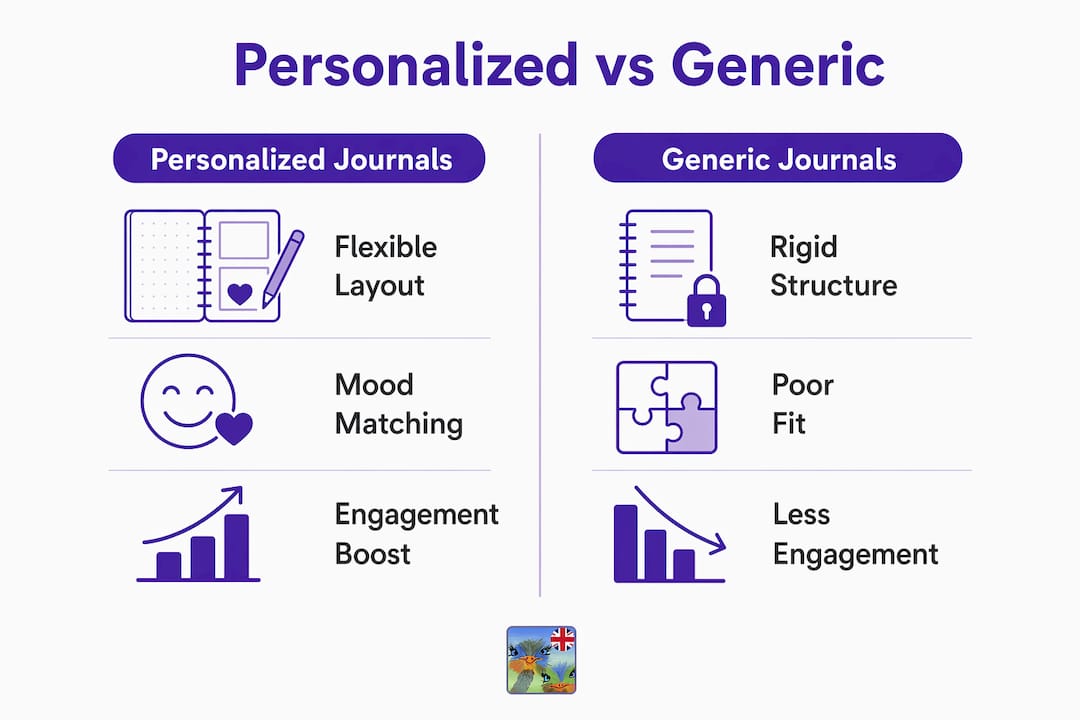
Here is what typically goes wrong with standard journals. You buy one with a Monday-through-Sunday weekly spread, but your life runs on project cycles and sporadic bursts of reflection. By Wednesday, the layout feels like homework you forgot to do. Generic weekly layouts do not fit most people's natural rhythms, which leads directly to skipped entries and lost motivation. The journal starts to feel like evidence of your failure rather than a place to think.
There is also an emotional dimension most people overlook. A journal you chose, designed, or customized carries a sense of ownership that a generic notebook simply cannot replicate. Physical journals suited to personal preferences increase emotional connection and usage consistency. That connection is not superficial. It is the thing that makes you reach for the journal on a hard Tuesday night instead of scrolling your phone.
Think of this as frictionless intention. When every element of your journal, from the paper weight to the section layout to the cover, reflects your preferences, the barrier to sitting down and writing shrinks dramatically. You are not fighting the tool. You are using it.
- Mismatched layouts create cognitive friction before you write a single word
- Uninspiring covers reduce the emotional pull to pick the journal up
- Inappropriate paper (too thin, too rough, bleed-prone) makes the act of writing feel unpleasant
- Rigid formats signal that your thoughts must conform to someone else's structure
- Lack of personalized prompts leaves you staring at blank space with no entry point
Pro Tip: Before buying any journal, write down three specific things you want to do with it: process emotions, track goals, sketch ideas? That list is your specification. Match the product to the spec, not the other way around.
Mental health benefits backed by research

The benefits of personalized journals are not just anecdotal. Expressive writing is one of the most studied self-help interventions in psychology. Writing about significant personal experiences reduces stress and anxiety and can even improve immune function. That is not a small claim. It suggests that putting words on paper is doing something biological, not just emotional.
What makes personalized journaling more effective than generic journal prompts is the match between the prompt and your current emotional state. A prompt asking you to list three things you're grateful for sounds helpful in theory. In practice, for people who are going through genuine difficulty, it can backfire. Research found that some individuals experience increased negative affect when using unpersonalized gratitude exercises. Forcing positivity onto a mind that needs to process pain is not healing. It is suppression.
"For some, the writing was never about remembering. It was about releasing." — Expressive journaling commentary
This reframe is important. You do not need to reread your journals to benefit from them. The emotional benefits come from the act of writing itself, not from building an archive. That means every single entry counts, even the messy ones, even the short ones, even the ones you write at 11pm and never look at again.
One more finding worth knowing: handwriting wins over typing for cognitive engagement. Longhand writing forces deeper cognitive processing and memory retention compared to typing. When you write by hand, your brain cannot keep up word-for-word, so it is forced to synthesize, reframe, and prioritize. That is the reflection happening in real time. Pairing this with mindful creative journaling deepens the benefit further.
The key insight for mental wellness is this: the prompts and structure should meet you where you are emotionally, not where a template assumes you should be.
How to personalize your journal for real results
Personalization is not just about putting your name on the cover. It is about designing a journaling practice that you will actually maintain. Here is a practical framework:
-
Start with your emotional anchor. Choose one or two recurring themes you want to explore: stress at work, creative projects, relationship patterns, or fitness goals. These become your default prompts when you sit down and do not know where to begin. Aligning prompts to emotionally relevant content across sessions is what drives real cognitive integration.
-
Incorporate future-self reflection. Instead of only writing about what happened today, write to your future self. Describe where you want to be in three weeks and what you need to do this week to get there. A 3-week future-self intervention measurably improved weekly goal achievement compared to standard journaling. It is a surprisingly simple shift with outsized results.
-
Use handwriting intentionally. Choose a journal with paper weight and ruling that suits your pen. If the paper bleeds or feels scratchy, you will avoid writing. A journal that feels good to write in makes handwriting feel like a reward, not a chore. Explore story-driven journaling techniques to add narrative structure to your entries.
-
Give yourself permission to write less. Therapists recommend 2-3 line entries matched to mood rather than demanding full-page reflections every day. This is how habits actually form: through small, consistent doses rather than occasional marathons.
-
Build in flexibility sections. Add sketch space, goal-tracking grids, or weekly check-ins alongside your freewriting pages. A journal that only has lined pages cannot hold the full range of how your mind works.
Pro Tip: If you miss a day, do not try to catch up. Just write today's date and start fresh. Performance journaling, where you feel obligated to fill every page in order, is the fastest way to quit.
Choosing your personalization options
Not all custom journals are built the same. Understanding the types helps you invest in what actually works for your practice.
| Feature | Semi-custom journal | Fully custom journal | Best for |
|---|---|---|---|
| Cover design | Choose from preset options | Full embossed or printed design | Personal identity and aesthetic motivation |
| Paper type | Standard weight (80gsm) | Premium weight (100gsm+), fountain pen friendly | Handwriting quality and durability |
| Layout options | Lined, dot grid, or blank | Custom sections with goal tracking, sketch areas | Mixed-use journalers |
| Section structure | Fixed layout | Tailored sections for mood, goals, creativity | People with specific journaling goals |
| Binding style | Standard spiral or perfect bound | Lay-flat or Coptic-stitched for open use | Writers who dislike fighting a closed spine |
Semi-custom journals are a strong starting point. You get meaningful choices about cover color, paper type, and ruling style without the cost of a fully bespoke product. They work well for people who are new to deliberate journaling and want a better experience than a drugstore notebook, but are not yet sure exactly what they need.
Fully custom journals reward people who already know their preferences. If you know you write with a fountain pen, need dedicated goal-tracking spreads, and want a cover that feels like yours, a fully custom option delivers on all three. Creative arts practices like journaling are most sustainable when the tools match the practitioner, and the same principle applies here.
The best personalized journals in 2026 tend to combine quality materials with adaptable layouts, because that combination addresses the two biggest failure points: physical friction and structural rigidity.
My honest take on what actually changes things
I have watched people cycle through journaling phases for years, picking up beautiful notebooks and abandoning them within two weeks. What I have learned is that the problem is almost never motivation. It is mismatch.
Standard journals carry an implicit message: your thoughts should fit this structure. That message is subtle, but it is powerful. When your entry does not fit the daily log format, you feel like you are doing it wrong. And that feeling, compounded enough times, makes you stop.
What changed things for me was giving myself a journal that had no wrong answers. A layout with space to draw when I could not find words. Prompts I had written myself, based on what I actually wanted to think about, not what some generic wellness template told me I should want. Short pages that celebrated a three-sentence entry instead of guilting me about the blank lines underneath.
The research backs this up completely. Lowering entry barriers with flexible, brief, mood-matched entries is what builds lasting habits. It is not about the quality of your insights on any given day. It is about staying in the relationship with the practice.
My advice: start smaller than feels meaningful. Customize one element at a time. And treat the journal like a conversation you are having with yourself, not a performance you are giving for an imaginary audience.
— Mark
Find your journal at Munkterproducts
If you have been searching for a journal that actually fits the way you think, create, and grow, Munkterproducts has built a range designed around that exact need.

At Munkterproducts, you will find handcrafted journals, self-help planners, and creative notebooks with real customization options, including cover choices, paper quality, and layout structures suited to writers, goal-setters, and creative thinkers alike. Every product ships with postage included, and the catalog spans tools for both adults and children. Whether you are starting a new journaling practice or upgrading a habit you already love, there is a format here built to support it. The therapeutic value of creative self-expression is well established. All you need is the right tool to put it into practice.
FAQ
Why do most people quit generic journals quickly?
Generic journals use rigid layouts that do not match how individuals naturally think or organize their time, creating friction that makes skipping entries feel easier than continuing. The mismatch between structure and lifestyle is the primary reason people abandon journaling, not a lack of effort.
How do personalized journals help with mental health?
Custom journals support mental health by aligning prompts with your current emotional state, which improves cognitive processing and stress regulation. Research shows expressive writing reduces anxiety and can improve physical immune response when done consistently.
Is handwriting in a journal better than typing notes on a phone?
Yes. Handwriting engages deeper cognitive processing than typing because your brain must synthesize and reframe ideas in real time rather than transcribe them word-for-word, leading to better memory retention and genuine reflection.
How short can a journal entry be and still be useful?
Even two or three sentences count. Therapists recommend brief, mood-matched entries rather than demanding full pages, because consistency over time matters far more than length on any given day.
What features should I look for in a personalized journal?
Look for paper weight suited to your preferred writing instrument, a layout that holds the types of content you create (freewriting, sketching, goal tracking), and a cover that makes you want to pick it up. Physical appeal and structural fit together determine whether the habit lasts.