
TL;DR:
- Handwriting in notebooks actively engages multiple brain networks, fostering deeper creative thought than typing. Revisiting and iterating in physical notebooks nurtures idea growth, reflection, and long-term understanding. Consistent, intentional notebook practice unlocks new insights and enhances creative capacities across disciplines.
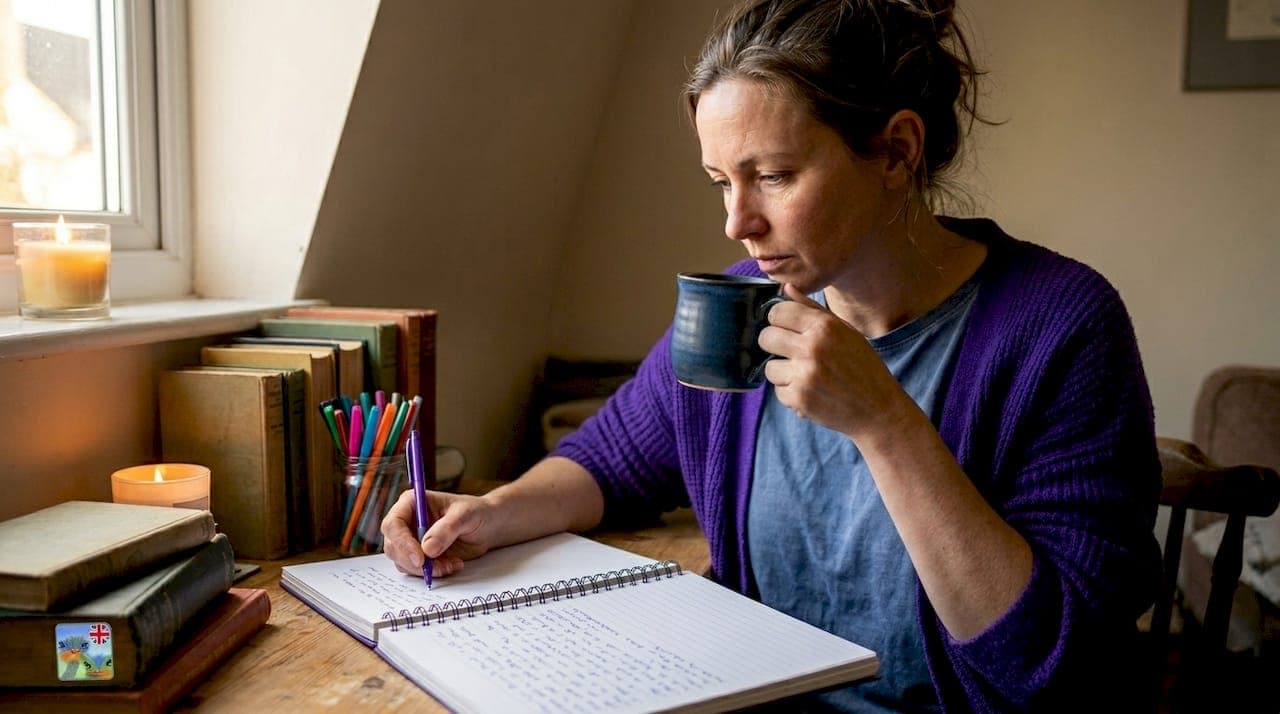
Most people assume that if words end up on a page, the method doesn't matter. Type it, write it, voice-record it. Same result. But the role of notebooks for creativity goes far deeper than storage. The act of putting pen to paper triggers brain activity that typing simply cannot replicate. Whether you're a student sketching out story ideas or an artist working through a concept that won't sit still, your notebook isn't just where ideas live. It's where they grow.
Table of Contents
- Key takeaways
- The role of notebooks for creativity starts in the brain
- Notebooks as a space for ideas to evolve over time
- Practical ways to use notebooks for ideas every day
- Notebooks versus digital tools for creative thinking
- How to design a notebook habit that actually sticks
- My honest take on notebooks and why they changed how I create
- Find notebooks worth writing in from Munkterproducts
- FAQ
Key takeaways
| Point | Details |
|---|---|
| Handwriting activates the brain | Writing by hand engages motor, language, and attention networks together, deepening creative thought. |
| Notebooks support iterative thinking | Returning to past entries sparks new insights and helps evolving ideas reach their full potential. |
| Analog beats digital for creativity | Physical notebooks offer sensory engagement and deliberate pacing that digital tools cannot replicate. |
| Prompts drive deeper reflection | Questions like "What changed?" turn a notebook from a dump zone into a dynamic thinking space. |
| Habit design makes the difference | Separating raw idea pages from revision sections creates a sustainable and productive creative workflow. |
The role of notebooks for creativity starts in the brain
Before your pen leaves a single mark, something significant is already happening. Handwriting engages multiple brain systems simultaneously, recruiting motor networks, language centers, and attention systems all at once. Typing activates far fewer regions. The result is that a written notebook page is cognitively richer territory than anything produced on a keyboard.
The pace matters just as much as the process. Handwriting is slower, and that's the point. That slight friction forces you to decide what's worth writing at all. You naturally start summarizing, rewording, and selecting rather than dumping every word you hear or think. Handwriting encourages selective summarization rather than passive transcription, which means your notebook fills with filtered, quality ideas rather than noise.
Here's what that looks like in practice for notebooks for creative thinking:
- You're brainstorming a short story. On a laptop, you might type 300 words of half-formed scenes. In a notebook, you write 80 words but every single one is intentional.
- You're sketching a character. The act of writing their backstory by hand makes you pause and imagine. You don't just list traits. You discover them.
- You're working through a design concept. Your hand slows your brain just enough to notice the idea underneath the obvious one.
There's also a neurological layer worth knowing. Handwriting produces greater theta and alpha brain connectivity, which are the frequencies most associated with memory formation and creative insight. This is not a metaphor. Your notebook is physically changing how your brain processes ideas.
"Handwriting makes notebooks active thinking partners, not just memory aids, by slowing and deepening thought." — Psychology Today
Pro Tip: Try writing your next brainstorm session by hand for just ten minutes before opening any digital tool. The ideas you arrive at will feel more considered and more yours.
Notebooks as a space for ideas to evolve over time
One of the most underrated aspects of notebooks in the creative process is what happens when you go back. Not to edit. Not to review. But to re-enter. A great idea rarely arrives complete. It arrives as a fragment, and it needs time and attention to become something real.
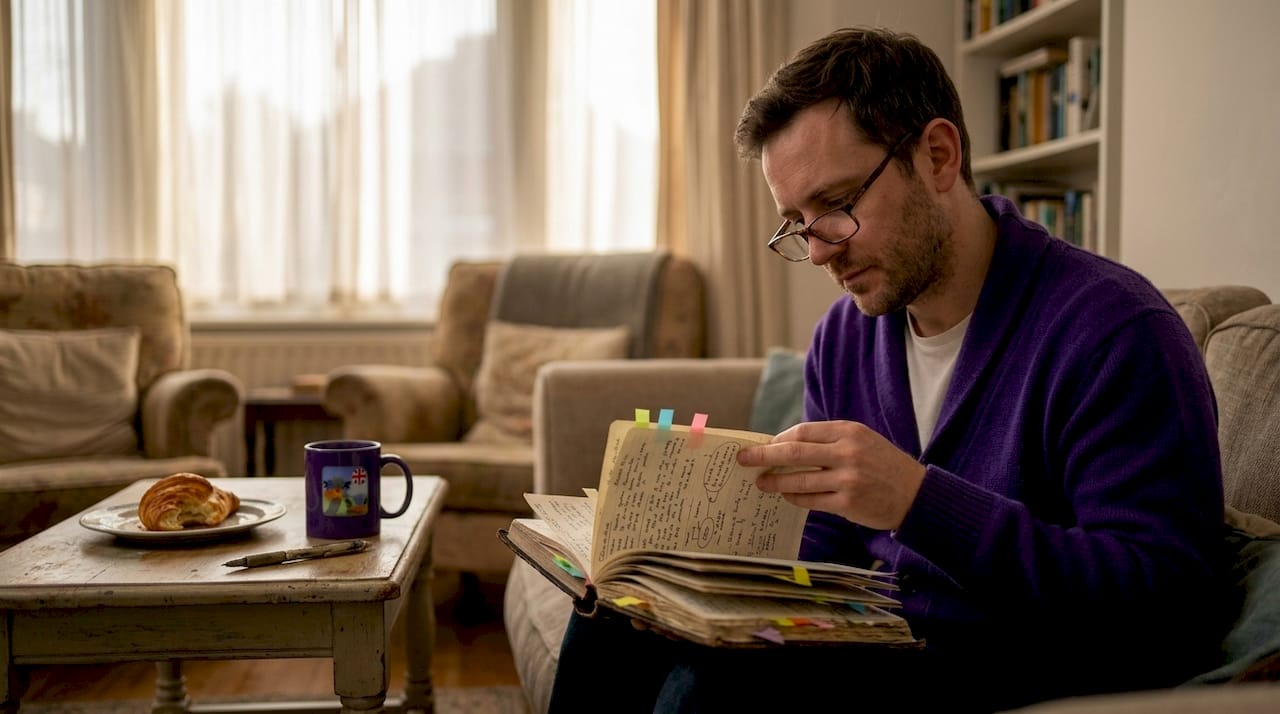
Regular handwritten note-taking sharpens questions over time and helps writers identify confusion earlier, before it becomes a creative block. When you return to a page you wrote two weeks ago, you bring new context. You see connections you missed. You find the question buried inside what you thought was an answer.
Nature journaling offers a striking example of this in action. Researchers have found that long-term journaling leads to more sophisticated sensemaking over time. Students who kept science nature journals didn't just record what they saw. They built mental models, revised those models, and grew more nuanced in their understanding with each entry. Creatives and students can apply the same principle.
Here's a practical four-step approach to building an iterative notebook practice:
- Write without judgment first. When ideas arrive, capture them raw. No editing, no second-guessing. This is your idea deposit.
- Leave space for re-entry. Write on one side of the page only, or leave wide margins so future-you has room to respond.
- Schedule return visits. Set a weekly ritual to re-read the last seven days of entries with fresh eyes.
- Track evolution consciously. Note when an idea shifts. Write "Update:" and document how your thinking changed and why.
Iterative revisiting and revision in notebooks are central to creative growth. The notebook becomes a conversation with yourself stretched across time, and that conversation is where your best work often begins.
Pro Tip: Use reflective journaling prompts like "What surprised me about this idea?" or "What am I still confused about?" These questions unlock the kind of honest thinking that transforms raw material into real creative work.
Practical ways to use notebooks for ideas every day
Knowing notebooks are powerful is one thing. Using them well is another. The good news is that the most effective creative notebook habits are also the most accessible.
Combining writing with visual thinking is one of the highest-impact moves you can make. Drawing and mind-mapping in notebooks expose knowledge gaps and boost recall better than writing alone. When you map out a concept visually, you reveal the edges of what you actually understand. That's where the interesting work lives.
Practical methods that work well for both creatives and students include:
- Story-driven journaling: Instead of listing ideas, write them as scenes. Give your concept a character who faces a problem. This approach, which you can explore more through story-driven journaling, forces you to think through implications and emotional logic.
- Notebook prompts for creativity: Questions like "What does this idea want to become?" or "Who would hate this and why?" break through surface-level thinking.
- Divided sections: Keep a rapid capture zone at the front for raw ideas and a slower, reflective zone at the back for developed thinking. This mirrors how creativity actually works, which moves between expansion and refinement.
- Coloring and visual journaling: Especially for artists and students processing emotion, coloring book journaling combines tactile engagement with self-reflection in a way that pure writing cannot.
Daily creative writing practice improves divergent thinking, vocabulary, and imaginative capacity. A notebook is the natural home for that practice.
Notebooks versus digital tools for creative thinking
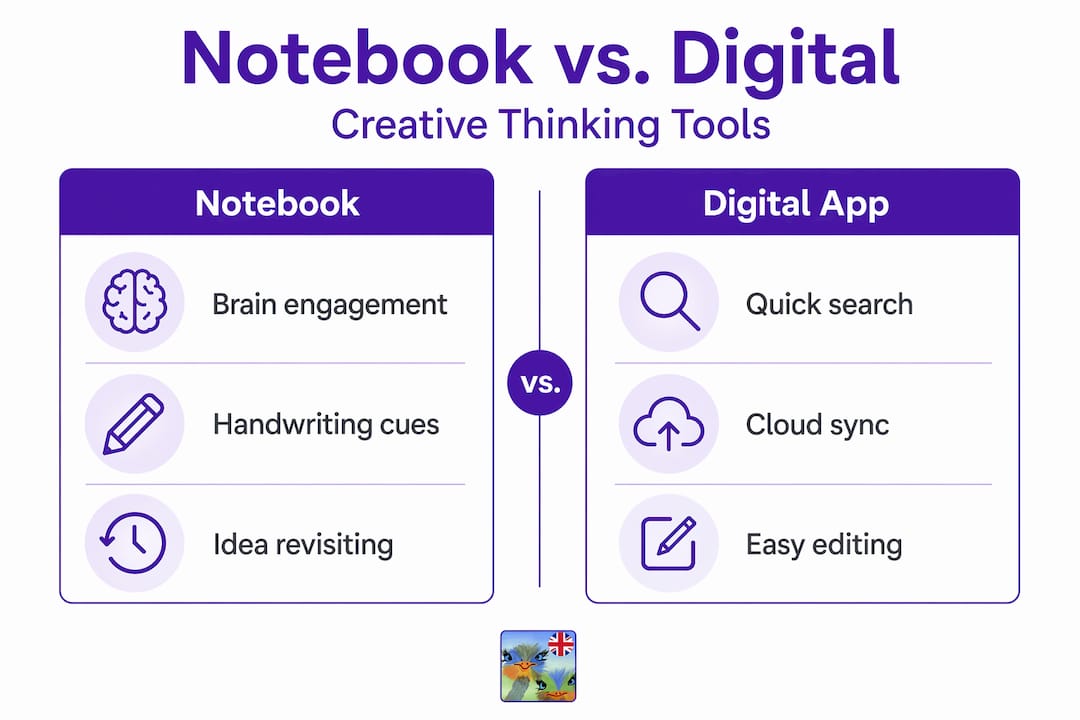
This isn't about rejecting technology. It's about knowing which tool does which job. Digital tools are fast, searchable, and easy to share. They're genuinely useful for collaboration, publishing, and organizing finished work. But when it comes to generating and deepening original ideas, they have real limitations.
| Feature | Physical notebook | Digital note app |
|---|---|---|
| Brain engagement | High, multi-network activation | Lower, primarily visual processing |
| Pace of thinking | Deliberately slow, promotes reflection | Fast, promotes transcription |
| Sensory engagement | Tactile, kinesthetic, personalized | Uniform, screen-dependent |
| Idea quality filter | Built-in through selective writing | Absent, everything gets recorded equally |
| Revisiting experience | Physical texture supports memory cues | Scrollable but cognitively flat |
| Creativity support | Strong, especially for ideation | Better suited for organizing existing ideas |
The tactile experience of a physical notebook is not a trivial factor. The texture of the paper, the resistance of the pen, the visual weight of your own handwriting on a page. These sensory inputs create memory anchors that a screen cannot replicate. When you flip back through a physical notebook, you remember not just the idea but the moment and the mood in which you wrote it. That context is creative fuel.
How to design a notebook habit that actually sticks
Most people abandon notebook habits not because they lack discipline but because they haven't designed the practice thoughtfully. A notebook you pick up once and abandon creates zero creative value. A notebook you return to consistently becomes one of the most powerful creative thinking tools you own.
Start with a low-commitment daily routine. Even five minutes of freewriting in the morning, before you check your phone, sets a creative tone for the day. The goal isn't volume. It's contact. Regular, brief contact with your notebook matters more than occasional marathon sessions.
Effective notebook workflows separate rapid idea generation from slower reflective sections. Give each function its own physical space in the notebook. Front section for fast capture, back section for considered revision. This design prevents your notebook from becoming a pile of unprocessed fragments.
Design prompts directly into the notebook. Write questions at the top of pages before you need them. "What am I avoiding thinking about?" or "What model am I building here?" These kinds of re-entry prompts, which are backed by sensemaking research in journaling, turn a blank page into an invitation rather than a pressure.
Pro Tip: Number your pages and keep a simple index in the first two pages. When you can find an idea again in thirty seconds, you're far more likely to build on it rather than lose it in the back pages.
My honest take on notebooks and why they changed how I create
I've spent years watching creative people set up elaborate digital systems and then quietly abandon them for a battered notebook. I've done it myself. And I think I understand why now.
A notebook doesn't ask anything of you. It doesn't notify you. It doesn't need to sync. It holds whatever you give it without judgment, and it waits. That quality. It's not just convenient. It's psychologically freeing in a way that unlocks a different kind of thinking.
What I've found is that the real value isn't in the writing. It's in the returning. The notebooks I've learned the most from are the ones I've re-read. The ideas I thought were half-baked turned out to be seeds. The confusion I documented became clarity once I had more context.
I genuinely believe that in a world pushing everything toward speed and efficiency, the slow practice of handwriting in a notebook is one of the few remaining places where creativity can breathe. Not because it's old-fashioned. Because it's honest. Your handwriting is your thinking, unmediated. And creative work, at its core, needs that.
If you're a student or a creative who's tried and abandoned notebooks before, my take is this: the notebook wasn't the problem. The habit design was. Build the structure, use the prompts, and go back. That's where the growth lives.
— Mark
Find notebooks worth writing in from Munkterproducts
If reading this has made you want to reach for a notebook, that instinct is exactly right. But not all notebooks are created equal, and the quality of your creative companion matters.

Munkterproducts offers a thoughtfully curated range of handcrafted notebooks, planners, and self-help journals designed with creative individuals and students in mind. These aren't mass-produced filler pages. They're built to support the kind of intentional, reflective, and iterative writing this article is about. From journals with structured prompts to open-format notebooks that give your ideas room to breathe, there's something for every creative workflow. Browse the full collection at Munkterproducts and find the notebook that fits the work you're ready to do. You can also explore unique notebooks for creative expression to see which styles best match your creative practice.
FAQ
What is the role of notebooks for creativity?
Notebooks support creativity by providing a physical space for brainstorming, reflection, and iterative idea development. Handwriting in notebooks activates multiple brain networks simultaneously, which deepens cognitive processing and generates higher-quality creative ideas than typing alone.
Why is handwriting better than typing for creative thinking?
Handwriting forces deeper cognitive processing than typing by engaging motor, language, and attention systems together, while also slowing your pace enough to filter and select ideas deliberately. Typing tends to produce passive transcription rather than active creative engagement.
How do you use notebook prompts for creativity?
Write open-ended questions at the top of pages before your session, such as "What is this idea trying to become?" or "What changed since I last thought about this?" These prompts invite re-entry and push your thinking past the obvious surface-level response.
Can notebooks really help students become more creative?
Yes. Daily creative writing practice measurably improves divergent thinking, vocabulary, and imaginative capacity in students. A physical notebook used consistently for writing, sketching, and reflection is one of the most accessible creative thinking tools available.
How often should you write in a notebook to see creative benefits?
Even five minutes of daily handwriting creates meaningful results over time. Consistency matters more than session length, and regular use sharpens questions and clarifies creative thinking in ways that irregular bursts of writing cannot replicate.