
TL;DR:
- Creative activities at home reduce stress, induce flow, and improve emotional well-being for people of all ages. Regular engagement in arts, journaling, or puzzles supports mental health, enhances learning, and builds resilience through measurable brain and body effects. Creating a dedicated, clutter-free space helps establish sustainable creative routines that are essential for long-term personal growth.
Creative activities at home aren't just enjoyable ways to pass time. Research consistently shows they reduce stress and anxiety by lowering cortisol levels and inducing flow states, which are those deeply satisfying moments when you're completely absorbed in what you're doing. Whether you're a parent hunting for meaningful projects for your kids or an adult who hasn't picked up a coloring book since childhood, the science is clear: creativity belongs to everyone, not just artists. This article walks through the evidence, breaks down practical starting points, and shows you how simple creative habits can genuinely transform your well-being at home.
Table of Contents
- The science behind creativity at home
- Why creative play matters for children
- Creative hobbies for adults: More than just a pastime
- Setting up your creative space at home
- What most guides miss: The underestimated power of at-home creativity
- Explore creative solutions for your home
- Frequently asked questions
Key Takeaways
| Point | Details |
|---|---|
| Creativity lowers stress | Home activities like art-making reduce stress hormones and anxiety, benefiting adults and kids. |
| DIY fosters growth | Self-directed creative play builds deeper learning, agency, and problem-solving skills in children. |
| Hobbies boost health | Coloring, journaling, and puzzles are tied to improved mental health, happiness, and cognitive function. |
| Environment matters | Setting up a dedicated creative space enhances accessibility and helps balance work-life boundaries. |
| Routine is key | Making creative activities a regular part of daily life delivers lasting well-being and resilience. |
The science behind creativity at home
Most people assume creativity is a personality trait you either have or don't. That belief stops a lot of people from ever trying. The reality is that creative activities work on your brain and body in measurable ways, regardless of whether you consider yourself artistic.
Research shows that just 45 minutes of art-making reduced cortisol levels in participants, and more than 80% of arts-based interventions studied demonstrated significant stress reduction. Cortisol is your primary stress hormone, and when it stays elevated over time, it damages your sleep, immune system, and mood. Bringing it down through something as simple as coloring or journaling is a genuinely powerful health tool.
"Creative activities at home are low-cost, accessible tools complementing therapy, promoting resilience via flow and expression."
The concept of "flow" is central to why these activities work so well. Flow is a state of focused engagement where time seems to disappear. You've probably felt it while assembling a puzzle or filling in an intricate coloring pattern. During flow, the brain's default mode network quiets down, which is the part responsible for rumination, self-criticism, and anxiety. The effect is almost meditative, and you don't need years of practice to reach it.
What the numbers actually say
| Creative activity | Documented benefit | Evidence level |
|---|---|---|
| Art-making (general) | Reduces cortisol in 45 minutes | Clinical study |
| Coloring and drawing | Induces flow, reduces anxiety | Multiple studies |
| Journaling | Improves emotional processing | Well-established |
| Puzzles | Lowers dementia risk, boosts memory | Large population data |
| Craft hobbies | Higher happiness and life satisfaction | 90,000+ older adults |
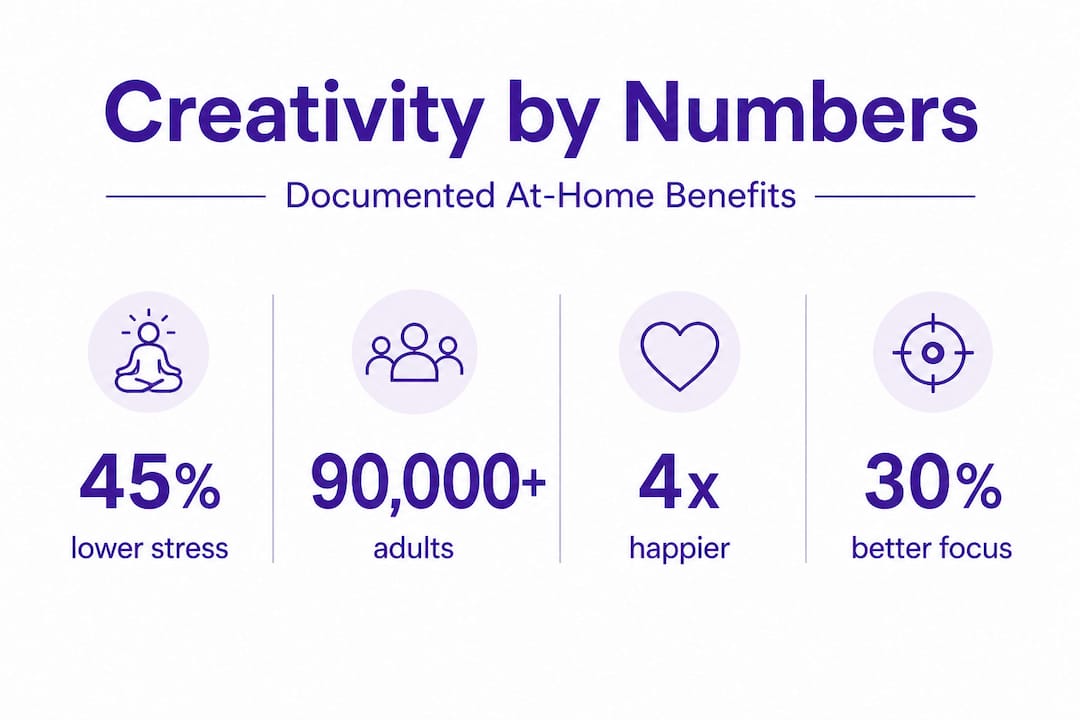
A massive study tracking over 90,000 older adults found that hobby engagement was directly linked to higher levels of health, happiness, and significantly lower dementia risk. That's not a small sample or a short-term finding. It's decades of evidence pointing toward something most of us have access to right now, sitting in our own homes.
The benefits of adult activity books connect to this evidence base directly. Word searches, coloring pages, and structured journaling prompts all activate the same brain pathways that larger studies have documented. Creativity doesn't require an art degree or expensive materials to deliver real results.
Why creative play matters for children
While creativity boosts adults' well-being, its impact on children is uniquely powerful. Kids are still building the cognitive frameworks they'll use for the rest of their lives, and creative play actively shapes those frameworks in ways that passive screen time simply cannot match.
The key difference between DIY creative play and passive creative consumption comes down to agency. When a child watches someone else draw or craft, they observe. When they do it themselves, they predict, experiment, correct, and learn. Research shows that prediction generation in DIY tasks led to deeper conceptual learning compared to simple observation. The child who guesses what will happen when they mix colors learns more than the child who watches someone else do the mixing.
A 2025 study published in nature reinforced this, finding that self-directed activities enhance agency and produce stronger learning outcomes than passive alternatives. Agency, in developmental terms, is the sense that your actions matter and produce real results. Children who regularly experience that feeling through creative play grow into more confident, adaptable problem-solvers.
DIY vs. passive creative activities for kids
| Activity type | Child's role | Learning outcome | Confidence impact |
|---|---|---|---|
| DIY drawing or crafting | Active creator | Deep, exploratory | High |
| Following a coloring prompt | Semi-active | Structured, focused | Moderate to high |
| Watching creative videos | Passive observer | Surface, observational | Low |
| Activity books with prompts | Active participant | Guided and creative | High |
Here are some high-impact creative activities that work beautifully for kids at home:
- Storytelling with illustration: Have children draw scenes from a story they invent, then narrate it back to you. This builds language, sequencing, and spatial reasoning at once.
- Prediction-based crafts: Before starting a project, ask "What do you think will happen?" This small habit dramatically increases how much they retain.
- Activity books with varied formats: Mixing word puzzles, drawing prompts, and mazes keeps engagement high while working different skills.
- Seasonal themed projects: Holiday and themed activity books give context to creative tasks, which helps younger children stay focused.
Pro Tip: Before starting any craft or activity book page, ask your child to predict the outcome or tell you what they think the finished picture will look like. This single habit, backed by research on children's creativity, measurably deepens what kids take away from the activity.
If you're looking for structured starting points, children's journals for creativity offer prompts that guide without restricting. The right journal gives a child just enough structure to feel confident and just enough freedom to genuinely explore. You can also use an activity book checklist to make sure the books you choose are developmentally appropriate and genuinely engaging, not just colorful time-fillers. And if you're feeling ambitious, resources that explain how to create activity books for kids from scratch can turn a rainy afternoon into something memorable.
Creative hobbies for adults: More than just a pastime
Just as DIY play shapes a child's mind, purposeful creative hobbies are a powerhouse of support for adult well-being. The challenge for most adults is that they've internalized the idea that creativity is a luxury or a talent-based pursuit. Neither is true.
Mandala coloring is one of the most studied examples. A 2026 study published in Frontiers in Public Health found that digital mandala coloring reduced anxiety, heart rate, and skin conductance, with flow fully mediating the relationship between coloring and anxiety reduction. In plain terms: the coloring worked because it produced flow, and flow calmed the body's stress response at a physiological level. Lower heart rate. Lower skin conductance. Measurably calmer.
You don't need to start with mandalas. Any structured coloring page with repeating patterns will produce similar effects. The point is to give your brain a focused, low-stakes task that absorbs attention without demanding performance. Exploring coloring themes for relaxation can help you find the visual style that resonates with you, whether that's nature scenes, geometric patterns, or confidence-affirming illustrations.
Journaling works differently but complements coloring well. Where coloring quiets the mind, journaling organizes it. Writing about emotions, experiences, and goals forces you to externalize thoughts that otherwise loop endlessly. Regular journaling is linked to improved mental health and self-esteem in large-scale studies. A creative journaling guide can help you move beyond blank-page paralysis into prompts that actually feel meaningful to engage with.
Puzzles occupy a unique space in the adult creative hobby landscape. They're not "artistic" in the traditional sense, but they activate pattern recognition, spatial reasoning, and working memory in ways that genuinely protect cognitive health over time. For adults who feel intimidated by drawing or coloring, puzzles are a powerful entry point. Resources on the best puzzles for adults can match puzzle type and difficulty to where you're starting, so the challenge feels satisfying rather than frustrating.
Here's what consistent adult creative hobby practice looks like in practice:
- 20 to 30 minutes of coloring three to four times per week produces measurable anxiety reduction over four to six weeks.
- Daily journaling, even just five sentences, builds emotional clarity and self-awareness over time.
- Puzzle sessions of 30 to 45 minutes challenge working memory without inducing the kind of stress that undermines cognitive benefit.
- Rotating between activities keeps engagement fresh and exercises different neural pathways.
Pro Tip: Variety is your best tool. Rotating between coloring, journaling, and puzzles across the week gives you the emotional regulation benefits of flow-based tasks, the cognitive benefits of puzzle-solving, and the self-understanding benefits of reflective writing. Each fills a different gap.
Setting up your creative space at home
To fully unlock creativity, your environment matters. A cluttered, undefined space sends your brain a signal that this isn't a serious or safe place to create. A small, intentional setup sends the opposite message.
The biggest challenge for most people working and living in the same space is avoiding work-life blur. When your creative corner is two feet from your laptop and work papers, it becomes very hard to switch mental modes. Physical boundaries, even simple ones, help the brain transition between work and play.
Here's a practical setup process that works whether you have a dedicated room or just a corner of a shared space:
- Choose a consistent location. It doesn't need to be large. A small table, a corner of a bookshelf, or even a dedicated tray that you pull out each session all work. Consistency tells your brain: this is where creativity happens.
- Gather your core tools in one place. Coloring books, pencils, journals, and puzzles should live together, not scattered across different rooms. Accessibility removes friction, and friction is the enemy of habits.
- Set a physical boundary from work areas. If possible, face a different direction from your work setup. Use a small plant, a lamp, or a simple decorative item to signal that this corner has a different purpose.
- Prepare for quick starts and easy cleanup. If setup takes more than two minutes, you'll skip it on busy days. A small box, basket, or caddy that holds everything together means you can be up and creating in under a minute.
- Keep it visually inspiring, not cluttered. A few finished pages on the wall, a favorite book within reach, or a color you love in the space itself all make the area feel inviting rather than obligatory.
Pro Tip: The biggest barrier to creative habits isn't motivation—it's friction. Make your setup so easy to start that even on a tired Tuesday evening, you'll actually sit down. Two-minute rule: if you can start in two minutes, you'll start far more often.
The types of educational books for creativity you keep in your creative space matter too. Books that prompt and inspire, rather than just instruct, keep the space feeling alive. A good activity book or journal on the table is an open invitation to create, and that visual cue is more powerful than most people realize.
What most guides miss: The underestimated power of at-home creativity
Most articles about creative activities at home treat them as pleasant extras. Nice-to-haves for a slow Sunday. Something you do when there's nothing else on the schedule. That framing undersells what the evidence actually shows.
Creativity at home isn't supplemental. It's foundational. The resilience and flow benefits documented in research aren't minor mood lifts. They're the kinds of neurological and psychological changes that build a person's capacity to handle difficulty, regulate emotion, and maintain cognitive sharpness across decades. That's not a nice bonus. That's a core life skill.
Most guides focus on the fun of it, which is real and valuable, but it means they skip the deeper argument: creative activities deserve regular, protected time in your week the same way exercise does. You wouldn't say, "I'll go for a run when I have some free time." The research on creativity justifies the same commitment.
The other thing most guides miss is the distinction between doing creativity and consuming it. Watching someone else craft on a video platform is enjoyable, but it doesn't produce the same neurological benefits as making something yourself. The flow state, the cortisol reduction, the cognitive engagement: all of those require your hands and your mind to be actively involved.
The adult activity book benefits we talk about aren't marketing language. They reflect a real body of evidence that says structured creative engagement, done consistently, changes how you feel and how you think. Make it routine. Not an afterthought.
Pro Tip: Schedule your creative time the same way you schedule appointments. A 20-minute block on your calendar three times a week is enough to start building the compounding benefits that research documents over weeks and months.
Explore creative solutions for your home
Ready to bring these benefits into your daily life? The research points clearly toward one direction: pick something, start small, and be consistent. Whether that's a coloring book that speaks to your style, a journaling prompt that fits your season of life, or a puzzle that matches your current energy level, the tools matter.

At Munkter Products, you'll find a curated collection of coloring books, journals, activity books, puzzles, and novelty stationery designed for both children and adults. Every product is chosen with the understanding that creativity should be accessible, enjoyable, and genuinely beneficial. Postage is included, and the range covers everything from kids' educational activity books to adult coloring books built around confidence and self-expression. Browse what's available and find the tools that make your creative corner feel complete.
Frequently asked questions
What are the best creative activities for stress relief at home?
Art-making, coloring, journaling, and puzzles are all proven to lower stress: cortisol drops after just 45 minutes of creative activity, and mandala coloring specifically reduces anxiety through measurable physiological changes including lower heart rate.
How do DIY creative activities help children learn?
DIY activities produce deeper conceptual understanding because children predict, experiment, and self-correct rather than passively observe: prediction generation in hands-on tasks consistently outperforms observation alone, and self-directed activities enhance agency and confidence in ways passive alternatives cannot match.
Can creative hobbies improve adult mental health and cognitive function?
Yes, consistently and significantly: large-scale data from over 90,000 older adults links hobby engagement to higher happiness, stronger self-esteem, and meaningfully lower dementia risk over time.
How do I organize a creative space at home?
Choose a consistent location, keep all your tools together in one easy-to-access spot, and create a physical boundary from your work area to help your brain switch modes. Clear boundaries between work and creative spaces are the most important structural factor in making creativity a sustainable habit.