

TL;DR:
- Story-driven puzzles enhance motivation by embedding narrative context that makes players care about solving challenges. They improve cognitive retention and reasoning by anchoring puzzles within meaningful characters and themes, leading to deeper engagement and learning. Integrating story elements into puzzle design transforms exercises into immersive experiences that foster empathy, motivation, and lasting understanding.
Most people think puzzles are about logic. Put the piece in the right place, crack the code, move on. But the role of story-driven puzzles is far more sophisticated than that framing suggests. When a puzzle is wrapped in narrative, something shifts in the brain. The solver is no longer just testing spatial reasoning or pattern recognition. They are invested. They have a reason to push through. Research and game design both point to the same conclusion: story transforms puzzles from exercises into experiences, and that distinction matters enormously for educators, parents, and puzzle enthusiasts alike.
Table of Contents
- Key takeaways
- The role of story-driven puzzles defined
- Cognitive benefits of story-driven puzzles
- Story-driven vs. traditional puzzles
- Using story-driven puzzles in education
- My honest take on story and puzzle design
- Explore story-driven puzzles at Munkterproducts
- FAQ
Key takeaways
| Point | Details |
|---|---|
| Story changes motivation | Narrative context gives solvers intrinsic reasons to push through hard puzzles. |
| Cognitive gains are measurable | Story-driven puzzles improve memory, reasoning, and emotional engagement more than logic-only formats. |
| Context shapes difficulty perception | A narrative frame makes hard puzzles feel purposeful rather than frustrating. |
| Escape rooms prove the model | Teams solve narrative puzzles faster because story clarifies intent and direction. |
| Educators can apply this now | Classroom puzzles with characters and themes produce stronger learning outcomes than abstract drills. |
The role of story-driven puzzles defined
Not every puzzle with a picture on the box is a story-driven puzzle. The distinction matters. A mechanic-driven puzzle asks: Can you solve this? A story-driven puzzle asks: Why does this need to be solved? That shift in framing changes everything about how a solver engages.
Story-driven puzzles weave narrative elements directly into the puzzle structure. These elements typically include:
- Characters whose goals or fates depend on the puzzle outcome
- Themes that the puzzle mechanics metaphorically reflect
- Progression where each solved puzzle advances the story, not just a level counter
- Emotional stakes that make the solver care about the result
A strong modern example is Dream of Three Lives, which uses over 50 nonogram puzzles to piece together fragments of a protagonist's lost memories. Each puzzle you solve literally reconstructs the character's past. The mechanic and the story are the same thing. That is the gold standard of narrative puzzle integration.
Another example is Phonopolis, which builds its entire puzzle logic around sound and language themes that mirror its story about reclaiming individual voice in a homogenized society. The puzzles feel earned because they reflect what the story is about.
Jonathan Blow's Order of the Sinking Star takes this further with 1,000+ interconnected puzzles where thematic motifs like magic mirrors are not decoration but structural components of both story and gameplay.
Pro Tip: When evaluating whether a puzzle is genuinely story-driven, ask whether removing the narrative would change how you solve it. If the answer is no, the story is decorative, not integrated.
Cognitive benefits of story-driven puzzles
The case for storytelling in puzzles is not just aesthetic. There are real cognitive reasons why narrative integration produces better outcomes for learners and players.
Here is how story specifically benefits the brain during puzzle-solving:
-
Immersion improves motivation. When a solver is emotionally invested in a character or outcome, they tolerate higher difficulty. Narrative puzzles as metaphors transform hard challenges into meaningful story-driven actions that players pursue intrinsically, not just for the reward of completion.
-
Memory retention increases. Context anchors information. A puzzle solved to "save a character" or "unlock a hidden room" is more likely to be remembered than an abstract grid puzzle. The narrative becomes a retrieval cue.
-
Reasoning deepens through character. Social or "people puzzles" require solvers to understand character motivations and social constraints, pushing reasoning beyond spatial logic into genuine empathy and perspective-taking.
-
Stress decreases during play. 30 minutes of puzzling can lower cortisol levels, creating a meditative, focused state. Add a compelling story and that focus sharpens further because the solver has something to return to mentally.
-
Imagination gets activated. As Ryan Veeder observes, puzzles engage imagination by requiring players to connect narrative threads, valuing thought process over mechanical gatekeeping.
"Puzzles should advance story events naturally, often via player discoveries without forced exposition." This principle, drawn from decades of adventure game design, captures why the best story-driven puzzles feel like revelation rather than interruption.
The emotional involvement that story generates is not a soft benefit. It is the mechanism by which solvers stay engaged long enough to actually learn. That is the core argument for the importance of narrative puzzles in any educational context.
Story-driven vs. traditional puzzles

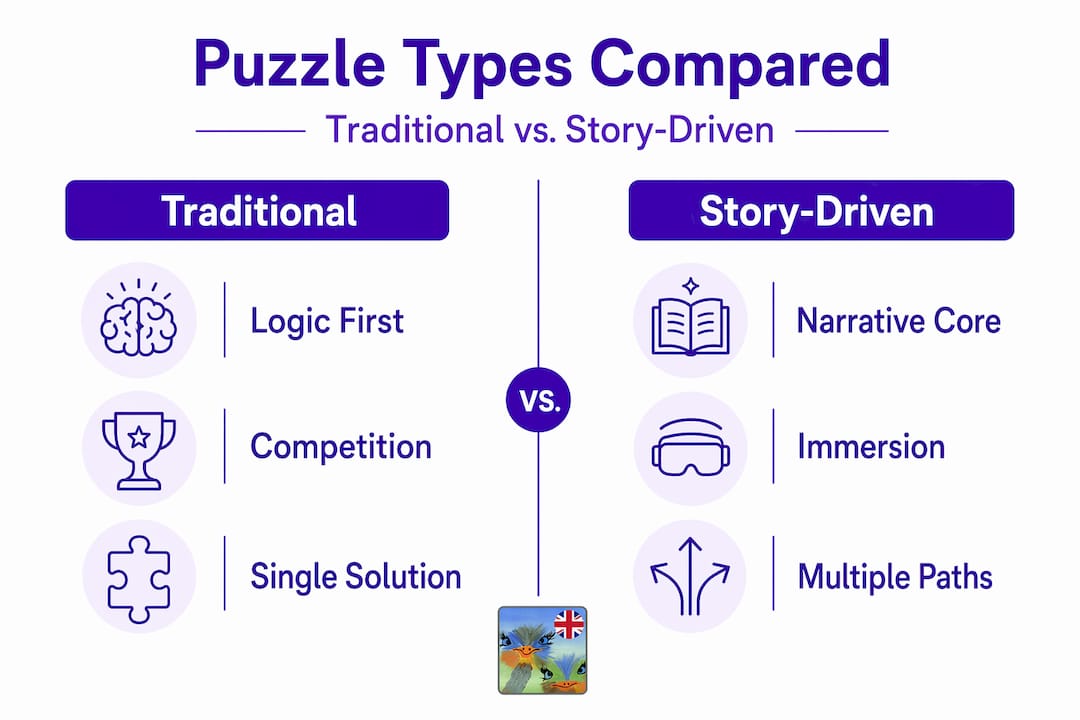
Understanding when story integration helps and when it creates friction is where the real nuance lives. Here is a direct comparison:
| Factor | Traditional puzzles | Story-driven puzzles |
|---|---|---|
| Primary motivation | Completion, competition | Emotional investment, curiosity |
| Difficulty tolerance | Lower for abstract tasks | Higher when stakes feel meaningful |
| Pacing | Fast and flexible | Can slow if exposition is heavy |
| Memory retention | Moderate | Higher due to narrative anchoring |
| Accessibility | Broad, works for all ages | Best when story is age-appropriate |
| Best use case | Skill drills, speed challenges | Deep learning, empathy development |
The honest limitation of story-driven puzzles is pacing. When narrative delivery is clumsy, it interrupts flow. Successful narrative puzzles use environmental cues and staged context rather than heavy dialog to keep immersion intact. When a designer over-explains the story through long cutscenes or text dumps before each puzzle, the mechanic suffers.
Different solver types also respond differently. Pure logic enthusiasts often prefer mechanic-driven puzzles where the rules are clean and the challenge is mathematical. Thematic players, by contrast, find abstract puzzles cold and disconnecting. Neither group is wrong. Knowing your audience changes which format to reach for.
Escape rooms are the clearest real-world proof of effective narrative-puzzle synergy. Narrative-driven escape room teams solve puzzles faster because story context clarifies intent. Participants understand why they are unlocking a box or decoding a message, which reduces trial-and-error and increases directed reasoning. The story is not just atmosphere. It is a functional aid to problem-solving.
For puzzle enthusiasts exploring how puzzle types compare across formats, the breakdown of puzzle types for adults offers a practical starting point for matching format to goal.
Using story-driven puzzles in education
Knowing the theory is one thing. Applying it in a classroom, workshop, or family learning session is another. Here is where educators and parents can make the most direct use of the research.
Effective techniques for incorporating puzzles with narrative depth into learning environments include:
- Anchor puzzles to characters students create. Let students name and describe a character before introducing the puzzle. Suddenly the maze or word search belongs to someone. Stakes appear from nothing.
- Use thematic coherence as a design principle. If your lesson is about ecosystems, the puzzle should involve animals making decisions, not abstract shapes. The theme should mirror the learning objective.
- Sequence puzzles like chapters. Each solved puzzle should reveal something new about the story or the concept. This mirrors how adventure game puzzles blend with story progression to enhance immersion without arbitrary obstacles.
- Build in collaborative puzzles. Group story puzzles require students to share information, argue interpretations, and reach consensus. That process teaches collaboration and communication alongside the content itself.
- Debrief the narrative, not just the answer. After a puzzle is solved, ask: What happened in the story? Why did the character need this? That debrief cements the learning in emotional memory.
Engaging story-driven games and books designed for children provide ready-made frameworks that educators can adapt. Parents selecting puzzle books can use a puzzle book checklist to identify which formats include genuine narrative integration versus decorative themes.
Pro Tip: The fastest way to test whether your educational puzzle has real narrative depth: ask a student to explain the story after completing it. If they can tell you what happened and why it mattered, the story worked. If they just describe the mechanic, the narrative did not land.
Puzzles that teach empathy specifically benefit from what researchers call "people puzzles." These require solvers to understand a character's motivations and constraints before a solution becomes visible. That type of reasoning is directly transferable to real social situations, which makes it one of the most powerful tools an educator can use.
My honest take on story and puzzle design
I've spent a lot of time with puzzles, books, and the people who make them. And one thing I've learned is that most narrative-puzzle failures share the same cause: the story was added after the puzzle was built.
You can feel it immediately. The puzzle works, but the story feels like wallpaper. There's no metaphorical resonance. The character exists but does nothing to change how you think about the challenge in front of you. When that happens, players notice, even if they can't name what's wrong.
What I've found actually works is building the story and the puzzle simultaneously, letting each constrain the other. The best puzzle designers I've encountered treat the narrative as a design rule, not decoration. If the story is about loss, the puzzle mechanics should involve removal, absence, or reconstruction. That coherence is what makes players feel that solving the puzzle means something.
My contrarian view: pure logic puzzles are underrated and often unfairly dismissed in educational contexts. Not every learning moment needs a story. But when you want a student to stay curious through frustration, to return to something difficult and try again, story is almost always the better tool. It creates the emotional reason to persist.
The mindset shift I've watched happen in both children and adults when puzzles connect emotionally is hard to overstate. Solvers stop asking "Am I done yet?" and start asking "What happens next?"
— Mark
Explore story-driven puzzles at Munkterproducts

If this article has you thinking about which puzzles and books actually deliver genuine narrative depth, Munkterproducts has done the curation work for you. The collection at Munkterproducts includes handcrafted puzzle books, activity collections, and storytelling-focused materials designed for both children and adults. Whether you are an educator building a classroom resource kit or a puzzle enthusiast looking for your next deeply engaging experience, the catalog spans formats from word search books with artistic themes to educational activity books built around characters and narrative progression. Every product is selected with the same principle that drives good puzzle design: the experience should mean something when you finish it.
FAQ
What makes a puzzle story-driven?
A story-driven puzzle integrates narrative elements such as characters, themes, and emotional stakes directly into the puzzle mechanics, so that solving the puzzle advances the story in a meaningful way rather than just completing a level.
How does storytelling in puzzles improve learning outcomes?
Story provides emotional context that anchors new information in memory, increases motivation to persist through difficulty, and engages social reasoning through character-based challenges, all of which deepen understanding compared to abstract drills.
Are story-driven puzzles better for children or adults?
Both age groups benefit significantly. Children gain empathy and language skills through character-driven puzzles, while adults experience increased engagement and stress reduction, especially when puzzles with narrative depth reflect personally meaningful themes.
Can educators create their own story-driven puzzles?
Yes. The most effective approach is to build the story and the puzzle structure together, using thematic coherence so the mechanics reflect the lesson's emotional or conceptual core, rather than adding a story to a pre-built puzzle after the fact.
Why do escape rooms work so well as narrative puzzles?
Escape room teams solve puzzles faster when story context is present because narrative clarifies the intent behind each challenge, reducing random trial-and-error and replacing it with directed, purposeful reasoning.