
TL;DR:
- Puzzle books are collections of mental challenges designed to entertain, educate, and exercise the mind across various skill levels. They offer diverse formats like visual, word, and logic puzzles, which promote focus, problem-solving, and cognitive development in both children and adults. The key to maximizing benefits lies in selecting age- and interest-appropriate books that encourage regular engagement and mindful, screen-free relaxation.
Most people picture a simple grid of squares or a child's maze when they hear the words "puzzle book." That picture barely scratches the surface. A puzzle book is a structured collection of mental challenges, ranging from crosswords and logic grids to hidden pictures and visual brain teasers, designed to entertain, educate, and genuinely exercise the mind. They suit toddlers building focus for the first time and adults looking for a satisfying screen-free wind-down at the end of a long day. This guide covers the types, the real cognitive benefits, and exactly how to pick the right one.
Table of Contents
- What is a puzzle book and what types does it include?
- Benefits of puzzle books for children and adults
- How puzzle difficulty and theme impact children's learning and engagement
- Choosing puzzle books for adults: styles and formats
- Tips for selecting the perfect puzzle book for your needs
- A fresh take: why puzzle books are more than just entertainment
- Explore our curated puzzle books for all ages and interests
- Frequently asked questions
Key Takeaways
| Point | Details |
|---|---|
| Puzzle categories | Puzzle books include visual, word, logic, and variety types with various difficulty levels for all ages. |
| Developmental fit matters | Choosing puzzle books that match children’s age, skills, and interests improves learning and engagement. |
| Screen-free benefits | Puzzle books offer adults a relaxing, focused alternative to digital games supporting mental wellness. |
| Practical formats | Spiral bindings and lay-flat designs make puzzle books convenient for solving anywhere. |
| Choose with purpose | Selecting puzzle books based on cognitive style and usability ensures a satisfying puzzle experience. |
What is a puzzle book and what types does it include?
A puzzle book is a printed or bound collection of puzzles organized around a theme, skill level, or puzzle category. Unlike a single game or a loose activity sheet, a puzzle book provides a sustained mental experience, giving you something to return to again and again. Think of it as a gym membership for your brain, except it fits in your bag and never closes.
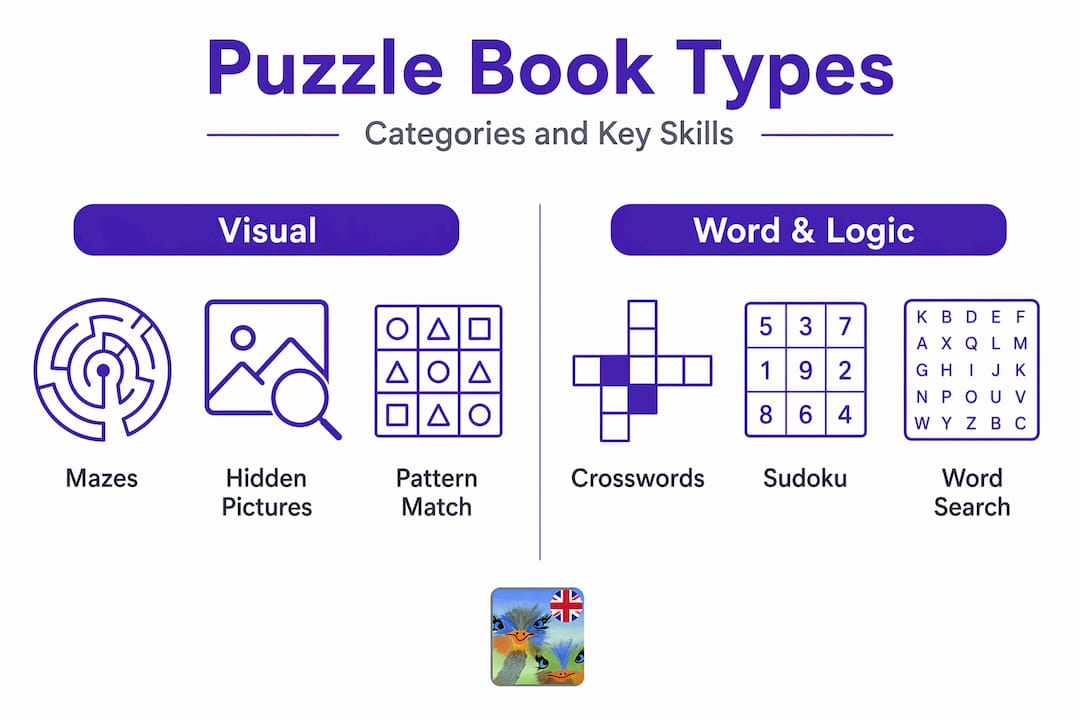
The four main categories of puzzle books break down like this:
- Visual puzzles: Mazes, spot-the-difference, hidden pictures, and pattern recognition challenges. These train spatial awareness and visual scanning.
- Word puzzles: Crosswords, word searches, anagrams, and fill-in-the-blank vocabulary games. These strengthen language skills and memory recall.
- Logic puzzles: Sudoku, number grids, deduction puzzles, and brain teasers requiring rule-based thinking. These develop reasoning and analytical skills.
- Variety books: A blend of all three categories above. These are ideal for people who enjoy switching gears mid-session.
As puzzle book categories show, most quality books also come in tiered difficulty levels, from beginner to expert, so there is genuine room to grow inside a single format.
Here is a quick comparison to help you visualize the differences:
| Puzzle type | Primary skill trained | Best suited for |
|---|---|---|
| Visual (mazes, hidden pictures) | Spatial awareness, focus | Young children, visual thinkers |
| Word (crosswords, word searches) | Vocabulary, memory | Language learners, adults |
| Logic (sudoku, deduction grids) | Reasoning, pattern deduction | Analytical minds, older children |
| Variety (mixed formats) | Broad cognitive flexibility | All ages wanting diverse challenges |
Difficulty matters just as much as category. A beginner word search uses large fonts and common words. An expert version might layer anagram clues on top of hidden words. Knowing where you sit on that spectrum before you buy saves a lot of frustration and keeps the experience enjoyable rather than defeating. You can explore best puzzle types for adults to match your personal cognitive style more precisely.
Benefits of puzzle books for children and adults
Knowing the types of puzzles is useful. Understanding why they matter is where things get genuinely interesting.

For children, the benefits go well beyond keeping them busy. Research into preschoolers shows that puzzle performance is shaped by age, difficulty level, and theme, with a child's inhibitory control (their ability to pause, focus, and resist distraction) playing a measurable role in how well they perform. This matters because it means the right puzzle book is not just entertainment; it is active developmental support.
For adults, the picture is different but equally compelling. Puzzle books serve as a low-effort, screen-free alternative to phone-based games, offering a focused mental workout without the notifications, ads, and rabbit holes that digital platforms bring. That distinction is more valuable than it sounds in an age where attention is constantly fragmented.
Core benefits across both groups include:
- Sustained focus: Completing a puzzle requires staying with a problem longer than most digital activities demand.
- Problem-solving habits: Each puzzle presents a mini-challenge with a clear solution, building a satisfying feedback loop.
- Creativity and flexible thinking: Especially true for variety books where the solver must shift mental gears between formats.
- Emotional regulation: For children especially, the experience of trying, failing, and succeeding within a manageable challenge builds patience and resilience.
- Screen-free relaxation: For adults, this is the single biggest practical draw.
Pro Tip: If you are buying a puzzle book for a child, prioritize theme over difficulty. A child who loves dinosaurs will push through a harder puzzle than one featuring shapes they find boring. Theme drives engagement, and engagement drives the learning.
For parents navigating the selection process, this guide on choosing children's books offers deeper insight into matching format and content to developmental readiness.
How puzzle difficulty and theme impact children's learning and engagement
This is where most parents make their biggest mistake. They buy a puzzle book based on age range printed on the cover and wonder why their child either breezes through it in ten minutes or gives up in frustration. Age range is a starting point, not a prescription.
Research confirms that difficulty and theme significantly affect preschoolers' puzzle performance, with inhibitory control acting as a mediating factor. Two children of the exact same age can need entirely different levels of challenge based on how well they manage their impulses and sustain attention. A child with stronger inhibitory control can tackle multi-step logic challenges earlier than peers. A child who is still developing that skill needs simpler, more rewarding formats to stay engaged.
Here is how to apply this practically when choosing puzzle books for kids:
- Observe before you buy. Watch how your child handles frustration during play. Do they try again or walk away? That tells you more than their age does.
- Match the theme to their current obsession. Vehicles, animals, fantasy characters — whatever holds their attention in other contexts will hold it here.
- Start one level easier than you think necessary. Early wins build confidence. A child who feels capable will push themselves further than one who starts with defeat.
- Look for books with graduated difficulty inside one volume. This way the child grows into the book rather than outgrowing it in a week.
- Revisit regularly. A puzzle book your child struggled with three months ago might be exactly right today. Development is not linear, but it is consistent.
Pro Tip: Inhibitory control develops fast between ages three and five. A puzzle book that felt overwhelming in January can be genuinely enjoyable by March. Keep books on the shelf rather than donating them after one try.
Pairing the right puzzle book with a broader reading approach helps enormously. The children's educational books guide covers how to build a collection that supports cognitive development at each stage, not just entertain in the moment.
Choosing puzzle books for adults: styles and formats
Adults have different stakes. You are not choosing for developmental growth (though that is a side benefit). You are choosing for enjoyment, mental challenge, and practical fit with your lifestyle. The right category matters more than the brand name on the cover.
Here is how each major puzzle type serves different cognitive preferences:
- Word puzzles develop vocabulary, language recognition, and retrieval speed. They suit people who love reading, writing, or language learning.
- Logic puzzles train deduction, systematic thinking, and rule-following. They appeal to analytical personalities who enjoy working through structured problems.
- Visual puzzles focus on spatial reasoning and pattern detection. They attract creative thinkers, artists, and people who are naturally observant.
- Variety books offer the broadest experience. They prevent boredom and force mental flexibility, which is genuinely useful for overall cognitive health.
Beyond puzzle type, physical format is worth thinking about more than most buyers do. Puzzle books targeting specific taxonomies are more impactful than brand recognition alone, but format affects day-to-day usability just as much.
| Feature | Why it matters |
|---|---|
| Spiral binding | Lays flat for easier solving, ideal for commuting or travel |
| Font size | Smaller fonts tire eyes faster; important for extended sessions |
| Paper quality | Thicker paper prevents bleed-through from pens |
| Puzzle variety within volume | Keeps sessions fresh and trains multiple skills |
| Answer key placement | Back-of-book placement avoids accidental spoilers |
Pro Tip: If you primarily solve puzzles on the couch or in bed, spiral binding is not essential. If you solve at a coffee shop table or on a train, it is genuinely worth prioritizing. Buy for how you actually live, not how you imagine you might.
For a deeper look at why adults benefit from activity books beyond the puzzle format, the adult activity books benefits article covers the research-backed case for making this a regular practice.
Tips for selecting the perfect puzzle book for your needs
By now you have a solid foundation. Here is how to translate that into an actual purchasing decision.
For adults:
- Identify your dominant cognitive interest — language, logic, or visual — and start with a book that serves that strength before branching out.
- Pick a difficulty level that challenges you within 20 minutes of starting, not immediately. Too easy breeds boredom; too hard breeds abandonment.
- Check for spiral binding and format details if you solve outside the home regularly.
- Read puzzle book reviews before purchasing, especially for niche categories like lateral thinking puzzles or cryptic crosswords, where quality varies dramatically.
- Consider where to buy puzzle books carefully. Specialty book retailers and curated online stores often offer better variety and quality control than mass-market options.
For parents buying for children:
- Prioritize theme first, then difficulty level.
- Look for books matched to your child's current developmental stage, not just their birthday.
- Choose books with clear progression so the challenge grows with the child.
- Avoid books with tiny print or cluttered layouts for younger children; visual clarity directly affects engagement.
Pro Tip: The best puzzle books for adults are not necessarily the ones with the most puzzles per dollar. They are the ones you will actually finish. A thinner book you complete beats a thick one collecting dust on the shelf.
A fresh take: why puzzle books are more than just entertainment
Here is the uncomfortable truth that most puzzle book marketing glosses over: the benefit is not in the book. It is in the habit.
A puzzle book you open once and leave on the nightstand does nothing for your brain. The cognitive benefits, the emotional regulation, the satisfying sense of progress, they all require return visits. This is actually good news, because it means you do not need to find the "perfect" puzzle book. You need to find one that makes you want to come back tomorrow.
That is a harder standard to meet than it sounds. Digital games are engineered with dopamine loops designed by teams of psychologists. A puzzle book has to earn your attention with a simpler offer: a real problem, a quiet moment, and a payoff you can feel without a notification. Puzzle books offer a screen-free alternative that genuinely engages different mental faculties and reduces digital fatigue for adults, and that is not a small claim in a world where most leisure activities are screen-based by default.
For children, the stakes are even higher. When you choose a puzzle book that matches a child's current attention capacity and interests, you are not just giving them something to do. You are teaching them that concentration is rewarding. That trying again after failure leads somewhere good. That slow, focused work produces something better than instant gratification. Those lessons do not show up on a test, but they shape how a child approaches every challenge they face later.
The benefits of adult activity books extend into this same territory: there is genuine mental health value in carving out regular time for analog, focused, low-stakes problem-solving. It is not a productivity hack. It is a practice of presence.
Choose your puzzle book the way you would choose a good book: for how it makes you feel when you are in it, not how impressive it looks on a shelf.
Explore our curated puzzle books for all ages and interests
Understanding what a puzzle book can do for your mind and your family is one thing. Finding the right one is another.

At Munkter Products, we have built a collection of puzzle and activity books for exactly the audience this article describes: parents who want more than busywork for their kids, and adults who want something genuinely engaging that does not involve a screen. Our books span word searches, activity puzzles, and themed collections across multiple skill levels, with designs that work for daily use. Postage is included, and the range is built for gift-giving as much as personal use. Browse our puzzle book collection to find the right fit for where you are right now.
Frequently asked questions
What types of puzzles are most common in puzzle books?
Puzzle books commonly include visual, word, and logic puzzles such as mazes, crosswords, and sudoku, along with variety books that blend all three into a single volume.
How do I choose the right difficulty level for a child's puzzle book?
Select based on the child's attention abilities and interest theme, not just age, since puzzle performance is influenced by inhibitory control and thematic engagement as much as by developmental stage.
Are puzzle books better than digital games for adults?
Puzzle books offer a screen-free mental workout that many adults find more focused and restorative than digital games, with no notifications or algorithm-driven distractions competing for your attention.
What features improve the usability of puzzle books on the go?
A spiral spine that lays flat is the single most practical feature for solving away from home, making puzzle books easy to use on commutes, during travel, or anywhere without a flat surface.