
TL;DR:
- Choosing the right puzzle depends on your goals, whether for mental challenge, relaxation, or social interaction. Different puzzle types train distinct cognitive skills and suit various moods, making rotation and variety key to maximizing growth. Engaging with puzzles you enjoy fosters motivation, sustained practice, and long-term benefits, regardless of their ranking in popularity.
Picking a puzzle sounds simple until you're staring at a wall of options and wondering whether you want to sharpen your logic, unwind after work, or challenge a group of friends. The choice matters more than most people realize. Different puzzle types train different parts of your brain, suit different moods, and reward different kinds of thinking. Controlled research on puzzles shows that the cognitive benefits you get depend heavily on the type of puzzle you practice, not just the act of solving in general. This guide walks you through everything you need to match the right puzzle to your goals.
Table of Contents
- How to choose the right puzzle for your goals
- Popular types of puzzles for adults
- Side-by-side comparison of adult puzzle types
- Puzzle variants and advanced challenge options
- What most guides miss about adult puzzles
- Find your next favorite puzzle
- Frequently asked questions
Key Takeaways
| Point | Details |
|---|---|
| Match puzzle to goal | Choose puzzles based on your mental, social, or relaxation objectives. |
| Explore mechanics | Trying different puzzle mechanics boosts cognitive engagement and keeps things interesting. |
| Variants deepen challenge | Advanced variants like cryptic crosswords and escape rooms add layers of skill and teamwork. |
| Scientific support | Research backs cognitive and brain health benefits from regular puzzle-solving. |
How to choose the right puzzle for your goals
Before you grab the first puzzle that catches your eye, it helps to ask one honest question: what do you actually want from this? That single question changes everything about your selection.
Intention shapes the whole experience. Experts recommend matching puzzle mechanics to your goal, whether that goal is mental exercise, relaxation, or social interaction, and then calibrating difficulty to your current skill level. Someone who wants a focused solo brain workout will get more from a logic grid or Sudoku than from a cooperative escape room. Someone who wants to connect with friends on a Friday night will find an escape room far more satisfying than a solo crossword.
Here are the main factors worth thinking through before you commit:
- Your primary goal: Are you aiming for cognitive challenge, stress relief, or group fun?
- Available time: Some puzzles, like a 1,000-piece jigsaw, reward slow, multi-session commitment. Others, like a quick word search, fit into a 20-minute break.
- Preferred mechanics: Do you enjoy working with words, numbers, spatial layouts, or physical objects?
- Difficulty appetite: Beginner puzzles build confidence. Advanced puzzles build deeper skills. Both are valid depending on where you are.
- Solo vs. social: Some puzzle types are designed for one person; others genuinely improve with multiple players.
The cognitive angle is worth understanding properly. Puzzle-based cognitive training works best when it targets specific skills through repeated practice, not just general mental activity. Crossword training, for instance, builds verbal fluency and vocabulary retrieval in ways that Sudoku simply does not. Sudoku builds pattern recognition and logical deduction in ways that crosswords do not. The puzzle type is the training program.
Reading about adult activity book benefits can also help you understand how structured puzzle formats support both relaxation and skill development at the same time.
Pro Tip: Try one puzzle from three completely different categories before committing to a regular habit. You may surprise yourself with what holds your attention longest.
Popular types of puzzles for adults
Once you know what you want, the next step is understanding what each major puzzle type actually offers. Each one has a distinct mechanic, a distinct appeal, and a distinct set of skills it trains.
The most widely recognized puzzle categories for adults include jigsaw and spatial puzzles, word puzzles, number and logic puzzles, mechanical and physical puzzles, visual puzzles, and specialty or social puzzles. Here is what makes each one tick:
-
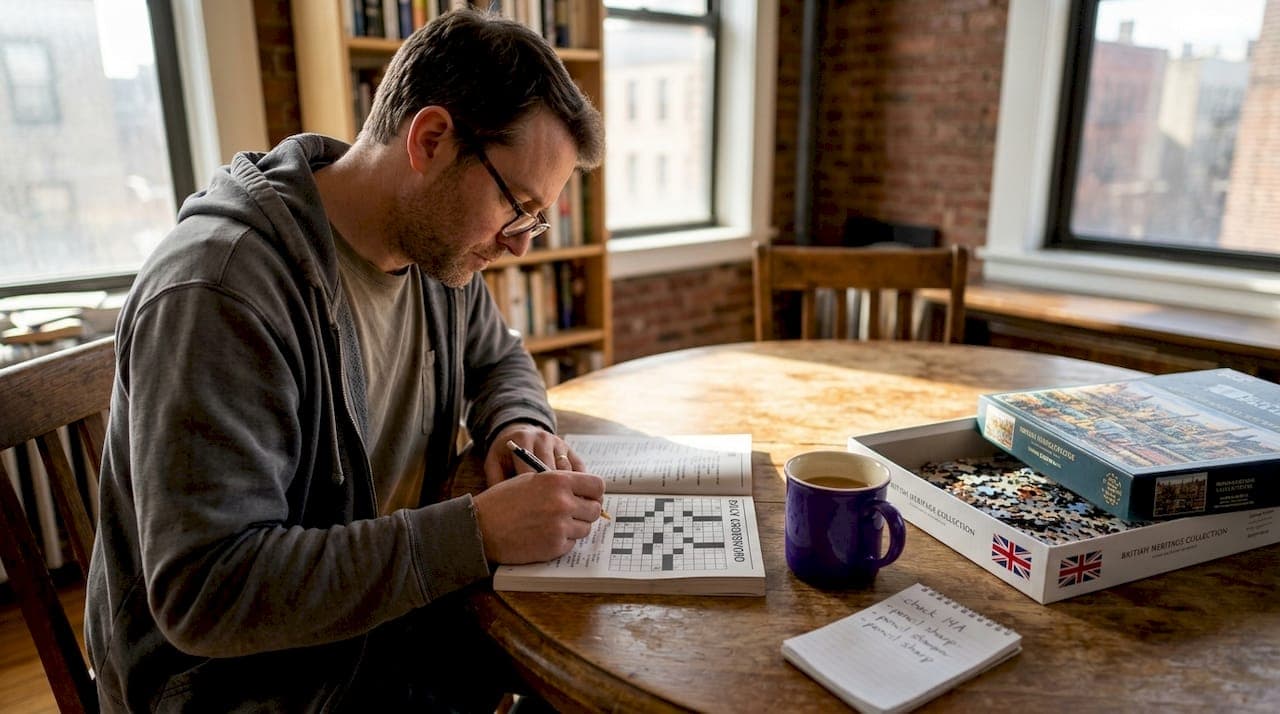
Jigsaw puzzles: You assemble hundreds or thousands of interlocking pieces into a complete image. The appeal is tactile and visual. Jigsaws train spatial awareness, patience, and pattern recognition. They are deeply satisfying for solo solvers who enjoy slow, meditative focus.
-
Word puzzles (crosswords, word searches, cryptograms): These puzzles use language as the primary material. Crosswords require you to recall words from definitions and fit them into intersecting grids. Word searches train visual scanning. Cryptograms decode substituted letters. All three build vocabulary and verbal fluency.
-
Number and logic puzzles (Sudoku, Kakuro, logic grids): Sudoku's famous 9x9 grid requires you to place digits 1 through 9 in every row, column, and box without repeating. No math is involved, only pure logical deduction. Kakuro combines number placement with arithmetic. Logic grid puzzles ask you to match variables using a series of clues. These are the heaviest cognitive workouts in the category.
-
Mechanical and physical puzzles (Rubik's Cube, interlocking rings, puzzle boxes): These puzzles exist in three dimensions. You manipulate physical components to reach a solution. The Rubik's Cube, for example, requires learning a sequence of moves and spatial reasoning to solve. They build fine motor skills alongside logical thinking.
-
Visual and hidden-object puzzles (mazes, spot-the-difference, optical illusions): These puzzles challenge your perception and attention to detail. Mazes train spatial navigation. Spot-the-difference games sharpen visual focus. They are accessible, low-pressure, and great for winding down.
-
Specialty and social puzzles (escape rooms, murder mysteries, cooperative board puzzles): These combine multiple puzzle types within a narrative or social framework. An escape room might include logic puzzles, hidden-object challenges, and wordplay all in one session. Murder mystery games layer deduction over storytelling. They work best with groups and reward collaboration.
Exploring personal growth with puzzles reveals how even leisure-focused puzzle formats can contribute meaningfully to skill development and self-awareness over time.
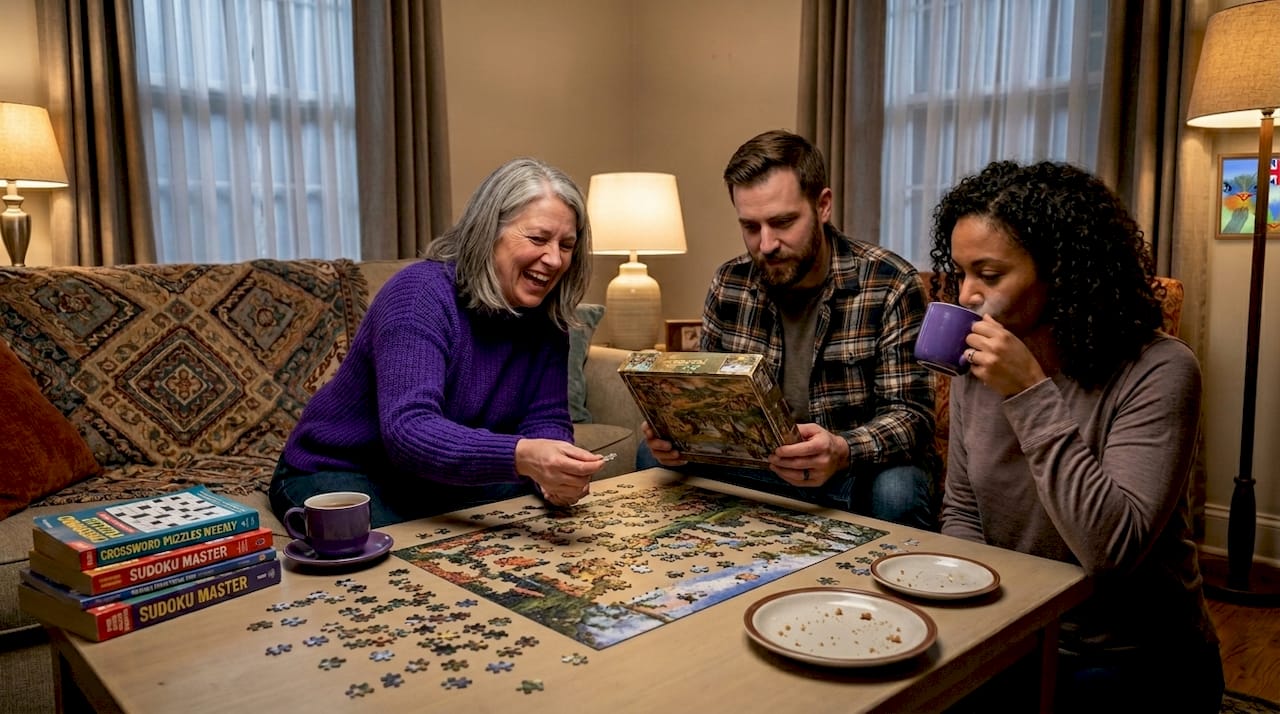
Pro Tip: Specialty puzzles like murder mysteries and escape rooms are genuinely different from solo puzzles. They train communication, negotiation, and collective reasoning, skills that a crossword simply cannot replicate.
Side-by-side comparison of adult puzzle types
Seeing the options laid out together makes it much easier to spot which type fits your current needs. The table below compares the six major categories across the factors that matter most to adult solvers.
| Puzzle type | Core mechanic | Solo or group | Skills trained | Experience level |
|---|---|---|---|---|
| Jigsaw | Spatial assembly | Solo or pair | Spatial reasoning, patience, focus | Beginner to advanced |
| Word/Crossword | Word-clue grid | Solo | Vocabulary, verbal fluency, memory | Beginner to advanced |
| Logic/Sudoku | Grid constraint | Solo | Logical deduction, pattern recognition | Beginner to advanced |
| Physical/Mechanical | Object manipulation | Solo | Spatial reasoning, motor skills, sequencing | Intermediate to advanced |
| Visual/Hidden object | Perceptual scanning | Solo or pair | Attention to detail, visual focus | Beginner |
| Specialty/Social | Multi-mechanic narrative | Group | Communication, collaboration, deduction | All levels |
One insight worth highlighting: mechanics-driven puzzle categories each train different cognitive operations repeatedly, which is exactly why experienced puzzlers often rotate between types rather than sticking to just one. A person who only solves Sudoku gets very good at logical deduction but misses the verbal fluency gains from crosswords and the spatial gains from jigsaws. Rotating your puzzle diet is not just variety for variety's sake. It is a genuinely smarter approach to cognitive training.
The table also reveals something interesting about difficulty. Visual and hidden-object puzzles are the most accessible entry point for new solvers. Physical and mechanical puzzles tend to demand more experience before they feel rewarding. Everything else scales well from beginner to advanced depending on the specific variant you choose.
Pro Tip: Try alternating your puzzle type every month. One month of Sudoku followed by one month of crosswords followed by one month of jigsaw work will give you broader cognitive benefits than any single type can provide alone.
Puzzle variants and advanced challenge options
Once you feel comfortable with the basics of any puzzle category, variants within that category open up a whole new level of challenge. This is where puzzle-solving becomes genuinely deep.
Advanced variants exist in almost every category, and they often require learning an entirely new set of rules rather than just getting faster at the old ones. Here are some of the most rewarding examples:
- Cryptic crosswords: These go far beyond standard definition-based clues. Each clue contains both a definition and a wordplay element, and you need to identify which is which.
- Advanced Sudoku (X-Sudoku, Killer Sudoku): X-Sudoku adds diagonal constraints. Killer Sudoku replaces given numbers with caged regions that must sum to specific totals. Both demand more sophisticated logical chains.
- Cooperative escape puzzles: These add time pressure and communication requirements that solo puzzles never include. Teams must divide tasks, share information, and synthesize solutions together.
- Cryptogram variants: Some use multiple substitution layers or historical cipher systems, requiring knowledge of letter frequency and linguistic patterns.
- 3D jigsaws and shaped puzzles: These remove the flat-grid assumption and require solvers to think about how pieces connect across three dimensions.
The cryptic crossword example deserves a closer look because it illustrates how dramatically a variant can change the skill set required.
"Solving cryptic crosswords requires learning specific clue mechanisms, including containers, substitutions, reversals, and hidden words, rather than relying on vocabulary alone. Each clue is a small puzzle within the larger puzzle."
Cryptic clue grammar is genuinely a separate skill from standard crossword solving. A strong standard crossword solver may struggle with cryptics at first because the entire method changes. Learning cryptic clue mechanics like containers (where one word is hidden inside another) and substitutions (where a synonym replaces a word) requires deliberate study, not just more practice of the same approach.
This is actually good news. It means that even after years of solving, there are always new layers of challenge available within familiar puzzle families. You never truly run out of room to grow.
What most guides miss about adult puzzles
Most articles about puzzle types end up ranking them. They tell you crosswords are best for vocabulary, Sudoku is best for logic, and jigsaws are best for relaxation. That framing is not wrong, but it misses the most important point entirely.
The best puzzle type for you is the one that keeps you coming back. Full stop. A Sudoku grid that sits untouched on your coffee table for three weeks is doing nothing for your brain. A word search you genuinely enjoy completing every morning is building real habits and real skills.
What we have noticed, both through experience and through the research, is that the adults who get the most out of puzzles are not the ones who found the "optimal" type. They are the ones who stayed curious. They tried a cryptic crossword after years of standard crosswords. They picked up a Rubik's Cube after a decade of jigsaws. They joined a murder mystery night after mostly solving alone.
Variety is not just a nice idea. It is the mechanism by which your brain keeps adapting. When you rotate puzzle mechanics, you keep hitting cognitive skills that your current favorite puzzle does not train. That is where the real growth happens.
Personal interest matters more than any popularity chart. If you find number puzzles tedious, forcing yourself through Sudoku because it is "good for your brain" will not produce the same benefits as genuinely engaging with a puzzle type you love. Motivation sustains practice. Practice produces results.
The puzzle benefits for relaxation angle is also worth taking seriously. Not every puzzle session needs to be a cognitive workout. Sometimes the goal is to quiet your mind, and a gentle word search or a meditative jigsaw session serves that purpose beautifully. Matching your puzzle to your mood on a given day is just as valid as matching it to a long-term cognitive goal.
Build a puzzle habit that prioritizes ongoing curiosity. Expand your skills deliberately. And resist the urge to stick with only what you already know you are good at.
Find your next favorite puzzle
Ready to put this into practice? At Munkter Products, you will find a carefully curated selection of adult puzzle books, word search collections, and activity books designed to challenge and entertain in equal measure. Whether you are drawn to artistic word searches, brain-training activity books, or creative formats that blend puzzles with self-expression, there is something here to match your goals.

The right puzzle does more than pass the time. It builds focus, sharpens language skills, and gives your brain the kind of structured challenge it genuinely enjoys. Browse the full collection and find the format that fits where you are right now, then grow from there.
Frequently asked questions
What puzzle types are best for mental exercise?
Number and logic puzzles like Sudoku and Kakuro are consistently recommended for mental exercise because they focus on reasoning, deduction, and pattern recognition rather than general knowledge.
Can solving puzzles improve brain health in adults?
Yes. Controlled studies on puzzle training have measured real changes in cognitive performance and resting-state brain connectivity in adults who completed structured puzzle programs, going well beyond anecdotal claims.
What is a cryptic crossword?
A cryptic crossword is a word puzzle where each clue contains both a definition and a wordplay element, and solving requires learning specific clue mechanics like containers, reversals, and substitutions rather than relying on vocabulary alone.
Are there social or group puzzles for adults?
Absolutely. Escape rooms and cooperative puzzles are specifically designed for group problem-solving, combining logic, communication, and collaboration in ways that solo puzzle formats cannot replicate.
Recommended
- Discover the benefits of adult activity books for relaxation
- Types of educational books that spark creativity
- Why interactive books for kids boost learning and engagement
- Unlock personal growth with educational books in 2026
- Rätsel für Erwachsene: Geist stärken, Freizeit beleben
- Chess Puzzles — Daily Tactical Training | Democratic Chess