

TL;DR:
- Themed journals provide focused prompts and structures that reduce anxiety and support consistent writing. They enhance self-awareness and stress reduction by guiding reflection on specific topics like emotions, gratitude, or dreams. By blending visual elements and flexible formats, they evolve with your needs and foster meaningful personal growth.
Most people assume journaling means staring at a blank page until something honest falls out. That assumption alone stops more people from journaling than any lack of time or discipline ever could. Understanding themed journals changes that picture completely. A themed journal, known in creative and therapeutic circles as a structured reflective journal, gives your writing a specific focus, whether that's emotions, gratitude, dreams, stories, or visual art. Instead of wandering, you work within intentional boundaries. And within those boundaries, something unexpected happens: you go deeper, not shallower.
Table of Contents
- Key takeaways
- What themed journals are and the varieties available
- The psychological and creative benefits of journaling with themes
- How to create your own themed journals
- Real examples that show what themed journals can do
- My honest take on themed journaling
- Find the right journal to match your practice
- FAQ
Key takeaways
| Point | Details |
|---|---|
| Themes reduce blank page anxiety | Theme prompts provide direction that removes the hesitation most journalers feel before writing. |
| Structure supports creativity | Page templates and zones reduce decision fatigue, making it easier to show up consistently. |
| Two types of journaling exist | Separating processing journals from archival ones makes practice more manageable and effective. |
| Themes can match any goal | From emotional release to creative writing, themed journals adapt to your current need. |
| Aesthetics matter for habits | Visual layout choices support sustained practice by lowering friction on low-energy days. |
What themed journals are and the varieties available
A themed journal is any journal centered on a specific subject, intention, or creative framework. Where a general journal welcomes anything, a themed journal says: "Here, we focus on this." That focus is what makes it powerful, and what distinguishes it from the catch-all notebooks most of us abandon by February.
There are more varieties than most people realize. Here is a breakdown of the most common types:
- Gratitude journals prompt daily or weekly appreciation entries, often with structured questions to sharpen attention to positive experiences.
- Emotion journals track feelings across time, often using scales, color coding, or short narrative entries to build emotional self-awareness.
- Art journals combine drawing, painting, collage, and written reflection in the same spread, treating the page as a visual canvas.
- Dream journals capture subconscious imagery immediately after waking, building a personal catalog of recurring symbols or narratives.
- Creative writing journals use prompts, character sketches, and scene-building exercises to develop storytelling instincts.
- Coloring book journals blend coloring book journaling with reflective prompts, making the act of coloring a gateway to self-reflection.
- Story-driven journals use narrative arcs and character-based prompts to guide personal exploration through fictional or autobiographical lenses.
- Bullet and planner-inspired journals borrow from productivity systems but redirect that structure toward personal growth and self-monitoring.
| Journal Type | Core Purpose | Best For |
|---|---|---|
| Gratitude journal | Shift attention toward appreciation | Stress reduction, positive habit building |
| Emotion journal | Track and understand emotional patterns | Self-awareness, therapy support |
| Art journal | Combine visual and written expression | Visual thinkers, mixed-media creators |
| Creative writing journal | Build narrative and storytelling skills | Writers, imaginative thinkers |
| Dream journal | Record and interpret subconscious imagery | Curious minds, introspection seekers |
| Story-driven journal | Explore self through narrative structure | Anyone using fiction for self-discovery |
| Coloring book journal | Use color and art as reflective entry points | Beginners, anxiety management |
The theme you choose does not just shape what you write. It shapes how you think while writing. A gratitude journal trains your brain to scan for positive details throughout the day. An emotion journal builds the habit of naming feelings before reacting to them. That is where the real value lives.
The psychological and creative benefits of journaling with themes
The research here is more specific than most people expect. A longitudinal study found that theme-prompt journaling significantly reduces task anxiety over time by engaging a cognitive-affective-behavioral mechanism. In plain terms: writing about something specific, repeatedly, changes how your brain processes stress around that subject.
A randomized controlled trial showed that expressive writing interventions produced significant stress reduction at immediate, one-month, and three-month follow-ups. This was not casual journaling. It was structured, intentional writing with a clear emotional focus. That distinction matters.
One nuance worth understanding: writing about stress works best when you are constructing narratives about resolved experiences, not venting about ongoing ones. If you are in the middle of a difficult situation, journaling about it in an unstructured way can sometimes amplify distress rather than ease it. A themed journal gives you a frame. Instead of venting, you are analyzing, reflecting, or even fictionalizing. That shift in approach produces better outcomes.
"The act of writing itself is not therapeutic. What you do with the writing, the frame you bring to it, determines whether you grow or simply repeat your pain on paper."
Themed journaling also solves the creative block problem in a way that free-form writing cannot. Blank page friction is a real psychological barrier. When your journal already has a theme, a structure, or a prompt waiting for you, the resistance drops immediately. You do not have to decide what to write about. You already know. That small shift changes everything for people who want to journal consistently but keep stopping.
Pro Tip: Pair your written prompts with a visual element on the same page, a color swatch, a simple sketch, or a magazine cutout. Research shows that aesthetic visual structure lowers the friction of returning to your journal on days when words feel difficult.
Another benefit that does not get enough attention: journaling for release does not require you to ever reread what you wrote. The benefit comes from the writing process itself, not the archive. Knowing this removes a lot of pressure. You do not need a perfect, beautifully preserved journal. You need a space where honest writing can happen.

How to create your own themed journals
Starting a themed journal does not require any special supplies or experience. It requires a clear intention and a few structural decisions made upfront. Here is how to do it well.
1. Choose a theme that connects to your current life. Pick something you are genuinely curious about, not what you think you should journal about. Current emotions, a creative goal, a recurring dream, your reading life, a period of transition. The theme should feel relevant, not aspirational.
2. Set up page templates or zones before you start writing. This is the step most beginners skip, and it is the most important one. Repeated page templates reduce the decision fatigue that kills journaling habits. A simple two-zone page with "Today's prompt" at the top and "What I noticed" at the bottom gives you enough structure to start without overthinking.
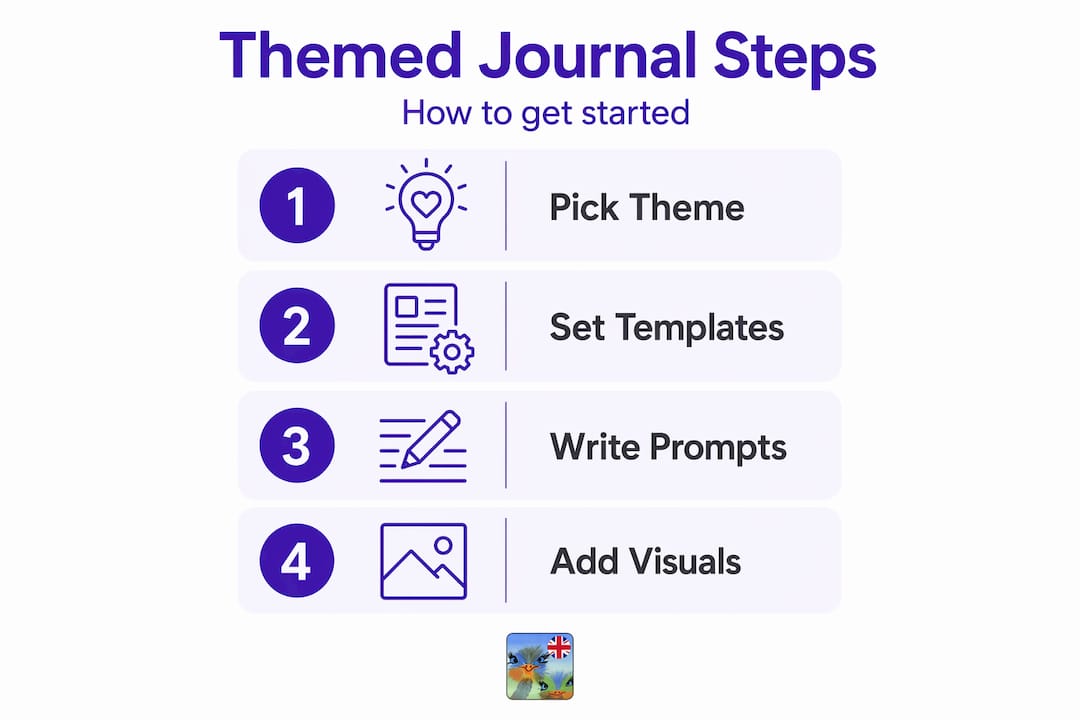
3. Write prompts in advance for at least the first two weeks. Do not rely on inspiration to generate questions. Write them ahead of time. For a creative writing journal, that might look like: "Describe a memory using only sensory details." For an emotion journal: "Name three feelings from today and trace each one back to its source."
4. Add visual elements intentionally. Stickers, washi tape, color coding, hand-drawn borders. These are not decorative extras. They make your journal feel like a space worth returning to. Experts consistently recommend combining reflective writing with visual journaling elements for sustained practice.
5. Review and evolve your theme every 30 days. Your themed journal should grow with you. At the end of each month, spend ten minutes rereading your entries and asking: Is this theme still serving me? What pattern keeps showing up? What question do I want to explore next month?
Here are some themed journal ideas to spark your next project:
- Emotions tracking across seasons or life events
- Gratitude with specific daily categories (people, moments, sensory experiences)
- Dream recording with symbols and recurring images
- Self-discovery through story prompts and character exploration (try story-driven journaling as a starting point)
- Travel memory journals with sketches and ticket stubs
- Creative writing sprints with timed prompts and character sketches
- Personal wellness tracking with mood, sleep, and energy correlation
Pro Tip: Keep two separate notebooks: one processing journal for raw emotional release that you never plan to reread, and one archival journal for entries you want to return to. Experienced journalers swear by this separation because it removes the performance pressure from writing.
Real examples that show what themed journals can do
The gap between knowing what a themed journal is and feeling inspired to start one is usually a gap in examples. So let us close it.
Consider someone who cannot write consistently in a general journal but thrives in a gratitude journal with three fixed daily questions. The theme does not limit them. It licenses them to show up without needing something important to say. That small permission changes everything.
An illustrated journal works differently. The writer begins each entry with a quick sketch, however rough, of the emotional tone of their day. The act of drawing first bypasses the analytical part of the brain, making the written reflection that follows more honest. Many people discover things through that visual-to-verbal sequence they never access through writing alone.
Prompt-based journals serve yet another function. They guide journalers through a progression from description to evaluation to reflection. Research confirms that staged writing models that move from describing what happened, to evaluating how you felt, to identifying what you want to do differently, strengthen both emotional integration and personal growth. A well-designed themed journal builds that progression into every page.
"A themed journal does not restrict your voice. It creates the conditions where your voice can actually be heard."
Here is what makes themed journals particularly worth exploring over time: they change. A journal that starts as a gratitude practice might evolve into a creative writing space six months later. The notebooks for creativity that serve you best are the ones that stay flexible enough to grow alongside you. You can shift the theme, add new zones, or combine two intentions into one journal as your needs change.
Daily prompt-based journaling builds consistency better than open-ended free writing, especially for beginners. Even a few minutes per day with a focused prompt produces measurable results in mental wellness and self-awareness over time.
My honest take on themed journaling
I have watched people start journaling with genuine excitement and abandon it within three weeks. Almost always, the same reason: they did not know what to write about. Free-form journaling demands that you arrive with something to say, every single time. That is not a sustainable ask for most people.
What I have found, both personally and in reading the research, is that themed journaling for self-discovery works precisely because it removes that demand. You do not need to arrive inspired. You need to arrive willing.
The challenge people do not talk about enough is the tension between structure and freedom. Too much structure and a journal starts to feel like a form to fill out. Too little and you are back at the blank page problem. The sweet spot is what I call bounded exploration: a theme that points the direction without dictating the destination. A prompt like "Write about a color that describes your current mood" is specific enough to start, but open enough to take you somewhere unexpected.
I also think people underestimate how much the physical journal matters. A beautiful, thoughtfully designed journal changes how you feel about sitting down to write. It signals: this practice matters. That signal is not trivial. It is often what gets you back to the page on the days when nothing else does.
The other thing I want people to hear: consistency matters more than depth. A three-minute themed entry you write every day builds something a brilliant quarterly reflection cannot.
— Mark
Find the right journal to match your practice
Ready to move from reading about themed journaling to actually doing it? Munkterproducts carries a curated selection of handcrafted journals, self-help planners, and creatively designed notebooks built specifically for the kind of intentional practice we have covered here.

Whether you are starting a gratitude practice, exploring creative writing, or looking for a visually designed space that makes showing up feel like a pleasure rather than a task, Munkterproducts has something worth exploring. Read more about handmade journals for creativity to understand how the right physical journal supports the practice you want to build. Then browse the full collection at Munkterproducts and find the journal that fits where you are right now.
FAQ
What exactly is a themed journal?
A themed journal is a structured reflective journal focused on a specific subject, intention, or creative framework rather than open-ended free writing. Common themes include gratitude, emotions, dreams, creative writing, and art.
How do themed journals differ from regular journals?
Regular journals welcome any content without direction, while themed journals use prompts, templates, or a central focus to guide writing. This structure reduces blank page anxiety and supports deeper, more consistent reflection.
Can themed journaling actually reduce stress?
Yes. A randomized controlled trial showed that structured expressive writing produced significant stress reduction at immediate, one-month, and three-month follow-ups, particularly when writing focused on processing past experiences.
How do I choose the right theme for my journal?
Pick a theme connected to something you are genuinely curious or concerned about right now, whether that is an emotion, a creative goal, or a life transition. Themes work best when they feel personally relevant, not abstractly aspirational.
Do I need to reread my journal entries to benefit from them?
No. Research shows that the writing process itself provides the benefit, regardless of whether you ever look back at what you wrote. Many effective journalers use their notebooks purely for release, never for review.