
TL;DR:
- Handmade journals activate deeper memory and emotional processing through tactile cues that digital tools lack.
- Regular expressive writing in such journals reduces stress and helps turn fragmented emotions into coherent narratives.
- The practice encourages honest, flexible self-expression without the pressure of perfection, fostering lasting mental health benefits.
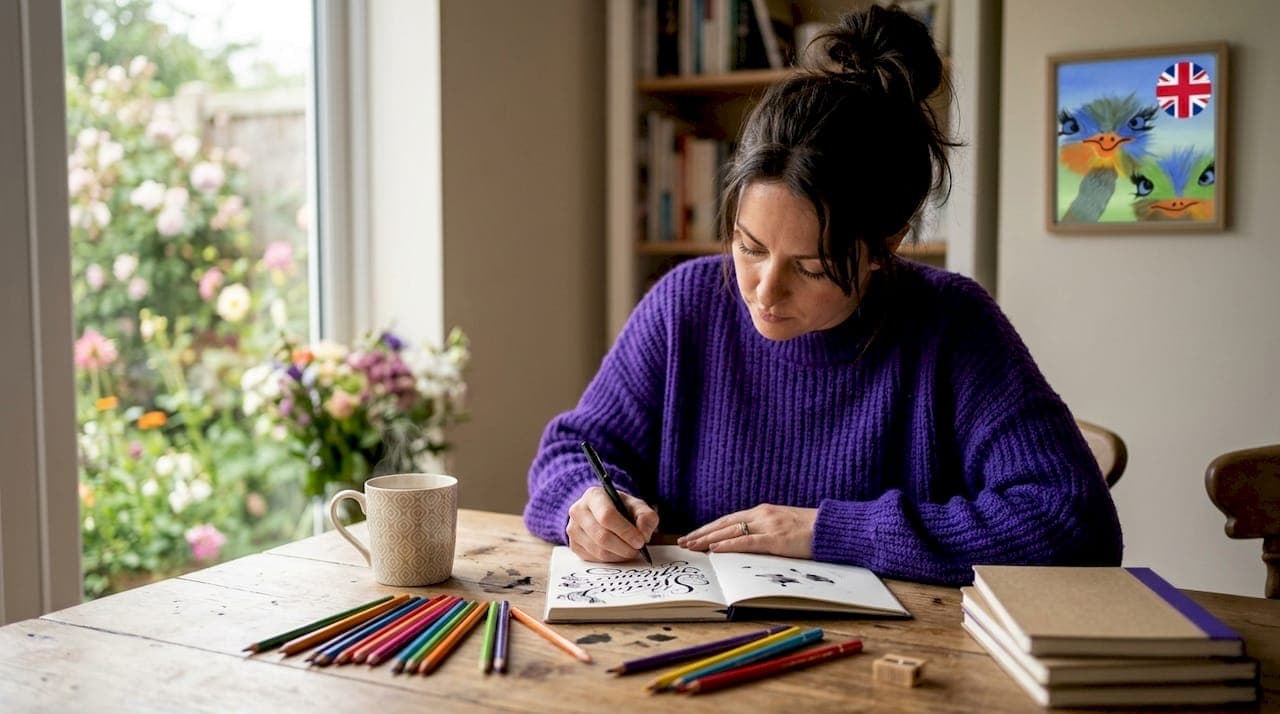
Most people assume digital apps are the smarter choice for journaling. They're searchable, always with you, and never run out of pages. But here's what that logic misses: the reason to use handmade journals has almost nothing to do with convenience, and everything to do with how your brain actually works. Research on handwriting and expressive writing therapy reveals a surprisingly strong case for putting pen to paper in a journal that feels like it was made for you. This article breaks down the science, the emotional benefits, and the practical ways to start, without any pressure to do it perfectly.
Table of Contents
- Key takeaways
- Why use handmade journals: what the brain science says
- How journaling protects your emotional health
- Releasing the pressure: there's no wrong way to do this
- Practical ways to build your handmade journal practice
- My honest take on what handmade journaling actually changes
- Start your own handmade journal practice with Munkterproducts
- FAQ
Key takeaways
| Point | Details |
|---|---|
| Paper activates deeper memory | Writing by hand on physical paper triggers stronger hippocampal engagement than typing on a screen. |
| Expressive writing reduces stress | Writing for 15 to 20 minutes across several days measurably lowers long-term stress markers. |
| No perfect method exists | Handmade journals welcome sketches, lists, and messy pages as valid forms of self-expression. |
| Tactile ritual builds consistency | The physical feel of a handmade journal acts as a reliable cue that anchors a regular writing practice. |
| Creative flexibility supports growth | Mixing writing, art, and reflection in one journal deepens both mindfulness and personal insight. |
Why use handmade journals: what the brain science says
The conversation about digital versus paper is not just about preference. It is about how differently your brain processes each experience.
A University of Tokyo study found that writing on paper produces stronger activation in the hippocampus and visual cortex compared to digital input. Those regions govern episodic memory and spatial awareness. When you write in a physical journal, your brain registers where on the page you wrote something, how the pen felt, even how much pressure you used. Those cues become retrieval anchors later. Typed notes don't carry any of that.
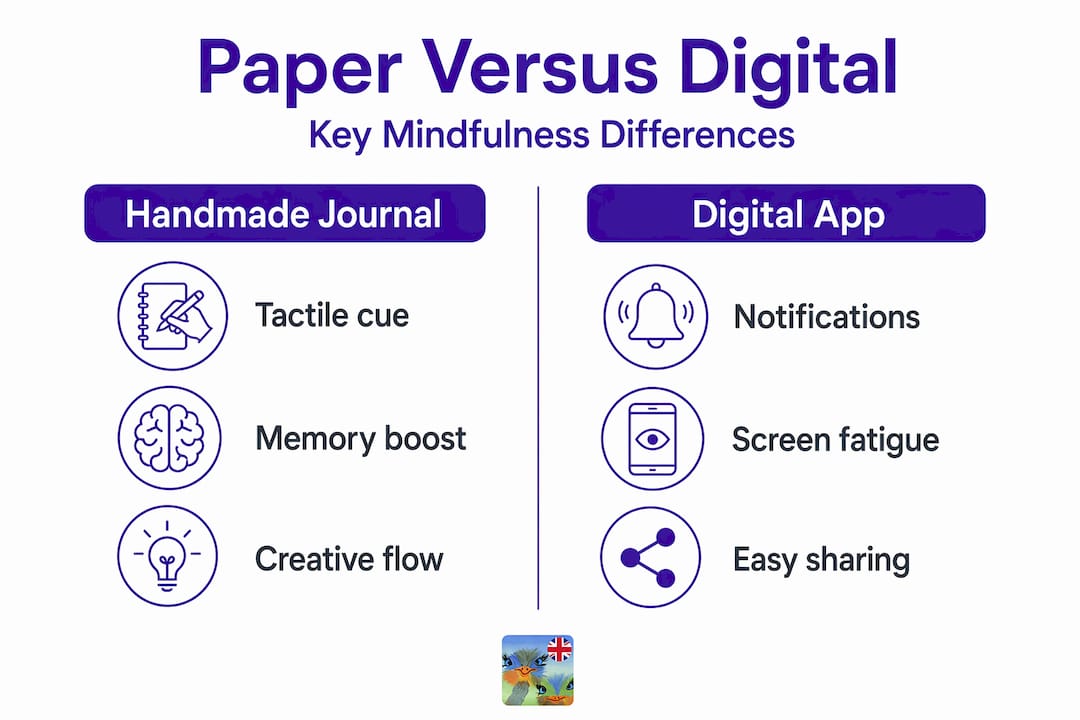
There is something else worth knowing. Digital note-taking lacks spatial cues that paper naturally provides. Scrolling through uniform text on a screen gives your brain very little to hold on to. A handwritten page has texture, position, even ink variation. These are not decorative details. They are memory scaffolding.
Here is where handmade journals take this a step further compared to generic store-bought notebooks:
- Physical uniqueness: A handmade journal looks and feels different from every other object on your desk. That distinctiveness signals to your brain that this is a special space, not a task list or a work document.
- Slower interaction: The tactile ritual of opening a handmade journal, feeling the cover, settling in before you write, creates what practitioners describe as a mindful reflective pause that generic notebooks rarely trigger.
- Deeper cognitive engagement: The slower pace of handwriting shifts the brain away from reactive thinking and into a more reflective state, which is exactly what you want for creative or emotional writing.
- Permanence: Unlike a cloud document, a handmade journal is an artifact. It doesn't disappear when a subscription expires or a device breaks.
Pro Tip: If you're new to handmade journals, use the first page for something low stakes, a single word, a doodle, or today's date. This removes the friction of the "blank first page" and signals to your brain that the journal is already in use.
How journaling protects your emotional health
Psychologist James Pennebaker spent decades studying what happens when people write about difficult experiences. His findings changed how therapists and researchers think about emotional processing.
The core protocol is simple: write 15 to 20 minutes for three to four consecutive days about something emotionally significant. No editing, no audience, no performance. Studies based on this model show measurable reductions in stress hormones, fewer doctor visits, and stronger immune responses in participants.
Why does it work? The mechanism is neurological. Difficult emotions are often stored as fragmented, sensory memories in the amygdala, the brain's alarm system. Writing forces you to construct a narrative around those fragments. That narrative structure moves the memory from amygdala-stored fragments into the hippocampus, where it becomes a coherent story rather than a trigger. You haven't erased the experience. You've just changed how your brain carries it.
Real-world evidence supports this too. In a controlled study with first-year nursing students, the group that practiced expressive writing saw their stress scores drop from 92 to 83 over three months. The control group's stress rose significantly over the same period. Same workload. Different outcome because of a writing practice.
Here is a simple framework for getting started with expressive writing in your handmade journal:
- Choose a consistent time. Morning works well for processing overnight thoughts. Evening works for winding down. What matters is regularity, not when.
- Pick one topic or emotion. You don't need to solve anything. You just need to describe it honestly.
- Write without stopping for at least 15 minutes. Don't cross things out. Don't reread as you go.
- Close the journal when you're done. This physical act signals completion and creates a mental boundary between the writing space and the rest of your day.
"You don't have to understand what you're feeling before you start writing. The writing is how you find out."
Handmade journals are especially effective for this practice because they function as consistent tactile cues that tell your nervous system it's time to slow down and reflect. The journal becomes a ritual object, not just a tool.
Releasing the pressure: there's no wrong way to do this
One of the most common reasons people avoid journaling is the fear of doing it incorrectly. This fear is not irrational. It usually comes from seeing beautifully curated journal spreads online or imagining that meaningful entries require meaningful prose.
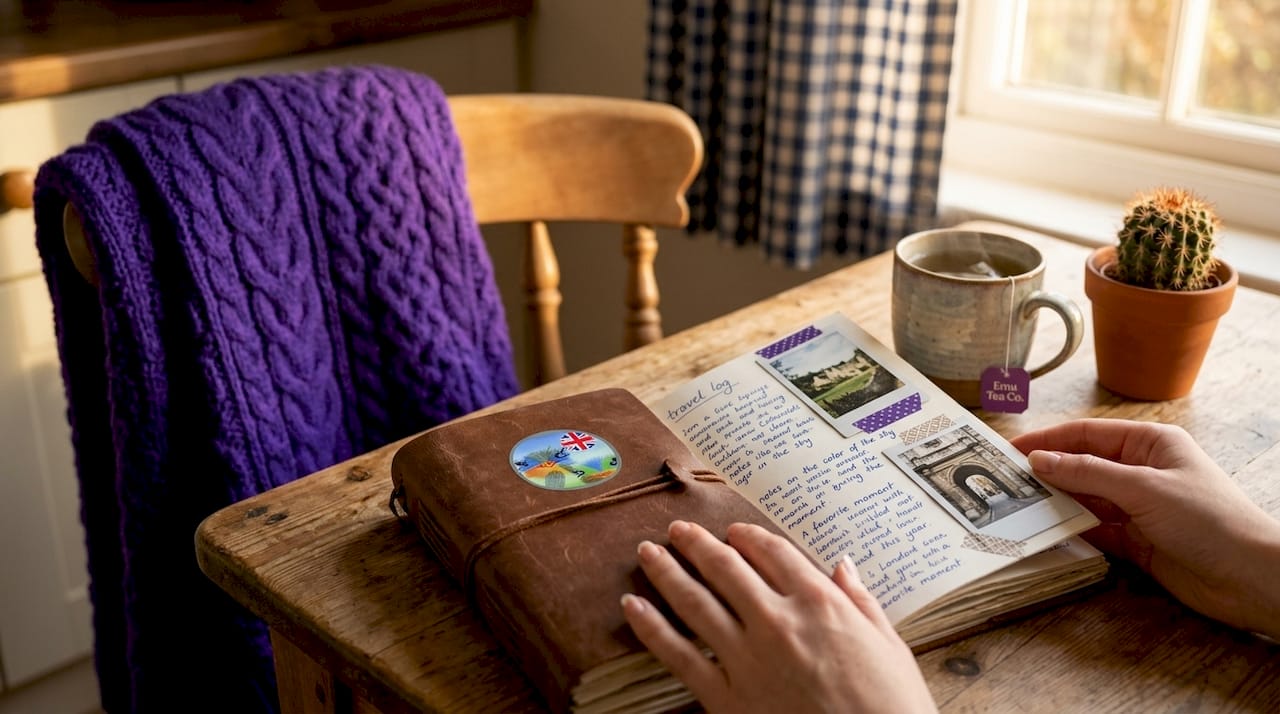
The truth is that there is no wrong way to use a handmade journal. The page doesn't judge you. A journal that holds a grocery list next to a heartfelt paragraph and a rough sketch of your coffee cup is not a failed journal. It's an honest one.
Some of the most valuable handmade journal uses have nothing to do with writing full sentences:
- Paste in a receipt, a ticket stub, or a photo and write one line about why you kept it.
- Draw a rough map of a place you visited or a room from your childhood.
- Write a list of things you noticed today, not analyzed, just noticed.
- Fill a page with a single color using whatever pens are nearby.
- Copy out a quote or a song lyric that's been living in your head.
Art journaling and mark making extend beyond writing to offer genuine mental health benefits. Mixed media practice, combining imagery and text, promotes stress reduction and creative thinking that pure text journaling sometimes misses. Your handmade journal is the ideal home for this kind of hybrid expression.
The importance of custom journals lies partly in their permission-giving nature. Because someone made it by hand, because it has weight and texture and its own personality, you feel less inclined to waste it on perfection and more inclined to fill it honestly. That psychological shift is not trivial. Imperfection and flexibility are what make a journaling habit sustainable over time.
Practical ways to build your handmade journal practice
Knowing the benefits is one thing. Knowing how to actually start and maintain the practice is another. Here are concrete approaches that work for different personalities and schedules.
Journaling styles worth trying
| Style | What it involves | Best for |
|---|---|---|
| Gratitude journaling | Three to five specific things you're grateful for each day | Building a positive focus habit |
| Memory keeping | Short descriptions of experiences with dates and sensory details | Preserving personal history |
| Art journaling | Sketches, collages, color, and mixed media alongside words | Visual thinkers and creative exploration |
| Prompt-based writing | Responding to a question or sentence starter each session | People who want structure |
| Stream of consciousness | Unfiltered, timed writing without editing or rereading | Emotional processing and mental clarity |
Whatever style fits you, the key is frequency over length. A consistent writing structure, same time, similar prompts, predictable duration, amplifies emotional processing far more than occasional long sessions.
If you're looking for a structured entry point, the book journaling approach offers a gentle framework that pairs reading with reflection in your journal, which is a natural fit for the advantages of handmade notebooks over purely digital alternatives.
For readers who love blending creativity and self-reflection, the coloring book journaling method is worth exploring too. It combines visual engagement with mindful writing in a way that honors the full range of what these journals can hold.
The lasting value of handmade journals is not just in the writing you produce. It's in the person you become through the practice. Pages accumulate. Patterns emerge. You start to see yourself more clearly, not because you had profound thoughts, but because you showed up and wrote them down.
My honest take on what handmade journaling actually changes
I'll be direct with you. I resisted handmade journals for a long time because I thought they were for people who had their inner life neatly organized. I imagined careful cursive, pressed flowers, and thoughtful weekly reflections. That wasn't me.
What changed my mind wasn't aesthetics. It was the physical act of holding something that felt like it mattered. A generic spiral notebook doesn't create that signal. A handmade journal does, at least for me. The moment I opened one and felt the texture of the cover, something settled. My brain seemed to register: this is where you go to think.
What I've learned is that the benefits of handmade journals are not passive. They don't happen just because the journal looks beautiful. They happen because the ritual of using it consistently interrupts the noise of the day. My entries are often messy, incomplete, and grammatically questionable. That's not a problem. That's the point.
The advice I find myself giving most often: don't wait until you have something important to write. Start with whatever is in your head right now. The habit is the product. The journal just makes it easier to keep showing up.
— Mark
Start your own handmade journal practice with Munkterproducts

If this article has made you want to explore what a handmade journal can do for your own creative practice and emotional well-being, Munkterproducts has a thoughtfully curated range worth browsing. From self-help journals to notebooks and planners designed for both personal reflection and creative expression, the collection at Munkterproducts is built for people who take their inner life seriously. You'll also find event journals and programs for those seeking a more customized journaling experience. Every product ships with postage included, and the catalog covers a wide range of creative and mindful formats worth exploring.
FAQ
Why use handmade journals instead of apps or digital tools?
Handmade journals activate stronger memory encoding and deeper cognitive engagement than digital devices because physical paper provides spatial and tactile cues that screens cannot replicate.
What are handmade journals good for emotionally?
Research by James Pennebaker shows that expressive writing for 15 to 20 minutes over three to four days measurably reduces stress and helps convert fragmented emotional memories into coherent narratives that are easier to process.
Do I need to be creative to use a handmade journal?
No. Handmade journals welcome any content, including lists, rough sketches, quotes, and unfinished thoughts. There is no standard your entries need to meet.
How often should I write in my handmade journal?
Consistency matters more than duration. Even five to ten minutes daily builds the habit and emotional processing benefits that research associates with regular expressive writing practice.
What makes artisanal journals different from regular notebooks?
Artisanal journals carry a tactile and visual distinctiveness that signals to the brain this is a dedicated reflective space. That psychological separation from everyday objects helps create a more mindful and focused writing state.