

TL;DR:
- Story-driven journaling uses narrative techniques to facilitate self-discovery and personal transformation.
- It involves reframing limiting beliefs and exploring life as a developing story with characters and themes.
- Advanced methods include shadow work, role-playing, and mythic mapping for deeper emotional healing and creativity.
Most people think journaling means writing down what happened today. But what if your journal could do something far more powerful? Story-driven journaling treats your life as a living narrative, one you can actively shape, revise, and reimagine. It pulls from creative writing, spiritual practice, and therapeutic technique to help you understand not just what happened, but what it means. If you have ever felt stuck in the same mental loops or wondered why certain patterns keep repeating, this approach offers a way out. This article walks you through what story-driven journaling is, how it works, its benefits, and advanced techniques worth exploring.
Table of Contents
- Defining story-driven journaling
- How story-driven journaling works
- Therapeutic and creative benefits
- Edge cases and advanced techniques
- Why story-driven journaling is more than a trend
- Find your next step: tools for story-driven journaling
- Frequently asked questions
Key Takeaways
| Point | Details |
|---|---|
| Narrative-based growth | Story-driven journaling uses personal storytelling to foster self-discovery and emotional healing. |
| Creative techniques | Prompts, character development, and role-play transform bland journaling into active self-authorship. |
| Mental health benefits | Narrative reframing helps overcome limiting beliefs and supports mental well-being. |
| Advanced approaches | Fantasy journaling and RPGs offer innovative ways to explore and rewrite your inner narratives. |
Defining story-driven journaling
Story-driven journaling is not a single, neatly packaged method. There is no single established definition in major publications. Instead, it has emerged as a variant of guided, creative, and spiritual journaling traditions, all united by one core idea: using narrative frameworks to drive self-discovery. Rather than simply logging events, you are building a story around your experiences, complete with themes, turning points, and character arcs.
This matters because the stories we tell about ourselves shape how we feel, make decisions, and relate to others. Traditional journaling captures what happened. Story-driven journaling asks why it happened, what it means, and how you want the next chapter to read.
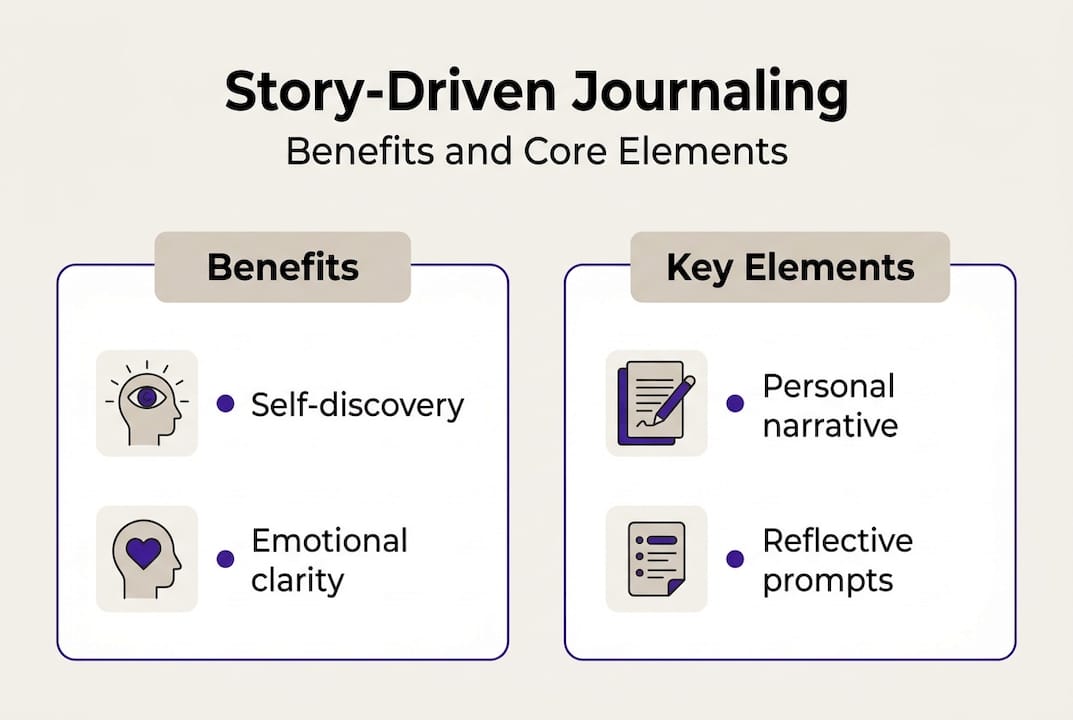
Here is how the two approaches compare:
| Feature | Traditional journaling | Story-driven journaling |
|---|---|---|
| Primary focus | Recording events | Rewriting personal narratives |
| Structure | Free-form or prompted | Narrative and intentional |
| Therapeutic depth | Mild to moderate | Moderate to deep |
| Creative engagement | Low to moderate | High |
| Goal | Reflection | Meaning-making and transformation |
The key features that define story-driven journaling include:
- Narrative intentionality: Every entry serves a larger story arc you are consciously crafting.
- Character perspective: You explore yourself and others as characters with motivations, fears, and growth trajectories.
- Reframing: Limiting beliefs and painful events are examined and rewritten with new meaning.
- Creative freedom: You can use fiction, metaphor, and imagination alongside factual reflection.
- Therapeutic grounding: The process integrates tools from narrative therapy and expressive writing.
"The most powerful stories are not the ones that happen to us, but the ones we choose to tell about what happened."
This practice sits at the intersection of books and self-improvement, drawing on the same principles that make great literature transformative. If you have ever been moved by a memoir or a novel that mirrored your own struggles, story-driven journaling invites you to become both the author and the protagonist of that kind of story. Exploring educational books for personal growth alongside your journaling practice can deepen this effect considerably.
How story-driven journaling works
Once you understand what story-driven journaling is, the next step is seeing how it works in practice. The process is more structured than free writing, but more flexible than a rigid therapy protocol. It blends prompts, creative techniques, and reflective exercises into a rhythm that suits your life.
One of the most effective entry points is the narrative prompt. These are questions designed to surface the stories you are carrying, often without realizing it. Rewriting limiting narratives using prompts like "What story have I been telling myself that no longer serves me?" is a core method in this practice. The prompt does not just invite reflection. It challenges you to identify the plot you have been living and decide whether you want to keep it.
Here is a typical sequence for a story-driven journaling session:
- Set the scene. Write a brief description of where you are emotionally right now, as if you were setting the opening of a chapter.
- Identify the narrative. What story have you been telling yourself about a current challenge or relationship?
- Question the story. Is this story true? Is it the only possible interpretation?
- Rewrite the story. Craft an alternative version that is equally plausible but more empowering.
- Develop the character. Write about yourself or someone in your life as a fully realized character with understandable motivations.
- Close with intention. End each session with a sentence about how you want the next chapter to begin.
This storytelling workflow for creativity mirrors what many writers use to develop authentic fiction. Journaling supports storytelling by brainstorming ideas and developing characters from personal insights, overcoming blocks through free writing, tracking progress, and inspiring authentic voice through role-playing different perspectives.
Here is a quick look at how specific prompts connect to outcomes:
| Prompt | Likely outcome |
|---|---|
| "What story am I telling myself?" | Surfaces unconscious limiting beliefs |
| "Who is the hero of this chapter?" | Builds agency and self-compassion |
| "What would my future self say?" | Encourages long-term thinking |
| "Rewrite this scene with a new ending" | Develops creative problem-solving |
Pro Tip: Try writing a journal entry from the perspective of your "highest self" or a mentor figure you admire. This role-play technique creates emotional distance from current problems and often unlocks insights that direct reflection misses.
Therapeutic and creative benefits
Knowing how to apply story-driven journaling methods, it is worth understanding the deeper benefits this practice brings, both emotionally and creatively. This is not just a creative exercise. It is a genuine tool for emotional health.

Unlike plot-driven fiction, story-driven journaling focuses on character-driven personal evolution and integrates therapy techniques like narrative reframing for emotional health. This distinction is important. You are not trying to write a dramatic story. You are trying to understand yourself more fully, and then grow.
The emotional and creative benefits include:
- Reduced anxiety: Externalizing internal narratives through writing creates psychological distance from overwhelming emotions.
- Improved self-awareness: Examining your life as a story helps you spot recurring patterns and themes.
- Greater resilience: Reframing painful events as part of a larger growth arc builds emotional flexibility.
- Creative confidence: Regular narrative writing strengthens your voice and imagination.
- Clarity on values: Story-driven prompts often reveal what you truly care about, beneath surface-level concerns.
- Authentic self-expression: Writing from multiple perspectives loosens rigid self-concepts.
"Narrative reframing is not about denying what happened. It is about choosing what that experience means for who you are becoming."
This practice also breaks through creative blocks in a way that staring at a blank page never will. When you are writing about your life rather than for an audience, the pressure drops. Ideas flow more freely. Many writers and artists use journaling as a warm-up precisely because it bypasses the inner critic.
Pro Tip: If you feel creatively stuck, write a journal entry where you are the villain of your own story. It sounds counterintuitive, but exploring your shadow side on paper often releases the tension that is blocking creative flow. Reading science fiction for creativity alongside your journaling practice can also spark unexpected narrative angles.
Edge cases and advanced techniques
Beyond mainstream techniques, story-driven journaling has evolved to include some genuinely surprising approaches for deep exploration and healing. These are not for everyone, but they show just how far this practice can reach.
One of the most intriguing is fantasy journaling for shadow work. Rooted in Jungian psychology, shadow work involves exploring the unconscious parts of yourself that you typically suppress or deny. Fantasy journaling uses avatars to safely explore these unconscious aspects, creating fictional characters who embody the traits you find difficult to acknowledge in yourself. It is a remarkably safe container for confronting difficult material.
Advanced methods and applications include:
- Journal RPGs (role-playing games): Solo narrative play where you write both the character and the world, often using dice or card prompts to introduce randomness and surprise.
- Spiritual narrative rewriting: Using sacred or spiritual frameworks to reinterpret traumatic experiences as part of a larger meaningful journey.
- Avatar journaling: Creating a fictional alter ego who handles situations the way you wish you could, then gradually integrating those qualities into your real self.
- Multi-perspective journaling: Writing the same event from three or more viewpoints, including people you are in conflict with.
- Mythic journaling: Mapping your life story onto archetypal myths or fairy tales to find universal meaning in personal experience.
"When you give your inner world a landscape and a cast of characters, even the darkest material becomes something you can explore rather than something that explores you."
These approaches are increasingly popular among therapists, creative coaches, and creative journaling alternatives communities. While precise adoption statistics are limited, interest in guided journaling alternatives and shadow work practices has grown sharply in wellness and creative writing spaces over the past several years. The appeal is clear: these techniques meet you exactly where you are, whether you are processing grief, chasing a creative breakthrough, or simply trying to understand yourself better.
Why story-driven journaling is more than a trend
Here is the perspective most guides skip: story-driven journaling is not popular because it is new. It is popular because it works in a way that generic journaling often does not. Writing "I feel sad today" gives you a record. Writing "The character I have been playing in this chapter is someone who shrinks to keep others comfortable, and I am ready to rewrite that role" gives you a map.
The real power is in the ritual of revision. Great authors do not publish their first drafts. Neither should you accept your first story about who you are. Storytelling for lasting impact works because meaning is not fixed. It is made, remade, and refined over time. That is not a therapy concept. It is a writing concept, and it belongs in your journal.
Most people abandon journaling because it starts to feel repetitive. Story-driven journaling solves that problem by giving every entry a narrative purpose. You are not just recording. You are authoring.
Find your next step: tools for story-driven journaling
Ready to move from understanding to practice? The right tools make a genuine difference when you are building a new creative habit.

At MunkterProducts.com, you will find handcrafted journals, self-help notebooks, and curated stationery designed for exactly this kind of intentional, creative work. Whether you are just starting out or deepening an existing practice, having a dedicated, beautiful journal changes how seriously you take the process. Pair that with a clear storytelling workflow and you have everything you need to start writing the story you actually want to live.
Frequently asked questions
How does story-driven journaling differ from traditional journaling?
Story-driven journaling centers on rewriting personal narratives with intentional, therapeutic focus, while traditional journaling typically records daily events without a narrative framework or transformative goal.
Can story-driven journaling help with emotional healing?
Yes. It uses narrative reframing for emotional health and guided prompts to address limiting beliefs and emotional blocks, making it a practical tool for personal growth alongside professional support.
What are some prompts for starting story-driven journaling?
Strong starting prompts include "What story have I been telling myself?" and "If my life is a text, what is the central theme the Universe is trying to teach me?" Both surface unconscious narratives quickly.
Are advanced techniques like fantasy journaling or journal RPGs effective?
Yes. These approaches allow safe exploration of unconscious aspects through fictional avatars and narrative play, supporting deeper self-discovery and creative growth without the pressure of direct self-confrontation.