
Science fiction offers families far more than an escape into distant galaxies and futuristic worlds. When children engage with sci-fi stories, they develop critical thinking skills, expand their imaginations, and learn to question the world around them in healthy, productive ways. These narratives present complex problems that require creative solutions, exposing young readers to scenarios that challenge conventional thinking. For families seeking meaningful shared experiences, science fiction creates natural opportunities for discussion, bonding, and collaborative learning. This article explores how sci-fi reading strengthens family connections while nurturing creativity, supporting STEM education, and building communication skills that last a lifetime.
Table of Contents
- Key takeaways
- How science fiction sparks creativity in children
- Science fiction's role in learning and STEM development
- Building family bonds through shared science fiction reading
- Choosing age-appropriate sci-fi and avoiding pitfalls
- Explore curated science fiction collections for your family
- Frequently asked questions
Key Takeaways
| Point | Details |
|---|---|
| Creativity boost | Science fiction exposes children to imaginative scenarios beyond everyday reality, encouraging flexible thinking and creative problem solving. |
| STEM learning support | Science fiction makes abstract scientific concepts tangible and supports STEM learning through inquiry and problem solving. |
| Family bonding through reading | Shared science fiction reading creates natural opportunities for discussion, bonding, and collaborative learning. |
| Parental guidance matters | Parents should ensure age appropriateness of content to support positive experiences. |
How science fiction sparks creativity in children
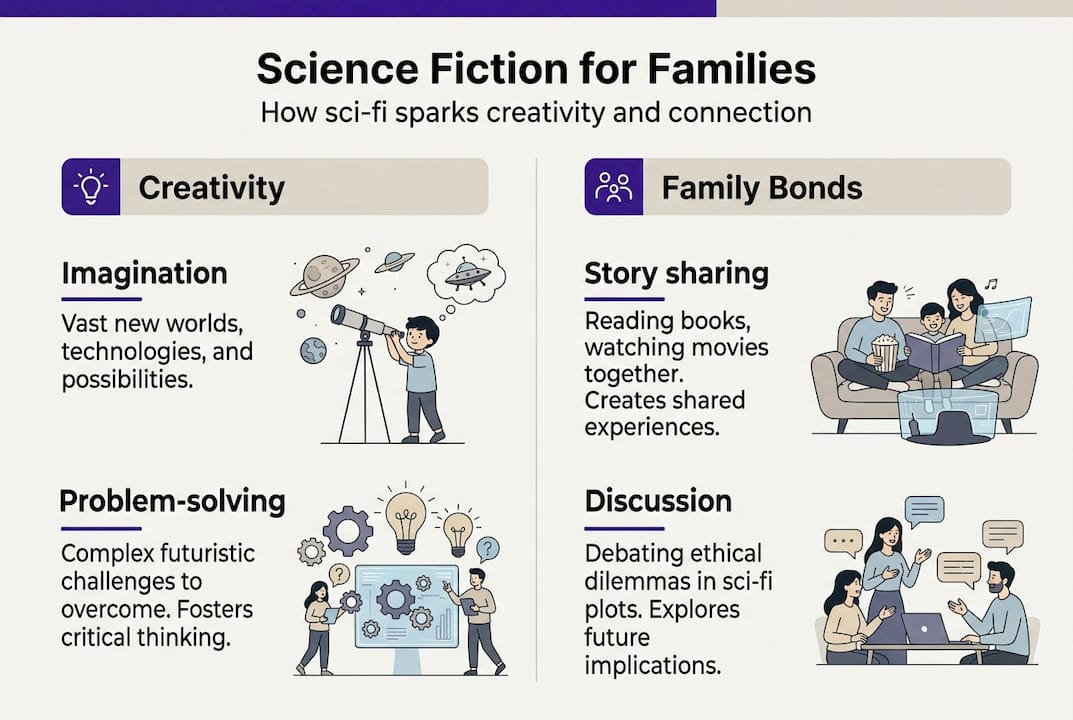
Science fiction transports children into imaginative scenarios that stretch far beyond everyday reality. These stories present alternative worlds, advanced technologies, and societies operating under different rules, encouraging young readers to envision possibilities that don't yet exist. When children encounter aliens with unique communication methods or civilizations solving problems through innovative technologies, they learn to think flexibly about challenges in their own lives.
Research confirms that sci-fi helps kids think creatively by encouraging them to explore futuristic scenarios and question established norms. This exposure develops what psychologists call divergent thinking, the ability to generate multiple solutions to open-ended problems. Children who regularly engage with science fiction demonstrate stronger skills in originality, fluency of ideas, and mental flexibility compared to peers who focus solely on realistic fiction.
The cognitive benefits extend beyond simple imagination. Studies show measurable improvements in creativity metrics like fluency and originality in middle schoolers exposed to science fiction literature. These students scored higher on assessments measuring their ability to generate novel ideas and think outside conventional frameworks. The structured yet imaginative nature of sci-fi provides a perfect balance, offering enough familiarity for children to engage while pushing boundaries enough to stimulate creative growth.
Key ways science fiction enhances creativity:
- Presents problems requiring innovative solutions that don't exist in current reality
- Introduces perspectives from non-human characters, expanding empathy and viewpoint flexibility
- Challenges assumptions about how societies, technologies, and relationships must function
- Encourages speculation about cause and effect in complex systems
Pro Tip: After finishing a sci-fi chapter, ask your child to redesign one element of the story. How would they solve the protagonist's problem differently? This simple exercise reinforces creative thinking patterns and shows children their ideas have value.
Science fiction essentially functions as a creativity gymnasium for young minds. Each story presents a new set of rules, technologies, and social structures to understand and navigate. Children learn to unlock creativity and insight by constantly adapting to new fictional frameworks, a skill that transfers directly to real-world problem solving. When faced with challenges at school or in social situations, children experienced in sci-fi thinking can more easily imagine alternative approaches and unconventional solutions.
"Science fiction is the most important literature in the history of the world, because it's the history of ideas, the history of our civilization birthing itself." – Ray Bradbury
This creative foundation serves children throughout their lives, helping them approach obstacles with curiosity rather than frustration and view limitations as temporary rather than fixed.
Science fiction's role in learning and STEM development
Science fiction excels at making abstract scientific concepts tangible and exciting for young learners. Rather than presenting dry facts about physics, biology, or engineering, sci-fi stories embed these principles within compelling narratives. Children learn about gravity while following characters navigating zero-G environments, understand ecosystems through tales of terraforming alien planets, and grasp robotics principles by engaging with artificial intelligence characters.
Research demonstrates that sci-fi promotes learning in STEM subjects through narrative engagement with scientific concepts. When children encounter science within story contexts, they retain information more effectively than through traditional instruction alone. The emotional investment in characters and plots creates memory anchors that help solidify understanding of complex principles. A child might forget a textbook definition of photosynthesis but remember forever how the protagonist survived on Mars by growing plants.
A recent study involving 110 students revealed increased curiosity and preference for science fiction materials supporting STEM learning. Students exposed to sci-fi narratives showed measurably higher interest in pursuing science-related activities and expressed greater confidence in their ability to understand scientific concepts. This confidence matters enormously, as children who believe they can learn science are far more likely to persist through challenging material.
How science fiction supports STEM development:
- Presents scientific principles through character-driven stories that maintain engagement
- Demonstrates practical applications of abstract concepts in relatable scenarios
- Normalizes scientific thinking and problem-solving as exciting rather than intimidating
- Introduces cutting-edge scientific ideas in accessible formats before formal education covers them
- Shows diverse characters succeeding in STEM fields, expanding children's sense of possibility
The storytelling workflow to boost creativity naturally incorporates scientific thinking into imaginative play. Children begin asking "what if" questions that mirror the scientific method: forming hypotheses, considering evidence, and testing ideas through imagination. This informal practice with scientific reasoning builds comfort with processes they'll later encounter in formal education.
| STEM Skill | Sci-Fi Learning Method | Real-World Application |
|---|---|---|
| Critical thinking | Analyzing plot problems and solutions | Evaluating information sources |
| Systems thinking | Understanding interconnected story elements | Recognizing cause and effect patterns |
| Hypothesis formation | Predicting story outcomes | Scientific inquiry process |
| Technical vocabulary | Learning terms through context | Confidence with specialized language |
Pro Tip: Keep a "science questions" journal while reading sci-fi with your children. When stories mention concepts like wormholes, genetic engineering, or quantum mechanics, write down questions to research together later. This transforms entertainment into active learning.
"The best science fiction stories are those that illuminate some aspect of the human condition, while also exploring the boundaries of what's possible."
Science fiction also addresses the "why should I care" question that plagues STEM education. Children see immediately how scientific knowledge enables characters to solve problems, save lives, and create better futures. This relevance makes abstract concepts feel urgent and worth understanding, transforming passive learning into active curiosity.
Building family bonds through shared science fiction reading
Shared reading creates dedicated time for families to connect without the distractions of screens, schedules, and separate activities. When families choose science fiction for these moments, they gain conversation starters that go far beyond simple plot discussion. Sci-fi stories raise questions about ethics, technology, society, and human nature that invite everyone to share perspectives and explore ideas together.
Research confirms that reading builds family cohesion by encouraging bonding, communication, and emotional development. These shared experiences create a family culture around learning and imagination. Children feel valued when parents invest time in reading together, and the discussions that follow help them develop communication skills in a low-pressure environment. Parents gain insight into how their children think, what concerns them, and how they process complex ideas.
Science fiction discussions naturally evolve beyond the story itself. A tale about first contact with aliens might spark conversations about how we treat people different from ourselves. A story about environmental collapse on another planet creates openings to discuss sustainability without lecturing. These discussions help children practice articulating thoughts, defending positions with evidence, and considering alternative viewpoints, all within the safe context of fictional scenarios.
Family shared reading creates rituals that strengthen family identity and tradition. Regular sci-fi reading sessions become anticipated events that children remember into adulthood. These rituals communicate that learning, imagination, and togetherness matter to the family. Children internalize these values and often continue the tradition with their own families.
Ways to maximize family bonding through sci-fi:
- Establish weekly sci-fi reading nights with special snacks or cozy settings
- Take turns choosing books so everyone feels ownership of the shared experience
- Act out favorite scenes together, bringing stories to life through play
- Create artwork inspired by story settings or characters
- Visit science museums or planetariums to explore concepts from recent reads
Pro Tip: Start a family sci-fi book club with simple rules. Each person shares one favorite moment and one question the story raised. Keep it relaxed and fun, not like a school assignment. The goal is connection, not analysis.
The emotional safety of discussing fictional scenarios helps children explore difficult topics. They can express fears about technology, ask questions about mortality, or discuss ethical dilemmas without feeling personally vulnerable. Parents can gauge their children's understanding and concerns while modeling thoughtful consideration of complex issues. This practice builds communication patterns that serve families well when navigating real-world challenges.
Science fiction also provides top holiday activity books for kids and year-round opportunities to extend the reading experience. Families can create their own sci-fi stories, design alien species, or build models of spaceships from their favorite books. These activities transform passive reading into active creation, deepening engagement and creating additional bonding opportunities.
Choosing age-appropriate sci-fi and avoiding pitfalls
Not all science fiction suits all ages, and families must navigate content carefully to ensure positive experiences. Older sci-fi classics, while influential and well-written, often contain sexist or racist elements that reflect the prejudices of their publication eras. Stories from the 1950s through 1980s frequently feature passive female characters, stereotyped alien races standing in for real ethnicities, and assumptions about gender roles that contradict modern values.
Parents should preview materials before sharing them with children, particularly when exploring classic sci-fi. What seemed progressive decades ago may now feel outdated or harmful. This doesn't mean avoiding older works entirely, but rather approaching them with context and discussion. Explaining that stories reflect their time periods helps children develop media literacy while still enjoying imaginative plots.
Modern science fiction offers increasingly diverse and inclusive options. Contemporary authors create stories featuring protagonists of various backgrounds, abilities, and family structures. These books present futures where diversity is normalized rather than tokenized, helping all children see themselves as potential scientists, explorers, and heroes. Publishers now actively seek stories that challenge rather than reinforce stereotypes.
Expert guidance emphasizes that parental involvement ensures age-appropriateness and relevance of sci-fi materials. Parents know their children's maturity levels, sensitivities, and interests better than any general recommendation can capture. Some eight-year-olds handle complex themes easily while some twelve-year-olds prefer gentler stories. Trusting parental judgment while staying informed about content helps families find the right fit.
| Age Range | Appropriate Themes | Themes to Avoid | Recommended Starting Points |
|---|---|---|---|
| 6-8 years | Friendly robots, space exploration, time travel | Violence, dystopia, existential dread | Picture books with sci-fi elements |
| 9-11 years | Problem-solving adventures, alien contact, invention | Graphic violence, complex politics | Middle grade series with clear heroes |
| 12-14 years | Ethical dilemmas, technology impact, social systems | Excessive darkness without hope | Young adult with balanced tone |
Practical selection strategies:
- Read reviews from multiple sources, including other parents and educators
- Check content warnings on sites like Common Sense Media for specific concerns
- Start with award winners from recent years for quality assurance
- Involve children in selection by letting them choose from pre-screened options
- Discuss concerning content when it appears rather than avoiding all challenging material
Pro Tip: Create a family sci-fi rating system. After finishing each book, rate it together on factors like excitement, scariness, and thought-provocation. This builds your personalized guide for future selections and teaches children to evaluate media critically.
The essential sci-fi reading checklist helps families navigate the vast landscape of available titles. Curated lists organized by age and theme save time while ensuring quality. These resources help families discover hidden gems beyond the most famous titles, expanding their sci-fi horizons.
Balance matters when building a sci-fi reading diet. Mix lighter adventure stories with more thoughtful pieces. Include both classic and contemporary works to show how the genre evolves. Seek stories with diverse authors and characters to provide varied perspectives. This balanced approach helps children develop sophisticated understanding of the genre while maintaining enthusiasm.
Explore curated science fiction collections for your family
Finding quality science fiction that aligns with your family's values and interests doesn't have to be overwhelming. Curated sci-fi collections offer carefully selected materials designed to inspire creativity, support learning, and create meaningful family experiences. These collections take the guesswork out of selection, providing age-appropriate options that balance entertainment with educational value. Whether you're just beginning your family's sci-fi journey or expanding an existing library, specialized resources help you discover stories that resonate with your children's interests while fostering the creativity and learning benefits discussed throughout this article.

Frequently asked questions
What age is best to start sci-fi reading with children?
Most children can begin enjoying simple science fiction concepts around ages seven to eight, when they've developed enough reading comprehension to follow more complex plots. However, every child develops differently, so adjust based on individual interest and maturity rather than strict age guidelines. Start with gentler, more imaginative tales featuring friendly robots or space exploration before introducing stories with complex ethical dilemmas or darker themes. Picture books with sci-fi elements work well for younger children, building familiarity with genre conventions before transitioning to chapter books.
How can families make sci-fi reading more engaging together?
Transform reading from passive consumption into active experience through creative extensions. Discuss plot predictions before each chapter, draw scenes or characters, or act out favorite moments together. Create activity books for kids that extend the stories through puzzles, writing prompts, or art projects. Establish rituals like weekly sci-fi book nights with special snacks or cozy reading spots. Consider starting a mini family book club where everyone shares favorite moments and questions the story raised, keeping discussions relaxed and fun rather than academic.
Are there risks with exposing children to old sci-fi stories?
Older science fiction often contains stereotypes and outdated views about gender, race, and society that can confuse or harm children if presented without context. Stories from earlier decades may feature passive female characters, problematic alien stereotypes, or assumptions about social hierarchies that contradict modern values. Parents should preview classic sci-fi before sharing it with children and choose modern, inclusive options when possible. Use the sci-fi reading checklist to find contemporary works that maintain imaginative storytelling without problematic content. When reading older classics, discuss the historical context and how perspectives have evolved.
Does science fiction work for children who struggle with reading?
Science fiction's engaging plots and imaginative scenarios often motivate reluctant readers more effectively than realistic fiction. The genre's emphasis on action, problem-solving, and visual world-building appeals to children who find traditional literature boring or difficult. Start with shorter works, graphic novels, or illustrated sci-fi to build confidence and interest. Audio books provide another excellent entry point, allowing children to enjoy complex stories while developing listening comprehension. The key is matching content to the child's interests rather than reading level, then providing support as needed to access stories they find genuinely exciting.