

TL;DR:
- Keeping a book journal helps you retain and revisit your reading insights over time. Structuring the journal with sections like a book log, quotes, reviews, and a TBR list enhances reflection and organization. Ultimately, consistency and honest, low-pressure entries foster a meaningful and enjoyable reading and journaling practice.
You finish a book that moved you deeply, set it down, and two weeks later you can barely recall the plot let alone the quote that stopped you cold on page 147. That frustration is incredibly common among readers who care about what they read. Book journaling solves this by giving you a personal record of every thought, reaction, and insight that a story sparks. This guide walks you through each step, from choosing your journal to making entries that actually stick, so your reading life becomes something you can revisit, grow from, and truly enjoy.
Table of Contents
- What you need to start book journaling
- Designing your journal layout: core sections and why they matter
- How to capture entries: low-pressure methods and creative prompts
- Maintaining engagement: make it mindful, not homework
- Our take: the surprising freedom (and boundaries) of book journaling
- Ready to start? Find the right tools for your journaling journey
- Frequently asked questions
Key Takeaways
| Point | Details |
|---|---|
| Simple setup | A few structured sections—log, reviews, quotes, and TBR—are all you need to start book journaling effectively. |
| Authentic entries | Honest, low-pressure notes help you capture real reactions and insights without making journaling a chore. |
| Mindful practice | Book journaling enhances your reading experience by making it more mindful, not by measuring speed or output. |
| Flexible expression | Adapting your journal to your style and needs makes the experience sustainable and rewarding. |
What you need to start book journaling
Before you write a single word, it helps to know why you want to keep a reading journal. Your purpose shapes everything from how elaborate your setup is to how often you sit down to write. Some readers want a simple log of what they finished. Others want a creative outlet combining sketches, color, and reflection. Some use it to track growth in their taste over time. None of these are wrong.
A practical step-by-step approach to starting a book journal involves setting a clear purpose first, then building out core sections like a book log, review pages, quotes, and a TBR list before you ever write your first entry. That sequence matters because it removes the blank-page paralysis that stops so many would-be journalers before they begin.
Your options at a glance
| Format | Best for | Cost range |
|---|---|---|
| Blank notebook | Creative, freeform writers | $5 to $25 |
| Dot-grid journal | Structured layouts with flexibility | $10 to $30 |
| Digital app (Notion, Goodreads) | Searchable, portable records | Free to $10/month |
| Printable templates | Quick start, low commitment | Free to $5 |
| Dedicated reading journal | Ready-made prompts and sections | $15 to $40 |
Once you pick a format, gather a few basics: your journal, a reliable pen, sticky tabs for marking pages in the books you're reading, and optional extras like colored markers, washi tape, or printed stickers. If you love the idea of mixing art with reflection, take a look at coloring book journaling as a way to add a visual dimension to your practice. For those who want to explore other creative journal options before committing to a single format, it's worth browsing a few styles first.
Key supplies checklist:
- A notebook or journal of your choice
- Pens in at least two colors (one for notes, one for highlights or headings)
- Page flags or sticky tabs
- A list of your recent reads to jumpstart your first entries
- Optional: washi tape, stickers, colored pencils, or highlighters
Pro Tip: Choose what feels fun, not what looks the most impressive on Instagram. A system you enjoy using twice a week will always beat the elaborate setup you abandon after day three.
Designing your journal layout: core sections and why they matter
With your materials ready, the next step is deciding how your journal will be organized for maximum benefit. A thoughtful layout means you never stare at an empty page wondering what to write. It also gives your journal long-term value as a reference you can return to months or years later.
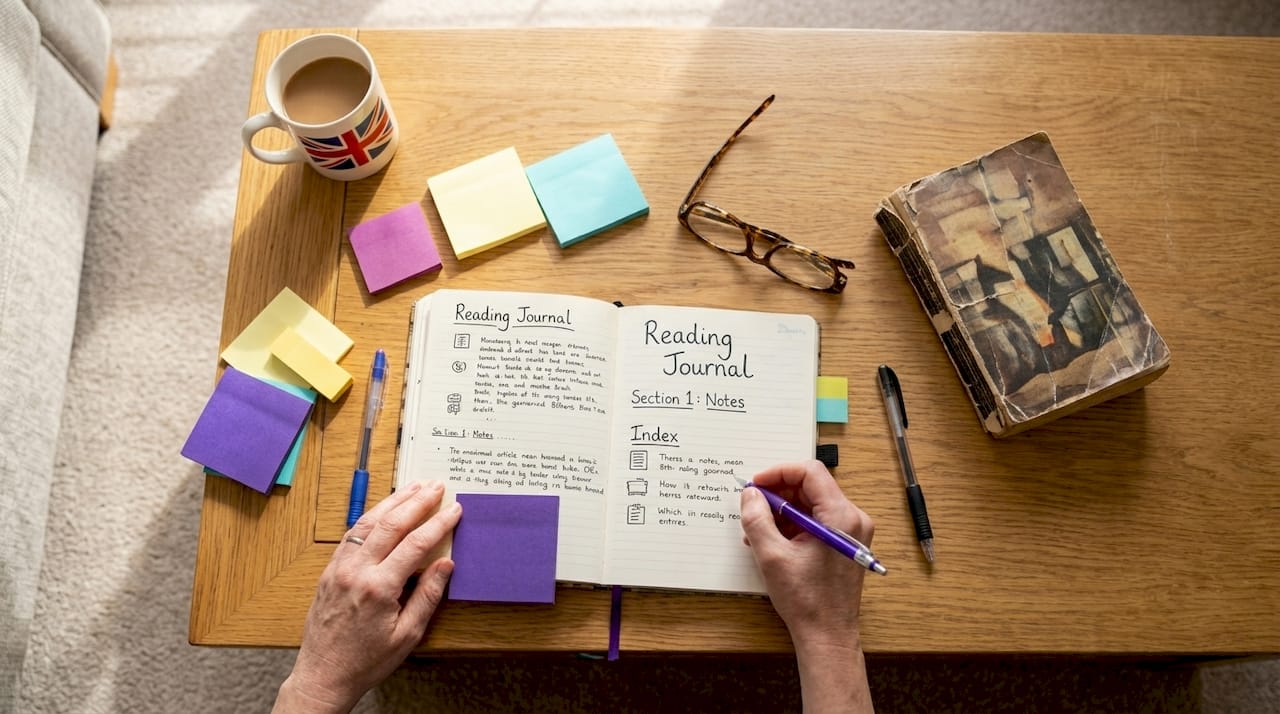
Research-backed guidance on structuring your reading journal recommends four core sections: a Book Log, Review pages, a Quote Collection, and a TBR list. Each serves a distinct purpose, and together they create a complete picture of your reading life.
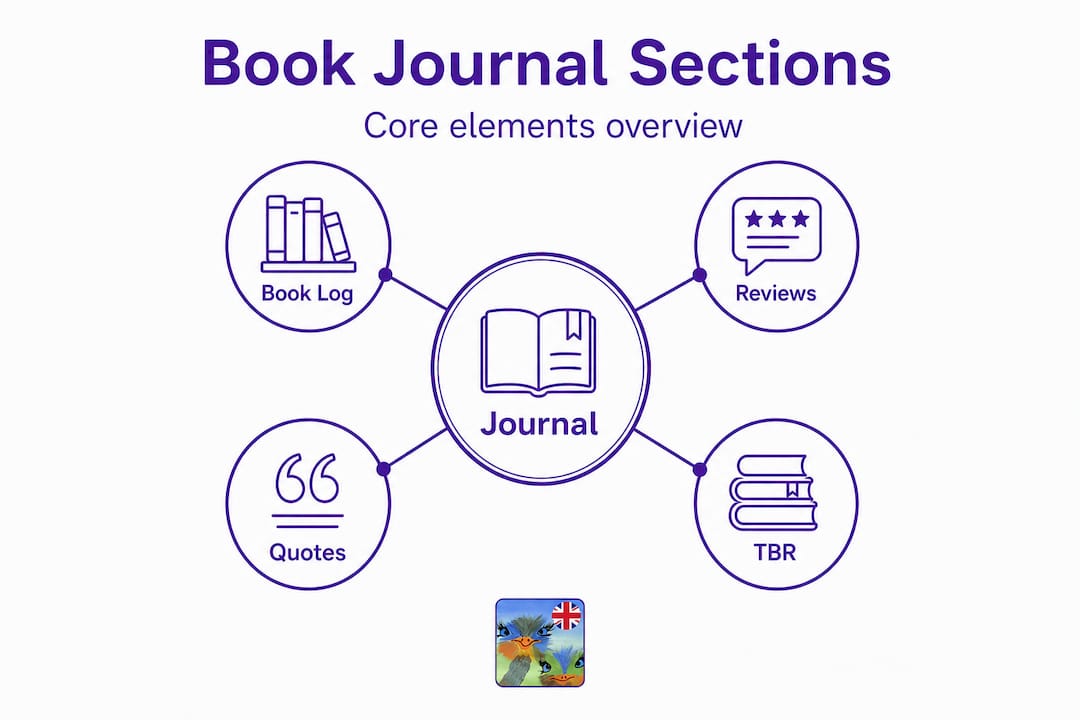
Core sections compared
| Section | What you record | Why it matters |
|---|---|---|
| Book Log | Title, author, dates, rating | Tracks volume, pacing, and patterns |
| Review Pages | Reactions, likes, dislikes | Deepens processing and recall |
| Quote Collection | Standout lines and passages | Preserves what moved or challenged you |
| TBR List | Books you plan to read | Keeps momentum and curiosity alive |
Why each section earns its space:
- Book Log: This is your at-a-glance record. Seeing how many books you read in a year, or noticing you always speed through thrillers but take weeks on literary fiction, reveals patterns you'd never catch otherwise.
- Review Pages: Writing even three sentences about what you liked forces you to articulate your reaction, which is what locks a reading experience into long-term memory. Story-driven journaling works on the same principle: putting experience into words makes it real and retrievable.
- Quote Collection: A great line read in isolation feels electric. A page full of great lines from a single book tells you something profound about what that author values. Over time, your quote collection becomes a personal anthology of ideas that shaped you.
- TBR List: Curiosity fuels consistent reading, and a TBR list keeps that curiosity organized. If you use books in self-improvement as part of a personal growth practice, a TBR list lets you plan your reading intentionally rather than grabbing whatever is nearby.
Spend 20 to 30 minutes setting up these sections before you write your first entry. Add a simple index page at the front, number your pages, and you have a journal that functions as a searchable archive, not just a pile of scattered notes.
How to capture entries: low-pressure methods and creative prompts
Once your journal is structured, it's time to start filling it with entries that work for your life and mindset. The single biggest mistake new book journalers make is treating entries like book reports. They feel pressure to write something insightful, thorough, or articulate, and so they write nothing at all.
To avoid making reading feel like homework, keep entries low-pressure. A single word, one sentence, or a short paragraph is genuinely enough. Focus on feelings and moments that stood out rather than forcing a complete summary. The goal is an honest snapshot, not a polished essay.
And the research supports this approach. Reflective, prompt-guided journaling has empirical support for improving learning engagement, meaning the act of putting your reactions into words, even briefly, is doing meaningful cognitive work.
Five creative entry methods to try
- The one-word entry: Just write the single word that captures your feeling when you set the book down. "Shattered." "Bored." "Awed." You can always expand later.
- The three-sentence review: One sentence on what happened, one on how you felt, one on whether you'd recommend it. Clean, fast, and surprisingly effective.
- The prompt response: Use open-ended questions to unlock your reaction. "This book made me feel..." or "The most surprising moment was..." or "I want to remember..." These prompts are especially useful when you feel like nothing stands out enough to write about.
- The in-the-moment note: When a line or scene hits you mid-read, flag it and jot two or three words on a sticky note. Transfer it to your journal that evening. This is the most honest kind of entry because it's captured before your brain has time to rationalize or forget.
- The mixed-media entry: Sketch a scene, paste in a bookmark, tape in a receipt from the coffee shop where you read the last chapter. Context makes entries more vivid and personal. You can borrow this idea from activity book prompts, which use varied formats to keep engagement high.
Honest notes are always better than forced detail. A single genuine sentence about how a book made you feel will mean more to you in five years than two paragraphs of forced analysis written because you thought you should.
Pro Tip: Keep your journal on your nightstand or next to your reading chair. Physical proximity removes the friction that turns "I'll write that up later" into "I never wrote that up at all."
Maintaining engagement: make it mindful, not homework
Now that you're making entries, let's talk about how to keep up the practice in a way that feels rewarding, not overwhelming. The biggest threat to a book journal is the expectation that you need to do it perfectly or not at all.
Book journaling is about mindfulness and reflection, not measuring outputs. It may make your reading more intentional and enjoyable, but it won't necessarily make you read faster or turn you into a literary critic. When you let go of that productivity framing, the journal becomes something you want to return to rather than a task on your to-do list.
Research also confirms that motivation predicts learning retention more consistently than method. Put simply: the approach you're excited about will outperform the "optimal" approach you dread. Caring about what you read and how you record it matters more than having the perfect template.
Four habits that keep book journaling sustainable
- Set a realistic frequency. Aim for one entry per book finished, not one entry per reading session. Give yourself permission to catch up if you fall behind.
- Celebrate imperfect entries. A one-word entry for a book you didn't love is still a valid record. Logging it means it's not lost.
- Revisit old entries periodically. Reading a note you wrote six months ago can reveal how your taste, values, or perspective has shifted. This is one of the most rewarding parts of keeping a consistent journal.
- Use your journal as inspiration, not obligation. If you're between books, flip through old quotes and let them guide your next pick. Browse your TBR list. Let the journal fuel your curiosity. For educational book inspiration, your journal can become a roadmap for deliberate reading growth.
This journal is for you. Set your own standards, honor your own reactions, and let the practice evolve at whatever pace feels right.
A quick note on digital vs. paper: Digital journals win on searchability and portability. Paper journals win on sensory satisfaction and focus. Many committed book journalers keep both: a paper journal at home for creative entries and a digital log for quick on-the-go notes. Neither is more legitimate than the other.
Our take: the surprising freedom (and boundaries) of book journaling
Here's what most guides won't tell you: the book journaling setups that last longest are the ones where people regularly break their own rules.
We've seen readers who sketch in their journals when they said they'd only write. We've seen minimalists who go full scrapbook for one beloved novel and then go back to plain text. And we've seen meticulous loggers who leave entire months blank and then write a retrospective entry from memory that turns out to be the most honest thing in the whole journal.
Book journaling is not an optimization tool. It's not a system for becoming a smarter, faster, more impressive reader. The moment you start treating it that way, the joy drains out of it. What makes this practice genuinely valuable is authentic connection with texts. You're building a conversation with the books you read, and like any real conversation, it doesn't need to follow a script.
The most liberating thing you can do is log a DNF (did not finish) without shame, or write "I hated this and I'm not sure why" and leave it at that. That's real data about your taste and your inner life. It's worth more than a carefully crafted five-star review you wrote because you thought you should have loved it.
We believe the handcrafted books and journals that last in people's hands are the ones with character: dog-eared pages, coffee rings, crossed-out words. Your journal should look used because it was. Let your system evolve as you do. All you need is honesty and curiosity, and the rest takes care of itself.
Ready to start? Find the right tools for your journaling journey
With your journaling system mapped out, having the right materials close at hand makes the difference between a habit that sticks and one that fades after the first week.

At Munkter Products, you'll find a thoughtfully curated range of journals, notebooks, activity books, and creative stationery designed for exactly this kind of intentional practice. Whether you prefer a clean, structured planner or a freeform notebook that leaves room for sketches and color, there's something here to match your style. If you're shopping for a reader in your life, the thoughtful book gift guide is a great place to find inspiration for pairing the perfect journal with a meaningful read. Give your reading life the tools it deserves.
Frequently asked questions
What are the core sections every book journal should include?
Essential sections are a book log, review pages, a quote collection, and a TBR (to be read) list. These four sections, as outlined in this custom reading journal guide, create a complete and organized system for tracking and reflecting on your reading.
How do I avoid making book journaling feel like homework?
Keep entries short, authentic, and focused on genuine moments or feelings rather than comprehensive summaries. Low-pressure, honest entries such as a single word or a brief note are completely valid and often more meaningful than lengthy write-ups.
Can I include books I didn't finish or didn't like in my journal?
Yes, absolutely. Logging DNF (did not finish) entries or mixed reactions is encouraged for honest and useful record-keeping. Treating those entries as valid records prevents the journal from becoming a highlight reel that misrepresents your actual reading experience.
Does book journaling help improve my memory of books I read?
Book journaling supports active reflection and mindfulness, which helps reading experiences and key highlights stick in your memory longer. Reflective, prompt-guided journaling has research backing for improving learning engagement and recall.
Is there an ideal way to organize a digital reading journal?
No single method works best for everyone. Use digital apps, spreadsheets, or custom templates based on whatever feels easy and motivating for you. Consistency matters far more than format, so choose the tool you'll actually return to.