

TL;DR:
- Adult activity books activate relaxation responses, boost dopamine, and support mental well-being.
- They offer complex, engaging tasks like coloring, puzzles, and journaling for personal growth.
- Regular use can reduce stress, improve focus, and encourage mindful, screen-free relaxation.
Adult activity books have quietly become one of the most effective wellness tools available, and most people never see it coming. While many assume these books are strictly for children, research tells a different story. Repetitive activities in adult activity books activate the parasympathetic nervous system and boost dopamine, creating measurable relaxation effects. This article covers what adult activity books are, who benefits from them, the science behind their calming power, and how to choose the right one for your goals. Whether you're after stress relief, creative stimulation, or personal growth, there's a format built for you.
Table of Contents
- What is an adult activity book?
- How adult activity books support mental well-being
- Types of adult activity books and choosing the right one
- Making the most of your adult activity book
- Why adult activity books are more than a trend
- Ready to start your own activity book journey?
- Frequently asked questions
Key Takeaways
| Point | Details |
|---|---|
| Evidence-backed benefits | Adult activity books reduce stress, boost mood, and support brain health. |
| Diverse book formats | Options include coloring, puzzles, journaling, and creative challenges for all interests. |
| Supports personal growth | Activity books promote mindfulness and self-improvement for adults. |
| Screen-free engagement | These books offer a meaningful, low-tech alternative to digital entertainment. |
What is an adult activity book?
An adult activity book is a printed book designed to engage grown-ups in structured, hands-on tasks that go far beyond simple entertainment. Unlike children's versions that focus on basic learning, adult editions are built around complexity, nuance, and personal exploration. They challenge the mind while simultaneously offering a calming, focused experience.
The range of formats is surprisingly wide. You might pick up a book filled with intricate mandala coloring pages, a puzzle collection with crosswords and logic grids, a guided journaling workbook, or a themed word search designed around topics you actually care about. Some books blend multiple formats into one, giving you variety within a single volume.
Here's what typically sets adult activity books apart from their children's counterparts:
- Complexity: Designs, puzzles, and prompts are built for mature cognitive engagement
- Themes: Adults get topics like travel, self-reflection, pop culture, and mindfulness instead of cartoon animals
- Open-ended prompts: Journaling and creative sections encourage self-discovery rather than right-or-wrong answers
- Aesthetic quality: Adult books often feature high-quality paper, detailed artwork, and sophisticated layouts
- Personal development focus: Many are designed to build skills like focus, creativity, or emotional awareness
The appeal isn't accidental. Adult activity books blend childhood nostalgia with complex tasks for relaxation and brain training, which explains why so many adults feel an immediate pull toward them. There's something deeply satisfying about returning to a hands-on, low-pressure activity after a day of screens and decisions.
Adults are also drawn to these books because they offer a rare combination: structured enough to guide you, but open enough to feel personal. If you've ever browsed activity books for kids and thought "I wish there was something like this for me," you already understand the appeal. Even holiday activity books designed for children have inspired adult spin-offs because the concept of themed, seasonal engagement resonates across all ages.
With the basics explained, let's explore the specific wellness benefits these books provide.
How adult activity books support mental well-being
The wellness case for adult activity books isn't just anecdotal. There's real neuroscience behind why coloring a complex pattern or solving a puzzle makes you feel better. When you engage in low-demand, repetitive tasks, your brain shifts into a more relaxed state. The fight-or-flight response quiets down, and your body's rest-and-digest system takes over.
"Repetitive activities activate the parasympathetic system, boost dopamine, and enhance neuroplasticity, especially useful in anxious times."
This matters because dopamine is your brain's reward chemical. When you complete a section of a coloring page or finish a puzzle, your brain releases a small burst of it. That's not just a pleasant feeling. It's your nervous system reinforcing the behavior, making you want to return to the activity again. Over time, this builds a positive habit loop that supports mood and mental resilience.
Neuroplasticity, the brain's ability to form new connections, is also at play. Engaging regularly with puzzles, creative prompts, or even structured drawing challenges your brain to work in new ways. This keeps cognitive pathways active and flexible, which is especially valuable as we age.
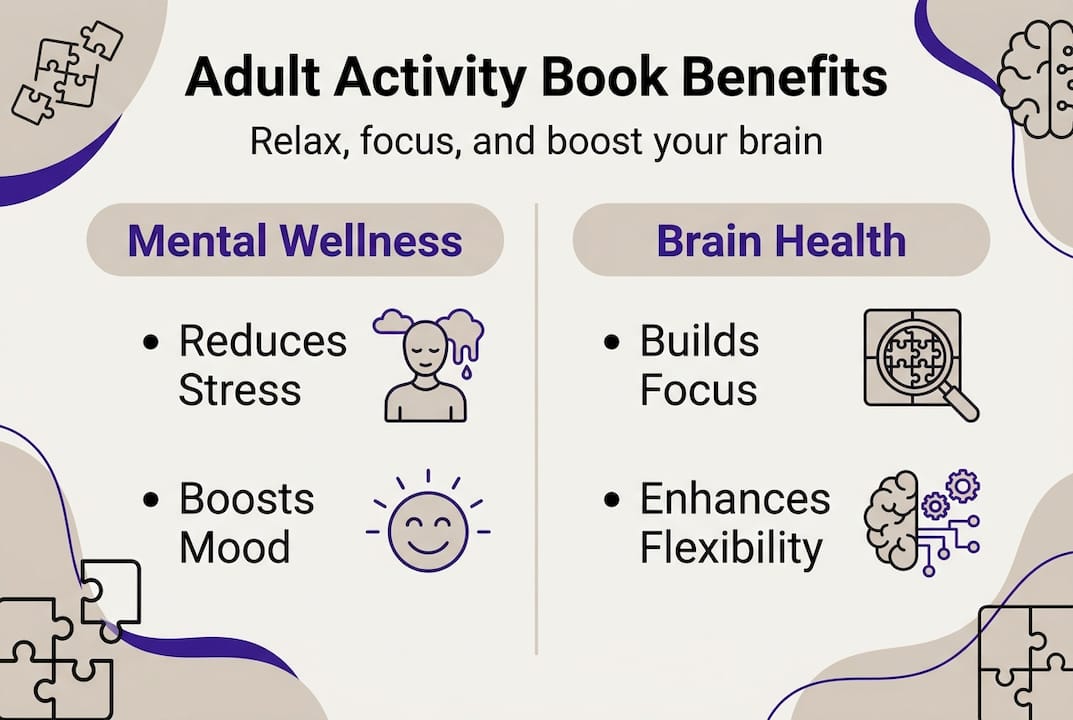
The benefits go beyond neuroscience, though. Unlike scrolling through social media or watching TV, activity books demand focused attention. That focused state is closer to meditation than most people realize. You're not passively consuming. You're actively creating, solving, or reflecting. That distinction makes a real difference in how rested your mind feels afterward.
Understanding interactive book benefits shows how engagement quality matters far more than time spent. The same principle applies to adults. Thirty minutes with an activity book can feel more restorative than two hours of passive screen time.
Here's a quick summary of the emotional benefits you can expect:
- Stress reduction: Repetitive tasks lower cortisol and calm racing thoughts
- Mood improvement: Dopamine release creates a steady, gentle sense of reward
- Focus boost: Structured tasks train your attention span over time
- Emotional processing: Journaling prompts help you work through feelings in a safe, private space
- Sense of accomplishment: Finishing a page or puzzle builds real confidence
Pro Tip: Set aside a distraction-free environment, even just 20 minutes with your phone in another room, and you'll notice a significantly deeper sense of calm from your activity book session.
If you're curious about how books support personal growth with books, activity books are one of the most accessible entry points available.
Once you understand the wellness benefits, it's easy to see why so many people try adult activity books for personal development.
Types of adult activity books and choosing the right one
Adult activity books range from coloring and journaling to brain-challenging puzzles adopted for mindfulness and scalable personal growth. Knowing which type fits your goals saves you from buying a book that sits untouched on your shelf.
Here's a comparison of the three main formats:
| Format | Difficulty | Primary benefit | Best for |
|---|---|---|---|
| Coloring books | Low to medium | Relaxation, creativity | Stress relief, unwinding |
| Puzzle books | Medium to high | Cognitive challenge, focus | Brain training, mental sharpness |
| Journals/prompts | Varies | Self-reflection, emotional growth | Personal development, clarity |
Each format serves a different need. Coloring books are ideal if your main goal is to decompress. The repetitive motion and color choices engage just enough of your brain to keep you present without overwhelming you. Puzzle books are better if you want a mental workout alongside your relaxation. Journals and prompt books work best when you want to understand yourself better or work through something specific.
Here's a simple process for picking the right one:
- Identify your primary goal: relaxation, creativity, or cognitive challenge
- Consider your current stress level: if you're highly stressed, start with something low-demand like coloring
- Think about your schedule: puzzles and journals reward longer sessions, coloring works in short bursts
- Browse themes that genuinely interest you: engagement drops fast if the subject matter bores you
- Check the difficulty level: look for something that challenges you slightly without causing frustration
For readers who want more structured guidance, exploring advanced activity book options can help you assess quality markers before buying. You can also find books specifically designed for activity books for self-improvement that blend multiple formats for a richer experience.
Pro Tip: Start with a format that combines something familiar with a slight challenge. If you loved puzzles as a kid, try an adult puzzle book with themed categories you care about now. That mix of nostalgia and novelty keeps engagement high.
Choosing a book is the first step. Next, let's look at how to maximize its benefits through practical strategies.
Making the most of your adult activity book
Owning an activity book is easy. Actually using it consistently is where most people struggle. The key is treating it like any other wellness habit: small, regular, and intentional.

Start by anchoring your activity book to an existing routine. Morning coffee, lunch breaks, and the 30 minutes before bed are natural windows. Pairing the book with a habit you already have removes the friction of deciding when to use it. You don't need long sessions. Even 15 to 20 minutes of focused engagement delivers real benefits.
NYT puzzles and other advanced activities offer scalable difficulty for all levels of self-improvement, which means you can grow with your book rather than outgrowing it quickly. Look for books that offer progression, whether that's increasing puzzle complexity, deeper journaling prompts, or more detailed coloring designs.
Here's a sample weekly plan to keep things fresh and consistent:
| Day | Activity | Duration | Goal |
|---|---|---|---|
| Monday | Coloring page | 20 min | Decompress after work |
| Wednesday | Puzzle or word search | 25 min | Mental sharpness |
| Friday | Journaling prompt | 20 min | Reflection and clarity |
| Sunday | Free choice | 30 min | Enjoyment and creativity |
Variety is your friend. Using the same format every day can make even a great book feel stale. Rotating between relaxation-focused and challenge-focused activities keeps your brain engaged and your motivation steady.
Here are some creative twists to keep things interesting:
- Group activities: Share a coloring book with a friend or partner for a low-key social experience
- Themed challenges: Commit to finishing a puzzle book around a topic you want to learn more about
- Art swaps: Exchange finished coloring pages with someone else as a form of creative connection
- Timed sessions: Set a timer and see how much you can complete, great for puzzle books
For those who want to go deeper, story-driven journaling tips can transform a simple prompt book into a powerful tool for self-discovery and personal narrative.
Now that you know how to get the most out of your activity book, it's valuable to consider a broader perspective on their evolving role in adult life.
Why adult activity books are more than a trend
A lot of people write off adult activity books as a novelty, something that spikes in popularity during stressful times and then fades. That framing misses the bigger picture entirely. These books aren't trending because of marketing. They're returning because they meet a need that modern life consistently fails to address: the need for focused, screen-free, tactile engagement.
Digital brain games promise similar benefits, but they deliver them through the same device that causes screen fatigue in the first place. There's a fundamental difference between staring at a phone app and holding a pencil over paper. The physical act matters. It slows you down in a way that pixels simply can't.
From our experience, the people who get the most out of activity books aren't the ones who treat them as a temporary fix. They're the ones who build a small, regular habit around them. Fifteen minutes a few times a week, done consistently, outperforms any digital wellness app for genuine calm and creative satisfaction. Personal growth with books is a long game, and activity books are one of the most sustainable ways to play it.
Ready to start your own activity book journey?
You now have a solid understanding of what adult activity books offer, how they work, and how to use them well. The next step is finding one that genuinely fits your life.

At MunkterProducts.com, you'll find a curated selection of adult activity books designed for real relaxation, creative exploration, and personal growth. From intricate coloring books to thoughtful journals and engaging puzzles, every product is chosen with your well-being in mind. Postage is included, so getting started is simple. Browse the collection and find the book that matches exactly what you're looking for right now.
Frequently asked questions
What kinds of activities are included in adult activity books?
Most adult activity books feature puzzles, coloring pages, journaling prompts, and creative challenges designed for relaxation and mental growth. Adult activity books include complex puzzles, coloring, and prompts built specifically for mindfulness and creativity.
Are there proven benefits to using activity books as an adult?
Evidence shows that repetitive activities in these books can reduce anxiety, boost mood, and enhance brain flexibility. Repetitive activity book exercises activate relaxation responses and boost dopamine in measurable ways.
How do I choose the best activity book for my needs?
Start by deciding whether you want to relax, boost creativity, or challenge your mind, then select a book format that matches your goal. Selection should be based on personal goals, whether that's relaxation, creativity, or cognitive challenge.
Can adult activity books help with screen fatigue?
Yes, they offer a screen-free alternative for relaxation and mindfulness, providing real benefits not available from digital activities. Adult activity books provide an effective screen-free way to relax and foster mindfulness that digital tools simply can't replicate.