

The creative writing process is the repeatable system you use to turn a stray idea into a finished piece of work. It's not one fixed sequence of steps. It's whatever sequence gets you from a blank page to a draft, over and over, on demand. Writers who publish consistently, according to Writer's Digest's pacing research, aren't the ones with more free time on their hands. They're the ones who pace themselves before, during, and after each session, using small rituals that make starting easier.
The core claim of this article is simple: repeatability beats perfection. A flawless first chapter you can't replicate next Tuesday is worth less than a rough one you can produce on command. This guide walks through the stages, the personal methods (plotting, pantsing, and the hybrid "plantsing"), a stack of exercises pulled from real prompt collections, and the routine-building tactics that turn occasional bursts of inspiration into a system.
Two things to do right now, before reading further:
- Set a timer for 10 minutes and write without stopping, even if it's garbage.
- Pick one prompt from the exercises section below and use it tomorrow morning.
Key Takeaways
A repeatable, logged system of priming, timeboxed sessions, and post-session notes outperforms talent or inspiration alone for consistent creative output.
| Point | Details |
|---|---|
| Identify your method | Test plotting, pantsing, and plantsing across three short sessions before committing to one. |
| Use stages as scaffold | Move through idea, plan, draft, revise, and polish, looping back whenever a stage reveals a gap. |
| Prime before you start | Repeat the same small ritual, drink, sound, or reread, every session to cut start-up friction. |
| Log every session | Note what you wrote and where to pick up next time to reduce the next session's friction. |
| Revise in order | Fix structure first, then scenes, then line-level polish, never in reverse. |
Table of Contents
- What Are the Different Types of Creative Writing Processes?
- What Are the Stages of the Creative Writing Process?
- Which Writing Method Should You Try First?
- What Are Some Good Creative Writing Exercises and Prompts?
- How Do You Build a Reliable Writing Routine?
- How Do You Revise Effectively and Track Your Progress?
- Who's Behind This Guide, and What Tools Support the Process?
- How Do You Handle Writer's Block?
- How Do You Balance Creativity With Discipline?
- An Editor's Take on the Advice Everyone Keeps Repeating
- Sources
What Are the Different Types of Creative Writing Processes?
Every writer eventually settles into a rhythm, and most rhythms fall into one of four recognizable camps. Knowing which one you're closest to saves months of forcing a system that fights your instincts.
Plotters outline before they write a single scene. They build character sheets, chapter summaries, sometimes full beat sheets before drafting starts. This tends to work best for longer projects with multiple plot threads, tight deadlines, or heavy research requirements, like historical fiction or mystery novels where clues need planting in the right order. A plotter working on a thriller might spend a week mapping the murder weapon, the alibi, and the reveal before writing page one, because untangling that logic mid-draft costs far more time than planning it up front.
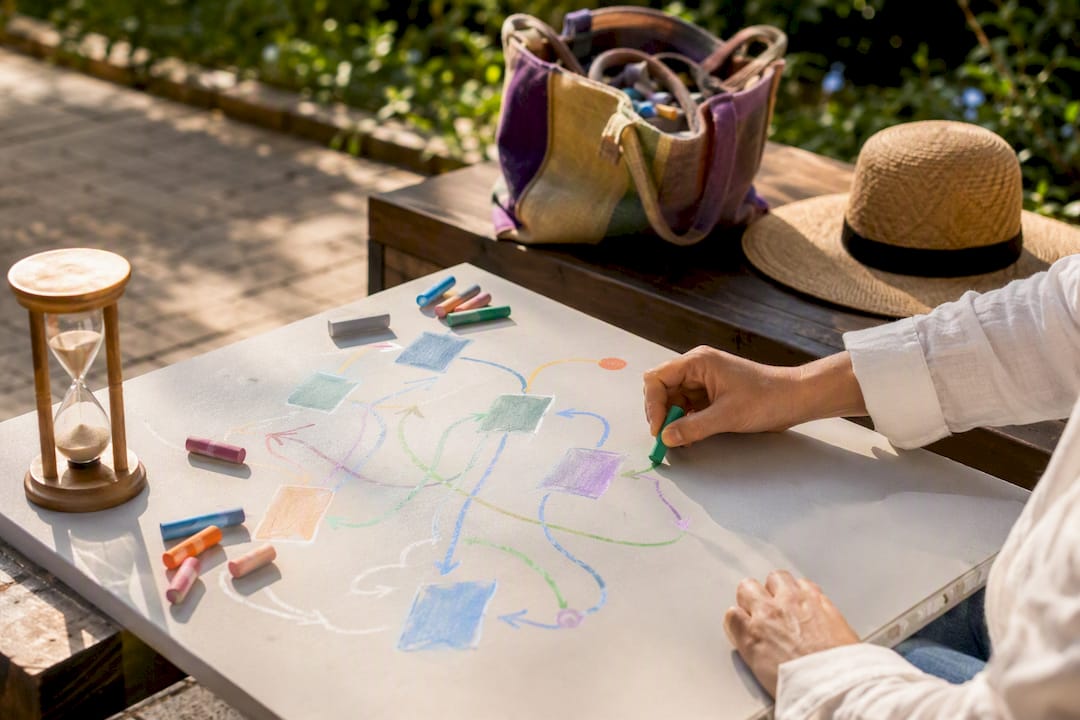
Pantsers write "by the seat of their pants," discovering plot and character through the act of drafting itself. This suits short stories, poetry, and personal essays where voice matters more than architecture, and it works especially well for writers who find outlines kill their momentum. A pantser might sit down knowing only that a character walks into a diner at midnight, and let the scene tell them why.
Plantsers blend the two: a loose skeleton (maybe five plot points) with wide-open space to improvise between them. This fits novel-length work where you want structural safety without losing spontaneity, and it's the most common approach among writers who've tried both extremes and found each one limiting in a different way.
Reverse-outliners draft first, then build an outline from what they've already written, using it to catch plot holes and pacing problems before revision. This works well for writers who think best on the page but still need a structural map before tackling a second draft.
None of these are permanent identities. Most writers shift between them depending on the project, the deadline, and the genre.
What Are the Stages of the Creative Writing Process?
Think of these five stages as a scaffold, not a straitjacket. Writers loop back constantly, and that's normal, not a sign something's broken.
- Idea generation. The goal is volume, not quality. Collect more seeds than you need using prompts, overheard dialogue, or "what if" questions. Next step: keep a running list in one place, whether that's a phone note or a dedicated journal, so ideas don't scatter across scraps of paper.
- Planning. The goal is enough structure to start without over-engineering. Next step: write a single paragraph describing your story's shape, even if you're a committed pantser. One paragraph, not ten pages.
- Drafting. The goal is forward motion, full stop. Next step: set a daily or session-based word or time target you can actually hit on a bad day, not just a good one.
- Revision. The goal is structural repair before line-level polish. Next step: read the whole draft once without touching a single sentence, just to map what's broken.
- Polish and publication prep. The goal is readiness for outside eyes. Next step: format the manuscript to submission or self-publishing standards and draft a one-paragraph pitch or blurb.
Stages overlap constantly. You'll often revise a chapter while still drafting the next one, or realize mid-draft that your planning missed a key motivation and loop back to stage two. That's the process working, not failing.
Which Writing Method Should You Try First?
Plotting gives you speed and fewer structural rewrites, at the cost of feeling constrained in the moment. Pantsing gives you spontaneity and often stronger voice, at the cost of heavier revision later. Plantsing splits the difference, trading some of each extreme for a middle ground that suits most novel-length projects.
Rather than picking a lane by instinct, run three short experiments and let the results decide for you:
- Session one: Outline-first. Spend 10 minutes planning, then write for 20.
- Session two: Pantsed freewrite. Skip planning entirely; write for 30 minutes cold.
- Session three: Plantsing split. Jot three plot points in 5 minutes, then write for 25.
After each session, log three things: how fast the words came, how much you enjoyed the session, and how much revision the output will likely need. Do this over three separate days, not back to back, so fatigue doesn't skew the comparison.
Pro Tip: Don't judge a method by output quality alone. A pantsed scene that reads messy but took no willpower to write can beat a polished outline that left you dreading the next session. Sustainability wins over a single strong draft.
Most writers find their honest answer isn't "I'm a plotter" or "I'm a pantser." It's "I plot the big turns and pants the scenes in between," which is just plantsing with a different name.
What Are Some Good Creative Writing Exercises and Prompts?
Exercises aren't training wheels you graduate from. Professional writers keep using them because a warm-up for the creative muscle works the same way at any skill level.
- Timed freewrite. Set a timer for 10 minutes, write without stopping or editing. Writers Online recommends this as a way to bypass your internal editor and sometimes surface usable material.
- Photograph prompt. Pick a random photo (stock image, family photo, anything) and write the scene happening just outside the frame.
- What-If prompt. Ask a single destabilizing question, "What if the letter arrived a day late?" and write the fallout for five minutes.
- Character mash-up. Combine two unrelated character traits (a pacifist bounty hunter, a claustrophobic astronaut) and write their internal monologue in a tense moment.
- First-line prompt. Borrow an opening line from a book you haven't read and write your own scene from there.
- Card combination. Draw two random nouns, or pull them from a hat, and force a scene that connects them.
- Sensory list. List five things you'd smell, hear, and touch in a setting, then write the scene using at least three.
- Dialogue-only scene. Write a full scene using only dialogue, no action tags or description.
- Constraint drabble. Write a complete micro-story in exactly 100 words. The word limit forces decisions fast.
- Reverse scene. Write the ending first, then draft backward toward a beginning that earns it.
A collection of exercises like these shows that timed freewrites, image prompts, and card combinations remain some of the most consistently effective tools for generating scene and character seeds on demand. Large prompt directories, including Reedsy's prompt library, exist specifically so writers never run out of starting points across genres.
A reliable micro-session template: 5 minutes on one exercise above as a warm-up, then 25 minutes of focused drafting on your actual project. That 30-minute block fits into a lunch break and still produces real pages.
How Do You Build a Reliable Writing Routine?
Inspiration is unreliable. A routine isn't. The fastest way to find your prime writing time is a one-week logging experiment: for seven days, jot down when you wrote, for how long, and rate your focus from one to five. Patterns show up fast, and they're often not what you expected. Plenty of self-described night owls discover their sharpest hour is 7:00 AM, before the day's noise starts.
Priming rituals work because they signal to your brain that it's time to shift modes. Writer's Digest's research on pacing points to small, repeated cues as a reliable way to cut start-up friction. A three-step ritual might look like this:
- Same drink, every session (tea, coffee, water, doesn't matter which).
- Same playlist or ambient sound, so your brain hears the cue and starts associating it with focus.
- Reread your last session's closing note before typing a single new word.
For pacing during the session itself, a Pomodoro-style block (25 minutes on, 5 minutes off) works for most writers, though some find 45/15 splits let them stay in flow longer without the interruption feeling disruptive. Whatever the split, one distraction rule matters more than the rest: phone in another room, notifications off, full stop.
Pro Tip: Keep your ritual boring on purpose. Novelty is fun but unreliable; the whole point of a ritual is that it works the same way on your worst day as your best one.
How Do You Revise Effectively and Track Your Progress?
Revision goes in order: big-picture structure first, then scene-level pacing, then line edits last. Fixing commas in a chapter you're about to cut wastes hours you'll never get back.
- Structural pass: Does the plot hold together? Do character motivations make sense? Fix this before anything else.
- Scene pass: Does each scene earn its place? Cut or tighten anything that stalls momentum.
- Line pass: Polish sentence rhythm, word choice, and grammar last, once the bones are solid.
For feedback, ask readers specific questions rather than "what did you think?" Try "where did you get bored?" or "did the ending feel earned?" Vague feedback produces vague revisions; targeted questions produce fixes you can actually act on.
Two simple tracking systems keep momentum alive. A daily log notes what you wrote, how long it took, and one sentence about where to pick up next time; pacing research from Writer's Digest confirms that this kind of closing note meaningfully cuts next-session start-up time. A milestone checklist marks bigger wins, first draft complete, first full revision done, beta readers sent, so progress is visible even during slow stretches.
Who's Behind This Guide, and What Tools Support the Process?
This guide comes from the editorial team at Munkterproducts, a publisher and retailer of journals, notebooks, planners, and self-help stationery built for writers who want physical tools to match a digital-age process. The perspective here draws on established pacing and priming research, not guesswork.
If you're building the kind of logging habit described above, a dedicated notebook beats a scattered pile of sticky notes. Munkterproducts' guide to unique notebooks for creative expression covers formats suited to planning and idea capture, and the science behind why stationery inspires creativity explains why a physical ritual object works better for some writers than an app ever will.
For prompt practice specifically, the journaling prompts list with 60+ ideas and a selection of short dystopian novels for one-sitting dread give you a ready supply beyond what's covered here.
Next steps if you're just starting:
- Buy or grab a notebook you actually enjoy opening.
- Run the three-session method experiment from earlier this week.
- Log every session, even the bad ones.
How Do You Handle Writer's Block?
Writer's block is rarely a talent problem. It's almost always a system problem, usually one of three: no clear next step, too much internal pressure to write something good, or a stalled session with no way back in.
The fix for "no clear next step" is the one-sentence plan from the tracking section above. Before closing a session, write down exactly what happens next: not "continue chapter 4," but "Maria confronts her sister about the letter." Vague intentions create blank-page paralysis; specific ones don't.
The fix for "too much pressure" is lowering the stakes deliberately. Give yourself permission to write a genuinely bad paragraph, just to break the freeze. Constraint exercises help here too. A 100-word drabble or a strict time limit forces decisions and short-circuits the perfectionism that often causes the block in the first place.
The fix for a stalled session is switching modes entirely. If your novel has stalled, write a totally unrelated freewrite or prompt for 10 minutes. It's not procrastination if it gets you back into a writing headspace, and it often loosens whatever was stuck.
Block tends to return in cycles. Building the habits above doesn't eliminate it forever, but it shortens each episode considerably.
How Do You Balance Creativity With Discipline?
Discipline without creativity produces competent, lifeless pages. Creativity without discipline produces brilliant fragments that never become a finished book. The balance point is smaller and more forgiving than most advice suggests.
Realistic goals matter more than ambitious ones. A goal of "write 2,000 words a day" sounds impressive and fails most people within two weeks, because it ignores real life: work, family, bad days, sick kids. A goal of "show up for 20 minutes, five days a week" survives contact with an actual schedule, and consistency compounds in ways that occasional heroic sessions never do.
Give creativity room inside a disciplined frame rather than treating the two as opponents. Your priming ritual and time block are the discipline; what happens once you start typing is where creativity gets to run loose. The structure exists to get you to the page, not to control what you do once you're there.
Adjust the frame every few weeks based on what your logs actually show, not on what you think should be working. If Tuesday sessions consistently underperform, move them. If 45 minutes reliably produces more than 25, extend the block. The system serves you, not the other way around.
An Editor's Take on the Advice Everyone Keeps Repeating
Most advice about finding your creative writing process treats it like a personality test. Are you a plotter or a pantser? Pick one and identify with it forever. That framing has done writers a disservice. The research on pacing and priming points somewhere else entirely: process isn't an identity, it's a set of variables you test and adjust, the same way you'd tune any repeatable workflow.
The conventional advice oversells the choice of method and undersells the boring stuff around it, the ritual, the session log, the one-sentence note before you stop writing. Those unglamorous habits do more to prevent stalled projects than any outlining philosophy.
If you take one thing from this guide, take the logging habit. Run the three-session experiment, write down what actually happened, and let the results argue with your assumptions. Most writers are wrong about which method suits them until they've measured it.
— Mark
Sources
- Pacing Your Writing Process - Writer's Digest
- Writing exercises (collection) - Dave McCreery
- Creative writing prompts — Writers Online
- Reedsy — creative writing prompts directory