

Pick one prompt below, set a timer for 5–15 minutes, and write without editing yourself. That's the whole method. Self reflection journal ideas work best when you treat them as a starting point, not a performance.
10 ready-to-use prompts you can copy right now:
- What am I carrying today that I didn't choose to carry?
- What's one thing I keep avoiding, and what does that avoidance cost me?
- When did I last feel genuinely proud of myself? What made that moment real?
- What belief about myself am I least willing to question?
- Describe a moment this week when you felt most like yourself.
- What would I do differently if I knew no one was watching or judging?
- What emotion showed up most this week, and what was it trying to tell me?
- Who in my life brings out the best version of me, and why?
- What does "enough" look like for me right now?
- If I could send one message to my future self one year from today, what would it say?
When the timer goes off, read back what you wrote and underline one sentence that surprises you. That sentence is your takeaway for the day.
Key Takeaways
Consistent, structured expressive writing produces measurable benefits across psychological and physical well-being, and the quality of your engagement matters more than the number of sessions you complete.
| Point | Details |
|---|---|
| Start with one prompt and a timer | Set 5–15 minutes, write without editing, and close with one takeaway sentence. |
| Match format to session length | Use quick-check (Q) prompts for 1–5 minute check-ins; save deep (D) prompts for 20–40 minute sessions. |
| Engagement and instruction shape outcomes | Open-ended, acceptance-style prompts produce better results than vague or directive ones. |
| Temporary distress is normal | Feeling activated after a deep session is common; grounding lines at the close reduce that risk. |
| Munkterproducts guided journals | Purpose-built layouts with prompt space and a takeaway section support the structured approach described here. |
Table of Contents
- How to start journaling without overthinking it
- A categorized library of self-reflection prompts
- How to turn these prompts into a repeatable routine
- Why expressive writing actually helps (and when to be careful)
- What I've learned from recommending prompts
- A guided journal that's built for this kind of writing
- Sources
How to start journaling without overthinking it
The biggest obstacle to journaling isn't finding prompts. It's the blank page feeling like a test. These steps cut that friction down to almost nothing.
A 5-step starter routine:
- Choose your format: a physical notebook, a notes app, or a dedicated journal. Physical tends to work better for deep reflection because there are no notifications competing for your attention.
- Set a timer before you write a single word. Five minutes for a quick check-in, 20–40 minutes for a deeper session. The timer removes the pressure of deciding when to stop.
- Write your chosen prompt at the top of the page. Don't read it twice. Just start writing the first thing that comes to mind.
- Use stream-of-consciousness for the first two minutes: write whatever arrives, even "I don't know what to write." That phrase almost always unlocks something real.
- Close with one concrete sentence: "One thing I'm taking from this session is ___." This step is what separates processing from rumination.
Short-format vs. deep-format sessions
A 1–5 minute check-in suits mornings or evenings when you want a pulse on your emotional state without opening a long conversation with yourself. A quick-check prompt like "What's my energy level right now, and what's driving it?" takes two minutes and gives you useful data.
A 20–40 minute deep session is for bigger questions: identity, values, a relationship pattern you keep noticing. These sessions benefit from a structured approach. The R.E.F.L.E.C.T. framework sequences reflection as: recount the event, name the emotion, feel it in the body, look for the pattern, examine the story you're telling, offer yourself compassion, then take one small step. That last step is the difference between insight and spinning.
The 3-3-3 and 3-2-1 methods
The 3-3-3 method: write 3 things you're grateful for, 3 things you accomplished, and 3 things you want to focus on tomorrow. Takes under five minutes and works well as an evening wind-down.
The 3-2-1 method: write 2 things that went well, 1 thing you'd do differently, and 1 question you're sitting with. The open question at the end keeps the reflection alive without demanding an answer right now.
Pro Tip: If you catch yourself rewriting the same sentence or second-guessing your word choice, you've left journaling and entered editing. Set a rule: no crossing out. Messy first drafts are the most honest ones.
A categorized library of self-reflection prompts
These self discovery journal prompts are grouped by theme so you can match a prompt to what you actually need today. Each theme includes quick-check prompts (Q) for short sessions and deeper prompts (D) for longer ones.
Self-development
- (Q) What's one habit I want to strengthen this week?
- (Q) What did I learn about myself in the last 24 hours?
- (D) What pattern keeps showing up in my life, and what might it be pointing to?
- (D) What version of myself am I growing toward, and what's standing in the way?
- (D) What would I need to believe about myself to make the change I keep putting off?
Emotions and well-being
- (Q) What emotion is loudest right now? Where do I feel it in my body?
- (Q) On a scale of 1–10, how present am I today? What's pulling me away?
- (D) What am I afraid to feel, and what would happen if I let myself feel it fully?
- (D) Describe a time you handled a difficult emotion well. What did you do?
- (D) What does my inner critic say most often, and is any part of it worth listening to?
Gratitude
- (Q) Name three things that happened today that I'm glad happened.
- (Q) Who made my life easier this week without being asked?
- (D) What do I take for granted that, if it disappeared tomorrow, I would miss deeply?
- (D) Write about a difficult experience you're now grateful for. What did it teach you?
- (D) What part of your ordinary day would your past self have considered a gift?
Relationships
- (Q) Who have I been showing up for lately? Who have I been neglecting?
- (Q) What's one thing I wish I'd said to someone this week?
- (D) Describe a relationship that changed you. How are you different because of it?
- (D) What do I need from my closest relationships that I haven't asked for?
- (D) Where in my relationships am I giving from a full place, and where am I giving from depletion?
Memories and life review
- (Q) What's a memory that made me smile recently?
- (D) Describe a moment from your childhood that still shapes how you see the world.
- (D) What's a decision from your past that you've made peace with? How did that peace arrive?
- (D) If you wrote a chapter title for the last year of your life, what would it be?
- (D) What story about your past are you ready to rewrite?
Values and identity
These are identity journal prompts that tend to surface the most honest answers when you write quickly without planning.
- (Q) What do I stand for today?
- (Q) What's one value I've been living out well lately?
- (D) Where is there a gap between what I say I value and how I actually spend my time?
- (D) Who am I when no one is defining me?
- (D) What would I refuse to compromise on, no matter the cost?
Creativity and fun
- (Q) What would I do today if I had no obligations and no one to impress?
- (Q) What's something I used to love doing that I've stopped making time for?
- (D) If you could design your ideal creative project with no limits, what would it look like?
- (D) Write about a time you surprised yourself with something you made or created.
- (D) What does play mean to you now, as an adult? When did you last experience it?
Career and purpose
- (Q) What part of my work felt most meaningful this week?
- (Q) What am I tolerating at work that I haven't named out loud yet?
- (D) What would I pursue if I knew I couldn't fail and didn't need the money?
- (D) What does success look like to me now, separate from what others expect?
- (D) What legacy do I want my work to leave, even in small ways?
How to turn these prompts into a repeatable routine
A single journaling session is useful. A four-week habit changes how you think. Here's a low-friction starter plan.
4-week starter plan
- Week 1: Three sessions, 5–10 minutes each. Use only quick-check (Q) prompts. Goal: build the habit of sitting down, not the habit of going deep.
- Week 2: Three sessions, 10–15 minutes each. Introduce one deep (D) prompt per session. Close every session with the one-sentence takeaway.
- Week 3: Four sessions per week. Mix Q and D prompts. Try the 3-2-1 method on two of the four days. Notice which themes you keep returning to.
- Week 4: Four sessions per week. Choose one theme from the categorized library and spend the whole week in it. This is where patterns start to surface.
After four weeks, you'll know your natural session length, your preferred themes, and whether morning or evening works better for you. That self-knowledge is itself a form of personal growth through journaling.
A simple tracking structure
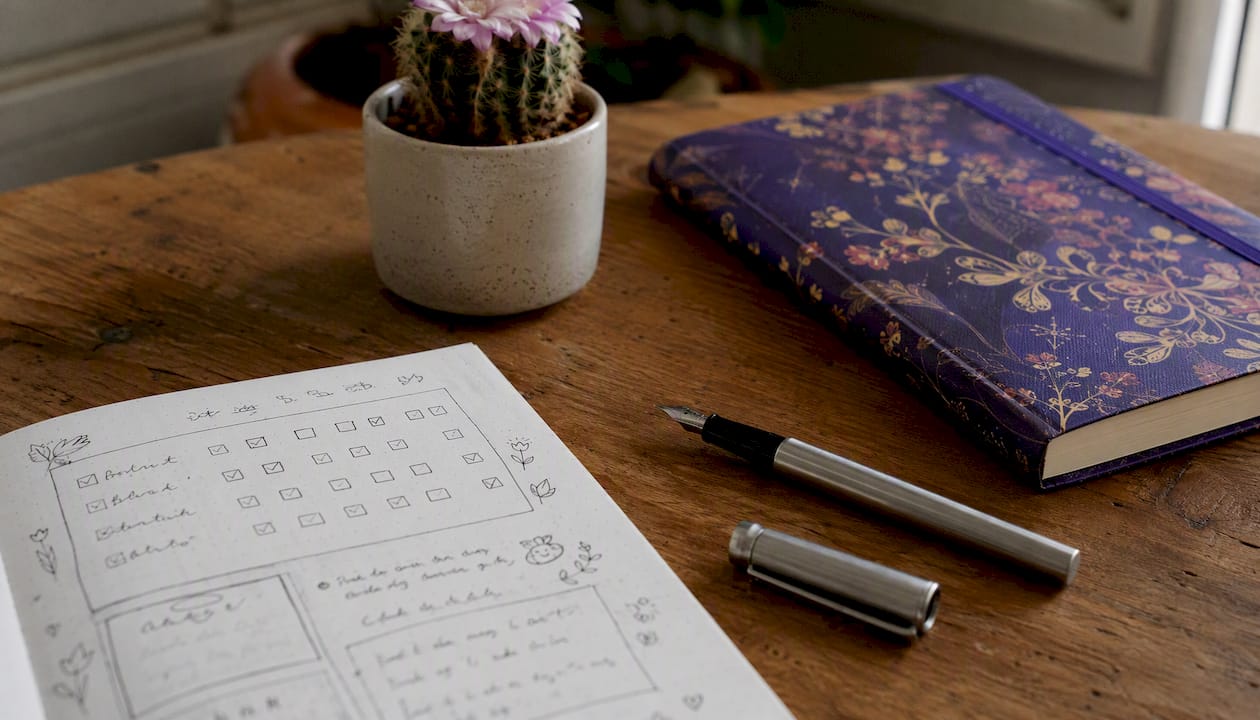
Keep a running log at the back of your journal or in a separate notes file:
| Date | Prompt used | Session length | One-line takeaway |
|---|---|---|---|
| Example | "What am I avoiding?" | 5–15 min | I avoid conflict because I confuse it with rejection. |
You don't need to track every session. Track the ones where something shifted. Over four weeks, even three or four logged entries will show you a pattern you couldn't see in the moment.
Pro Tip: Measure progress by one insight per week, not by how many sessions you complete. A single sentence that reframes something you've been stuck on is worth more than seven completed check-ins that said nothing new.
Why expressive writing actually helps (and when to be careful)
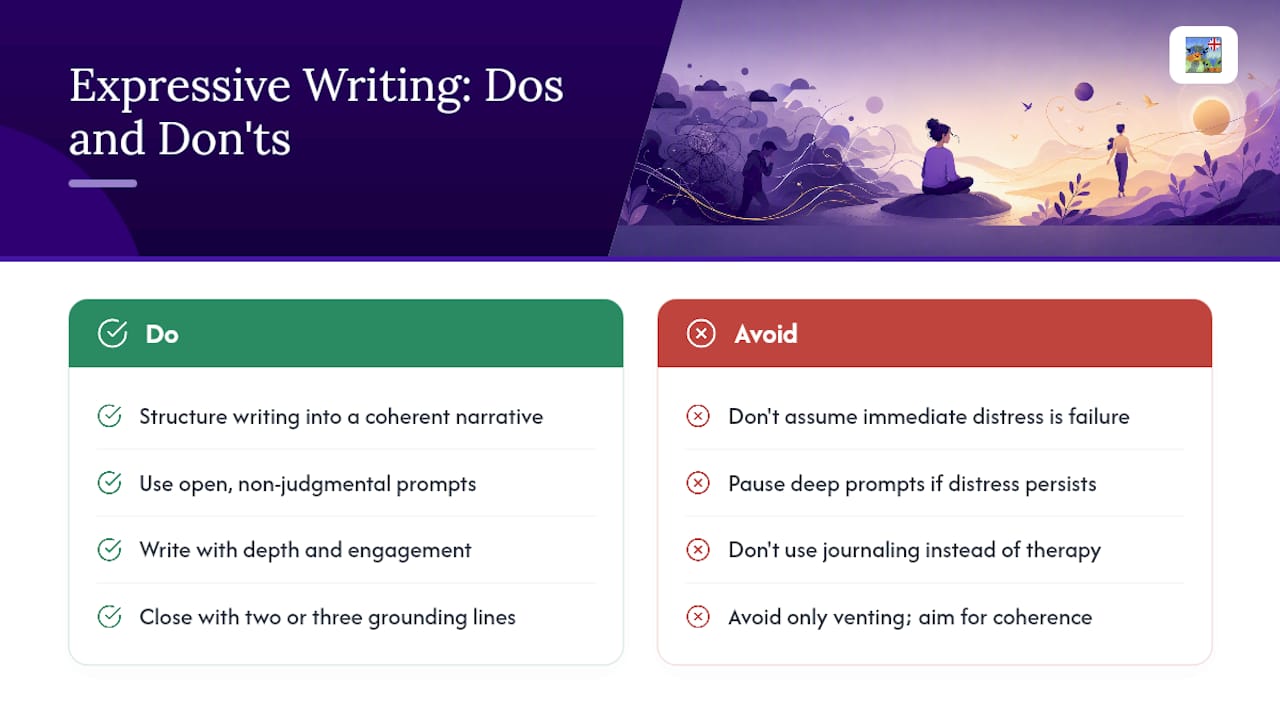
The evidence behind journaling isn't anecdotal. A research synthesis of expressive-writing studies found that writing about emotional experiences produced significant improvements across physical health, psychological well-being, physiological functioning, and general functioning. One finding worth noting: immediate distress often increases right after a writing session and is unrelated to longer-term outcomes. Feeling worse in the moment doesn't mean the practice isn't working.
A separate synthesis by Smyth (1998) found that narrative coherence across writing sessions correlated with improvement, suggesting that structuring reflection, rather than just venting, supports the integration that produces measurable benefits. Writing that moves from raw emotion toward a coherent story tends to do more than writing that stays in the emotional weeds.
Instruction quality and engagement depth both matter. A study on acceptance-enhanced expressive-writing instructions found that participants who received guidance encouraging open emotional exploration and who wrote longer, more engaged entries showed better outcomes than those who received standard instructions. The prompts in this article are written in that spirit: open-ended, non-judgmental, and designed to invite rather than direct.
The APA's coverage of expressive writing underscores that implementation matters as much as the practice itself. A few practical safety notes: if a session leaves you feeling activated rather than settled, close with two or three grounding lines describing what you can see, hear, and feel in the room right now. That sensory anchor returns you to the present. If you find that journaling consistently increases distress rather than eventually easing it, or if you're working through trauma, consider pausing the deep prompts and speaking with a therapist before continuing. Journaling is a powerful tool, not a substitute for professional support.
What I've learned from recommending prompts
The most common mistake I see is treating a journal prompt like an essay question. People write toward a conclusion, tidy it up, and miss the whole point. The best entries I've read, and the most useful ones I've written, are the ones that end mid-thought, with a question the writer didn't expect to ask themselves.
My personal rule: when a session gets intense, I close with three grounding lines. What I can see, what I can hear, what I'm physically touching. It takes thirty seconds and it means I leave the journal feeling present rather than activated. Try it after any deep-format session.
A guided journal that's built for this kind of writing
If you've been journaling on loose paper or in a generic notebook, a purpose-built journal changes the experience. Munkterproducts handcrafts self-help journals with layouts designed for prompt-based reflection: dedicated space for the prompt, room for your response, and a one-line takeaway section so you always close with something concrete.

Physical journals remove the distraction problem that digital notes apps can't fully solve. No notifications, no switching tabs, no temptation to edit what you wrote. The handcrafted journal formats at Munkterproducts are built for exactly the kind of writing this article describes: structured enough to guide you, open enough to let you surprise yourself. Browse the full range and find the format that fits your session style.
Sources
Primary research:
- Chasing elusive expressive writing effects: emotion-acceptance instructions and writer engagement improve outcomes
- Written emotional expression: research synthesis (expressive writing outcomes)
- Written emotional expression: Effect sizes, outcome types, and mechanisms (Smyth 1998 synthesis)
- Speaking of Psychology podcast: expressive writing (APA)
Practical guides and further reading: