
TL;DR:
- A creative journaling workflow is a flexible process focused on capturing and developing ideas through intentional daily practice. It emphasizes habit formation, using tools suited to individual preferences, and rotating techniques to stay creatively engaged. Regular reflection and forgiving imperfections help build a sustainable habit that fosters honest self-expression and long-term growth.
A workflow for creative journaling is a purposeful, adaptable process that helps you capture and develop ideas through consistent, intentional practice. Unlike productivity journaling, which focuses on output and efficiency, creative journaling explores inner landscapes and honest self-expression without performance pressure. The difference matters because it changes what you put on the page and how freely you do it. A structured creative journaling process gives your practice direction without killing spontaneity. The key is building a workflow that fits your life, not one that adds another obligation to it.
What does a workflow for creative journaling actually look like?
A creative journaling workflow is not a rigid schedule. It is a repeatable sequence of small decisions: when you write, what tools you use, how you start, and what you do when you get stuck. Think of it as a personal operating system for your creative mind. The workflow exists to reduce friction, not to impose rules.
The most effective workflows share three traits. They are consistent enough to become habit, flexible enough to survive a bad week, and personal enough to feel worth returning to. Research confirms that habit adherence roughly triples when you set a two-minute minimum for sessions rather than aiming for long, ambitious blocks. That single insight reshapes how you design your entire practice.
What tools do you need to get started?
The right tools reduce the gap between having an idea and getting it on the page. That gap is where most creative journaling habits die. Choosing tools that invite use, rather than tools that impress others, is the first real decision in your workflow.
Three broad approaches exist, each with genuine strengths:
- Analog. A physical notebook and pen offer tactile engagement, zero battery anxiety, and a proven link between handwriting and memory consolidation. Handmade and curated journals, like those from Munkterproducts, add a sensory quality that digital screens cannot replicate. Research into why stationery inspires creativity shows that the physical act of writing activates different cognitive pathways than typing.
- Digital. Apps and voice recording tools let you capture ideas anywhere, search past entries instantly, and layer media like photos or audio clips. Modern workflows increasingly use a "capture first, structure later" model, where voice-first AI tools log spontaneous moments without requiring a desk or a pen.
- Hybrid. Many experienced journalers use both. They capture ideas digitally throughout the day, then transfer and expand the best ones into a physical journal during a dedicated session.
| Tool category | Best for | Key advantage |
|---|---|---|
| Handmade notebook | Deep reflection, daily writing | Tactile, distraction-free |
| Digital app | On-the-go capture, searchability | Always accessible |
| Voice recorder or AI tool | Spontaneous ideas, hands-free logging | Zero friction capture |
| Coloring or art journal | Visual expression, right-brain activation | Bypasses verbal blocks |
Pro Tip: Keep your journal on your pillow, your desk, or wherever you start your morning. Physical proximity cuts activation energy and makes starting feel automatic.
How do you build and maintain a creative journaling habit?
Habit formation is the engine of any journaling workflow guide. Without it, even the best techniques stay theoretical. The science here is clear and practical.
Anchoring journaling to an existing cue, a practice called habit stacking, removes the need for willpower. You attach journaling to something you already do: morning coffee, the end of a commute, or the ten minutes before bed. The cue triggers the behavior automatically over time.
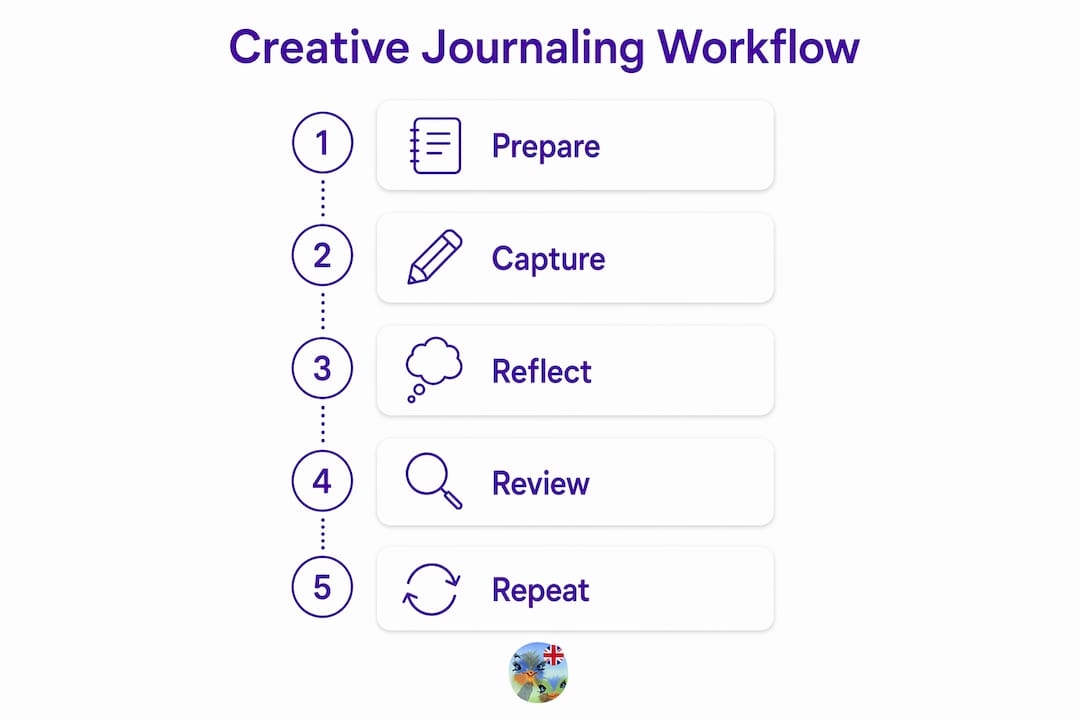
Follow this sequence to build your creative journaling process from scratch:
- Choose your cue. Pick one daily event that reliably happens. Pair your journal session with it every day for the first two weeks.
- Set a two-minute floor. Commit to writing for at least two minutes, no matter what. Two minutes of honest writing beats zero minutes of planned writing every time.
- Capture first. Write whatever is in your head without editing. Fragments, half-formed ideas, and emotional reactions all count.
- Connect and expand. Once the raw material is on the page, look for threads. Ask: what does this remind me of? What question does this raise?
- Play with form. Experiment with lists, sketches, dialogue, or free verse. The creative journaling process thrives when you treat the page as a playground, not a report.
- Review weekly. Spend five minutes at the end of each week rereading your entries. Revisiting past entries fuels new connections and surfaces patterns you missed in the moment.
| Session type | Frequency | Duration |
|---|---|---|
| Daily capture | 5–7 days per week | 2–5 minutes |
| Deep exploration | 3–4 days per week | 10–20 minutes |
| Weekly review | Once per week | 5–10 minutes |
Research confirms that 3 to 4 sessions per week lasting 10 to 20 minutes each produces better long-term results than daily marathon sessions. Sustainability beats intensity at every stage of habit formation.
Pro Tip: If your internal editor shows up and starts criticizing your writing, switch to writing with your non-dominant hand for two minutes. The awkwardness short-circuits self-censorship and gets raw ideas flowing.
What creative journaling techniques actually work?
Technique variety keeps a journaling practice alive past the first month. Using the same approach every day eventually flattens the experience. Rotating methods keeps your creative mind engaged.
These techniques have strong track records among creative journalers:
- Morning Pages. Write three pages of longhand stream-of-consciousness immediately after waking. The goal is quantity, not quality. This technique, developed by Julia Cameron in The Artist's Way, clears mental clutter and surfaces subconscious material.
- Idea Box. Dedicate one section of your journal to raw ideas only. No context, no explanation. Just the seed. Return to the box weekly and pick one idea to develop.
- Visual Journaling. Combine drawing, collage, and handwriting on the same page. You do not need artistic skill. Cutting images from magazines and writing around them counts. Exploring different art mediums can open entirely new creative channels within your journaling practice.
- Artist Date. Take yourself on a solo outing, a museum, a market, a park, with your journal. Write or sketch what you observe. New environments produce new material.
- Prompt-driven sessions. Use a specific question to anchor a session when you feel blank.
Strong prompt categories to rotate through include:
- Sensory prompts. "Describe a smell that takes you back somewhere."
- Conflict prompts. "Write about a decision you keep avoiding."
- Curiosity prompts. "What would you do if you knew you could not fail?"
- Observation prompts. "Describe a stranger you saw today as if they were a character in a novel."
- Gratitude with specificity. "Name one small thing that went right today and explain why it mattered."
The value of messy, honest entries cannot be overstated. The greatest barrier to creative journaling is the internal editor that demands polished output. Allowing imperfect pages is not a compromise. It is the actual practice.
How do you troubleshoot a stalled creative journaling workflow?
Every journaling practice hits a wall. Knowing what to do when that happens is what separates people who journal for years from those who quit after three weeks.
Common obstacles and their fixes:
- Perfectionism. Lower the bar deliberately. Give yourself permission to write one terrible sentence. One sentence leads to another.
- Time pressure. Shorten sessions, not frequency. A two-minute entry on a packed day keeps the habit alive. Skipping entirely breaks the chain.
- Boredom with format. Switch mediums. If you write, try sketching. If you sketch, try collage. Advanced journalers treat the page as a layered art piece, using paint and collage over old entries rather than starting fresh pages. The imperfection becomes part of the record.
- Motivation loss. Return to your "why." Write one sentence about what you hoped journaling would give you when you started.
- Inconsistency. Adjust frequency before quitting. Dropping from daily to three times per week is not failure. It is calibration.
Environmental adjustments also help. A dedicated journaling spot, a specific candle or playlist, or a particular mug signals to your brain that creative mode is starting. Ritual reduces the decision cost of beginning.
Pro Tip: When a page feels finished but unsatisfying, add a layer. Paint over it, paste something on top, or write in the margins. Treating your journal as a dynamic creative space rather than a permanent record removes the pressure to get it right the first time.
Key Takeaways
A sustainable workflow for creative journaling depends on habit stacking, a two-minute minimum, and rotating techniques that keep the practice honest and alive.
| Point | Details |
|---|---|
| Start with a two-minute floor | Committing to just two minutes per session dramatically increases long-term habit adherence. |
| Match tools to your lifestyle | Analog, digital, and hybrid approaches each work; choose the one that reduces friction for you. |
| Capture first, structure later | Write raw ideas without editing; refine and connect them in a separate step. |
| Rotate techniques regularly | Morning Pages, Idea Box, and visual journaling each activate different creative pathways. |
| Review entries weekly | Rereading past pages compounds creative insights and reveals patterns worth developing. |
Why I think most journaling advice sets people up to quit
Most journaling guides tell you to write every day, fill a full page, and be consistent. That advice sounds reasonable. In practice, it creates a perfectionism trap that kills the habit within two weeks.
What I have found actually works is the opposite of intensity. Start embarrassingly small. Two minutes. One sentence if that is all you have. The goal in the first month is not creative output. The goal is showing up. The creative material comes later, once the habit is wired in.
The analog versus digital debate also misses the point. The best tool is the one you actually use. I have kept voice memos on my phone, scrawled in cheap notebooks, and worked through elaborate art journals. Each phase served a different creative need. Blending both approaches, capturing digitally and expanding on paper, gives you the speed of technology and the depth of handwriting without sacrificing either.
The hardest part of building a creative journaling practice is accepting that bad pages are not wasted pages. They are the raw material. Every honest, messy entry you write is data about how your mind works. That data compounds. Six months in, you will find ideas connecting across entries in ways that surprise you. That is when journaling stops feeling like a habit and starts feeling like a creative partner.
Give yourself permission to be a beginner for longer than feels comfortable. The practice rewards patience more than talent.
— Mark
Journals and stationery that support your creative practice
Munkterproducts carries a range of handcrafted notebooks, self-help journals, and novelty stationery designed to make sitting down to write feel worth it.

The right physical journal changes the experience of writing. Munkterproducts offers notebooks and journals built for creative use, from guided self-help formats to open-page notebooks that give you full creative control. Each product ships with postage included, so there is nothing standing between you and a fresh start. If you are building a creative journaling workflow and want tools that hold up to daily use, the Munkterproducts catalog is a practical place to look.
FAQ
What is a workflow for creative journaling?
A creative journaling workflow is a repeatable personal process for capturing, developing, and reviewing ideas through writing or visual expression. It combines habit formation strategies with flexible creative techniques to sustain long-term practice.
How often should I journal for creative benefits?
Research shows that 3 to 4 sessions per week lasting 10 to 20 minutes each produces better results than daily marathon sessions. Consistency at a moderate pace outperforms intensity every time.
What is the best way to start a journaling habit?
Anchor your journaling session to an existing daily cue and commit to a two-minute minimum. Habit stacking removes the need for willpower and makes starting automatic over time.
How do I overcome writer's block in my journal?
Use a prompt from a sensory, conflict, or curiosity category to anchor the session. Alternatively, switch mediums entirely: sketch, collage, or write with your non-dominant hand to bypass the internal editor.
Do I need a special journal to start creative journaling?
Any notebook works to begin. That said, a journal you find physically appealing reduces the activation energy required to open it. Handcrafted journals and quality stationery, like those from Munkterproducts, add a tactile quality that makes returning to the page easier.