

If you want steady progress instead of another abandoned notebook, pick a guided goal journal with habit trackers and short daily prompts — the structure keeps you accountable and the tracking pages make progress visible instead of guesswork. Undated workbooks work better if your schedule shifts often. Both formats are available, so the right pick usually comes down to whether you crave structure or flexibility.
TL;DR:
- Guided prompt journals are best for beginners and those who struggle with blank pages, as they provide structure and reduce writing friction.
- Undated journals suit people with irregular schedules, allowing flexibility to start anytime without wasting unused pages.
- Habit tracking and regular review pages are critical features that boost goal adherence and visibility of progress over time.
- Short-term sprints of 30 to 90 days are most effective for measurable progress, with consistency and daily habit checks being key factors.
- The success of a goal journal depends more on the habit of daily review than on the specific format or premium quality of the journal itself.
Table of Contents
- What Are the Main Goal Journal Formats and Features?
- How Do You Use a Goal Setting Journal Effectively?
- What Should You Check Before Buying a Goal Journal?
- Ready-to-Copy Prompts and Sprint Templates
- Guided Journals vs. Blank Notebooks vs. Digital Hybrids
- What Do Goal Setting Journals Typically Cost?
- How Long Before a Goal Journal Shows Results?
- Munkter Products Journals Mapped to What You Need
- Why Most Goal Journals Fail (And What Actually Works)
- Sources
What Are the Main Goal Journal Formats and Features?
Goal setting journals fall into three basic camps, and picking the wrong one is the fastest way to end up with a notebook that gathers dust by February.
Guided-prompt journals hand you the structure. Every page has a question, a fill-in-the-blank milestone tracker, or a rating scale. You open the book and know exactly what to write. This format suits beginners and anyone who has started five journals and finished none of them, because the friction of "what do I even write" disappears. Many popular guided journals combine short daily prompts with periodic reflection pages and habit trackers to boost accountability, which is why that combination shows up again and again in bestseller listings.
Blank or semi-structured notebooks give you a dot grid or lined page and nothing else. You build your own system. This works well for people who already journal, who have opinions about bullet journaling, or who find pre-printed prompts limiting rather than helpful. It fails badly for first-timers, who tend to stare at a blank page and write nothing at all.
Hybrid digital and print options split the difference. A printed workbook with a companion PDF, or a planner designed to be used alongside a note-taking app, lets you map big goals on paper and execute daily tasks digitally. Printable and digital workbooks are increasingly sold as flexible, low-cost alternatives to bound journals, and they work especially well if you like to reprint pages or resize your layout instead of committing to one fixed format.
Dated vs. undated: the decision that actually matters more than prompt style
A dated journal assigns each page to a specific day or week. That builds urgency, but it also means a missed week leaves you with blank, wasted pages staring back at you. An undated journal lets you start on any page, on any day, which forgives inconsistency. If your work schedule is irregular, or you know you'll skip weeks during busy seasons, undated wins. If you thrive on deadlines and want the calendar pressure, dated wins.
Sprint-style journals split the difference by ignoring calendar dates entirely and counting days from your own start point instead. Formats lasting about one to three months work because they're short enough to finish, long enough to see real change, and they don't punish you for starting mid-month.
Physical features worth checking before you buy
The features on the label matter less than how the journal survives daily handling. Check these before adding to cart:
- Paper weight: anything under 100 GSM will show ink bleed-through if you use markers, gel pens, or highlighters for habit trackers.
- Binding: lay-flat or spiral binding stays open on a desk; perfect-bound journals tend to snap shut mid-write.
- Size: A5 (roughly 5.8 by 8.3 inches) travels well; larger formats give more room for weekly spreads but don't fit most bags.
- Pockets or an elastic closure: small details, but they keep loose printouts or a pen from sliding out.
- Page layout: check whether weekly spreads give you enough room for more than one goal, especially if you're tracking work and personal targets at once.
None of this is complicated, but it's exactly the kind of detail that gets skipped when you're scrolling a product page on your phone, and it's exactly why so many journals end up half-used in a drawer.
How Do You Use a Goal Setting Journal Effectively?
A journal doesn't do anything by itself. The habit around it is what produces results, and the research backs this up directly: structured planning with frequent review is associated with better goal maintenance than ad-hoc intention alone. Intending to exercise more doesn't move the needle. Writing "walk 20 minutes, Tuesday and Thursday" and checking it off does.
Here's a workflow that turns blank pages into actual progress.
- Pick one to three priority goals, not ten. Trying to track a dozen goals at once splits your attention so thin that none of them get real momentum. Write each goal as a specific, measurable outcome ("run a 5K under 30 minutes" beats "get fit").
- Break each goal into three to five milestones. A milestone should be checkable in a single sitting. "Research routes" and "run first mile without stopping" are milestones. "Get better at running" is not.
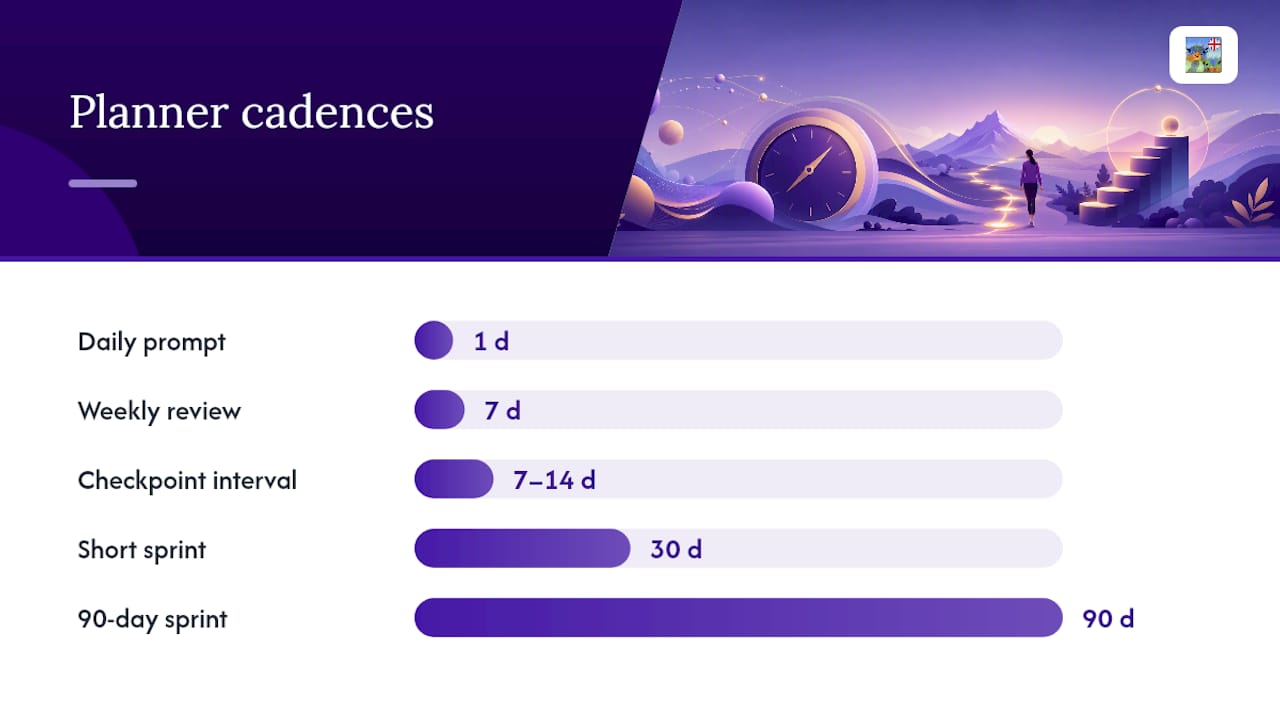
- Do a two-minute morning check-in. Write today's date, glance at your active milestone, and note one action you'll take today. That's it. This isn't a journaling session; it's a compass check.
- Do a sixty-second nightly review. Did you do the thing? Check a box or circle yes/no. If not, write one word about why (tired, busy, forgot). Patterns show up fast once you have a week of these notes.
- Set aside fifteen minutes on Sunday for a weekly plan. Look at the coming week's calendar, decide which three days you'll act on each goal, and write it down. Vague intentions like "exercise more this week" rarely survive Wednesday.
- Reflect monthly on what's actually working. Reread your daily notes. Are you hitting milestones on schedule, ahead, or stalled? Adjust the milestone timeline rather than the goal itself.
- Run a quarterly reset. Every three months, retire finished goals, promote a new one from your "someday" list, and rewrite your milestones with what you've learned about your own pace.
Pro Tip: Keep your nightly review under sixty seconds. The moment journaling starts to feel like homework, most people quit within two weeks. Short and boring beats long and abandoned.
A sample seven-day workflow you can copy this week
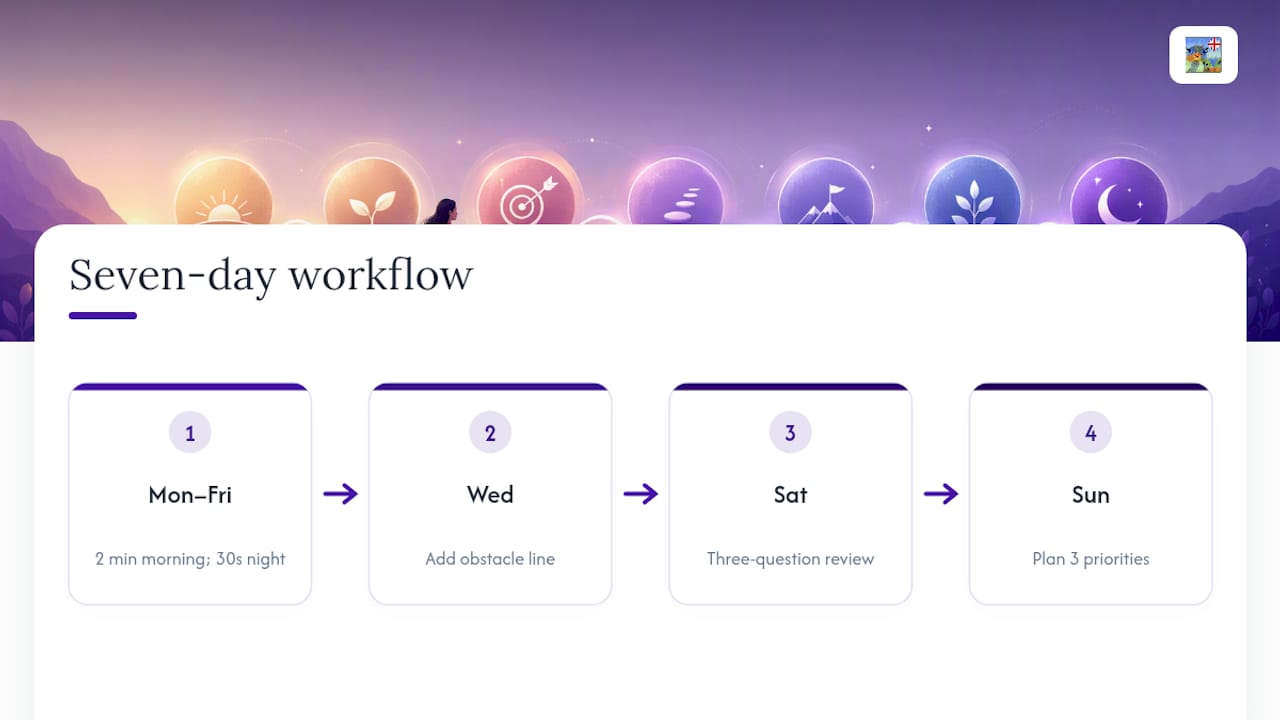
Monday through Friday, spend two minutes each morning writing the day's single most important action toward your top goal, then thirty seconds each night marking it done or not. Wednesday, add one extra line noting any obstacle that came up. Saturday, skip the daily prompt and instead answer three questions: What moved forward this week? What stalled? What's the one thing you'll do differently next week? Sunday, write next week's three priority actions before you go to bed, so Monday morning doesn't start with a blank page and a decision fatigue problem.
Pairing this with a simple visual tracker helps more than most people expect. A basic habit tracker that tracks just one or two habits at a time tends to outperform elaborate multi-habit grids, mostly because it's easier to glance at and actually keep up.
What Should You Check Before Buying a Goal Journal?
Most people choose a journal based on the cover design. That's backwards. Use this checklist on the product page before you buy anything:
- Prompt type: Are the prompts specific ("What's one obstacle you can remove this week?") or generic filler ("How do you feel today?")? Specific prompts do more work for you.
- Review pages: Does the layout include weekly or monthly reflection spreads, or only daily entries? Without review pages, you'll write a lot and notice very little.
- Habit tracker presence: A built-in tracker grid saves you from designing your own, and it's one of the features buyers consistently rate highest in reviews.
- Paper and binding quality: Confirm GSM weight if listed, and check whether the binding lies flat.
- Portability: If you plan to journal on a commute or during a lunch break, a bulky hardcover planner will stay home.
- Price relative to what you'll use: A $12 undated notebook you fill out daily beats a $45 planner you use twice.
Match the journal to your actual habits, not your aspirational ones
Ask yourself three honest questions before buying. Do you already write daily, even informally, or would this be a new habit? Do you prefer being told what to write, or do open prompts feel restrictive to you? Is your schedule stable enough for a dated format, or does it shift week to week? Your answers point toward guided versus blank and dated versus undated far more reliably than any bestseller list.
Red flags that predict an abandoned journal
Watch for journals with prompts so generic they could apply to any goal ("What do you want?" repeated on every page), no tracking mechanism at all, or a page layout so dense it feels like homework before you've written a word. A journal that photographs beautifully for social media but gives you three lines to answer a complex question is designed to sell, not to be used.
Ready-to-Copy Prompts and Sprint Templates
You don't need to wait for the "perfect" journal to start. These templates work in any notebook, printable, or guided journal you already own.
Vision and goal-definition prompts (use once, at the start of a new goal or sprint):
- What does success look like in plain, specific terms, three months from now?
- Why does this goal matter to you right now, not just in general?
- What's the smallest version of this goal that would still feel like a win?
- What has stopped you from reaching this goal before?
- Who or what will you need to say no to in order to protect time for this?
Daily morning prompt (three lines, no more): Today's single priority action. One obstacle you expect. One thing you're grateful for or looking forward to.
Daily evening prompt (two lines): Did you complete today's priority action, yes or no? One sentence on why or why not.
Weekly review template (three questions plus an action list):
- What moved forward this week?
- What got stuck, and why?
- What's one adjustment for next week?
Follow those with a short bulleted action list: three concrete tasks for the coming week, written the night before Monday starts, not the morning of.
30/90/100-day sprint template: Set one goal, write it on page one with a target completion date. Add milestone checkpoints every seven to fourteen days, since shorter checkpoint intervals help reduce overwhelm and keep momentum going better than a single distant deadline. At each checkpoint, rate your progress from one to five and write one sentence on what needs to change before the next checkpoint.
Two quick examples show how this plays out. A reader training for a half marathon used the 90-day sprint template with checkpoints every two weeks. Their daily prompt tracked mileage and their weekly review flagged a recurring Tuesday scheduling conflict by week three, so they moved that run to Wednesday and stopped missing sessions. A second reader building a freelance client base used the vision prompts to define "steady" as three retained clients by month three, then used weekly reviews to notice that outreach emails sent on Fridays got far fewer replies than Tuesday emails, and adjusted accordingly.
Behavioral research backs the underlying mechanism here: committing goals to paper measurably increases follow-through compared with simply thinking about what you want to achieve. The templates work because writing forces specificity, and specificity is what turns a wish into a plan.
Guided Journals vs. Blank Notebooks vs. Digital Hybrids
Each format has a real tradeoff, not just a style preference attached to it.
Guided journals give structure and lower the barrier to starting, since practitioner reviews consistently report higher adherence among people who start with prompts rather than a blank page. The tradeoff: prompts that don't fit your specific goal can feel like filler, and you're locked into someone else's format.
Blank notebooks offer full flexibility and grow with you as your system evolves. The tradeoff: they demand more self-discipline upfront, and beginners often abandon them within the first two weeks because there's no built-in next step.
Digital hybrids let you edit, resize, and duplicate templates endlessly, and they travel on a phone you already carry. The tradeoff: screens invite distraction, and the tactile habit of physically writing goals down is part of what makes writing them effective in the first place, according to the same written-goal research cited above.
Here's the practical mapping. If you've never journaled consistently, start guided. If you've journaled for years and have your own system, blank notebooks won't frustrate you the way they frustrate a beginner. If you're managing complex, multi-part projects across work and life, a paper journal for high-level mapping paired with a digital tool for daily task execution tends to work better than forcing everything into one format.
What Do Goal Setting Journals Typically Cost?
Physical goal journals generally run from $10 to $25 for a standard paperback or softcover format, and $20 to $45 for hardcover planners with premium paper, ribbon markers, or elastic closures. Printable and digital versions tend to sit lower, often between $5 and $20, since there's no print or shipping cost baked in. Sprint-style journals (30, 90, or 100 days) often price toward the lower end of these ranges because they're shorter and use fewer pages.
The cost that actually matters is the cost per use, not the sticker price. A $12 undated notebook you fill out daily for six months costs about $0.07 per day. A $40 guided journal used for two weeks before it lands in a drawer costs closer to $3 a day. Price relative to your commitment level matters more than which format costs more upfront.
Digital hybrids sometimes carry a subscription fee if they're tied to an app, which changes the math over a year. A one-time $15 printable workbook you reprint each quarter can end up cheaper over twelve months than a $5-per-month subscription planner, depending on how many goals you're actually running.
How Long Before a Goal Journal Shows Results?
Most people notice a shift in clarity within the first one to two weeks, simply from writing goals down and breaking them into milestones. That's not the same as achieving the goal. It's the moment vague ambition turns into a specific plan you can act on daily.
Measurable progress on the goal itself usually takes four to eight weeks of consistent use, which lines up with why so many guided journals default to 30 or 90-day sprint formats. Shorter sprints show visible movement fast enough to keep you motivated. Longer goals, like a career change or a fitness transformation, often need three to six months of sustained tracking before the milestone checkpoints show a clear trend line rather than noise.
Set expectations around consistency, not calendar time. Someone who journals five days a week will see patterns faster than someone who journals sporadically, regardless of which journal they bought. If you're two weeks in and don't see dramatic change, that's normal, not a sign the format is wrong. Give any new system a full sprint cycle, 30 days minimum, before deciding whether to switch formats or adjust your goals.
Munkter Products Journals Mapped to What You Need
Picking a journal gets a lot easier once you match the format to how you actually work, rather than how you wish you worked.

If you're starting your first journal and want the prompts and milestone tracking already built in, a guided goal journal removes the guesswork on day one. If your schedule shifts week to week and dated pages would just pile up unused, an undated format lets you start whenever life allows without wasting pages. And if you're chasing one specific goal, whether that's a fitness target or a creative project, a focused journal like the women's gym journal shows how a niche format maps its features directly to a single outcome instead of spreading thin across everything at once.
A quick buying tip: choose undated if you value flexibility over structure, and check the paper weight before buying if you plan to use markers or gel pens for habit trackers, since thin paper bleeds through fast. The checkout process includes postage, so there are no surprise costs at checkout. Browse the travel journal if you want a portable option built for daily entries on the move, or check the activity and puzzle books collection if a guided workbook format fits your goals better than a traditional journal layout. Either way, the next step is simple: pick the format that matches your schedule and add it to cart today.
Why Most Goal Journals Fail (And What Actually Works)
Here's the uncomfortable truth about goal journals: the format matters less than most buying guides claim, and the habit around it matters more than almost anyone admits when they're trying to sell you a $40 planner.
I've watched the same pattern play out over and over. Someone buys a beautifully designed journal, writes enthusiastic entries for four days, then stops. The problem was never the paper quality or the prompt design. It was that nobody told them the two-minute morning check-in matters more than the elaborate weekly spread they spent twenty minutes filling out once and never touched again.
The micro-habit that actually moves the needle isn't the big monthly reflection everyone loves to talk about. It's the sixty-second nightly review, the one where you just circle yes or no on whether you did the thing. Customers who stick with a journal past the first month almost always mention some version of that small, boring ritual, not the inspirational prompts on the cover.
Where I'd push back on conventional wisdom: a lot of goal-setting advice treats the journal itself as the solution. It isn't. It's a mirror. If you're inconsistent with the habit around it, a $50 leather-bound planner performs identically to a free notebook you found in a drawer. The research on written goals improving follow-through backs this, but it also gets misquoted constantly to sell premium journals when the real lesson is simpler: write it down, check it daily, and the format is secondary.
That said, format isn't nothing. For someone who has never journaled before, a guided layout with a built-in tracker removes the exact friction point that kills most first attempts, which is why a combination leaning toward guided options for beginners is often recommended, while still providing undated and blank options for readers who already know what they want.
— Mark
Sources
- The power of writing about goals (example behavioral science literature)
- Self-regulation and scheduled review research (APA record)
- 6 Best Goal Setting Journals to Help You Stay on Track - LifeHack