

TL;DR:
- A self-help journal is a structured writing practice aimed at enhancing self-awareness and emotional resilience. Consistent journaling, especially when combined with mindfulness and gratitude techniques, improves emotional well-being and reduces stress. Challenges like writer’s block and lack of time can be addressed by prompts and short, routine sessions.
A self-help journal is defined as a dedicated writing practice where you regularly record thoughts, emotions, and reflections to build self-awareness and emotional resilience. This self-help journal guide covers everything you need to start, structure, and sustain that practice. Research confirms that journaling boosts mood and eases stress, making it one of the most accessible tools for personal development. The practice spans several styles, from expressive writing and gratitude journaling to mindfulness-based reflection, each targeting a different aspect of well-being.
What is a self-help journal and how does it work?
A self-help journal is a structured writing practice focused on emotional processing, self-reflection, and personal growth. Unlike a diary, which records events, a self-help journal asks you to examine why those events affect you and what you want to do differently. That shift from narration to reflection is where the real value lives.
The most recognized method in this space is the expressive writing protocol developed by psychologist James Pennebaker. His research shows that writing 15–20 minutes for 3–4 consecutive days produces measurable improvements in emotional processing. The key mechanism is externalization: putting a thought on paper removes it from the loop in your head and makes it easier to examine objectively.
Self-help journaling also overlaps with positive psychology techniques. Practices like "best possible self" writing and gratitude journaling fall under positive expressive writing, which reliably improves wellbeing and positive affect in non-clinical populations. Knowing which style fits your current goal helps you get results faster.
How to set up your tools and space before you start
The right setup removes friction and makes it easier to show up consistently. You do not need expensive equipment. What you need is a tool you will actually use and a space where you feel safe writing honestly.

Choosing your journaling tool
| Tool | Best for | Key advantage | Limitation |
|---|---|---|---|
| Physical notebook | Deep reflection and mindfulness | No notifications, tactile focus | Cannot search or back up entries |
| Journaling app | Busy schedules, on-the-go writing | Accessible anywhere, searchable | Screen distractions possible |
| Voice notes | Processing emotions quickly | Fast and natural | Harder to review and reflect later |
A personalized journal increases commitment because it feels like yours from the first page. Physical journals also remove the temptation to switch tabs or check notifications, which protects the quality of your reflection time.
Preparing your environment and mindset
Your journaling space should be quiet, comfortable, and free from interruptions. Even a corner of a room with a consistent chair and good lighting works. The goal is to create a sensory cue that tells your brain it is time to reflect.
Before your first session, clarify your motivation. Ask yourself: are you writing to manage anxiety, build self-awareness, process a specific situation, or simply develop a daily self-care habit? That answer shapes which prompts and styles you use. BBC Bitesize recommends starting small with accessible tools and linking journaling to existing routines, such as writing right after your morning coffee or before bed.
- Choose one consistent time of day for your sessions
- Keep your journal and pen in a visible spot as a visual reminder
- Set a timer so you commit to the full session without watching the clock
- Write your core motivation on the first page so you see it every time you open the journal
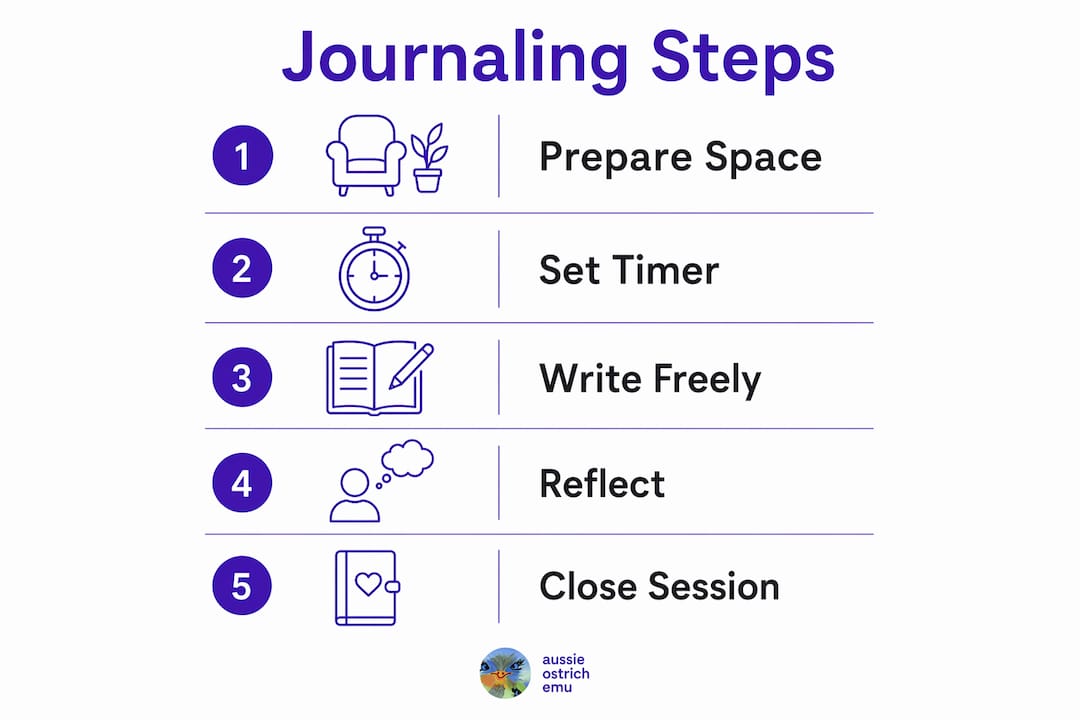
How to structure an effective self-help journaling session
Structure is what separates a productive journaling session from aimless venting. A clear routine helps you process emotions deeply and walk away with something useful.
Step-by-step session structure
-
Set your timer for 15–20 minutes. The expressive writing protocol requires strict adherence to this time limit across consecutive days to gain the full cognitive processing benefit. Shorter sessions can still help, but consistency matters more than length.
-
Choose a focus topic. Pick one emotion, situation, or question to explore. Broad topics produce shallow writing. A prompt like "What am I avoiding right now and why?" produces more insight than "How was my day?"
-
Write continuously without editing. Do not stop to correct spelling or reread sentences mid-session. Editing activates your inner critic and interrupts the flow of honest reflection. Write as if no one will ever read it.
-
Go deeper on the emotion, not just the event. Describe how a situation made you feel, what belief it triggered, and where you have felt that before. This is where journaling shifts from narration to genuine self-reflection.
-
Use positive expressive writing techniques when appropriate. Writing about your "best possible self," a future where things have worked out, or three things you are grateful for shifts your focus toward growth rather than rumination.
-
End with a reframe or next step. Ending each session with one concrete insight or action prevents journaling from becoming emotional dumping. Ask yourself: "What is one thing I can do differently based on what I just wrote?"
For a wide range of prompts to guide your sessions, the journaling prompts list at Munkterproducts covers over 60 ideas across growth, gratitude, and self-reflection categories.
Pro Tip: If you miss a day, do not restart the count. Simply continue the next day. Consistency over weeks matters far more than a perfect streak.
How do mindfulness and gratitude improve your journaling practice?
Mindfulness and gratitude are not add-ons to journaling. They are multipliers. When you bring deliberate attention and appreciation into your writing, the emotional benefits deepen significantly.
A systematic review and meta-analysis found that mindfulness-based interventions with gratitude components moderately reduce anxiety, depression, and stress. The largest effects appeared in programs lasting 8–12 weeks. That finding points to a practice mindset: short bursts help, but sustained effort produces the real shift.
The mechanism behind this synergy is straightforward. Mindfulness trains you to notice your thoughts without reacting to them. Gratitude redirects attention from what is wrong to what is working. Together, they shift focus from rumination to appreciation and connectedness, which enhances emotional regulation and life satisfaction.
Practical mindfulness and gratitude exercises to weave into your sessions:
- Mindful check-in: Before writing, take three slow breaths and name one physical sensation, one emotion, and one thought you notice right now.
- Gratitude specificity: Write three things you are grateful for, but describe why each one matters. Vague gratitude ("I am grateful for my family") produces less benefit than specific gratitude ("I am grateful my sister called to check on me today because it reminded me I am not alone").
- Savoring exercise: Describe one positive experience from the past 24 hours in sensory detail. This builds the habit of noticing good moments as they happen.
- Mood tracking: Rate your mood on a scale of 1–10 before and after each session. Tracking mood ratings helps you gauge which prompts and styles work best for you personally.
A 30-day gratitude practice, like the kind supported by structured gratitude tools, pairs naturally with journaling to build the appreciation habit outside of writing sessions too.
What are the most common journaling challenges and how do you fix them?
Consistency is the hardest part of any journaling practice. Most people do not quit because journaling stops working. They quit because life gets busy and the habit loses its anchor.
Writer's block is the most common early obstacle. The fix is simple: use a prompt. A question like "What emotion have I been carrying this week?" or "What would I tell a friend in my exact situation?" bypasses the blank-page paralysis immediately. The role of motivational journals in personal growth is partly about having that external nudge built into the format itself.
Lack of time is the second most common barrier. The solution is not to find more time. It is to shrink the session. A five-minute entry that ends with one clear insight beats a skipped session every time. Journaling works best when it balances structure with flexibility, so give yourself permission to write less on hard days without abandoning the practice entirely.
Emotional discomfort during writing is normal and often signals that you are touching something real. The key is to stay curious rather than judgmental. If a topic feels too heavy, write about your resistance to it instead. That indirect approach often opens the door more gently.
Recognize when journaling is not enough. Journaling is a support tool for wellbeing, not a replacement for professional care. If you are processing trauma, severe depression, or persistent anxiety, a licensed therapist provides the clinical support that writing alone cannot.
Pro Tip: Link your journaling session to a habit you already do every day, like making coffee or brushing your teeth at night. That pairing removes the decision of when to write and makes the habit automatic within two to three weeks.
Key Takeaways
Consistent, structured self-help journaling builds emotional clarity and self-awareness faster than unguided writing, especially when combined with mindfulness and gratitude practices.
| Point | Details |
|---|---|
| Define your purpose first | Clarify your motivation before starting so your prompts and style match your actual goals. |
| Follow the 15–20 minute rule | The expressive writing protocol shows this duration across consecutive sessions produces the deepest emotional processing. |
| End every session with a reframe | Close with one insight or next step to convert emotion into usable learning rather than venting. |
| Add mindfulness and gratitude | Eight to twelve weeks of combined mindfulness and gratitude practice produces moderate reductions in anxiety and stress. |
| Track your mood | Rating your mood before and after each session reveals which prompts work best for you personally. |
Why I think most people underestimate what a journal can actually do
Most people treat journaling as a mood diary. They write when something goes wrong, vent for a few minutes, and close the book feeling slightly better but no clearer. That is journaling as emotional release. It is useful, but it is not the full picture.
What I have observed over years of working with people who journal seriously is that the real shift happens around week four or five. That is when patterns start to appear. You notice you write about the same fear in different costumes. You see that your frustration on Tuesday is almost always connected to something you did not say on Monday. That level of self-awareness does not come from one session. It comes from the accumulation of honest writing over time.
The mindfulness component is where most guides fall short. They tell you to "be present" without explaining what that means in practice. Bringing a simple three-breath check-in before you write changes the quality of everything that follows. You stop writing from the surface and start writing from somewhere more honest.
Gratitude journaling gets dismissed as soft or simplistic. The research disagrees. The specificity of what you are grateful for and why is what makes it work. Generic gratitude is a habit. Specific gratitude is a practice. The difference shows up in how you feel six weeks in.
Start small. Write badly. End with one clear thought. That is the whole method, and it is more than enough to change how you understand yourself.
— Mark
Journals and prompts from Munkterproducts to support your practice

Munkterproducts carries a range of handcrafted self-help journals and planners designed for exactly this kind of intentional, reflective writing. Each journal is built to support a consistent daily practice, with layouts that guide your sessions without restricting your voice. Whether you are starting fresh or looking to deepen an existing habit, the self-help journals at Munkterproducts pair well with the structured methods covered in this guide. Postage is included, and the catalog covers everything from themed gratitude journals to open-format notebooks for expressive writing.
FAQ
What is self-help journaling?
Self-help journaling is a regular writing practice focused on emotional processing, self-reflection, and personal growth. It differs from diary writing by asking you to examine your thoughts and feelings, not just record events.
How long should a self-help journal session be?
Research on the expressive writing protocol recommends 15–20 minutes per session. Shorter sessions still help, but consistency across multiple days produces the deepest cognitive and emotional benefits.
What are good self-help journal prompts to start with?
Strong starting prompts include "What emotion have I been avoiding this week?" and "What would I tell a close friend in my exact situation?" Gratitude prompts like "What specific thing am I grateful for today and why?" also produce reliable wellbeing improvements.
How often should I write in my self-help journal?
Daily writing builds the strongest habit, but three to four sessions per week is enough to see meaningful benefits. Linking your sessions to an existing daily routine, like morning coffee or an evening wind-down, improves consistency.
When should I seek professional support instead of journaling?
Journaling supports wellbeing but does not replace clinical care. If you are processing trauma, severe depression, or persistent anxiety that does not ease with regular writing, a licensed therapist provides the level of support that journaling alone cannot offer.