

Pick one to three specific habits, choose a format you will genuinely open again tomorrow (paper grid, app widget, or hand-drawn heatmap), and set a five-minute weekly review. Do that tonight, log your first entry, and you have already outperformed most people who buy a fancy notebook and quit by day nine.
TL;DR:
- Tracking one to three habits with a simple format and weekly review significantly increases the chances of maintaining the behavior long-term.
- Using a tracking mode that matches the habit, such as checkbox, count, or duration, helps prevent abandonment caused by mismatched logging methods.
- Less polished systems like a plain calendar or paper grid with weekly reviews outperform elaborate trackers without review elements, especially for sustaining habits over time.
- Starting with clear, measurable habits like "walk 20 minutes" or "eat one vegetable at lunch" improves honest logging and reduces cheating.
- The key to effective habit tracking is consistency in reviews and small design changes rather than visual appeal or complex setups.
Table of Contents
- Habit Tracker Ideas by Life Area
- Which Habit Tracker Format Fits You?
- How to Choose What to Track
- Make Your Tracker Stick: Reviews, Misses, and Cues
- Copyable Habit Tracker Templates for Tonight
- Resources for Building Your Tracker
- The Part Everyone Gets Wrong About Habit Trackers
- Turn These Ideas Into a Tracker You Will Actually Use
- Sources
Habit Tracker Ideas by Life Area
The habits below are grouped by life area, with a one-line rule for what counts as "done" and which logging mode to use: checkbox for yes/no, count for repetitions, or duration for time. Matching the mode to the behavior matters more than most people realize, since a mismatched mode is often what causes people to quietly abandon a tracker within a few weeks.
Health
- Drink water: count (log glasses, target 6 to 8)
- Take medication or vitamins: checkbox (done or not done, no partial credit)
- Sleep by 11 p.m.: checkbox (in bed with lights off counts)
- Move for 20 minutes: duration (walk, stretch, or workout, any type)
- Eat one vegetable at lunch: checkbox
Focus
- Deep work block: duration (log actual minutes, not planned minutes)
- Phone-free first hour: checkbox
- Inbox to zero: checkbox (once daily, end of day)
- Single most important task done before noon: checkbox
Wellbeing
- Three-sentence journal entry: checkbox (any length over three sentences counts)
- Gratitude note: count (log how many things, aim for one to three)
- Meditation or breathing: duration (even two minutes counts)
- Call or text a friend: checkbox
Home
- Make the bed: checkbox
- Dishes cleared before bed: checkbox
- One five-minute tidy: duration
- Meal prep for tomorrow: checkbox
Creativity
- Write 200 words: count
- Sketch or doodle: duration (10 minutes minimum)
- Practice an instrument: duration
- Read 10 pages: count
Notice the pattern: vague goals like "be healthier" or "be more creative" never show up. Every entry is something you can look at tonight and say yes or no to.
Which Habit Tracker Format Fits You?
The five common formats are the paper journal, the bullet journal grid, a dedicated app, the calendar X-method, and the spreadsheet. Each one trades off differently between friction, visibility, and flexibility.
- Paper journal or notebook: zero setup friction, always visible if left open on a desk, but no reminders and easy to lose a page.
- Bullet journal grid: highly customizable and satisfying to fill in by hand, though it takes longer to build and rebuild each month.
- Dedicated app: built-in reminders and streak math, but only works if you actually open the app instead of swiping away the notification.
- Calendar X-method (the classic wall calendar with a big X on each done day): brutally simple and visible from across the room, but limited to binary logging only.
- Spreadsheet: best for people who want charts, counts, and multi-habit views, though it lives on a screen you may not open daily.
Here is a 30-second experiment worth running before you commit: open whatever tool you are considering right now, and time how long it takes to log one habit from a cold start. If it takes longer than 15 seconds, that format will lose to your phone's home screen within two weeks. This is the same reasoning HabitBox uses to recommend choosing by friction and portability over aesthetics. A gorgeous hand-lettered spread means nothing if you stop opening the notebook by week three. Pick the format you will actually touch, not the one that photographs best.
How to Choose What to Track
Start with one to three habits, not ten. The sweet spot once you have momentum is three to five, and guides consistently point to this range because tracking too many habits at once is the single fastest way to quit within a month.
- Write the vague version first. "Exercise more" or "eat better" are goals, not trackable habits.
- Convert it to something falsifiable. "Exercise more" becomes "walk 20 minutes" or "do 10 push-ups." "Eat better" becomes "eat one vegetable at lunch."
- Assign the right data type. Binary checkbox for anything yes/no (took vitamins, made bed). Count for repetitions (glasses of water, pages read). Duration for time-based activity (meditation, deep work, exercise).
- Cap yourself at three habits for the first two weeks. Add a fourth only once the first three feel automatic.
Pro Tip: If a habit feels hard to log honestly, it is usually because the definition is still vague. "Read more" invites cheating. "Read 10 pages" does not.
Make Your Tracker Stick: Reviews, Misses, and Cues
A tracker without a weekly review just becomes a guilt log. Block five to ten minutes once a week to count completions, spot which habit gets skipped most, and ask why. That single question turns raw data into a design fix, which is the whole point of tracking in the first place, according to Psychology Today's breakdown of habit tracking.
Here is the research that should change how you feel about missed days: Lally et al. found that missing a single day had no measurable effect on whether a habit eventually stuck, as long as the person resumed right away. One miss is noise. Two misses in a row is a signal, and that is when to act, not before.
- Resume the habit the very next day after a single miss, no exceptions.
- If you miss twice in a row, use the weekly review to ask what changed.
- Make one small design change per week, never more (move the tracker, shrink the target, change the time).
- Pair a new habit with an existing one (track flossing right after brushing, already logged on your bathroom mirror).
James Clear's advice on habit trackers backs this up: the best trackers work because they act as visible cues, not because they are elaborate. A calendar taped to your fridge beats a beautiful app buried three screens deep.
Copyable Habit Tracker Templates for Tonight
You do not need to design anything from scratch. Grab a pen, a notebook page, or an app widget and pick one of these.
- Monthly grid. Draw habits down the left, days across the top, one small box per cell. Best for three to five habits you want to see at a glance for the whole month.
- Heatmap or year-in-pixels. One row of 365 tiny squares, colored in daily based on how the day went. Best for mood or energy tracking where nuance beats a plain checkbox.
- Weekly checklist. Seven columns, refreshed every Monday. Best for anyone who finds a full month grid intimidating and needs a smaller weekly commitment.
- Streak counter. A single running number you update daily, no grid at all. Best for one keystone habit you want to protect above everything else.
- Sticker chart. Physical stickers on a printed grid. Best for tactile learners and anyone tracking habits with kids at home.
A pack of fine-liner pens or a sheet of dot stickers is often the only tool you need for the first three templates.
Resources for Building Your Tracker
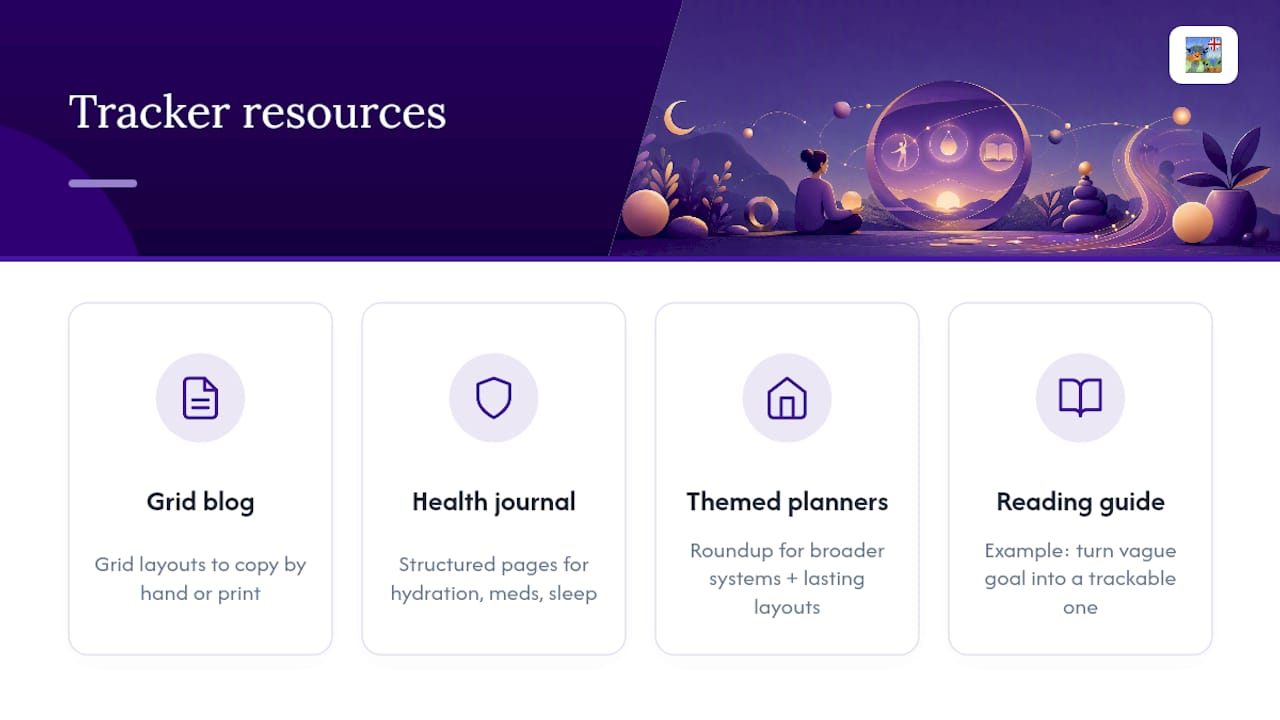
Munkterproducts publishes a few resources that map directly onto the formats above. The habit tracker planner blog walks through grid layouts you can copy by hand or print. If your tracked habits lean toward hydration, medication, or sleep, the health journal has structured pages built for exactly that kind of daily logging.
For people who want a broader system rather than a single tracker page, the themed planners for adults roundup shows how to combine aesthetics with a layout you will still use in March. And if reading is one of the habits on your list, the guide to building better reading habits gives a concrete example of turning a vague goal into a trackable one.
The Part Everyone Gets Wrong About Habit Trackers
Most habit tracker advice obsesses over the wrong variable. People agonize over app versus paper, color schemes, and streak counts, when the research keeps pointing somewhere else entirely: the weekly review is what makes tracking work, and almost nobody does it.
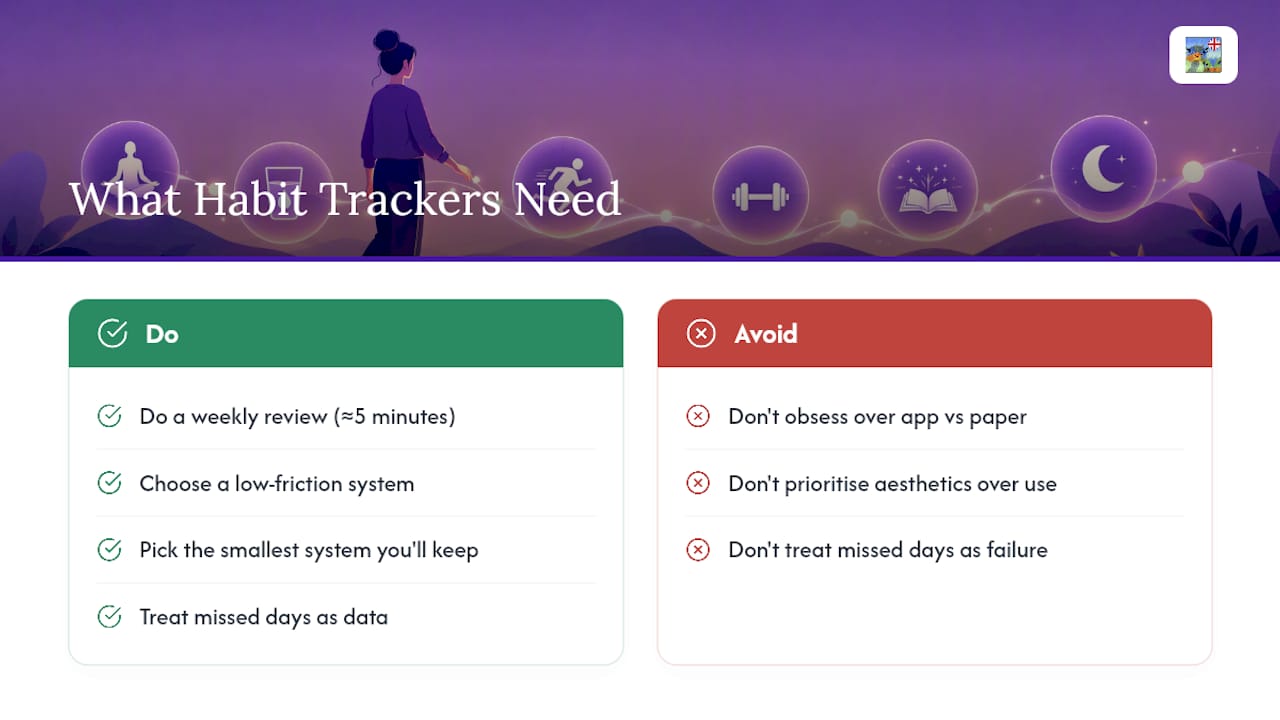
Here is the honest gap: a beautiful bullet journal spread with zero review behind it is just decoration. A plain checkbox on a printed calendar, reviewed for five minutes every Sunday, will outperform it every time. The ADHD-friendly tracker systems built for Notion succeed for the same reason paper grids do: low friction beats high polish.
If you take one thing from this article, take this: stop treating a missed day as failure and start treating it as data. Lally's research settled that argument over a decade ago. What the reader should prioritize first is not the prettiest system. It's the smallest one they will still be filling in on a Tuesday in March, three months from now.
— Mark
Turn These Ideas Into a Tracker You Will Actually Use
A tracker only works if you like opening it, which is exactly where Munkterproducts fits. Instead of printing a generic grid off the internet, you get handcrafted journals and planners designed around the habit categories covered above, from hydration and medication logs to creative daily check-ins.

The health journal gives you structured pages for the health habits listed earlier, no setup required. If your household is tracking habits alongside kids, the journals, notebooks, and planners collection covers everything from streak counters to sticker-friendly layouts, and a browse through the Easter activity book shows how the same puzzle-and-tracker format works for family routines too. Order today and your tracker arrives ready for tonight's first check-in.
Sources
- How are habits formed: Modelling habit formation in the real world — Lally et al.
- Habit Tracking: A Primer | Psychology Today
- Habit tracker — James Clear
- Habit Tracker: 2026 Guide + Free Template | MindJrnl