

TL;DR:
- Noah-inspired sci-fi explores themes of survival, rebuilding, and ethical choices after catastrophe.
- The Safehold series by David Weber is a comprehensive military sci-fi adaptation of Noah themes.
- Other works like The Noah Conspiracy and Hogan's Giants series examine ancient origins and survival mythologies.
If you've been searching for "the Noah book series" in science fiction expecting one definitive saga, you're not alone. Plenty of readers arrive at the same question and find the answer surprisingly layered. No single canonical series carries that exact title. Instead, the Noah narrative lives across multiple books and series, each borrowing from the same ancient well of survival, catastrophe, and new beginnings. This article cuts through the confusion and maps out the most significant Noah-inspired science fiction works, what they're really about, and which ones deserve a spot on your reading list.
Table of Contents
- How the Noah narrative inspires modern science fiction
- Safehold: The definitive Noah-inspired science fiction series
- Beyond Safehold: Other science fiction books with Noah themes
- Common themes, audience, and appeal of Noah-inspired sci-fi
- Our take: Why the best Noah-inspired science fiction is about more than survival
- Discover more science fiction worlds and Noah-inspired tales
- Frequently asked questions
Key Takeaways
| Point | Details |
|---|---|
| No single series | There isn't one definitive 'Noah' book series, but several works with Noah-inspired sci-fi themes. |
| Safehold stands out | Safehold offers the richest modern sci-fi take on the Noah narrative, blending survival with tech rebellion. |
| Genre diversity | Noah-themed science fiction comes in various flavors, from military epics to standalone thrillers and YA adventures. |
| Enduring appeal | Themes of survival, renewal, and challenging established order make these stories resonate across generations. |
How the Noah narrative inspires modern science fiction
The story of Noah is one of the oldest survival narratives in human history. A single figure, a catastrophic flood, a vessel carrying seeds of the future. It's almost engineered to work as a science fiction premise. You have a massive extinction event, a chosen group given a lifeline, and the enormous weight of rebuilding everything from scratch. That framework travels remarkably well across genres.
Science fiction has always gravitated toward apocalyptic scenarios because they strip society down to its bones. When everything is destroyed, writers get to ask the really interesting questions: Who decides who survives? What knowledge do we preserve? What mistakes do we repeat? The Noah story packages all of that into one iconic image, which is why so many sci-fi authors reach for it.
Here's a quick look at the ways Noah-inspired narratives show up in science fiction:
- Literal ark stories: A spacecraft or hidden planet serves as the new ark, carrying humanity away from annihilation
- Conspiracy and cover-up stories: Secret societies or ancient events tie back to a real or fictionalized Noah event
- Ancient origins tales: Sci-fi reframes biblical or mythic figures like Noah as ancient aliens, genetically advanced humans, or time travelers
- Allegorical survival: No flood, no ark ship, but the same moral weight of choosing who and what survives a collapse
As one way to frame it:
"The flood is never really about water. It's about what gets saved, what gets lost, and who makes that call."
A strong example of the conspiracy angle is The Noah Conspiracy by Michael Shaara, published in 1981. It's a standalone science fiction novel that takes a speculative look at Noah-linked ancient events with a thriller-style edge. James P. Hogan's Giants series also pulls from this territory, exploring humanity's deep past through a sci-fi lens even without a direct Noah reference.
Understanding why read science fiction in the first place helps explain the pull of these stories. Science fiction gives myth a new address. It takes something ancient and drops it into the future, forcing us to see it fresh.
Safehold: The definitive Noah-inspired science fiction series
If there's one science fiction series that takes the Noah concept and builds a sprawling, detailed world around it, it's Safehold. Written by David Weber, this is a 10-book military sci-fi series published between 2007 and 2019. The premise is built directly on a Noah-style operation.
Humanity is nearly wiped out by an alien species called the Gbaba. To survive, a group of humans launches "Operation Ark" and flees to a distant planet named Safehold. To prevent the Gbaba from ever finding them again, the planet's founders suppress all advanced technology and create a false religion to enforce that suppression across generations. The result is a planet deliberately locked into a medieval-era society, with no memory of Earth or the stars.

The series kicks into motion when a hidden android named Nimue Alban wakes up, carrying the memories of a dead female officer, and begins quietly working to restart human progress. That tension between technological progress and institutional control drives every book.
Here are the core themes that run through the Safehold series:
- Technology versus dogma: Progress is actively criminalized to ensure survival. Innovation becomes an act of rebellion.
- Free will and authority: Who has the right to decide what a society knows or believes?
- Institutional corruption: The church built to protect humanity has become the very thing threatening it.
- Long-game strategy: Weber loves military detail. Battles, logistics, and strategic planning fill enormous sections of each book.
| Feature | Safehold series | Typical sci-fi series |
|---|---|---|
| Core premise | Operation Ark, Noah parallel | Varies |
| Genre focus | Hard military sci-fi | Broad |
| Themes | Tech suppression, religion, war | Exploration, dystopia |
| Series length | 10 books | 3 to 7 average |
| Tone | Serious, strategic | Wide range |
For readers who enjoy essential sci-fi novels that mix epic scope with philosophical weight, Safehold is a serious commitment, but a rewarding one. Weber also engages deeply with dystopian themes in sci-fi, particularly around what happens when a controlling system outlives its original purpose.
Pro Tip: Start with the first book, Off Armageddon Reef, and give yourself time. The early books are dense with world-building, but the payoff by books three and four is significant.
Beyond Safehold: Other science fiction books with Noah themes
Safehold is the most structured and sustained Noah-parallel series in science fiction, but it's far from the only title worth knowing.
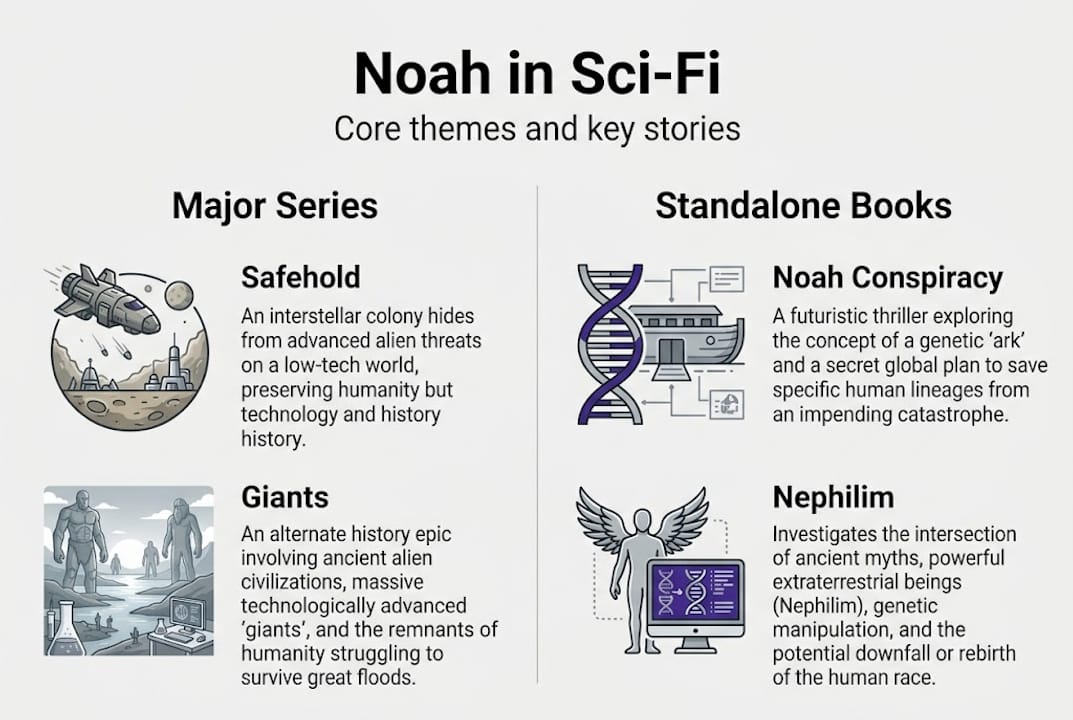
The Noah Conspiracy by Michael Shaara, best known for writing The Killer Angels, takes a very different approach. Published in 1981 and often overlooked, it's a standalone that blends speculative science with a thriller premise rooted in ancient human history. It's a quieter, more philosophical book than Safehold, and it appeals to readers who like their science fiction laced with historical mystery.
James P. Hogan's Giants series works differently again. It doesn't reference Noah by name, but it grapples with questions about ancient humanity, alien contact, and the true origins of civilization. Those themes place it firmly in the same conceptual territory, even without a flood narrative.
Here's how these titles compare:
| Title | Author | Year | Tone | Audience |
|---|---|---|---|---|
| Safehold series | David Weber | 2007 to 2019 | Military, serious | Adult sci-fi fans |
| The Noah Conspiracy | Michael Shaara | 1981 | Thriller, philosophical | Adult literary fans |
| Giants series | James P. Hogan | 1977 to 2005 | Speculative, cerebral | Adult sci-fi fans |
What makes these books interesting as a group:
- Each one literalizes a different part of the Noah myth (the ark, the cover-up, the ancient origins)
- They span decades, showing the myth's lasting grip on speculative imagination
- Tone ranges from gripping military strategy to quiet intellectual mystery
- All three question whether humanity's "official story" about itself is the real one
For a broader look at where these books fit, check out this sci-fi reading checklist or explore science fiction novel traits to understand what separates these works from straight-up historical fiction or fantasy.
Common themes, audience, and appeal of Noah-inspired sci-fi
These books don't share a publisher or a universe, but they share a heartbeat. Once you read a few, the common DNA becomes obvious.
The biggest shared themes across Noah-inspired science fiction:
- Cataclysm as catalyst: Destruction isn't the end of the story. It's the beginning.
- Survival ethics: Who deserves to survive? Who decides? These are never clean questions.
- Knowledge and power: What you know (or aren't allowed to know) shapes everything.
- Tradition versus innovation: Every Noah story puts a new society in tension with its own founding rules.
- Rebuilding as both gift and burden: Starting over sounds hopeful, but it carries enormous responsibility.
The Safehold series offers hard military science fiction with meticulous world-building around tech suppression and rebellion. It's best for readers who enjoy strategic depth alongside their philosophy. Lighter, more accessible entries (like YA-leaning Noah-themed adventures) give younger readers a way into the same ideas without the complexity of ten-volume commitments.
Chronicles of the Nephilim, a separate series, takes the darkest angle: biblical cosmology treated as literal history, with giants, ancient wars, and theological stakes baked into every chapter. It's closest to supernatural fantasy, but its speculative literalism gives it a sci-fi edge.
Pro Tip: If you prefer your Noah stories grounded and tactical, start with Safehold. If you like mystery and deep history, The Noah Conspiracy is a weekend read worth your time. If you want mythology treated with absolute seriousness, the Nephilim angle is its own rabbit hole.
Exploring how sci-fi books shape culture shows why these stories matter beyond entertainment. And if you want to understand what separates a satisfying series from a forgettable one, this look at key sci-fi series traits breaks it down clearly.
Our take: Why the best Noah-inspired science fiction is about more than survival
Here's what most listicles miss: the Noah story isn't really about surviving a flood. It never was. The flood is the setup. What actually matters is everything that comes after, and that's exactly where the best Noah-inspired science fiction does its most interesting work.
The stories that stick aren't the ones where humanity escapes destruction. They're the ones that ask what kind of humanity escapes. Safehold doesn't just move the ark to space. It makes the act of preserving humanity into a trap, a lie, a prison. The people who designed Operation Ark thought they were saving the species. They were also stealing its future.
That's the uncomfortable truth these books keep circling: salvation and control often arrive in the same vehicle. The Safehold series literalizes ancient cosmological ideas as functional narrative tools, which gives the whole story a mythic weight that pure military sci-fi rarely achieves.
Science fiction for families exploring these themes can use the Noah framework as a conversation starter about authority, knowledge, and what we owe each other when everything is on the line. The best sci-fi doesn't answer those questions. It just makes sure you can't stop asking them.
Discover more science fiction worlds and Noah-inspired tales
Ready to build your reading list around these worlds?

At Munkter Products, the science fiction book selection is curated with exactly this kind of reader in mind: someone who wants stories that carry weight, spark questions, and don't let you put them down easily. Whether you're drawn to hard military sci-fi like Safehold or want to explore the more philosophical edges of Noah-themed narratives, there's a starting point here for you. Learn how to build a sci-fi collection that reflects your taste and grows with your reading appetite.
Frequently asked questions
Is there an official 'Noah' book series in science fiction?
No, there isn't a single definitive series carrying that title. Several novels and series use Noah-inspired themes and storylines across science fiction, each taking a different approach.
What is the Safehold series about?
Safehold is a 10-book military sci-fi series by David Weber where humanity escapes alien extinction through "Operation Ark," hiding on a distant planet deliberately kept in a medieval state to avoid detection.
Are there standalone sci-fi books with Noah themes?
Yes. The Noah Conspiracy by Michael Shaara and James P. Hogan's Giants series both explore ancient human origins and survival narratives in standalone or loosely connected science fiction formats.
What common themes do Noah-inspired sci-fi stories explore?
These stories consistently explore survival and tech suppression alongside rebuilding civilization, ethical choices under pressure, and the ongoing tension between established tradition and human innovation.