

TL;DR:
- Science fiction is a thought experiment exploring scientific principles and their impact on society.
- Key traits include a novum, internal logic, cognitive estrangement, and philosophical themes.
- The genre has evolved through milestones like Mary Shelley's Frankenstein and influences real-world technology.
Science fiction is one of the most misunderstood genres in all of literature. Ask someone to describe it, and you'll likely hear something about robots, laser guns, or little green aliens. That picture is incomplete. A science fiction novel is really a thought experiment dressed in a story, using imagined science and technology to ask hard questions about who we are and where we're headed. From Mary Shelley's Frankenstein to Frank Herbert's Dune, the genre has shaped culture, sparked real inventions, and challenged readers to think differently. This article breaks down what a science fiction novel actually is, its defining traits, its history, and why it matters far beyond the spaceship on the cover.
Table of Contents
- Defining a science fiction novel
- Essential traits and common themes
- How science fiction differs from other genres
- Subgenres and evolution of science fiction
- A fresh look: Why science fiction matters beyond escapism
- Discover more science fiction inspiration
- Frequently asked questions
Key Takeaways
| Point | Details |
|---|---|
| Core definition | A science fiction novel explores speculative ideas grounded in science and technology. |
| Major traits | Common features include a central scientific concept, 'what if' exploration, and a focus on societal impact. |
| Genre boundaries | Science fiction differs from fantasy through its reliance on scientific plausibility, not magic. |
| Rich subgenres | The genre includes hard SF, soft SF, space opera, cyberpunk, dystopian, and many others. |
| Lasting influence | Science fiction reshapes how we think about technology, society, and the future. |
Defining a science fiction novel
Let's set aside the rockets and ray guns for a moment. At its core, a science fiction novel explores imagined elements grounded in scientific principles, such as advanced technology, space travel, time travel, or futuristic societies, examining their consequences on humanity and society. That definition is broader and more interesting than most people expect.
One concept that scholars use to pin down the genre is the novum, a Latin term meaning "new thing." Every true science fiction novel contains at least one novum, a scientifically grounded innovation or discovery that doesn't exist yet but could, in theory, exist. It might be a faster-than-light drive, a mind-uploading machine, or a genetically engineered plague. The novum is what separates sci-fi from every other genre.
Another key idea is cognitive estrangement, a term coined by theorist Darko Suvin. It describes the way science fiction makes the familiar feel strange. When you read about a society where corporations own governments, or where memory can be erased, you're being pushed to see your own world from a new angle. That discomfort is intentional and valuable.
Here's what separates science fiction from fantasy, its closest genre neighbor:
- Science fiction builds its world on scientific logic, even if that logic is speculative.
- Fantasy relies on magic, gods, or supernatural forces with no scientific explanation.
- Science fiction asks "what if this were possible?" Fantasy asks "what if magic were real?"
Internal consistency matters enormously. A science fiction novel must follow its own rules. If faster-than-light travel is possible in the story's universe, the author must apply that consistently. Breaking internal logic pulls readers out of the experience and weakens the story's credibility.
"The best science fiction does not predict the future. It prevents it by showing us what could go wrong if we aren't paying attention."
Exploring the benefits of reading sci-fi reveals how deeply this genre can sharpen critical thinking, boost empathy, and even influence career choices in science and technology. Understanding what counts as sci-fi is the first step toward appreciating just how wide that door really is.
Essential traits and common themes
With a working definition in mind, let's look at the qualities that consistently show up in science fiction novels.
According to genre scholars, key characteristics include a novum, internal scientific logic, cognitive estrangement, extrapolation from current science, a sense of wonder, and philosophical exploration. These traits work together to create stories that feel both alien and deeply human.
The most common traits you'll find across the genre include:
- Advanced technology that changes how society functions
- Alternate or future societies that reflect or distort our own
- Encounters with the unknown, whether alien life, artificial intelligence, or parallel dimensions
- Ethical dilemmas about what it means to be human
- Exploration of power, including who holds it and who suffers under it
Themes run deep in the best science fiction novels. 1984 by George Orwell uses a surveillance state to dissect political power and individual freedom. The Martian by Andy Weir focuses on human ingenuity and the science of survival. Dune by Frank Herbert weaves together ecology, religion, and imperialism into one of the most layered worlds ever built in fiction. Each of these essential science fiction novels uses its speculative setting to say something urgent about real life.

Statistics back up the genre's consistent preoccupations. Over 80% of sci-fi novels include elements of space travel, alien contact, or both, making these the genre's most recognizable calling cards. But that number also means a significant portion of the genre lives closer to Earth, exploring dystopian themes in sci-fi that feel uncomfortably close to today's headlines.
Pro Tip: When you pick up a new science fiction novel, look for the "big question" it's asking. Is it about identity? Power? Survival? That question is usually the real story, and the spaceships are just the vehicle.
How science fiction differs from other genres
Understanding a genre also means knowing what it isn't. Let's compare science fiction to the genres it's often confused with.
The clearest line is between science fiction and fantasy. Science fiction is distinguished from fantasy by its grounding in scientific plausibility versus magic or the supernatural. In a fantasy novel, a wizard casts a spell. In a science fiction novel, a scientist engineers a virus. Both outcomes might look similar on the surface, but the reasoning behind them is completely different.
"Science fiction's tether to scientific logic is what gives it its power to make us believe in the impossible."
Here's a quick comparison to make the distinction concrete:
| Feature | Science fiction | Fantasy |
|---|---|---|
| Power source | Technology, science | Magic, gods |
| World-building basis | Scientific logic | Mythological or supernatural rules |
| Core question | What could science make possible? | What if magic were real? |
| Classic example | Dune, 1984 | The Lord of the Rings, Harry Potter |
| Tone | Often analytical, cautionary | Often mythic, heroic |
Edge cases exist, of course. Star Wars is often called science fantasy because it uses the visual language of science fiction (spaceships, robots, lasers) but relies on a mystical force with no scientific explanation. It's a useful reminder that genre labels are tools, not cages.
Horror and science fiction also overlap. Frankenstein is both a horror novel and the founding text of science fiction. The difference usually comes down to intent: horror wants to frighten, while science fiction wants to make you think. Often, the best works do both.
Learning the key traits of sci-fi series can help you spot the genre's fingerprints even in stories that don't announce themselves as science fiction. Once you know what to look for, you'll find it everywhere.
Subgenres and evolution of science fiction
Genre boundaries set, it's time to see the spectrum within science fiction itself and how the genre has changed over time.
Major subgenres include Hard SF, Soft SF, Space Opera, Cyberpunk, and Dystopian, with over 20 identified subgenres including Biopunk and Cli-Fi. Each one has its own flavor, audience, and set of concerns.
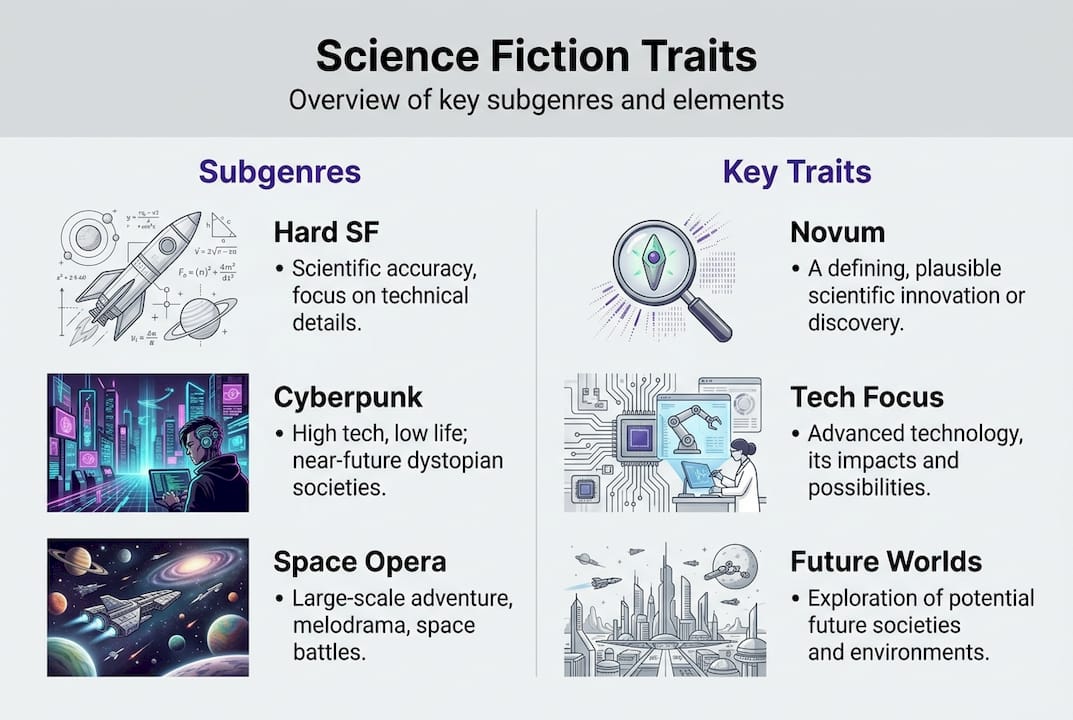
| Subgenre | Focus | Classic example |
|---|---|---|
| Hard SF | Scientific accuracy | The Martian by Andy Weir |
| Soft SF | Social sciences, psychology | The Left Hand of Darkness by Ursula K. Le Guin |
| Space Opera | Epic adventure in space | Dune by Frank Herbert |
| Cyberpunk | Technology, corporate dystopia | Neuromancer by William Gibson |
| Dystopian | Failed or oppressive societies | 1984 by George Orwell |
The history of science fiction traces back to ancient speculative works, but the modern genre really begins with Mary Shelley. Here's a quick timeline of key milestones:
- 1818 Mary Shelley publishes Frankenstein, widely considered the first true science fiction novel.
- 1860s-1900s Jules Verne and H.G. Wells establish adventure-driven science fiction with 20,000 Leagues Under the Sea and The War of the Worlds.
- 1930s-1950s The Golden Age of science fiction arrives, led by Isaac Asimov, Arthur C. Clarke, and Robert Heinlein in magazines like Astounding Science Fiction.
- 1960s-1970s The New Wave movement pushes the genre toward literary experimentation and social criticism.
- 1980s-present Cyberpunk, cli-fi, and diverse voices expand the genre's reach and relevance.
Using a sci-fi reading checklist is a great way to track your journey across these subgenres. And if you want to understand how these stories shape the world beyond the page, exploring sci-fi's societal impact shows just how far the genre's influence reaches, from NASA engineers to Silicon Valley founders. You can also browse sci-fi subgenres to find the corner of the genre that fits you best.
A fresh look: Why science fiction matters beyond escapism
Here's an opinion you won't hear often enough: science fiction is not a genre for people who want to escape reality. It's a genre for people who want to face it more honestly.
The best science fiction novels have inspired real-world innovations. The communicators in Star Trek preceded the flip phone. Arthur C. Clarke described geostationary satellites decades before they existed. These weren't lucky guesses. They were the result of writers thinking rigorously about where science was headed and what it would mean for people.
What separates a great science fiction novel from a mediocre one isn't the quality of the gadgets. It's the consistency of the world, the depth of the social commentary, and the honesty of the characters. A novel can have the most elaborate alien civilization ever imagined and still feel hollow if it doesn't say something true about human nature.
We think readers underestimate how much science fiction can change the way you see your own life. Reading it actively, not just for plot but for the questions it raises, is one of the most productive intellectual habits you can build. Building your sci-fi collection with intention, choosing books that challenge your assumptions rather than just confirm them, is where the real value lies.
Pro Tip: Treat every science fiction novel as a question, not an answer. The best ones leave you more curious than when you started.
Discover more science fiction inspiration
If the ideas in this article have sparked your curiosity, you're in the right place to take the next step. Science fiction is a genre best explored with a curated list in hand and a shelf ready to fill.

At Munkter Products, you'll find science fiction collections worth exploring, including the Noah series, which brings the genre's big ideas to life in an accessible and gripping format. Whether you're just starting out or adding to an existing library, our must-read sci-fi guides can help you find your next favorite novel. Great science fiction doesn't just sit on a shelf. It changes how you think.
Frequently asked questions
What makes a science fiction novel different from fantasy?
A science fiction novel is grounded in scientific plausibility, while fantasy relies on magic or the supernatural. The key difference is the reasoning behind the story's impossible elements.
What are the main subgenres of science fiction novels?
The main subgenres are hard science fiction, soft science fiction, space opera, cyberpunk, and dystopian, along with newer categories like biopunk and cli-fi.
Who are some of the most influential science fiction novelists?
Arthur C. Clarke and Isaac Asimov rank among the most influential, alongside Jules Verne, Mary Shelley, and Frank Herbert, all of whom shaped the genre's direction and reach.
Can science fiction novels predict future technology?
Many sci-fi novels inspire real science by functioning as thought experiments, and several have anticipated real inventions, from satellites to touchscreen interfaces.
What is the best way to start reading science fiction novels?
Begin with widely praised classics like Dune or 1984, then use award winners and subgenre guides to find books that match your specific interests and reading style.