

TL;DR:
- Guided journals use prompts and exercises to enhance reflection and mental health. They outperform free writing by promoting consistency and targeting specific goals. Regular practice with structure reduces anxiety and improves self-awareness over time.
A guided journal is a structured writing tool that uses prompts, questions, and exercises to direct your reflection and self-improvement practice. Unlike a blank notebook, it removes the intimidation of the empty page by telling you exactly where to start. Research shows guided journaling improves goal achievement by 42% and reduces anxiety symptoms by 28%. Those numbers make a strong case for choosing structure over spontaneity. Munkterproducts offers a curated range of guided journals designed to support exactly this kind of intentional, consistent practice.
What is a guided journal and why does it work?
A guided journal is defined as any journal that includes purposeful prompts, questions, or structured exercises to direct your writing. The standard term used in psychology and wellness circles is structured journaling, and the two phrases describe the same practice. The core mechanism is simple: prompts replace the pressure of deciding what to write, so you spend your energy on actual reflection instead of staring at a blank page.

Blank page syndrome is a real barrier for most beginners. Without a starting point, many people either write nothing or produce vague, circular thoughts that go nowhere. A guided journal solves this by acting as a conversational partner, asking you specific questions that pull out concrete observations, feelings, and goals.
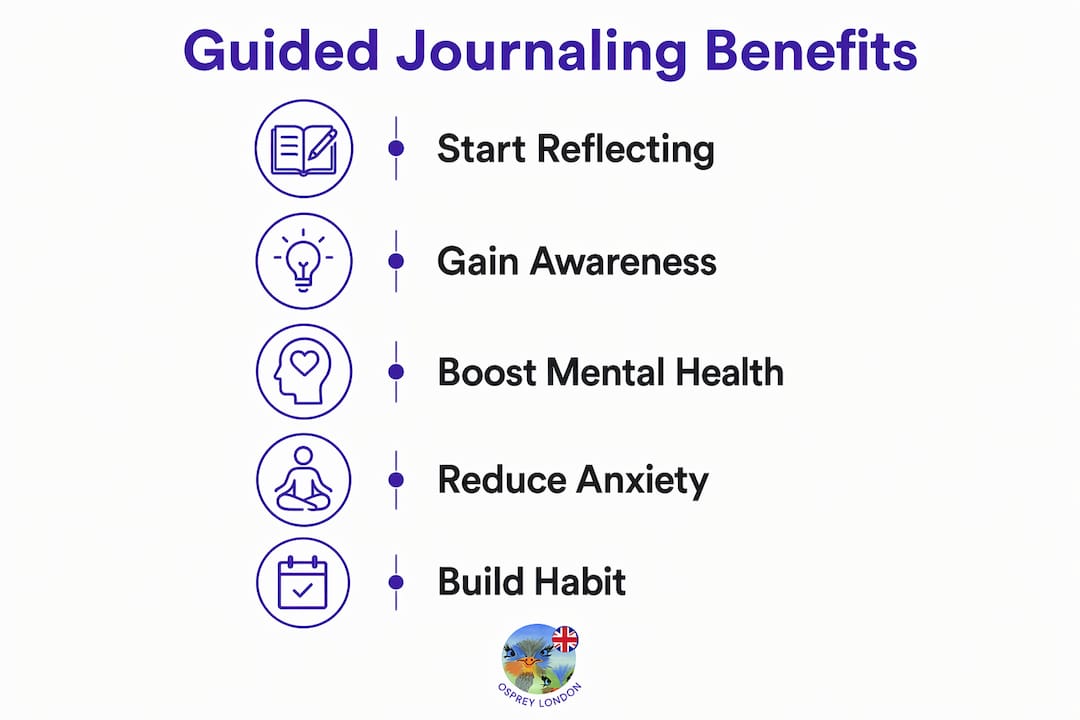
The importance of guided journaling lies in what it produces over time. Consistent, directed reflection builds self-awareness faster than occasional free writing. Readers who use structured prompts regularly report clearer thinking, better emotional regulation, and a stronger sense of personal direction.
How does guided journaling improve mental health?
The mental health case for guided journaling is backed by serious research. A meta-analysis of 146 studies found that writing with specific instructions produces larger mental health benefits than free writing. That finding is significant because it challenges the popular assumption that any journaling is equally effective.
Structured writing with CBT-based prompts externalizes thoughts, reducing cognitive load and breaking the cycle of rumination that keeps anxiety alive.
When you write in response to a prompt, you move from feeling to analysis. That shift is the core of Cognitive Behavioral Therapy (CBT), a clinically validated framework used by psychologists worldwide. Guided journals built on CBT principles ask you to identify a thought, examine the evidence for it, and reframe it. That sequence offloads working memory and gives your brain room to process rather than spin.
The anxiety reduction effect is not abstract. The 28% reduction in anxiety symptoms reported in recent research reflects what happens when people consistently externalize and examine their internal experience. Guided journaling also supports mindfulness and anxiety relief by anchoring attention to the present moment through specific, grounded questions.
What types of guided journals are there?
Guided journals span a wide range of formats and purposes. Guided journals vary from simple prompt books to CBT workbooks designed by psychologists, which means there is a format suited to nearly every goal and comfort level.
| Type | Primary purpose | Best for |
|---|---|---|
| Gratitude journal | Build positive thinking habits | Daily mood and mindset work |
| CBT workbook journal | Reframe negative thought patterns | Anxiety, stress, and emotional regulation |
| Goal-setting journal | Track progress and clarify intentions | Career, fitness, and personal growth |
| Mindfulness journal | Anchor attention to the present | Stress reduction and focus |
| Themed prompt book | Explore a specific life area | Creativity, relationships, or self-discovery |
Paper journals offer a tactile, distraction-free experience that many readers find more meditative. Digital formats offer search, reminders, and portability. The format matters less than the consistency of use. Choose the one you will actually return to each day.
Themed guided journals are particularly effective for readers who want to explore a specific area of life, such as creativity or self-expression, without the pressure of open-ended reflection. Munkterproducts carries several themed options that serve both beginners and experienced journalers.
How to start and maintain a guided journaling practice
Starting a guided journaling practice is straightforward when you follow a few clear principles. The biggest mistake beginners make is treating it like a diary and writing until they run out of steam. Focused, honest entries outperform long, rambling ones every time.
The recommended approach for beginners:
- Choose one journal type that matches your current goal, whether that is reducing stress, building gratitude, or clarifying a decision.
- Commit to 3–4 sessions per week, each lasting 5–10 minutes. That frequency builds habit without burning you out.
- Pick two or three prompts per session rather than working through an entire page. Depth beats volume.
- Write honestly, not impressively. Prompts are conversational tools, not tests. The goal is consistent engagement, not polished prose.
- Review your entries once a week to spot patterns in your thinking and track progress toward your goals.
Habit stacking is the most reliable way to make journaling stick. Attach your journaling session to an existing routine, such as morning coffee, a lunch break, or the ten minutes before bed. Relying on willpower alone is the biggest reason people abandon the practice within two weeks.
Pro Tip: Set your journal and a pen on your pillow each morning. When you see it at night, the visual cue does the motivating for you. No willpower required.
Many beginners also mistakenly equate longer entries with effectiveness. A five-minute session with a targeted prompt is often more insightful than thirty minutes of unfocused writing. Honesty and focus are the variables that matter.
If you need a starting point, a journaling prompts list with 60 or more ideas for growth gives you enough material to sustain months of practice without repeating yourself.
Guided journaling vs. free journaling: which one should you choose?
Free journaling and guided journaling serve different psychological functions. Free writing is the practice of writing continuously without prompts or structure, letting thoughts flow without direction. Guided journaling uses specific questions to focus that flow toward insight and change.
- Free writing builds fluency and releases emotional pressure. It works well as a creative warm-up or a way to vent without judgment. The limitation is that it rarely produces lasting behavioral change on its own.
- Guided journaling produces measurable outcomes. Free-form expressive writing lacks evidence as a stand-alone mental health intervention compared to structured journaling. The structure is what creates the therapeutic effect.
- CBT-based guided journals go further by asking you to examine the logic behind your thoughts, not just record them. That analytical layer is what separates journaling as a hobby from journaling as a self-improvement tool.
- Hybrid approaches work well for experienced journalers. Start with a guided prompt to anchor your session, then write freely for a few minutes to let the response develop naturally.
The difference between guided and free journaling is not about which is better in the abstract. It is about what you need right now. If you are working through anxiety, stress, or a specific goal, structure produces better results. If you are processing creatively or venting, free writing has its place.
Pro Tip: Use a guided prompt as your opening question, then allow yourself two minutes of free writing as a follow-up. You get the structure of guided journaling and the freedom of open expression in a single session.
Personalized journals that match your specific wellness goals tend to outperform generic notebooks because the prompts are calibrated to the outcomes you are actually chasing.
Key Takeaways
Guided journaling produces better mental health outcomes than free writing because structure, not volume, is what drives lasting change.
| Point | Details |
|---|---|
| Core definition | A guided journal uses prompts and exercises to direct reflection, removing the blank page barrier. |
| Mental health impact | Structured journaling reduces anxiety symptoms and improves goal achievement more than free writing. |
| Best frequency | Journal 3–4 times per week for 5–10 minutes to build a sustainable habit. |
| Habit formation | Attach journaling to an existing daily routine using habit stacking to improve consistency. |
| Format choice | Choose paper or digital based on what you will actually use consistently, not what sounds ideal. |
What I've learned from years of watching people journal
Most people who try journaling and quit do so because they set the bar too high. They buy a beautiful notebook, write three pages on day one, and then feel guilty when they miss a week. The journal becomes a symbol of failure instead of a tool for growth.
The readers I have seen benefit most from guided journaling are not the ones who write the most. They are the ones who show up with a single honest answer to a single good question, three or four times a week, for months. That consistency compounds in ways that a single marathon session never does.
What surprises most people is how quickly mental clarity improves. After two or three weeks of structured prompts, many readers report that they feel less reactive during the day. They have already processed the emotional content that would otherwise surface as irritability or anxiety. The journal absorbs it first.
The other thing worth saying plainly: perfectionism kills journaling faster than anything else. The prompt is not asking for a polished essay. It is asking for your honest, unfiltered response. The messier the answer, the more useful it usually is. Give yourself permission to write badly and you will almost always write something true.
— Mark
Guided journals worth exploring at Munkterproducts
Readers who are ready to move from understanding to practice will find a strong selection of guided journals and self-help journals at Munkterproducts.

Munkterproducts curates handcrafted journals and prompt-based notebooks designed for personal reflection, mindfulness, and self-improvement. The range includes options suited to beginners who need clear structure and experienced journalers who want themed or goal-specific formats. Every product ships with postage included, and the catalog covers both paper-based guided journals and novelty stationery that makes the practice feel worth returning to. Visit Munkterproducts to browse the full collection and find the journal that fits where you are right now.
FAQ
What is a guided journal used for?
A guided journal is used for personal reflection, goal setting, anxiety reduction, and building mindfulness habits. Structured prompts direct your writing so each session produces insight rather than aimless venting.
How is a guided journal different from a regular journal?
A regular journal is blank, leaving you to decide what to write. A guided journal includes prompts and exercises that focus your reflection and produce more consistent mental health benefits.
How often should you use a guided journal?
The recommended frequency is 3–4 times per week, with sessions lasting 5–10 minutes. That schedule builds a sustainable habit without creating pressure that leads to burnout.
Do guided journals actually help with anxiety?
Yes. Research shows structured journaling reduces anxiety symptoms by 28% by helping you externalize and examine anxious thoughts rather than ruminate on them.
What are good guided journal prompts for beginners?
Strong beginner prompts include "What am I grateful for today and why?" and "What thought kept returning to me this week?" A list of journaling prompts with 60 or more ideas gives beginners a full toolkit to start with.