

TL;DR:
- Journaling is a research-backed tool that improves mental clarity, emotional regulation, and personal growth. Consistent practice reduces depression, enhances self-awareness, and fosters cognitive flexibility through structured writing.
Journals are defined as one of the most research-backed tools for improving mental clarity, emotional regulation, and creative thinking available to anyone with a pen and paper. The importance of keeping a journal goes far beyond recording daily events. Studies show that consistent journaling reduces depressive symptoms, sharpens self-awareness, and builds the kind of cognitive flexibility that fuels personal growth. Whether you are new to the practice or returning to it, the science and the method both matter.
Why journals are important for mental health and emotional clarity
Journaling works because it forces the brain to translate raw emotion into structured language. That translation process alone reduces the intensity of negative feelings. When you write about a stressful experience, you activate the prefrontal cortex, the part of the brain responsible for rational thinking, which helps calm the emotional response.
The effects of journaling on mood are measurable and fast. Recording three positive things daily for just 14 days produces reductions in depressive symptoms comparable to antidepressants for mild to moderate depression. That result is striking because it requires no prescription, no appointment, and no cost beyond a notebook.
One underused technique is designated worry time. Scheduled worry journaling contains anxiety to a specific session, which reduces intrusive thoughts throughout the rest of the day. This approach comes directly from cognitive behavioral therapy, or CBT, and works because it gives anxiety a container rather than letting it bleed into every hour.
- Write for 15–20 minutes per session. Short, consistent sessions outperform longer, infrequent ones for both immune function and psychological wellbeing.
- Use designated worry time. Set a 10-minute window to write every worry, then close the journal and move on.
- Try gratitude entries. Specific, detailed gratitude notes produce stronger wellbeing improvements than vague positive statements.
- Avoid pure emotional venting. Unstructured venting can deepen rumination rather than resolve it.
Pro Tip: If you feel stuck in negative loops, switch to writing in the third person. Referring to yourself by name creates psychological distance and reduces emotional reactivity, making it easier to think clearly about what you are experiencing.
How does journaling boost creativity and problem-solving?
Journaling is one of the most direct paths to creative thinking because it removes the pressure of an audience. When you write only for yourself, the internal critic quiets down. That quieter mental state is where original ideas surface.

The role of journals in mindfulness connects directly to creative output. Mindful writing slows down reactive thinking and creates space for pattern recognition. Writers, designers, and entrepreneurs who journal regularly report spotting connections between ideas they would otherwise miss.
Themed and guided journals accelerate this process. A journal built around a specific creative challenge, a business goal, or a personal value gives your thinking a frame. Frames reduce the blank-page paralysis that stops many people before they start.
- Brainstorming pages: Dedicate one page per session to writing every idea related to a current challenge, no filtering allowed.
- Pattern reviews: At the end of each week, reread your entries and circle recurring themes or questions.
- Values mapping: Write about what mattered most to you this week and why. Clarity on values drives better decisions.
- Prompt-driven sessions: Use structured journaling prompts for growth to push thinking beyond habitual responses.
Pro Tip: Keep a separate "ideas page" at the back of your journal. Every time a random idea appears mid-entry, flip to the back and log it. Reviewing that page monthly reveals patterns you never expected.
What journaling methods work best for self-reflection?
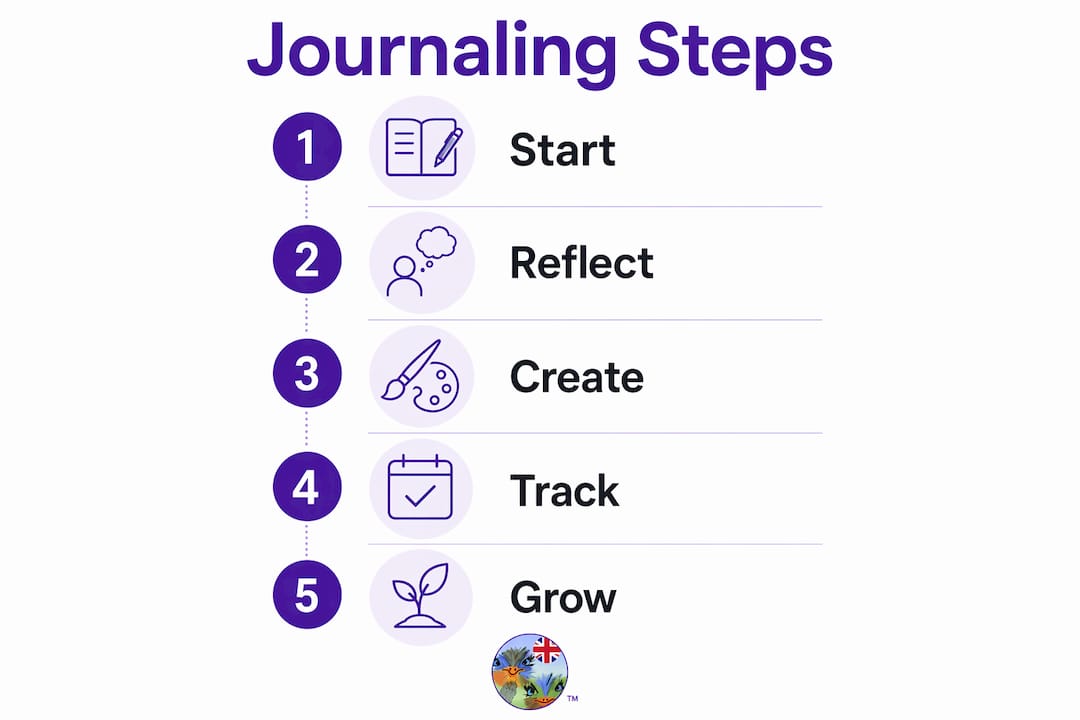
Self-reflection in journaling is not the same as rumination. The difference is direction. Rumination circles the same painful thought without resolution. Reflective journaling moves toward understanding, meaning, and next steps.
Reflective self-evaluation produces greater symptom reduction than ruminative brooding, which can actually worsen mood. The key is asking forward-moving questions: "What did I learn?" rather than "Why did this happen to me?"
Identity-based journaling is one of the most effective methods for young adults. A two-week identity journaling exercise helped participants report significantly less depression and fewer feelings of derailment two months after the intervention ended. The method works by connecting different life roles, such as student, friend, and professional, into a coherent sense of self.
| Method | Best for | Key technique |
|---|---|---|
| Gratitude journaling | Mood and wellbeing | Write 3 specific things daily |
| Identity-based journaling | Self-concept and depression | Connect different life roles in one entry |
| Designated worry time | Anxiety management | Schedule a fixed worry window |
| Third-person journaling | Emotional reactivity | Write about yourself using your name |
| Reflective prompts | Personal insight | Ask "what did I learn?" style questions |
Personalized journals support these methods by providing structure that matches your goals. A blank notebook works, but a journal designed around specific prompts or themes reduces the friction of getting started.
Pro Tip: Set a two-week commitment before judging whether journaling works for you. Research consistently shows that benefits accumulate over time, not after a single session.
How to start and maintain a journaling practice
Starting a journaling habit is simpler than most people expect. The biggest barrier is not knowing what to write. The second biggest barrier is inconsistency. Both are solvable with a clear setup.
Choose your format
- Physical journal: Best for focus and sensory engagement. Writing by hand slows thinking down, which supports deeper reflection.
- Guided journal: Ideal for beginners. Prompts remove the blank-page problem and keep sessions productive. Learn more about how guided journals work before choosing one.
- Digital journal: Useful for people who type faster than they write or who want searchable entries.
- Themed journal: Focused on a specific goal, such as gratitude, creativity, or career planning.
Build the habit
- Attach journaling to an existing routine. Write after your morning coffee or before bed.
- Keep your journal visible. Out of sight means out of mind.
- Start with 10–20 minutes daily. Consistency matters more than length.
- Use a simple prompt on days when motivation is low: "What is on my mind right now?"
Choose your prompts
Prompts are the fastest way to move past a blank page. Strong prompts connect to identity, values, or current challenges. Weak prompts ask surface questions that produce surface answers. The difference between "How was your day?" and "What did today reveal about what you value?" is the difference between a diary and a growth tool.
Journaling alongside wellness practices deepens the effect. Journals designed for mindfulness and self-care, like those found in wellness gift sets, pair well with meditation or breathwork routines. The physical act of writing in a quality journal also signals to your brain that this time is intentional and worth protecting.
Key Takeaways
Journaling is the single most accessible, research-backed practice for building mental clarity, reducing anxiety, and deepening self-awareness without cost or clinical intervention.
| Point | Details |
|---|---|
| Session length matters | Aim for 15–20 minutes daily; short, consistent sessions produce the strongest mental health benefits. |
| Method determines outcome | Reflective and identity-based journaling outperforms unstructured venting for mood and self-awareness. |
| Third-person writing reduces reactivity | Writing about yourself by name creates distance that lowers emotional intensity and improves thinking. |
| Two weeks is the minimum test | Research shows meaningful benefits appear within 14 days of consistent practice. |
| Prompts accelerate growth | Structured questions tied to identity and values produce deeper insight than open-ended entries. |
What I have learned from years of keeping a journal
Journaling changed how I solve problems more than any productivity system I have tried. The shift happened when I stopped treating my journal as a record of events and started using it as a thinking tool. Writing a problem out in full, then asking "what would I tell a friend in this situation?" consistently produces answers I could not reach by thinking alone.
The hardest part is not starting. The hardest part is continuing past the first week, when the novelty wears off and the blank page feels like a chore. My solution was to lower the bar completely. Three sentences counts. A single question counts. The handmade journal I use now makes the ritual feel worth protecting because the object itself has weight and intention.
The one mistake I see most often is using journaling as a venting session and nothing more. Venting has its place, but it is not the same as reflection. The moment you shift from "this is terrible" to "what does this tell me about what I need," the journal becomes genuinely useful. That shift is a skill, and like any skill, it gets easier with practice.
— Mark
Journals worth writing in, from Munkterproducts
The right journal makes a real difference in whether the habit sticks. Munkterproducts offers a curated range of handcrafted journals, self-help notebooks, and guided planners designed for exactly the kind of intentional practice this article describes.

Whether you want a structured guided journal with built-in prompts or a beautifully made blank notebook that feels worth returning to every day, Munkterproducts has options for every style and goal. Quality stationery is not a luxury. It is a signal to yourself that this practice matters. Browse the full journal collection at Munkterproducts and find the format that fits how you think.
FAQ
Why are journals important for mental health?
Journals reduce stress, anxiety, and depressive symptoms by helping people process emotions through structured writing. Research shows that just 14 days of consistent journaling produces measurable mood improvements.
How long should a journaling session be?
The optimal session length is 15–20 minutes. Short, daily sessions consistently outperform longer, infrequent ones for both psychological wellbeing and immune function.
What is the difference between journaling and rumination?
Journaling moves toward understanding and resolution, while rumination circles the same thought without progress. Reflective prompts that ask "what did I learn?" prevent the negative spiral that unstructured venting can create.
Does the type of journal matter?
The format matters less than consistency, but guided journals with structured prompts help beginners stay on track. Personalized and themed journals also reduce friction and keep sessions focused on specific goals.
How quickly does journaling produce results?
Identity-based journaling showed significant reductions in depression and feelings of derailment within two weeks, with benefits still present two months after the intervention ended.