

TL;DR:
- Confidence-building literature involves structured exercises that use evidence-based psychological methods to increase self-esteem. It differs from motivational books by requiring active participation and progress tracking to produce measurable improvements.
Confidence-building literature is defined as printed or digital self-help material designed with structured psychological techniques and exercises to increase personal confidence and self-esteem. This category sits apart from general motivational reading because it uses evidence-based psychological methods delivered through guided practice, not passive inspiration. The World Health Organization, the NHS, and academic publishers like SAGE have all produced materials that qualify under this definition. Understanding what separates true confidence-building literature from generic self-help is the first step toward choosing resources that actually work.
What is confidence-building literature and how does it work?
Confidence-building literature, also called psychological self-help literature, is any structured written resource that guides readers through exercises designed to shift negative thought patterns and reinforce positive self-belief. The WHO describes these materials as evidence-based self-help interventions delivered through print and digital formats, including reflection prompts, worksheets, and guided activities. The key word is "structured." A book that simply tells you to believe in yourself does not qualify. A workbook that walks you through identifying a negative belief, testing it against real evidence, and replacing it with a balanced thought does.
Self-efficacy and self-esteem are the two core psychological targets in this literature. Self-efficacy is your belief in your ability to complete specific tasks. Self-esteem is your overall sense of personal worth. Effective confidence-building resources address both, often using cognitive behavioral therapy principles adapted for self-guided use.
What structured techniques appear in confidence-building literature?
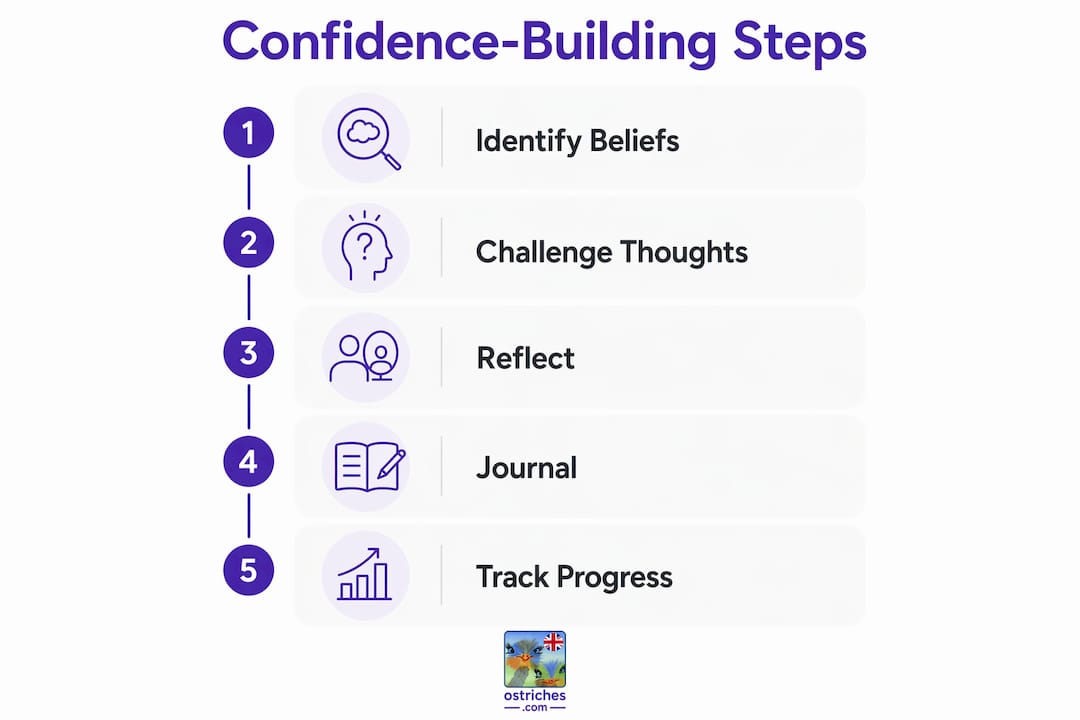
The techniques found in quality self-confidence literature are specific and repeatable. They are not vague encouragements. The NHS recommends a set of workbook-style steps that include:
- Writing down negative thoughts about yourself as they occur
- Challenging each thought by listing concrete evidence that contradicts it
- Keeping a visible list of at least five positive affirmations to reinforce that you are worthy
- Tracking small wins daily to build a record of competence
- Practicing self-compassion exercises that interrupt the inner critic
These steps reflect the core change mechanism in confidence-building literature: cognitive reframing. The NHS identifies this as the process of challenging negative beliefs with counter-evidence and reinforcing positives until new thought habits form.
Journaling is another widely used technique. A structured confidence journal differs from a diary because it uses specific prompts. Examples include "Name three things you handled well today" or "What fear did you face this week, and what did you learn?" These prompts direct attention toward growth rather than rumination.
Pro Tip: Set a fixed 10-minute window each day to complete one exercise from your confidence workbook. Consistency matters more than duration. A single completed worksheet beats an hour of passive reading every time.
The WHO's self-help model also emphasizes reflection exercises and guided worksheets as the delivery mechanism for real change. Inspirational reading alone does not produce the same outcomes because it does not require the reader to practice anything.
How does confidence-building literature differ from general self-help?
Not every self-help book builds confidence. The distinction matters because choosing the wrong type wastes time and can even reinforce the belief that "nothing works for me."
| Feature | General self-help books | Confidence-building literature |
|---|---|---|
| Worksheets and exercises | Rarely included | Core component |
| Evidence-based techniques | Varies widely | Required for quality materials |
| Outcome tracking | Not standard | Built into structure |
| Cognitive reframing tools | Occasional | Central method |
| Readability tailoring | Inconsistent | Designed for target audience |
General self-help books like many popular motivational titles focus on mindset shifts through storytelling and inspiration. They are valuable for motivation but do not teach a skill. Confidence-building literature, by contrast, treats confidence as a measurable learner outcome that grows through practice under the right conditions.
SAGE's educational framework for building reading confidence in adolescents illustrates this well. The framework treats confidence as a specific, trackable area of growth supported by instructional design and structured interactions. That same logic applies to adult self-help materials. A book that includes progress tracking, guided reflection, and skill-building exercises is doing what a good teacher does. A book that only inspires is doing what a good speech does.
The practical test is simple. Open the book and ask: does it require me to do something, or only to read something? If the answer is only to read, it is motivational content, not confidence-building literature.
What are the proven benefits of using confidence-building literature?
The evidence for structured confidence-building materials is strong across multiple populations. A 2026 study using a diabetes self-management e-booklet with 92 respondents found that low self-efficacy reports dropped from 90% to 66.9% after the intervention, with a statistically significant result (p=0.000). That is a meaningful shift in a clinical population using a printed resource, not a therapy program.
"WHO publication details Step-by-Step and Doing What Matters programs delivered in print formats with proven effectiveness in randomized controlled trials." — WHO Psychological Self-Help Interventions
The WHO's programs, Step-by-Step and Doing What Matters in Times of Stress, have been tested in randomized controlled trials and shown to reduce psychological distress while building coping capacity. Both are delivered through printed materials with guided exercises. This confirms that the format itself, structured print or digital workbooks, is an effective delivery system for psychological change.
Students benefit too. SAGE's framework for building reading confidence in adolescents links confidence development to instructional conditions and measurable outcomes. When students work through structured literacy materials that build confidence alongside skill, their independence and stamina improve. The same principle scales to adult readers using confidence-building journals and workbooks.

The life improvements that follow are practical. Higher self-efficacy predicts better performance at work, stronger relationships, and greater resilience under stress. Confidence-building literature does not promise overnight transformation. It builds a skill, and skills compound over time.
How can you select and use confidence-building literature effectively?
Choosing the right resource requires a short evaluation. Not every book marketed as a confidence builder meets the standard. Use this checklist before committing to a title:
- Check for exercises. The book must include worksheets, prompts, or structured activities. Passive reading sections alone do not qualify.
- Look for evidence-based grounding. Quality materials reference cognitive behavioral therapy, acceptance and commitment therapy, or WHO and NHS frameworks.
- Assess readability. A study on confidence literature effectiveness found that simplified layouts and age-appropriate design significantly improve comprehension and outcomes. If the language feels inaccessible, find a better-matched resource.
- Check for progress tracking. The best materials include a way to measure change, whether through self-rating scales, reflection logs, or milestone markers.
- Match it to your specific need. A reader struggling with social anxiety needs different exercises than one working on professional confidence. Tailored resources outperform generic ones.
For effective use, consistency beats intensity. Working through one exercise per day produces better results than reading three chapters in a single sitting. Pair your chosen book with a dedicated journal to capture insights and track patterns over time. Resources like top confidence-boosting books that integrate psychological techniques with structured practice give you the most return.
Self-help literature for confidence works best as a complement to other support, not a replacement. The NHS and WHO both present these materials as scalable self-management tools that expand access to mental health support. If your confidence struggles are connected to clinical anxiety or depression, professional care remains the primary resource.
Pro Tip: After completing a workbook exercise, write one sentence summarizing what you learned about yourself. This single habit turns passive completion into active learning and accelerates the confidence-building process.
Key Takeaways
Confidence-building literature works because it uses structured psychological exercises, not passive inspiration, to produce measurable improvements in self-efficacy and self-esteem.
| Point | Details |
|---|---|
| Clear definition matters | Confidence-building literature requires structured exercises, not just motivational content. |
| Core techniques | Cognitive reframing, journaling, and positive affirmation lists are the primary tools. |
| Measurable benefits | Structured e-booklets reduced low self-efficacy reports from 90% to 66.9% in one 2026 study. |
| Selection criteria | Look for worksheets, evidence-based methods, readability, and progress tracking before choosing a book. |
| Know the limits | Self-help literature supplements professional care; it does not replace it for clinical conditions. |
Why structured confidence literature changed how I think about self-help
The most common mistake I see readers make is treating confidence-building as a reading project. They collect books, highlight passages, and feel motivated for a day or two. Then nothing changes. The research is clear on why: reading about confidence and practicing confidence are completely different cognitive activities.
What shifted my thinking was seeing the WHO's evidence on Step-by-Step and Doing What Matters. These are not bestselling titles with celebrity endorsements. They are plain, structured workbooks tested in randomized controlled trials across multiple countries. They work because they require the reader to do something uncomfortable, to write down a negative belief, to challenge it, to sit with the discomfort of changing a thought pattern. That process is the opposite of comfortable reading.
The other thing I have noticed is that literacy and design matter more than most people expect. A beautifully written book that uses dense academic language will not help someone who finds reading difficult. The research on tailoring confidence literature to audience demographics is not a minor footnote. It is the difference between a resource that gets used and one that sits on a shelf.
My honest recommendation: start with one short, structured workbook rather than a long inspirational book. Complete every exercise before moving on. Track your responses over two weeks. The evidence for this approach is stronger than most people realize, and the investment is smaller than most people expect.
— Mark
Confidence-building resources worth exploring at Munkterproducts
Readers who want to put these ideas into practice will find a curated selection of printed materials at Munkterproducts. The catalog includes self-help journals, adult coloring books built around confidence themes, and structured notebooks designed to support daily reflection and personal growth.

Munkterproducts focuses on printed materials that combine structure with creativity, making them practical companions to any confidence-building program. Whether you are starting with a guided journal or looking for personal growth resources to complement your reading, the range at Munkterproducts covers both structured and creative formats. Postage is included with every order, and the catalog is updated regularly with new titles.
FAQ
What is confidence-building literature exactly?
Confidence-building literature is printed or digital self-help material that uses structured psychological exercises, such as worksheets and cognitive reframing prompts, to increase self-confidence and self-esteem. It differs from motivational books because it requires active practice, not passive reading.
How does confidence-building literature improve self-efficacy?
Structured exercises in confidence-building materials guide readers through identifying negative beliefs, challenging them with evidence, and reinforcing positive self-perceptions. A 2026 study showed self-efficacy improved significantly after participants used a structured self-management e-booklet.
Can confidence-building books replace therapy?
Confidence-building literature is a scalable self-management tool, not a replacement for professional mental health care. The NHS and WHO recommend these materials as a supplement to professional support, particularly for mild to moderate confidence challenges.
How do I know if a book qualifies as confidence-building literature?
A qualifying book includes worksheets, structured exercises, evidence-based techniques, and some form of progress tracking. Books that only offer inspirational stories or general advice do not meet the standard for true confidence-building literature.
Who benefits most from self-confidence literature?
Students, adults managing low self-esteem, and people recovering from setbacks all show measurable gains from structured confidence-building materials. Readability and design tailored to the reader's literacy level significantly improve outcomes.