

TL;DR:
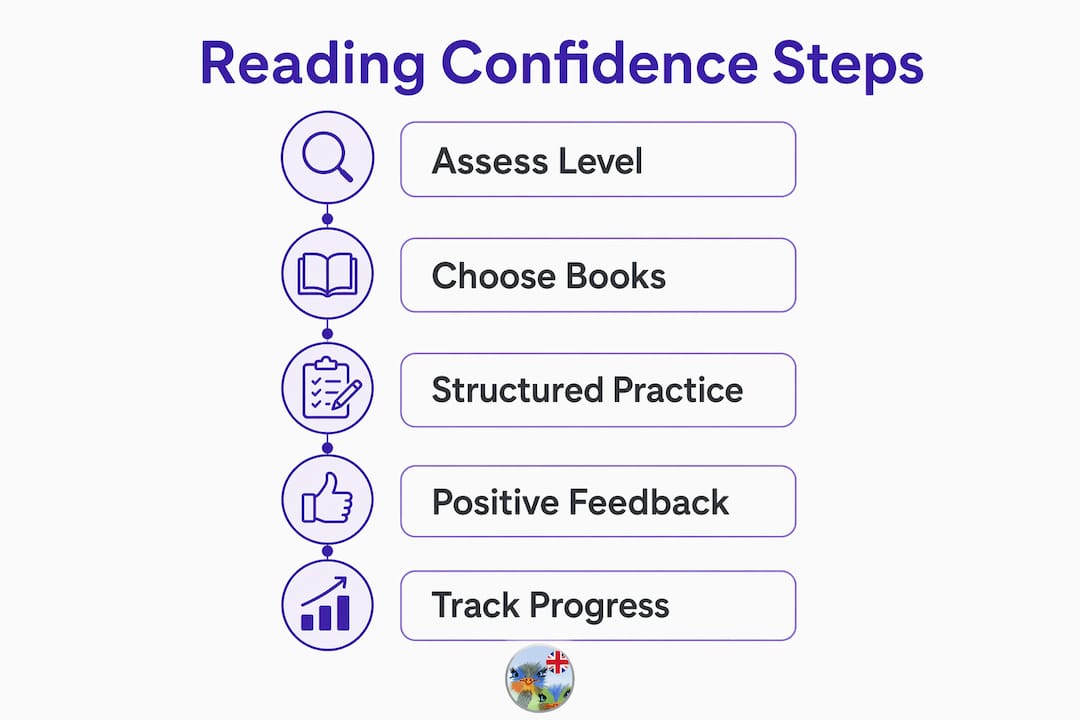
- Building reading confidence relies on choosing appropriately leveled texts that allow children to recognize at least 90% of words independently and focus on understanding meaning. Effective practice involves gradual stamina building through structured sessions, support for decoding skills, and positive feedback that coaches problem-solving. Creating a low-pressure, emotionally supportive environment fosters mastery and enthusiasm, leading to sustained engagement and literacy growth.
Reading confidence is a child's belief in their own ability to read accurately, independently, and with enjoyment. Without it, even technically capable readers disengage, avoid books, and fall behind. Knowing how to build reading confidence changes that pattern. The research is clear: children who feel capable while reading engage more, attempt unfamiliar words, and push through difficulty rather than shutting down. This guide gives parents and educators the specific, evidence-backed strategies to make that happen, from choosing the right books to structuring practice sessions and responding to mistakes in ways that build rather than break a child's belief in themselves.
How to build reading confidence through the right book choices
The single most powerful lever in literacy development is text difficulty. When a child struggles through a book where more than one in ten words is unfamiliar, they shift their mental energy entirely to decoding. Comprehension collapses, frustration rises, and reading starts to feel like a punishment. Scholastic describes the 90% word recognition target as the threshold for maintaining meaning focus and confidence. That means a child should be able to read nine out of ten words on any given page without help.
This principle has a name in literacy education: "confidence-preserving accuracy." The idea is that frequent decoding stops do not just slow reading down. They trigger behavioral avoidance, where children start associating books with failure and find reasons not to pick them up at all. Selecting texts that sit just below the frustration zone is not lowering the bar. It is giving children the conditions they need to actually grow.
Here is what "just-right" book selection looks like in practice:
- Independent level: The child reads 95 to 100% of words correctly and understands the content without support. These are ideal for solo reading time.
- Instructional level: The child reads 90 to 94% of words correctly. These work well for guided reading with a parent or teacher present.
- Frustration level: Below 90% accuracy. Reserve these for read-alouds where an adult handles the decoding load.
Confidence-themed children's educational books serve a dual purpose here. They reinforce self-belief through story content while being written at accessible reading levels. Rereading the same book two or three times is also a legitimate strategy, not a sign of stagnation. Repeated readings build automatic decoding, which frees up mental bandwidth for comprehension and makes reading feel effortless rather than labored.
Pro Tip: Ask your child's teacher for a reading level assessment, then use that level to filter book choices at the library or bookstore. Many publishers, including Scholastic and Leveled Literacy Intervention, label books by reading level directly on the spine or back cover.
What does a good reading practice session actually look like?
Structure matters as much as content. A child who sits down to read without a clear endpoint or a sense of progress will drift, fidget, or give up. The goal is to build reading stamina gradually, the same way you would build physical endurance. You do not start a new runner with a marathon.

Scholastic recommends timed reading sessions that increase in length over time. Think of it like stretching a rubber band slowly rather than snapping it. A child who can focus for five minutes today can reach ten minutes in two weeks if the increases are gradual and the sessions end on a positive note. Clear endpoints lower anxiety and create better conditions for fluency to develop.
Here is a practical session structure that works for most children between ages five and ten:
- Warm-up (2 to 3 minutes): Reread a familiar, easy book or a few pages the child already knows. This activates reading mode without pressure and builds fluency through repetition.
- Main reading (5 to 15 minutes, depending on age and stamina): Read a just-right book independently or with light support. Use a timer so the child knows when it ends.
- Story talk (3 to 5 minutes): Discuss what happened, what the child noticed, or what they think comes next. This reinforces comprehension without turning it into a quiz.
- Celebration moment (1 minute): Name something specific the child did well. "You figured out that tricky word by looking at the picture" is more powerful than "good job."
Partner reading and read-alouds belong in this structure too. When a parent or educator reads aloud with expression and enthusiasm, children hear what fluent reading sounds like. That model matters. Exploring reading together as a family consistently produces stronger literacy outcomes than solo practice alone.
Pro Tip: Let the child choose the book for the main reading portion whenever possible. Autonomy over book choice is one of the strongest predictors of reading engagement, according to literacy researchers at the University of Michigan.
Which techniques for confident reading actually work?
Decoding skill and reading confidence are not separate goals. They reinforce each other. A child who can decode quickly does not have to stop and struggle, so reading feels smooth and rewarding. A child who feels confident takes more risks with new words, which accelerates decoding skill. The cycle runs in both directions.
Phonemic proficiency sits at the foundation of this cycle. Research published in Education Sciences found a significant correlation between rapid phoneme substitution ability and fluent word recognition, with results reaching p < 0.001. The key word is rapid. Responses within two seconds predict automatic word reading far better than untimed phonemic tasks. This means drilling phoneme substitution with speed, not just accuracy, is a more effective way to build the kind of fluency that feels effortless.
Here are the techniques that translate this research into daily practice:
- Phoneme substitution games: Say a word, then ask the child to swap one sound for another as fast as possible. "Say 'cat.' Now change the /k/ to /b/." Speed matters here. Aim for responses under two seconds.
- Repeated reading of familiar texts: Pick a short passage and read it three times in a row. Time each reading. Children almost always get faster, and seeing that improvement is a direct confidence signal.
- Discussion over correction: When a child misreads a word, resist the urge to correct immediately. Scholastic advises using story talk instead. Ask, "Does that make sense with the picture?" or "What word would fit there?" This coaches problem-solving rather than creating shame around mistakes.
"Building confidence during struggle is less about rescuing immediately and more about coaching problem-solving through story talk." — Scholastic
Positive feedback must be specific to be useful. "You used the first letter and the picture to figure that out" teaches a child what they did right, so they can repeat it. Generic praise like "great reading" does not give them anything to build on.
How do you handle reading resistance and keep motivation alive?
Even children who are making real progress hit walls. They refuse to sit down, claim the book is boring, or start guessing wildly at words instead of reading them. These behaviors are almost always signals, not defiance. Guessing without looking at the letters usually means the text is too hard. Avoidance often means the child has experienced enough failure to associate reading with discomfort.
The Mind by Design makes a point that reframes the whole challenge: telling children to be confident does not work unless they have actually experienced success. Adults have to engineer those wins first. That means temporarily dropping the reading level, removing the audience, and removing the pressure until the child has a string of positive experiences to draw on.
Practical strategies for getting through resistance:
- Read to a pet or a stuffed animal. Reading aloud to animals or in a private space removes the fear of judgment and lowers anxiety enough for children to actually engage with the text.
- Set word-count or chapter goals instead of time goals. Concrete milestones like "read 50 words" or "finish this chapter" give children a clear finish line and a measurable win. Time-based goals can feel endless.
- Use growth mindset language deliberately. "You couldn't read that word yet" is different from "you can't read that word." The word "yet" signals that progress is expected and normal.
- Celebrate the attempt, not just the outcome. A child who tried a hard word and got it wrong is doing more valuable work than one who only reads words they already know.
Pro Tip: Keep a simple reading log where the child records books finished or pages read. Visual progress, like a chart filling up over weeks, gives children a concrete record of their own growth and makes the effort feel worth it.
Confidence-themed books also play a role here. When a child reads a story about a character who overcomes self-doubt, the narrative does emotional work that supports the skill-building happening on the page. Titles that build real self-esteem through story content are worth seeking out specifically for reluctant readers.
Key takeaways
Building reading confidence requires appropriately leveled texts, structured practice, and feedback that coaches problem-solving rather than correcting mistakes in the moment.
| Point | Details |
|---|---|
| Match text to reading level | Children need to recognize at least 90% of words independently to stay confident and focused on meaning. |
| Build stamina gradually | Start with short timed sessions and increase length slowly to avoid overwhelm and sustain engagement. |
| Prioritize phonemic speed | Rapid phoneme substitution practice predicts fluent word reading better than accuracy alone. |
| Replace correction with coaching | Use story talk and questions to guide decoding rather than immediately supplying the correct word. |
| Engineer achievable wins | Drop the difficulty level during resistance phases to rebuild the success experiences that confidence depends on. |
What I've learned about confidence that most reading guides miss
I have spent years watching children who were labeled "reluctant readers" transform into kids who ask for one more chapter before bed. The pattern is always the same, and it almost never starts with a new phonics program or a reading app. It starts with a book that felt easy enough to finish.
The mistake I see most often from well-meaning parents and educators is pushing difficulty too soon. The logic makes sense on the surface: harder books build harder skills. But competence and confidence develop together, not separately. A child who has never finished a book independently does not believe they can. No amount of encouragement changes that belief. Only the experience of finishing a book changes it.
What I have found actually works is what I call the "stack of wins" approach. You give a child three or four books they can read almost perfectly. You celebrate every single one. You let them reread favorites until they are bored of them. Then, and only then, you introduce something slightly harder. By that point, the child has evidence. They know they can do this, because they have done it.
The other thing most guides skip is the emotional environment. A child reading in front of a parent who sighs, corrects every word, or checks their phone is not going to build confidence. The physical and emotional space around reading matters as much as the text itself. Creating a low-pressure, genuinely curious atmosphere, where mistakes are treated as interesting puzzles rather than failures, is the foundation everything else sits on.
— Mark
Resources from Munkterproducts to support your child's reading journey

Munkterproducts carries a curated selection of confidence-building books and educational materials designed specifically for children and the adults who support them. From confidence-themed storybooks that reinforce self-belief through narrative to activity journals that make reading practice feel like play, the catalog is built around the same principles covered in this article. If you are looking for tools that align with evidence-based literacy strategies, the Munkterproducts collection is a practical starting point. You can also explore the reading habits guide on the Munkterproducts blog for additional strategies on turning daily reading into a lifelong skill.
FAQ
What is reading confidence in children?
Reading confidence is a child's belief in their ability to read accurately and independently. It develops through repeated successful reading experiences with appropriately leveled texts.
How do I know if a book is the right level for my child?
A just-right book is one where your child can read at least 90% of the words without help. If they are stopping frequently to decode, the book is likely at the frustration level and should be saved for read-alouds.
How long should a child's reading practice session be?
Start with five to ten minutes for younger or less confident readers and increase gradually over several weeks. Scholastic recommends timed sessions with clear endpoints to build stamina without overwhelming children.
What should I do when my child refuses to read?
Drop the difficulty level temporarily and remove the audience pressure. Reading to a pet, a sibling, or even a stuffed animal lowers anxiety and helps rebuild the positive associations that motivate independent reading.
Does rereading the same book actually help?
Rereading familiar texts builds automatic decoding and fluency, which directly supports comprehension and confidence. Repeated readings of the same passage consistently improve reading speed and accuracy, giving children measurable proof of their own progress.