
TL;DR:
- Creating your own activity book allows customization for a child's interests, learning pace, and goals.
- Effective activity books focus on clear objectives, age-appropriate design, and thorough testing with children.
- Simplicity, clarity, and engaging storytelling are essential for creating a successful, lovable children's activity book.
Most parents and educators have stood in a bookstore aisle, flipped through a dozen activity books, and walked away empty-handed. Too simple, too cluttered, wrong theme, wrong level. The frustrating truth is that no single off-the-shelf book perfectly fits your child or classroom. But here's the good news: you don't need a publishing degree or a design background to create one that does. Building your own activity book lets you match every page to your child's interests, learning pace, and goals. This guide walks you through the entire process, from choosing a focus to printing and sharing a finished book children will actually want to use.
Table of Contents
- Choosing your activity book focus and objectives
- Gathering materials and tools for your activity book
- Designing activities: step-by-step process
- Testing, adapting, and finalizing your activity book
- What most people miss when creating activity books
- Ready for more activity book inspiration?
- Frequently asked questions
Key Takeaways
| Point | Details |
|---|---|
| Set clear objectives | Define your learning goals and pick a theme before starting your activity book. |
| Choose quality materials | Use safe, durable materials and pick user-friendly tools for best results. |
| Design with variety | Include different types of activities to capture kids’ interest and support multiple learning styles. |
| Test and adapt | Try out your book with real kids, gather feedback, and adjust for an engaging final product. |
Choosing your activity book focus and objectives
Before you draw a single page or type a single prompt, you need a clear purpose. A book without a goal is just a pile of activities. A book with a goal is a learning tool.
Start by asking yourself one question: what do I want this child to walk away knowing or feeling? That answer shapes everything. Interactive activity design research confirms that interactive books boost learning and engagement when they align with a child's developmental stage and curiosity.
Here are the most common educational goals you can build around:
- Literacy: Letter recognition, phonics, simple sentences, storytelling prompts
- STEM: Counting, basic shapes, pattern recognition, simple science observations
- Creativity: Drawing prompts, coloring pages, collage activities, imaginative scenarios
- Social-emotional skills: Feelings identification, kindness challenges, friendship scenarios
- Holiday or seasonal themes: Festive coloring, cultural traditions, seasonal vocabulary
Once you pick a goal, choose a theme that excites your target age group. Animals, outer space, dinosaurs, holidays, and underwater worlds consistently pull children in. Themes create a sense of story and adventure across the pages, which keeps kids turning to the next activity instead of abandoning the book halfway through.
Age matters more than most people realize. A five-year-old needs large images, minimal text, and simple instructions. A nine-year-old can handle multi-step puzzles, short reading passages, and creative writing prompts. Matching complexity to age keeps the book from feeling either boring or overwhelming.
Pro Tip: If you're creating a book for a classroom, pick one broad theme and layer multiple subjects into it. A space theme can cover counting stars (math), writing alien names (literacy), and drawing planets (creativity) all in one cohesive package. Check out educational book ideas for more inspiration on structuring multi-subject themes.
Keep your scope realistic. A 10 to 20 page book is a manageable starting point. You can always expand later once you've tested what works.
Gathering materials and tools for your activity book
Once you know your focus, it's time to gather the right tools and supplies. The materials you choose affect how durable, usable, and enjoyable the finished book feels in a child's hands.
You have two main paths: physical creation or digital design. Many creators combine both, designing pages digitally and then printing them for physical use. An activity book material checklist helps you avoid the frustration of missing supplies mid-project.
Common materials you'll need:
- White cardstock or thick printer paper (80 lb or heavier for durability)
- Pencils, crayons, washable markers, and colored pencils
- Stickers, stamps, or foam shapes for tactile pages
- A ruler, scissors, and glue sticks for hand-assembled books
- A stapler, binder clips, or a simple comb binding kit for finishing
Digital tool comparison:
| Tool | Best for | Cost | Skill level |
|---|---|---|---|
| Canva | Visual layouts, templates | Free/paid | Beginner |
| Microsoft Word | Text-heavy pages, simple grids | Paid | Beginner |
| Google Slides | Quick drag-and-drop pages | Free | Beginner |
| Adobe InDesign | Professional multi-page layouts | Paid | Advanced |
| Book Creator (app) | Digital-only interactive books | Free/paid | Beginner |
For most parents and educators, Canva or Google Slides offers the fastest path from idea to printable page. Both have drag-and-drop interfaces, pre-made frames, and free illustration libraries that save hours of work.
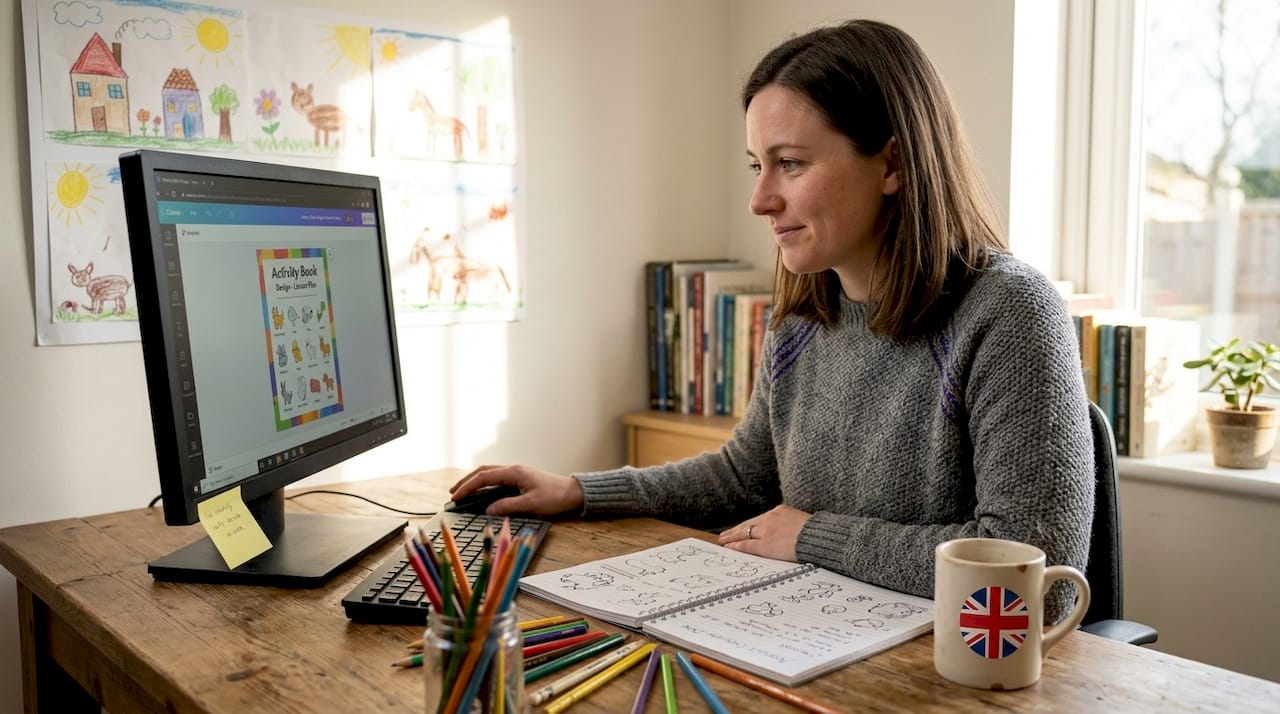
If you prefer a fully handmade approach, plain white cardstock and a set of fine-tip black markers for outlines work beautifully. Children often respond warmly to hand-drawn books because they feel personal and unique. You can also explore material sourcing alternatives if you want to find affordable supplies beyond the usual craft store options.
Budget matters too. A basic physical activity book can cost under $10 to produce at home. A digitally designed and professionally printed version might run $20 to $40 depending on page count and binding. Neither is wrong. Choose based on your time, budget, and how many copies you need.
Designing activities: step-by-step process
With your materials ready, here's how to lay out fun, effective activities children will love.
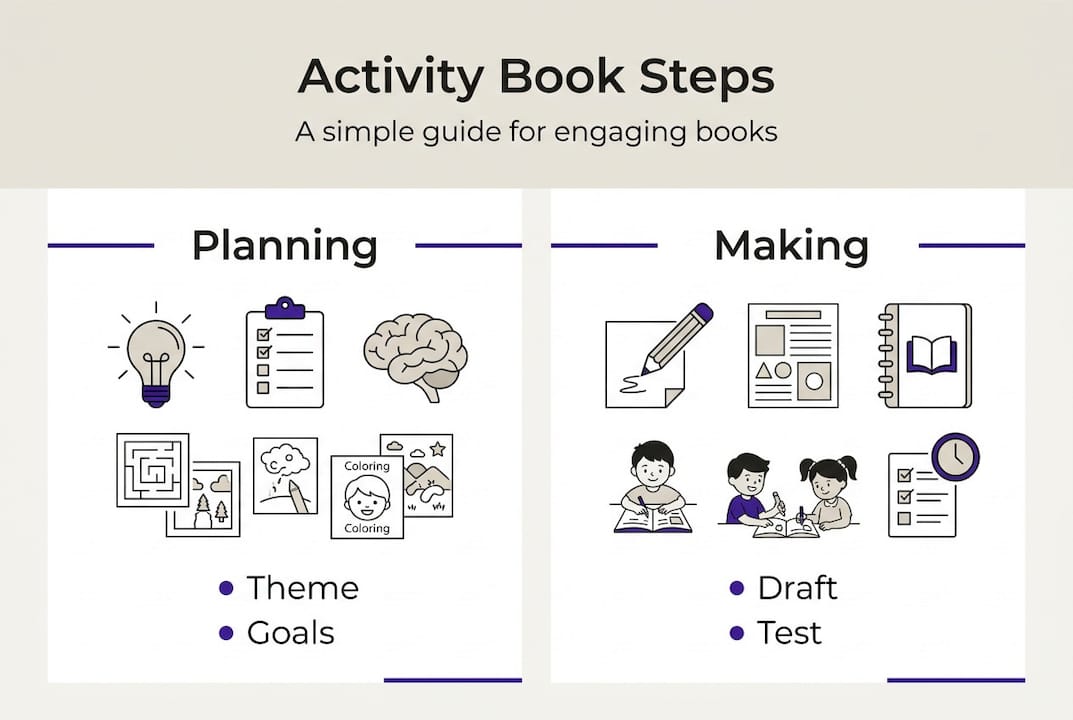
Step 1: Brainstorm a full activity list. Write down every activity idea that fits your theme and goal. Don't filter yet. Aim for at least 30 ideas so you have plenty to choose from.
Step 2: Sort and select. Pick 10 to 20 activities that offer variety. A strong book mixes coloring pages, puzzles, writing prompts, drawing challenges, and simple games. Variety keeps children engaged across multiple sessions.
Step 3: Draft each page. Create a rough version of every activity. Keep instructions short: one to two sentences maximum for younger children. For older kids, a short paragraph is fine.
Step 4: Test one section. Before finishing the whole book, show two or three pages to a child and watch what happens. Do they understand what to do without help? Do they smile? That feedback is gold.
Step 5: Adjust and finalize. Rewrite confusing instructions, simplify cluttered pages, and swap out activities that didn't land.
Holiday activity design studies show that holiday-themed books boost reading engagement and strengthen family traditions, making themed activity books especially powerful during seasonal events.
Pro Tip: If you're drawing pages by hand, use a light pencil grid first. Divide each page into clear zones: one for the activity title, one for instructions, and one large open area for the child's work. This prevents the cramped, confusing layouts that frustrate young learners.
Digital vs. physical assembly:
| Approach | Speed | Customization | Cost | Best for |
|---|---|---|---|---|
| Digital (print at home) | Fast | High | Low | Multiple copies |
| Hand-drawn/assembled | Slow | Very high | Very low | One-of-a-kind gifts |
| Hybrid (digital design, hand-colored) | Medium | High | Low-medium | Classroom sets |
You can also boost creativity through stories by weaving a simple narrative thread through your book. Give it a character, a quest, or a mystery to solve across the pages. Children stay invested when they feel like they're going somewhere.
Testing, adapting, and finalizing your activity book
You've crafted your book. Now ensure it truly works with your audience and finalize the details.
The single most important step most creators skip is real-world testing with actual children. Watching a six-year-old attempt your maze or try to follow your coloring instructions tells you more in five minutes than an hour of self-review ever will.
Sit with a child and observe without helping. Notice where they pause, look confused, or lose interest. Those moments are your revision list.
Common pitfalls to fix before finalizing:
- Too much text on a single page, which overwhelms young readers
- Instructions that assume prior knowledge the child doesn't have
- Activities that are too similar, causing boredom by page five
- Inconsistent difficulty that jumps from too easy to too hard without warning
- Poor contrast between background colors and activity areas
- Pages with no white space, making the layout feel chaotic
After testing, make targeted revisions. You don't need to rebuild the whole book. Usually, simplifying three or four pages and clarifying two or three instructions is enough to transform a frustrating experience into a smooth one.
Accessibility note: Always check that your font size is at least 14pt for young readers, that color contrast meets basic readability standards, and that activities do not require fine motor precision beyond your target age group's ability. Inclusive design makes your book usable for more children.
Publishing strategies for activity books have evolved significantly, and publishing considerations now include digital distribution, print-on-demand, and classroom licensing options that didn't exist a few years ago. Even if you're only making copies for your own family or class, thinking about format and accessibility early saves headaches later.
What most people miss when creating activity books
Here's something worth saying plainly: most first-time activity book creators spend 80% of their energy on how the book looks and almost none on how it actually functions in a child's hands.
Beautiful illustrations and clever themes matter. But a child who can't figure out what to do on page one will close the book and never return. Simplicity is not a compromise. It is the goal.
The creators who make the most effective books are the ones who test early, revise without ego, and prioritize clarity over cleverness. They treat the first version as a draft, not a finished product. That mindset shift changes everything.
We've seen this pattern repeatedly: the books that children return to again and again are rarely the most elaborate ones. They're the ones where every page feels achievable, every activity feels rewarding, and the child feels capable. Using storytelling for engagement as a structural tool, rather than just decoration, is one of the most underused strategies in children's activity book design. Build in a sense of progress and you'll build a book children genuinely love.
Ready for more activity book inspiration?
Creating your own activity book is one of the most rewarding projects you can take on as a parent or educator. You've now got the framework to go from blank page to finished book with confidence.

If you want to skip some of the heavy lifting or find ready-made inspiration, more book creation resources are available at Munkter Products. From handcrafted children's activity books to educational coloring books and novelty stationery, the catalog is built for exactly the kind of creative, learning-focused projects you're working on. Browse the full range and find tools, templates, and finished books that support your vision without starting from scratch.
Frequently asked questions
What is the best age group for homemade activity books?
Homemade activity books work best for children ages 3 to 10, with activities adapted for each developmental stage. Interactive books boost learning most effectively when content matches a child's current abilities and interests.
Which materials are safest for young children?
Use non-toxic crayons, washable markers, and sturdy paper to ensure safety and durability with young children. A thorough activity book material checklist helps you verify every supply before use.
How do I make my activity book engaging for all learning styles?
Include a mix of puzzles, coloring, storytelling, and interactive activities to match different learning preferences. Interactive books for kids consistently show higher engagement when variety is built into the structure.
What if my first version isn't perfect?
Test with kids, gather feedback, and make improvements because the first version is simply a starting point. Sound publishing considerations always include revision cycles as a standard part of the process.