

An evening reflection journal is a 1 to 5 minute nightly ritual where you answer three simple prompts: what went well, what drained you, and one thing to carry forward, to close out the day and quiet bedtime rumination. Do it right before turning off the light. That's the whole routine, and research on bedtime writing backs up why it works.
TL;DR:
- Keeping prompts fixed and answerable in one sentence helps prevent decision fatigue and maintains consistency in nightly journaling routines.
- Limiting entries to three lines or prompts prevents deep analysis that can interfere with sleep, especially if certain worries become repetitive.
- Anchoring the journaling habit to existing nightly activities like brushing teeth increases the likelihood of sticking to the practice long-term.
- Using a small, durable, and undated journal on a nightstand ensures easy access and reduces friction in completing the routine every night.
- Writing about unresolved tasks and feelings before sleep can reduce mental replay and decrease sleep latency by about nine minutes.
Table of Contents
- What Does an Evening Reflection Journal Do, and Why Does It Help?
- The 5-Minute Evening Reflection Template You Can Use Tonight
- Evening Journal Prompts Grouped by What Tonight Needs
- How to Make Evening Journaling Stick
- When Night Journaling Backfires, and How to Adapt
- How to Choose a Journal for Your Evening Reflection Practice
- A Note on Keeping This Practice Gentle
- Get the Journal That Matches This Routine
- Sources
- FAQ
What Does an Evening Reflection Journal Do, and Why Does It Help?
Morning journaling sets intentions. Evening reflection journaling closes doors. That distinction matters more than it sounds: a morning page asks "what do I want," while a nightly reflection journal asks "what can I put down now." Different jobs, different mental effects.
The mechanism is straightforward. Your brain keeps circling unfinished tasks and unresolved feelings because it hasn't registered them as handled. Writing them down, even in a single sentence, tells your brain the loop is closed. Gratitude prompts do something related but distinct: they redirect attention toward people and moments that made the day survivable, which expert commentary suggests works best as noticing real support rather than forcing positivity.
The evidence for this isn't just theoretical.
Statistic Callout: A Baylor University study found that participants who wrote a to-do list for the next day fell asleep about 9 minutes faster than those who didn't. A separate NCBI literature review points to expressive writing as a tool for lowering stress-related arousal before sleep.
- Evening journaling closes the day; morning journaling opens it.
- Offloading tasks reduces the mental replay that keeps you awake.
- Gratitude prompts shift attention toward support, not just positivity.
The 5-Minute Evening Reflection Template You Can Use Tonight
You don't need a blank page and an open-ended question. You need a fixed structure, because a tired brain doesn't handle ambiguity well. Here's the exact sequence.
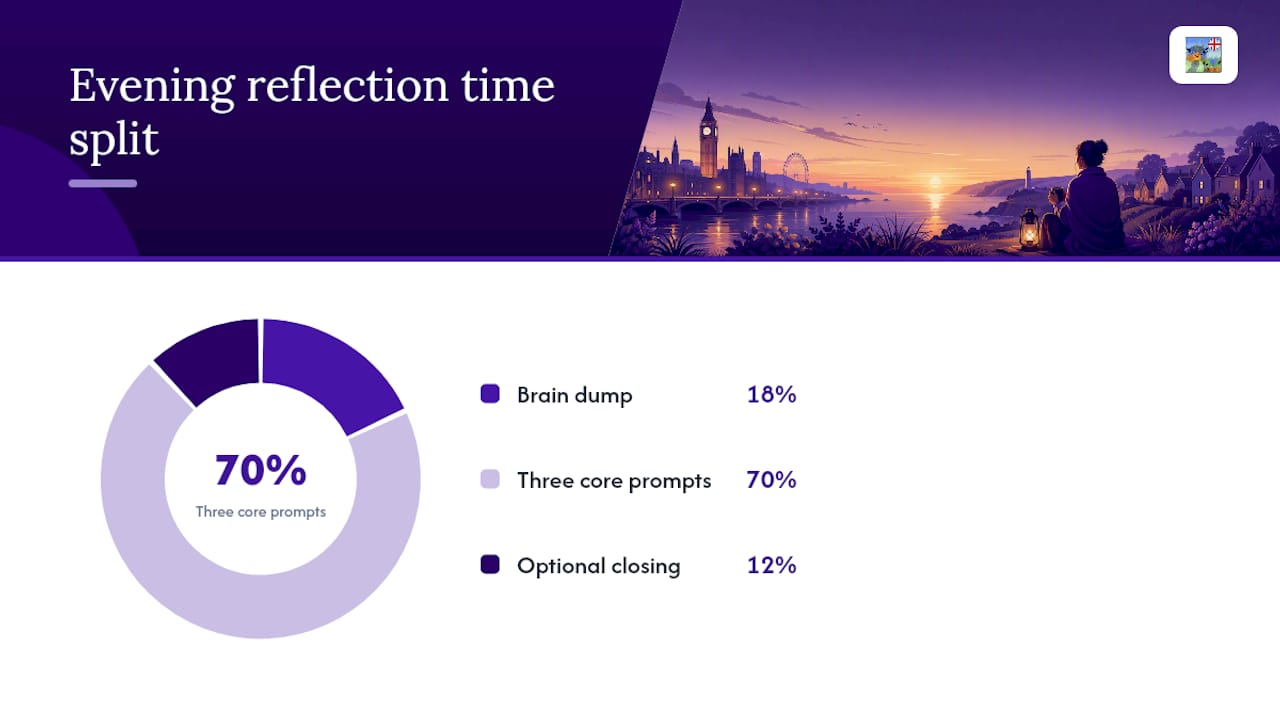
- Brain dump (30 to 60 seconds). Write down anything looping in your head, tasks, worries, stray thoughts, without editing. This is release, not analysis.
- Three core prompts (about 3 minutes). Answer each in one sentence: What went well today? What drained me? What's one thing I'll carry forward tomorrow?
- Optional closing line (30 seconds). Add one gratitude note or one specific next action, ideally with a time, place, or person attached so it stops floating around in your head.
Stop at five minutes. That's not a suggestion, it's the point. A practical guide to end-of-day reflection recommends this exact three-question structure, specifically because it's short enough to survive contact with exhaustion. Longer entries invite the kind of deep processing that can backfire at night, which the troubleshooting section below covers, as explained in detail in What Does an Open Ending Mean in Storytelling?.
Anchor the routine to something you already do every night, brushing your teeth, plugging in your phone, turning down the covers. The cue does the remembering so you don't have to.
Pro Tip: Keep the journal and a pen already open on your nightstand before bed. If you have to go find them, you've added a decision point, and decision points are where new habits die.
Evening Journal Prompts Grouped by What Tonight Needs
Some nights call for gratitude. Others call for damage control on a spiraling thought. Match the prompt to the actual need instead of forcing the same three questions every time.
Gratitude prompts (answer in one sentence):
- Who made today easier, even in a small way?
- What's one thing my body let me do today that I didn't think about?
- What small moment would I want to remember a year from now?
Closure prompts, for releasing unfinished business:
- What's one thing I'm choosing to leave unfinished until tomorrow?
- What decision am I overthinking that can wait until morning?
Anxiety relief prompts, body-focused rather than analytical:
- Where in my body do I feel tension right now, and what would loosen it?
- What's one fact (not a worry) about tomorrow that's actually true?
Tomorrow-prep prompts, to offload planning:
- What's the one task that matters most tomorrow, and when will I do it?
- What do I need to prepare tonight so morning-me isn't scrambling?
A prompt roundup on evening journaling groups prompts this same way, by goal rather than by generic theme, because a scattered list of forty questions is harder to use at 11 p.m. than four that match your actual mood.
How to Make Evening Journaling Stick
Most people don't quit journaling because they dislike it. They quit because the prompt felt too open-ended on a night they had nothing left to give. Fixed templates and single-sentence formats remove that friction entirely.
- Anchor the habit to an existing nightly cue, like right after brushing your teeth, and set a phone alarm 10 to 20 minutes before your target bedtime as a reminder.
- Use the same three-question format every night instead of hunting for a new prompt, which cuts decision fatigue to almost nothing.
- Keep your journal visible, not buried in a drawer. A pocket-sized or bedside-sized book you actually see is one you'll actually use.
- On nights you're too tired to write, a voice memo or a phone notes app works fine. The goal is offloading the thought, not the format.
Habit research on evening routines backs anchoring and time limits as the two biggest levers for consistency in a nightly journaling practice.
Pro Tip: If you keep skipping the written version, try saying your three answers out loud into a voice memo for two weeks. Once the habit itself is solid, switching back to paper is easy.
When Night Journaling Backfires, and How to Adapt
Writing before bed can occasionally do the opposite of what you want. If a prompt sends you down a spiral of analyzing a conflict, a mistake, or a worry, you've traded rumination on paper for rumination in your head, and neither helps you sleep.
Statistic Callout: Research summarized by ScienceDaily found that writing about the day's events before sleep reduces cognitive arousal, but that effect depends on the writing staying brief and closure-focused rather than turning into deep analysis.
- Cap entries to three lines if a topic feels heavy, and finish with a "parking" sentence: "I'll think about this more tomorrow."
- Swap the written prompt for two minutes of body grounding, slow breathing or noticing five things you can feel, if your mind won't settle.
- If a specific worry recurs three or more nights in a row, that's a sign to process it during the day or talk to someone qualified. A journal isn't a substitute for that.
How to Choose a Journal for Your Evening Reflection Practice
The right journal for this routine isn't the thickest or fanciest one. It's the one you'll actually open at 10 p.m. when you're half asleep.
- Size. A compact format you can keep on a nightstand beats a large journal you have to dig out.
- Layout. Lined pages work for the three-prompt template; a guided or prompted layout helps if you want structure built in.
- Dated vs. undated. Undated pages remove the pressure of "catching up" if you miss a night.
- Paper and durability. Thicker paper resists ink bleed if you write right before turning off the light.
Munkterproducts' 6x9 travel journal with 120 lined pages fits this exact use case: compact enough for a nightstand or bag, with enough lined space for the three-question format without wasted pages. If you'd rather have prompts built in instead of writing from a blank line, a guided journal removes even that small decision.
A Note on Keeping This Practice Gentle
Consistency beats perfection here, by a wide margin. A messy three-line entry every night does more for your sleep than a beautifully written page once a month. The one change that made this stick for me was tying it to brushing my teeth, no new alarm, no new decision, just one more thing after a thing I already do. It's not complicated. It's just repeatable.
— Mark
Get the Journal That Matches This Routine
Some sellers offer the physical tool this whole routine depends on, without the clutter of an app that wants your attention for twenty other things. That's the real advantage over a digital journaling app: a paper journal has no notifications, no feed, no reason to stay lit up after you've written your three lines.

The 6x9 travel journal with 120 lined pages is sized for exactly the template above, small enough for a nightstand drawer, with enough room to run the routine for months before you need a new one. If you'd rather have prompts already printed instead of writing from scratch, browse the activity and puzzle books collection for guided formats. Checkout is a single page with postage included, so getting a journal in hand takes minutes, not another decision you have to think through tonight.
Sources
- Can writing your to-dos help you doze? Baylor study suggests jotting down tasks can
- NCBI review on expressive writing and psychological/physiological outcomes
- The End-of-Day Reflection: A 5-Minute Evening Journaling Routine — Fond
FAQ
What Is the 3-3-3 Journaling Method?
Common versions ask for three things you're grateful for, three things you accomplished, and three things you're looking forward to, though exact wording varies by source. It works as a quick evening scan rather than an open-ended free write.
What Are the Best Journals for Reflection?
A compact, lined or lightly guided journal you'll actually keep by your bed works better than an elaborate one you rarely open. Munkterproducts' 6x9 travel journal fits the three-question, five-minute format directly.
What Is the 3/2/1 Method of Journaling?
This is another structured variant, typically three things noticed today, two feelings named, and one lesson or intention, used the same way as the three-question template: as a fixed frame that removes decision fatigue at night.
What Are Some Ideas for a Reflective Journal?
Group your prompts by need instead of using one generic list: gratitude prompts for calm, closure prompts for unfinished business, body-focused prompts for anxiety, and a single next-action prompt to offload tomorrow's planning.
Is Evening Journaling Better Than Morning Journaling?
They serve different purposes. Morning journaling sets intentions for the day ahead, while evening reflection journaling closes it out, and the Baylor research specifically ties nighttime writing to faster sleep onset.