

A self-discovery journal is a structured writing practice that turns raw feelings into visible patterns about your values, triggers, and goals, then pushes you to act on what you find. It works because naming a pattern on paper makes it easier to change than a pattern only felt in your head. Start tonight: set a timer for 10 minutes, pick one prompt from below, and write without editing yourself.
TL;DR:
- Journaling with a structured, action-oriented approach produces modest but reliable mental and physical health benefits, especially when sessions are consistent.
- Avoid rumination by ending each session with one small, concrete action and watch for repetitive complaints without new insights.
- Focus on specific prompts that target current moods or patterns to generate more meaningful insights in shorter sessions.
- Use frameworks like R.E.F.L.E.C.T. or the three-pillar method to give shape to each journaling session and prevent aimless writing.
- Guided journals with built-in prompts and review pages can help sustain the habit and deepen self-awareness over time.
Table of Contents
- What Makes a Self-Discovery Journal Different From a Diary
- What the Research Actually Shows About Journaling for Self-Awareness
- How to Start Tonight: A Session That Actually Produces Insight
- A Prompt Bank Organized by What You're Actually Trying to Learn
- Frameworks That Turn Raw Writing Into Real Insight
- Common Pitfalls That Quietly Kill a Journaling Habit
- What to Look for in a Guided Self-Discovery Journal
- Why Most Journaling Advice Undersells the Hard Part
- Where to Find a Journal Built for This Kind of Work
- Sources
What Makes a Self-Discovery Journal Different From a Diary
A diary records what happened. A self-discovery journal asks why it happened and what it says about you. That shift in intention changes everything about how you write and what you get out of it. Where a diary might log "argued with my sister again," a self-exploration diary pushes further: what pattern keeps showing up in that relationship, and what does your reaction reveal about a boundary you haven't set?
This isn't therapy, and it isn't a replacement for one. Journaling gives you a private space to process and notice patterns; a therapist helps you work through trauma, diagnosed conditions, or patterns too tangled to untangle alone. Think of the journal as the tool you use between sessions, or the tool you use when things are hard but not clinical.
Self-discovery journaling tends to earn its keep during specific life stretches:
- A career change where you're not sure what you actually want, versus what you think you should want
- Burnout, when you've lost track of what energizes you versus what just drains you
- A values misalignment, when your daily choices don't match what you say matters to you
- A relationship pattern that keeps repeating with different people
If your entries consistently spiral into panic, hopelessness, or intrusive thoughts, that's a signal to loop in a licensed professional alongside the notebook, not instead of it—consider exploring types of personal spiritual breakthroughs as part of your journaling and healing journey.
What the Research Actually Shows About Journaling for Self-Awareness
The evidence base here is real, but it's also more modest than most journaling blogs let on. James Pennebaker's expressive writing research found that writing about emotional experiences for several minutes across several sessions produces measurable benefits for both mental and physical health. That protocol, not a vague "just write daily," is the backbone of most modern journaling advice.
The effect is consistent but not dramatic. Studies aggregated in expressive-writing research show reliable but modest improvements in psychological well-being, alongside some physical health gains. A systematic review of writing interventions confirms that structured sessions lasting several minutes are enough to produce these effects. You don't need an hour. You need consistency and structure.
The downstream effects go beyond mood, too. Some research tracked in the same expressive writing literature links structured writing to faster re-employment after job loss and better academic performance in certain cohorts. That's a meaningful signal: writing that examines identity and setbacks can change behavior, not just feelings.
Here's the part most guides skip. Journaling has a real failure mode: rumination. Writing that just replays a hurt on loop, without moving toward insight or action, can deepen distress instead of relieving it. The fix isn't complicated, but it's non-negotiable:
- Every session should end with one small, concrete action, not just a feeling named
- If you notice the same complaint appearing word-for-word across five entries with no new angle, that's rumination, not reflection
- Writing in the third person about yourself can create enough distance to interrupt a rumination loop
How to Start Tonight: A Session That Actually Produces Insight
You don't need a ritual. You need a notebook, a timer, ten quiet minutes, and permission to write badly. Perfectionism kills more journaling habits than lack of time ever does.
Here's the sequence that works:
- Pick one prompt from a category that matches your current mood, not the one you think you "should" answer.
- Set a timer for 10 to 15 minutes and free write without stopping to edit, reread, or judge the sentences.
- Read back what you wrote once, and underline or circle any word or phrase that repeats, surprises you, or feels heavier than the rest.
- Name one tiny action tied to what you just noticed. Not a life overhaul. Something you could do by Friday.
That fourth step is the one people skip, and it's the one that separates insight from a diary entry that just sits there. Practitioners who work with journaling as a behavior-change tool consistently recommend closing every entry with something calendared, even something as small as sending one text or blocking 15 minutes to think.
Pro Tip: Keep the timer visible while you write. Knowing you only have to sit with the discomfort for 10 more minutes makes it far easier to write honestly instead of performing for an imaginary reader.
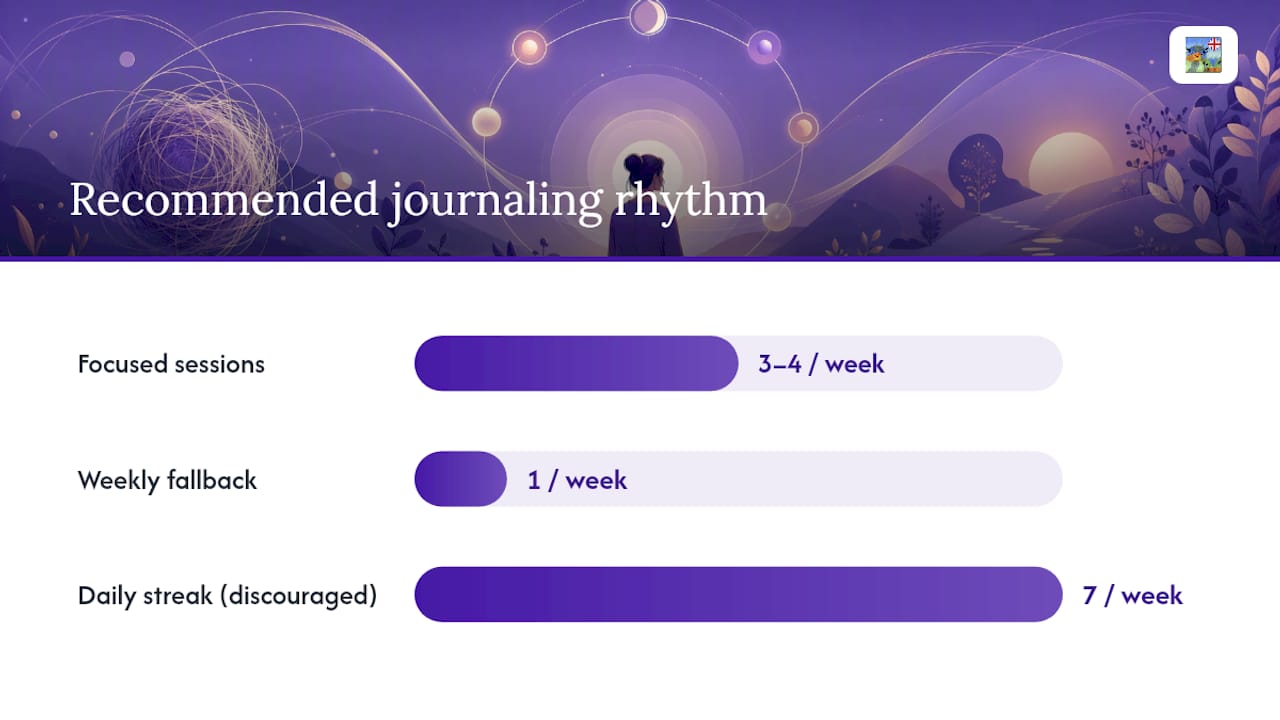
On cadence: three or four focused sessions a week beats a daily streak you'll eventually break and feel guilty about. If your week is genuinely packed, one solid weekly session still moves the needle, especially if you pair it with a monthly review to catch patterns across entries.
A Prompt Bank Organized by What You're Actually Trying to Learn
Vague prompts produce vague answers. "What do I want out of life?" is too big to answer honestly in 10 minutes. Prompts that force specificity, a person, a place, an exact moment, consistently dig up more than abstract questions ever will. Use the category that matches what's actually on your mind this week, then rotate through the others over the following month.
Values and meaning
- Describe a moment in the last year when you felt completely aligned with who you want to be. What were you doing?
- What would you do differently this week if no one else's opinion mattered?
- Name a value you claim to hold but haven't acted on in the last month. Why not?
- If you had to defend one belief to someone who disagreed, which belief would you fight hardest for?
Patterns and triggers
- What's a reaction you've had more than once this month that surprised you?
- Think of the last time you felt disproportionately angry or hurt. What did that moment remind you of?
- What do you avoid saying out loud, even to people you trust?
- Describe a specific person or situation that reliably puts you in a bad mood, and name exactly what about it does that.
Career and purpose
- Describe the last work task that made time disappear. What made it different from the others?
- What part of your current role would you keep doing even if it paid nothing?
- If you had to explain to a stranger why you do this job, what would you actually say, not the polished version?
- What's one skill you keep avoiding because you're afraid you're bad at it?
Relationships and boundaries
- Describe a specific conversation where you said yes but wanted to say no. What stopped you?
- Who in your life makes you feel smaller after spending time with them, and what exactly do they do?
- What's a boundary you've set once but haven't enforced consistently?
- Write about a relationship that changed shape this year. What triggered the shift?
Growth and next steps
- What's something you believed about yourself five years ago that you no longer believe?
- Name one thing you did this month that your past self would be proud of, and be specific.
- What's a small fear you could test this week with almost no risk?
- If this month were a chapter title, what would it be, and why?
For a longer running list to pull from when these feel used up, this collection of 60-plus growth prompts covers more ground across similar categories.
Frameworks That Turn Raw Writing Into Real Insight
Free writing alone can wander. A framework gives the session a shape without turning it into homework. The R.E.F.L.E.C.T. method is one repeatable structure: Recall a specific moment, Explore what you felt, Frame the pattern behind it, Learn what it reveals about a value or need, Evaluate whether your response served you, Commit to one action, then Track it in your next session. Running through those steps in order keeps a 10 minute session from turning into an unstructured vent.
Another useful structure balances three pillars: Connection, Positivity, and Resilience. This matters because journals that only chase positivity end up shallow. A research-informed approach to journaling in hard times recommends covering all three so you build durable coping skills instead of just collecting feel-good affirmations that don't hold up under real stress.
- Close every entry with one action, however small
- Review monthly instead of chasing a daily streak
- Rotate frameworks so no single method gets stale
Pro Tip: Pick one framework per month rather than switching every session. Consistency in structure makes it easier to compare entries later and actually spot the pattern you're looking for.
Common Pitfalls That Quietly Kill a Journaling Habit
Rumination is the biggest one. It looks like reflection but isn't: the same complaint, the same person, the same hurt, worded almost identically across five or six entries with no new angle and no action attached. The fix is a rule, not willpower: if you catch yourself repeating a complaint verbatim, stop and force one sentence naming an action, even a tiny one.
Blank-page anxiety is the second killer. The fix is structural, not motivational.
- Never open a session with an open prompt like "how am I feeling"; start with a specific question from a category above
- Keep the timer running even through silence; sitting with 90 seconds of nothing is normal and usually breaks
- Write the prompt itself at the top of the page if you're stuck, then just start answering it in fragments
Perfectionism shows up as crossing out sentences or rewriting the same line three times. Give yourself explicit permission to write badly, misspell words, and never finish a sentence. If an entry brings up distress that feels bigger than the page can hold, panic, dissociation, or thoughts of self-harm, stop writing and reach out to a professional. The notebook is not equipped for that, and it was never meant to be.
What to Look for in a Guided Self-Discovery Journal
A blank notebook works, but a guided journal removes the guesswork of what to ask yourself next. When you're shopping for one, check for a few specific things:
- Prompts grounded in a real framework, not just a list of generic questions copied from a blog
- A structure that pushes toward one action per entry, not just open reflection
- Weekly or monthly review pages that let you look back across entries and catch the pattern that a single entry can't show you
- A physical build that can survive daily handling if you're writing every day
Self-help journals built around a story-driven structure rather than a loose stack of disconnected questions fit directly into the R.E.F.L.E.C.T. and three-pillar frameworks above. If you want the mechanics behind that approach, this breakdown of story-driven journaling explains how the narrative structure guides you from prompt to pattern to action.
Why Most Journaling Advice Undersells the Hard Part
The internet treats journaling like a vibe: light a candle, write whatever comes, feel better. The research doesn't back that version. What actually moves the needle is closer to a discipline: a timed session, a specific prompt, and a mandatory closing action. Strip out the action step and you're left with expensive venting.
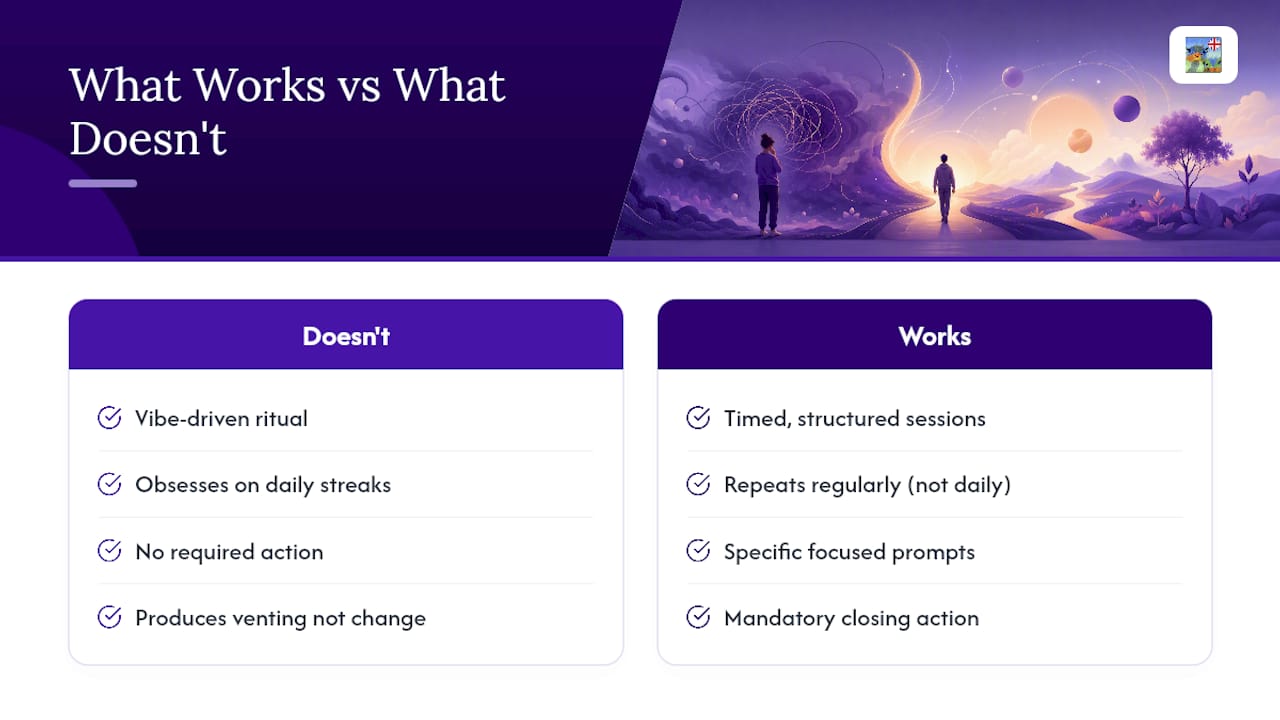
Where I think most guides get it wrong is the obsession with daily streaks. The evidence points toward structured, repeated sessions, not necessarily daily ones, with monthly review doing the real pattern-spotting work that a single entry never can. Chasing a streak just sets people up to quit the first time life gets busy and feel like they failed at journaling itself.
If you take one thing from this, prioritize the closing action over the prompt. A brilliant prompt that ends in "and that's just how I am" changes nothing. A mediocre prompt that ends in "so I'm going to text her Friday" changes something concrete by the weekend. Insight without action is just a well-written complaint.
— Mark
Where to Find a Journal Built for This Kind of Work
If the frameworks above make sense but a blank notebook still feels intimidating, a guided option removes that first barrier. Structured, story-driven self-help journals offer prompts built around the same reflection-to-action pattern this article walks through, so you're not designing your own framework from scratch while also trying to be honest with yourself.

That matters most for readers who've tried journaling before and quietly stopped, usually because an unstructured notebook turned into three vague sentences and a guilty conscience. A journal with built-in structure and review checkpoints solves that specific failure point. Adult coloring books and puzzle books are also available as a lower-effort way to unwind between writing sessions, alongside original science fiction titles for readers who want a break from self-reflection entirely. Browse the self-help journal collection to find a guided option that matches the frameworks covered here, and start your next session with a structure already built in.
Sources
- PubMed: expressive writing research (review/meta-analysis)
- NCBI PMC article on writing interventions and health
- Greater Good Science Center: How journaling can help you in hard times