
If you want a puzzle that actually fights back, start with Munkter Products' hard word-search book, or, if you'd rather print your own, set a generator to a 20×20 grid with the word list hidden and every direction turned on. Both routes get you to the same place: a puzzle dense enough to make an experienced solver slow down.
What separates a "hard" puzzle from a Sunday-paper time-filler comes down to a few measurable things: grid size, word length, direction rules, and whether you can see the word list at all. A 20×20 grid holding up to 25 words is commonly treated as the benchmark for "expert" difficulty, and puzzles at that size routinely take a practiced adult solver 20 to 40 minutes to finish. That's not a filler activity. That's a puzzle with teeth.
Munkter Products' hard word-search book is built around those exact levers, with sample pages available before you commit and a puzzle count you can verify on the product page itself. If you're not sure whether it's hard enough for you, that's the point of the sample. Open it, try one grid, and see how long it takes.
Key Takeaways
Genuinely hard word searches come from measurable design choices, and Munkter Products' hard word-search book applies all of them deliberately, from grid density to hidden vocabulary.
| Point | Details |
|---|---|
| Try a sample first | Preview a sample puzzle before buying or printing to confirm the difficulty actually matches your skill level. |
| Target 20×20 or larger | Grids at this size or bigger, with words averaging 7+ letters, define true expert-level difficulty. |
| Hide the word list | Removing visible word lists turns scanning into pure pattern recognition, the single biggest difficulty jump. |
| Prioritize separate answer keys | A complete, separate answer section prevents accidental spoilers and lets you verify solutions fairly. |
| Start with Munkter Products | Its hard word-search book combines curated vocabulary, dense grids, and sample pages you can check before buying. |
Still have questions about grid sizes, printable settings, or how to judge a book before buying? The next section covers the specifics.
Table of Contents
- Where to Get Hard Word Search Books: Buy or Print
- What Actually Makes a Word Search Hard?
- How Do You Pick the Right Hard Word-Search Book?
- Where Can You Find Free Printable Hard Word Searches?
- Sample Puzzle and How to Build Your Own
- How Do You Solve Hard Word Searches Faster?
- Why We Built Our Hard Word-Search Book This Way
- Our Recommended Pick for Advanced Solvers
- Frequently Asked Questions
- Sources
Where to Get Hard Word Search Books: Buy or Print
You have two real options here, and they solve different problems. One gets you a durable, curated book you can carry around and return to for weeks. The other gets you instant, free, and endlessly customizable puzzles you print at home.
Buying a physical book makes sense if you want consistency. A well-made hard word-search book has already been curated by someone who understands difficulty design, so you're not gambling on whether each puzzle actually delivers. When you're shopping, check three things on the product page before buying: a visible sample grid, a stated puzzle count, and whether large-print options exist if legibility matters to you. Retail listings for genuinely hard puzzle books tend to emphasize dense grids and careful large-print layout precisely because readability and difficulty aren't the same thing, and a book that sacrifices one for the other isn't doing you any favors.
Printing your own makes sense if you want to dial the difficulty exactly where you like it, today, for free. The better generator sites let you control grid size up to 30×30, toggle all eight directions, set a minimum word length, and hide the word list entirely. That last option matters more than people expect. Without a visible list, you're not scanning for a known target. You're pattern-matching against nothing, which is a completely different mental task.
| Factor | Physical book | Printable/download |
|---|---|---|
| Cost | One-time purchase | Often free, or low subscription cost |
| Portability | Travels well, no screen needed | Requires printing and paper |
| Difficulty control | Fixed by publisher | Fully adjustable per puzzle |
| Durability | Reusable, ink-friendly paper | Single-use unless reprinted |
| Answer key | Usually included, separate section | Usually a separate PDF page |
A few things worth weighing before you pick a lane:
- Books win on durability and the "no screen, no printer" convenience factor.
- Printables win on customization if you want to push past 25×25 or lock in a specific theme.
- Books tend to have better editorial quality control since someone already tested difficulty and legibility.
- Printables cost you time upfront (finding a reliable generator) that a book skips entirely.
What Actually Makes a Word Search Hard?
Difficulty in a word search isn't a feeling. It's a set of design choices you can point to and measure, and once you know what they are, you can judge any puzzle in about ten seconds flat.
Grid size is the biggest lever. A 10×10 grid has 100 letters to scan. Bump that to 20×20 and you're at 400 letters, four times the visual noise for the same number of hidden words. Push to 30×30 and you're well past 900 letters, which is where casual solvers usually give up and dedicated ones settle in for a real session. Elite Word Search's guidance puts a 20×20 grid with up to 25 words squarely in "expert" territory, and solvers report 20 to 40 minutes for a single puzzle at that size.
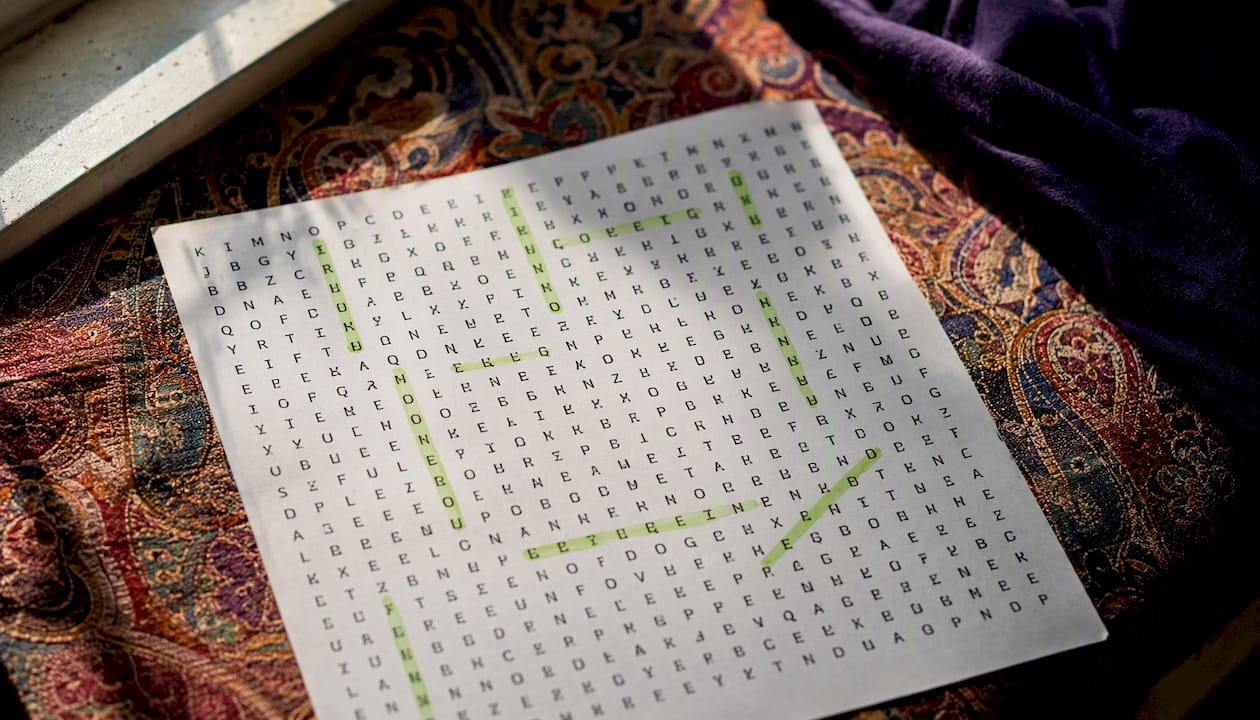
Word characteristics matter just as much as grid area. Short, common words like "cat" or "run" hide almost nowhere. Long, multi-syllable, or technical words create far more overlapping letter combinations, which means more false starts for your eye. Generator guidance suggests aiming for average word lengths of 7 characters or more for anything you'd call genuinely hard, and specialized vocabulary (medical terms, scientific names, obscure literary references) adds a second layer of friction because you can't lean on familiar word shapes.
Placement rules decide how the words sit in the grid. All eight directions, including backward and diagonal, roughly doubles the search space compared to a puzzle that only runs words left-to-right and top-to-bottom. And hiding the word list entirely removes your last crutch: instead of hunting for a known target, you're scanning raw letter noise for anything that resembles a real word.
| Difficulty lever | Easy setting | Hard setting |
|---|---|---|
| Grid size | 10×10 to 15×15 | 20×20 to 30×30 |
| Average word length | 4 to 5 letters | 7+ letters |
| Directions allowed | Horizontal/vertical only | All directions, including backward and diagonal |
| Word list visibility | Shown | Hidden |
| Vocabulary type | Common, everyday words | Technical, obscure, or multi-syllable |
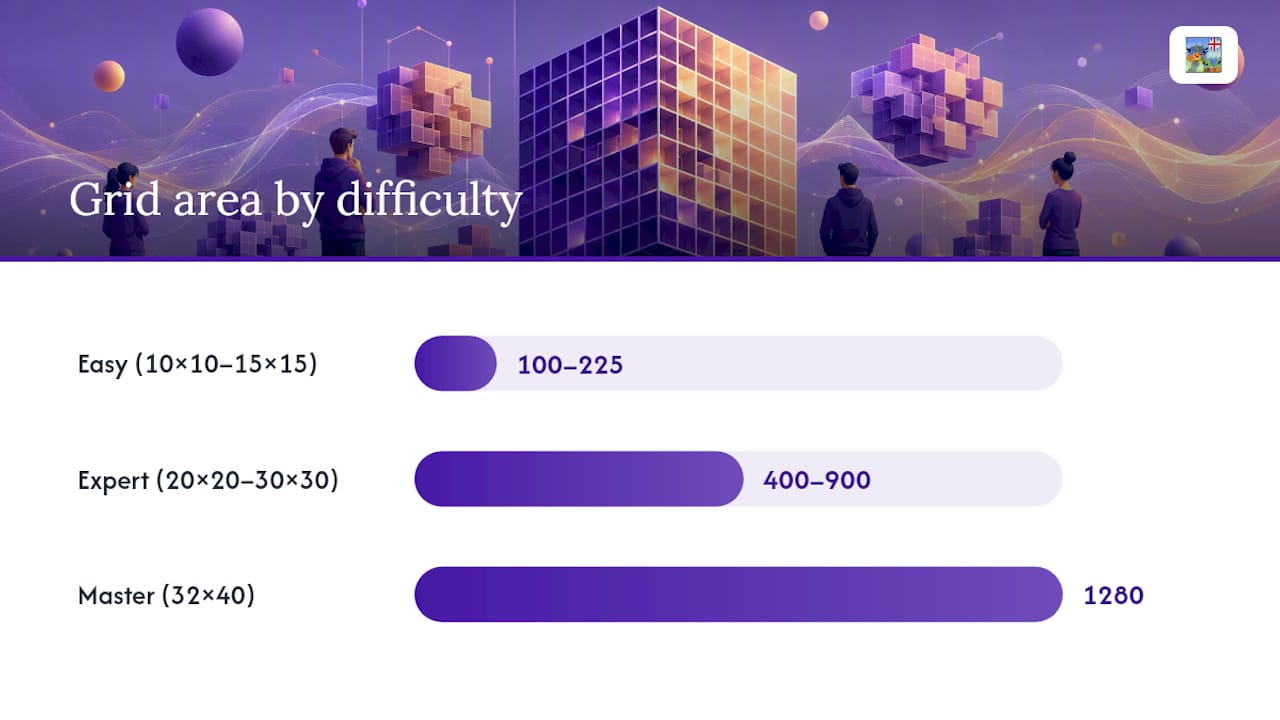
Some publishers push this even further. Extreme "master" puzzle books advertise oversized grid architectures around 32×40 and thousands of uncommon words, which is genuinely impressive as a design feat but honestly overkill for most solvers who just want a solid, sustained challenge rather than a multi-hour marathon.
How Do You Pick the Right Hard Word-Search Book?
You don't need to read a hundred reviews to figure out if a book is worth your money. You need to check five things, in this order, and skip anything that doesn't show its work.
- Look at the sample puzzle first. If a publisher won't show you a real page, that's your answer. A legitimate sample tells you grid size, word density, and font size in about five seconds.
- Check the puzzle count and page layout. Sixty puzzles crammed onto flimsy paper is a worse deal than forty puzzles printed with room to breathe.
- Confirm the answer key is complete and separate. A hard puzzle you can't verify is just frustrating, not fun. Look for a dedicated answer section, not answers squeezed into the margins.
- Check paper and print quality. Thin paper bleeds through if you solve in pen or marker, and cramped layouts sometimes print answers close enough to the grid that you spot a word by accident before you've earned it.
- Read a handful of reviews for specificity, not star counts. A review that says "the puzzles were legitimately hard, took me 25 minutes each" tells you more than a five-star rating with no detail.
Ask yourself two direct questions before buying anything: does this book use long, specialized words, or is it padded with easy four-letter filler? And are the grids genuinely dense, or does the sample page look sparse with lots of blank-feeling space? A publisher's marketing copy will always say "challenging." The sample page either proves it or doesn't.
Pro Tip: Time yourself on the sample puzzle before buying. If it takes under five minutes, the book's "hard" difficulty claim probably doesn't match your skill level, and you should look elsewhere.
Where Can You Find Free Printable Hard Word Searches?
Free generators are a legitimate option if you want to test difficulty settings before committing to a book, or if you just want an occasional puzzle without spending anything. The trick is knowing which settings actually produce something hard, because most default settings on generator sites are tuned for casual solvers, not you.
Look for a generator that gives you direct control over these settings:
- Grid size adjustable to at least 20×20, ideally up to 30×30
- A toggle for all eight directions, including backward and diagonal placement
- A minimum word-length filter so you can exclude short, easy words
- An option to hide the word list completely for maximum difficulty
- A downloadable PDF with the answer key on a separate page
PuzzleGenio documents settings up to 30×30 and explicitly recommends disabling the word list for the hardest mode, and it delivers the puzzle and answer key as two separate PDF pages, which matters if you're planning to hand the puzzle-only page to someone else or keep the solutions private for a group activity.
A quick way to test any generator: set the grid to 25×25, load 20 to 30 words, and hide the list. If the resulting PDF looks dense and the words don't jump out at a glance, the generator is doing its job. If you can spot half the words in ten seconds, keep looking.
Pro Tip: Print on heavier paper (24lb or higher) if you're solving in ink. Standard printer paper bleeds and can make backward or diagonal words harder to trace accurately, which adds frustration without adding real difficulty.
Sample Puzzle and How to Build Your Own
Picture a 20×20 grid themed around astronomy, with 22 hidden words ranging from "nebula" and "perihelion" to shorter anchors like "orbit" and "comet." No word list shown. All eight directions active. That's a fair representation of what an expert-level puzzle looks like on paper, and it's roughly the format you'll find in Munkter Products' hard word-search book.
If you'd rather build your own, follow these settings in order:
- Choose a grid size of at least 20×20; go to 25×25 or 30×30 if you want a real test.
- Set your word count between 20 and 30 words for that grid size.
- Enable all eight directions, including backward and diagonal.
- Set a minimum word length of 6 or 7 letters, and favor technical or thematic vocabulary over everyday words.
- Hide the word list if your generator supports it, since this is the single biggest difficulty multiplier.
- Generate a separate answer-key PDF so you can verify your solution afterward.
A few pitfalls sink otherwise-promising DIY puzzles, and they're worth avoiding on purpose:
- Loading too many short, common words dilutes difficulty even in a large grid.
- Low word density (too few words for the grid size) leaves too much empty space, which makes scanning easier, not harder.
- Small fonts or tightly packed letters cause eye strain that feels like difficulty but is actually just poor design.
For themed vocabulary ideas that raise difficulty without feeling arbitrary, themed word searches built around a specific subject (science, literature, history) tend to produce more interesting overlapping letter patterns than a random word bank ever will.
How Do You Solve Hard Word Searches Faster?
Experienced solvers don't just get lucky. They use consistent scanning patterns, and once you adopt one, your solve times drop noticeably even on the densest grids.
Start with a systematic sweep instead of random hunting. Scan row by row for the first letter of your target word, then check all eight directions from every match before moving to the next row. Diagonal sweeps deserve extra attention because they're the direction most solvers neglect, which is exactly why puzzle designers lean on them for difficulty. Long or unusual letter pairings (like "qu" or "ph") are worth memorizing as anchor points since they appear far less often than common combinations, which narrows your search dramatically.
A few habits separate fast solvers from frustrated ones:
- Isolate overlapping letter clusters first. Words sharing letters create visual traps, and spotting the overlap early prevents double-counting mistakes.
- Do a reverse check on every word. If you can't find it forward, flip your scan and read backward before assuming it isn't there.
- Practice on progressively larger grids. Start with 15×15 timed drills, then move to 20×20 once your average time stabilizes.
- Study vocabulary for the puzzle's theme beforehand if you know it. Recognizing "perihelion" instantly, instead of reading it letter by letter, cuts real time off a solve.
There's a genuine cognitive payoff here beyond entertainment. Puzzle complexity has been linked to sustained attention and vocabulary retention, and the brain-health case for regular puzzle solving holds up particularly well for harder puzzles, since they demand longer, more focused engagement than an easy grid you finish on autopilot.
Pro Tip: Keep a simple log of your solve times on similarly sized grids. Watching your average time drop over a few weeks is its own kind of satisfying, and it tells you when you're ready to move up to a harder grid size.
Why We Built Our Hard Word-Search Book This Way
I wanted our hard puzzle book to earn the word "hard" honestly, not just print it on the cover. That meant a few non-negotiable editorial choices from the start: grid density high enough to genuinely challenge an experienced solver, vocabulary curated by theme rather than pulled from a generic word bank, and layout decisions that never sacrifice legibility for the sake of looking dense.
Paper quality mattered more than I expected going in. Thin paper bleeds when you solve in pen, and answer keys printed too close to the grid can accidentally reveal a word before you've earned it. We kept the answer section fully separate for exactly that reason. Readers can check their work without any risk of spoiling the puzzle they're still working through.
What you'll find in our book: sample pages you can preview before buying, a stated puzzle count so there's no guessing about value, and grids built at the sizes serious solvers actually want, not padded with easy filler to inflate the page count. If you want more background on how puzzle books are put together and what separates a well-made one from a rushed one, our guide on what makes a strong word search book covers the format decisions in more depth.
Our Recommended Pick for Advanced Solvers
Munkter Products' hard word-search book is the fastest path to a puzzle that won't bore you after two pages. It's built with the specific difficulty levers this article covers: dense grids sized for real challenge, curated vocabulary instead of filler words, and a separate answer key section so you can check your work without spoiling the next puzzle.

Every book includes sample pages you can preview before you buy, so you're never gambling on whether "hard" means what you think it means. The puzzle count and grid sizes are listed right on the product page, and the paper stock was chosen specifically to hold up to ink and repeated use without the answer key accidentally showing through. If you've been burned before by a "challenging" puzzle book that turned out to be padded with easy words, this is built to avoid exactly that letdown.
Preview a sample puzzle and see the grid density for yourself on the Munkter Products site, and if you're shopping for someone else, it makes a solid pick alongside other thoughtful gift options for puzzle fans. Try the sample page first, then decide.
Frequently Asked Questions
What grid size counts as a truly hard word search? A 20×20 grid with about 25 words is widely treated as the expert baseline, and pushing to 25×25 or 30×30 raises difficulty further for solvers who want a longer session.
Are printable word searches as hard as puzzle books? They can be, if you control the settings yourself. A generator set to 25×25 with the word list hidden and all eight directions enabled produces a puzzle just as demanding as most published hard word-search books.
Why do some hard puzzles hide the word list? Hiding the list removes your reference point entirely, so you're scanning for patterns instead of hunting a known target, which is one of the fastest ways to raise difficulty without changing the grid size.
Do hard word searches actually help with focus or memory? Puzzles with higher complexity demand more sustained attention than easy ones, and consistent practice on denser grids has been linked to better vocabulary retention over time.
Is it better to buy a hard word-search book or print puzzles at home? Books offer curated, tested difficulty and better durability for long-term use, while printables give you full control over grid size and theme at no cost. Many solvers use both depending on the occasion.
Sources
A few resources are worth keeping on hand if you want to keep experimenting beyond this article.
- Free Hard Word Search Puzzles | Challenging 20x20 Grids | Elite Word Search
- Hard Word Search Puzzles - Free Printable | PuzzleGenio
- Amazon.com: Hard Word Search For Adults: World's Most Difficult Wordsearch Puzzles For Adults