
TL;DR:
- A word search book is a collection of puzzles featuring grids of letters with hidden words for readers to find, providing cognitive benefits across all ages. These books enhance visual scanning, pattern recognition, and vocabulary recall, making them valuable for children, adults, and seniors. They come in various formats, difficulty levels, and themes to suit different needs and preferences while maintaining accessibility and engagement.
Most people assume word search books are just something you grab at the airport to kill time. That assumption sells them short. A word search book is a collection of word search puzzles, each built around a grid of letters with hidden words waiting to be found. What surprises most people is how much is happening cognitively when you work through one. This article breaks down exactly what a word search book is, why it benefits readers of all ages, what types exist, and how to get the most out of one whether you're six or sixty.
Table of Contents
- Key takeaways
- What is a word search book and how puzzles work
- Why word search books benefit every age group
- Types of word search books available
- How to use a word search book effectively
- How to choose and buy the right word search book
- My take on why word search books still matter
- Discover puzzle books at Munkterproducts
- FAQ
Key takeaways
| Point | Details |
|---|---|
| Definition matters | A word search book is a structured collection of letter-grid puzzles, not just random filler activity. |
| Real cognitive benefits | Regular solving builds vocabulary, visual scanning, pattern recognition, and attention across all ages. |
| Many types available | Books range from large print and themed collections to educational and custom formats for every skill level. |
| Solving strategies work | Using start-letter anchoring and rare-letter focus makes solving faster and more satisfying. |
| Choosing the right book | Match theme, difficulty, and print size to the reader's age and purpose for the best experience. |
What is a word search book and how puzzles work
The Oxford Learner's Dictionary defines word search as a game consisting of letters arranged in a square containing hidden words to find. A word search book takes that single puzzle and multiplies it across dozens or even hundreds of pages, typically organized by theme, difficulty, or subject matter.
Each puzzle inside the book follows the same structure. You get a grid of letters, usually square or rectangular, and a word list printed nearby. Your job is to locate every word from that list inside the grid. Sounds simple. The catch is that words hide in eight directions: horizontally, vertically, diagonally, and in reverse across any of those angles. A word like "TIGER" might run left to right on one row, or it might run diagonally backward from the bottom right corner.
Grid sizes vary widely depending on the book's intended audience and difficulty level. Here is what you typically find:
- Beginner grids: 10x10 letters, shorter word lists, straightforward directions only
- Intermediate grids: 12x15 to 15x15, mixed directions, longer word lists
- Advanced grids: 18x18 to 20x20 or larger, all eight directions, densely packed letters
One detail most solvers never notice: letter cells are shared between multiple words in well-designed puzzles. That is what makes a grid look full and uniform rather than sparse. A good puzzle designer packs the grid efficiently so that filler letters blend naturally with the hidden words.
Pro Tip: Before you start scanning randomly, read the entire word list first. Grouping shorter words together and tackling them first builds momentum and helps your eye calibrate to the grid's letter density.
Word search books also typically include an answer key at the back, which is genuinely useful for beginners and for educators checking student work. Some books add thematic illustrations, fun facts, or vocabulary definitions alongside puzzles to deepen the experience.
Why word search books benefit every age group
Here is where the "just a time-filler" perception falls apart completely. Word search puzzles stimulate visual scanning, pattern recognition, vocabulary recall, and working memory at the same time. That is not one cognitive task. That is four running simultaneously every time you work through a grid.
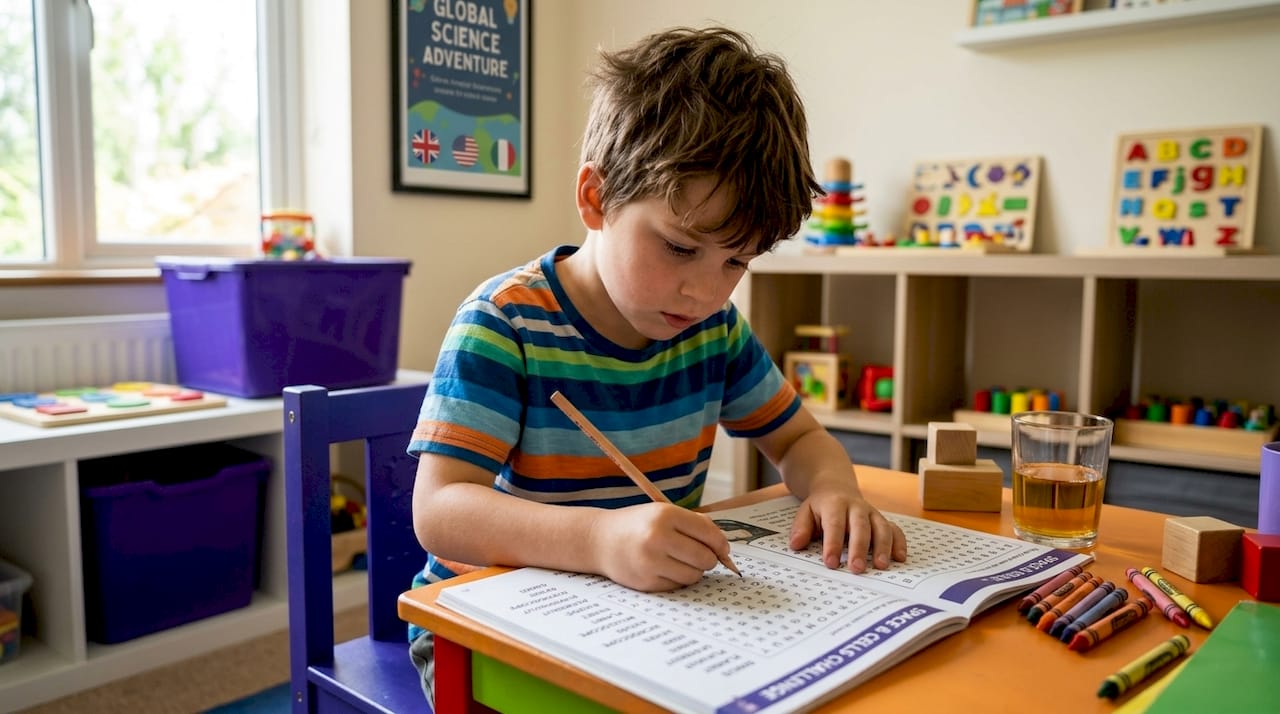
For children, the benefits show up in specific and measurable ways. Searching for a word like "PHOTOSYNTHESIS" in a science-themed puzzle reinforces spelling through repeated visual exposure. Kids are not just memorizing a definition. They are tracing letter sequences with their eyes and building what researchers call orthographic memory, the brain's ability to recognize and recall how words look on a page. Teachers and therapists use word search books precisely because they offer structured, level-adjustable challenges that work across a wide range of ages and abilities without intimidating reluctant learners.
For adults, the benefits shift slightly but remain significant. Word searches provide non-threatening brain exercise that encourages engagement even when someone feels mentally fatigued. They are low-stakes enough to pick up after a long workday but still demanding enough to keep your attention focused.
Seniors get a particularly meaningful advantage. Word searches are especially accessible for older adults because they remove the recall pressure that makes crosswords stressful. In a crossword, you need to retrieve a word from memory with only a clue. In a word search, the word is already there. You just need to find it. That distinction matters enormously for people who want cognitive engagement without frustration.
"Engaging regularly in word search puzzles is associated with slower cognitive decline and improved attention, making them a practical tool for long-term brain health at any age."
Compare that to other puzzle formats. Crosswords demand strong vocabulary retrieval and general knowledge. Sudoku is purely numerical and spatial. Word searches sit in a unique middle ground. They combine language skills with spatial visual scanning, engaging different brain areas at the same time. That dual engagement is what makes them more than entertainment. You can explore how different puzzle types stack up for adult cognitive engagement if you want a broader comparison.
Types of word search books available
Not all word search books are built the same, and that variety is one of the format's biggest strengths. Books come in many formats, including large print editions, themed collections, and custom puzzle options. Knowing the differences helps you pick the right one instead of grabbing whatever is on the shelf.
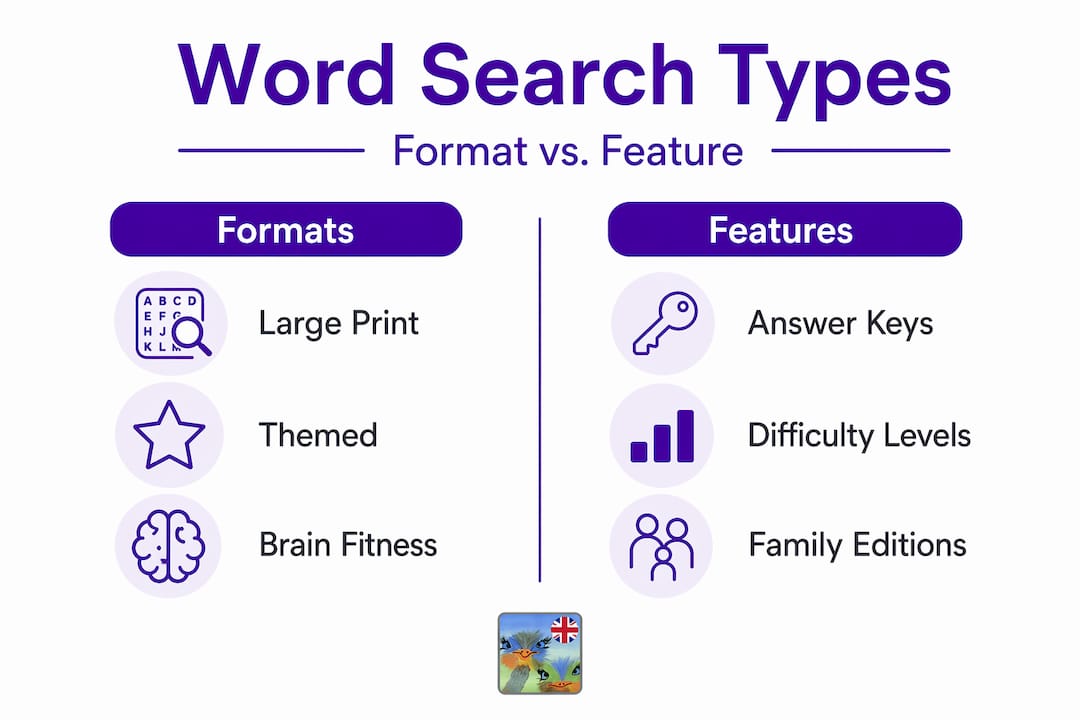
Here is a breakdown of the main types:
| Type | Best for | Key features |
|---|---|---|
| Large print | Seniors, low vision readers | Bigger grids, clear fonts, fewer words per puzzle |
| Themed collections | Hobbyists, children | Topics like animals, travel, holidays, sports |
| Educational subject books | Students, classrooms | Curriculum-aligned vocabulary, science, history |
| Brain fitness books | Adults, seniors | Progressively harder puzzles, cognitive focus |
| Custom or personalized | Gifts, special occasions | Names, events, or personal vocabulary lists |
Themed word search books deserve special attention because they dramatically increase engagement. A child who loves dinosaurs will spend far more time with a dinosaur-themed word search book than with a generic one. The same applies to adults. A gardening enthusiast working through a botany-themed puzzle is reinforcing real vocabulary in a context they care about.
Difficulty levels also vary more than most people realize. A beginner book might use a 10x10 grid with words running only left to right or top to bottom. An expert-level book might use a 20x20 grid with all eight directions active, including backward diagonals, and no word list categories to hint at groupings.
Pro Tip: If you are buying a word search book as a gift, check whether it includes solutions. A book without an answer key can turn a relaxing activity into a frustrating one, especially for casual solvers.
For families looking at the top word search books for families, themed books with varying difficulty levels in the same volume work best. They let different family members work at their own pace while sharing the same book. You can also find excellent educational book types that incorporate word searches alongside other activity formats.
How to use a word search book effectively
Knowing how to use a word search book well makes a real difference in how much you get out of it. Most people just scan randomly and hope a word jumps out. That works, but it is slow and misses a lot.
Here is a structured approach that experienced solvers actually use:
- Read the full word list first. Before touching the grid, scan all the words. Your brain starts pattern-matching immediately, even before you consciously search.
- Target rare letters first. Focusing on rare letters like Q, X, Z, or J in the word list dramatically shrinks your search area. There are only so many places those letters appear in any grid.
- Use start-letter anchoring. Find the first letter of a target word, then check all eight directions systematically from that point. This prevents you from missing words placed backward or diagonally.
- Work in passes, not one sweep. Do a first pass for short words, a second for medium, and a final pass for the longest words. Long words are often easier to spot once shorter words are crossed off.
- Mark found words clearly. Circle or highlight each word as you find it. This keeps your word list clean and prevents you from searching for words you have already located.
For classroom use, word search books work well as warm-up activities, vocabulary reinforcement tools, or quiet independent work. The role of word banks in worksheets follows a similar logic: presenting target words in a structured visual format builds recognition before deeper comprehension tasks begin.
For families, working through puzzles together turns a solo activity into a shared one. Assign different words to different family members, or race to find the same word from opposite sides of the grid. These small adjustments make word search books genuinely social.
How to choose and buy the right word search book
Picking the best word search books comes down to a handful of practical factors that most buyers overlook.
- Theme and subject matter: Choose a theme the solver genuinely cares about. Engagement drops fast when the topic feels irrelevant.
- Difficulty level: Match the grid size and direction complexity to the solver's experience. A 20x20 grid with backward diagonals will frustrate a first-time solver.
- Print size: Large print editions are not just for seniors. Anyone solving in low light or for extended periods benefits from bigger, cleaner text.
- Puzzle count: A book with 50 puzzles serves casual solvers well. Dedicated enthusiasts may want 200 or more.
- Solution availability: Confirm the book includes an answer key, especially for educational or gift use.
- Age appropriateness: Children's word search books should use age-appropriate vocabulary. A guide on choosing children's books can help you calibrate this for younger readers.
Online previews and customer reviews are genuinely useful here. A book that looks polished but has poorly constructed grids, where words overlap awkwardly or filler letters form unintended words, will frustrate solvers quickly. Specialty publishers and curated retailers tend to produce more carefully designed puzzles than mass-market options.
My take on why word search books still matter
I have spent years watching people dismiss word search books as the lowest rung of the puzzle world. Crossword enthusiasts look down on them. Sudoku fans ignore them. And I think that dismissal says more about puzzle snobbery than it does about the actual activity.
What I have come to appreciate is that word search books do something other puzzles do not. They meet people where they are. A child building reading confidence, a senior managing anxiety around cognitive decline, a teacher needing a five-minute classroom filler that still teaches something real. Word searches work for all of them without modification.
The cognitive benefits are real, but I think the social and emotional dimensions get overlooked. There is something genuinely satisfying about completing a puzzle with no wrong answers, only undiscovered ones. That low-stakes structure is not a weakness. It is the feature that makes word search books accessible to people who would never pick up a crossword.
My honest observation after seeing these books used across age groups and settings: the people who benefit most are often the ones who would never describe themselves as "puzzle people." That is the quiet power of a well-made word search book.
— Mark
Discover puzzle books at Munkterproducts
If this article has you thinking about picking up a word search book, or finding the right one for someone you know, Munkterproducts has a curated selection worth exploring.

Munkterproducts carries handcrafted and thoughtfully designed activity books for children and adults alike, including artistic word search books that go beyond the generic options you find in big-box stores. Whether you are looking for a themed puzzle book for a curious kid, a brain fitness option for an older adult, or one of the top word search books for families to enjoy together, the catalog covers a range of formats and difficulty levels. Postage is included, and the selection is built around quality over quantity. Browse the full puzzle book collection and find something worth solving.
FAQ
What is a word search book exactly?
A word search book is a collection of word search puzzles, each consisting of a letter grid with hidden words to find. The Oxford Learner's Dictionary defines word search as letters arranged in a square containing hidden words, and a book simply gathers many of these puzzles in one place.
Are word search puzzles actually good for your brain?
Yes. Word search puzzles engage visual scanning, pattern recognition, vocabulary recall, and working memory simultaneously. Regular engagement is linked to slower cognitive decline and improved attention, making them useful for both children and adults.
What types of word search books are available?
Word search books come in large print, themed, educational, brain fitness, and custom formats. Themes range from animals and holidays to academic subjects, and difficulty levels span from simple beginner grids to complex 20x20 puzzles with all eight word directions active.
How do I solve a word search puzzle faster?
Start by targeting rare letters like Q, X, or Z in the word list, then use start-letter anchoring: find the first letter of a target word and check all eight directions from that point. Working in passes by word length also speeds up solving significantly.
Are word search books good for kids?
Word search books are excellent for children because they reinforce spelling, build vocabulary through visual repetition, and offer a low-pressure format that encourages engagement. Teachers and therapists regularly use them as structured learning tools across different age groups and skill levels.