
TL;DR:
- Themed word searches serve as effective educational tools by activating prior knowledge and reinforcing vocabulary through focused visual scanning. They improve cognitive skills like attention, spelling, and working memory while offering an accessible, low-pressure activity for diverse learners. Properly designed and integrated into lessons, these puzzles enhance learning and engagement across all age groups.
Themed word searches are defined as vocabulary puzzles built around a single, unified topic, and their role in learning is to reinforce word recognition, spelling, and memory through focused visual engagement. Unlike general puzzles, a themed puzzle around "Ocean Life" or "Space Exploration" activates prior knowledge before a single word is found, giving the brain a cognitive head start. Resources like Puzzle Genio and Elite Word Search have documented how themed puzzles improve focus while reducing screen time and filling unstructured moments with productive mental activity. For parents, educators, and puzzle enthusiasts, understanding how these puzzles work makes the difference between choosing an activity and choosing a learning tool.
What is the role of themed word searches in education?
Themed word searches serve a specific educational function: they prime the brain to recognize and retain vocabulary before formal instruction begins. When a child scans a grid for the word "photosynthesis" inside a "Plants" themed puzzle, they are not just searching. They are encoding the letter sequence, building what researchers call orthographic memory. Orthographic memory builds faster through active letter-sequence retention during search than through rote repetition alone, because the brain must hold the target word in working memory while scanning.
The theme itself does significant cognitive work. Themes act as cognitive anchors that activate existing mental associations, which reduces the load required to process unfamiliar words. A child who already knows what a "volcano" looks like will find the word faster in an "Earth Science" puzzle and remember it longer because the visual and semantic memory systems are working together.
This dual engagement is what separates themed word searches from generic vocabulary drills. Drills are passive. Themed puzzles require the learner to search, compare, and confirm, which means the brain processes each word multiple times in a single sitting.
How do themed word searches benefit children's learning and cognitive skills?
The educational value of word searches extends well beyond spelling practice. Research points to four measurable areas where themed puzzles deliver consistent gains.
- Visual scanning and attention: Children must track rows and columns systematically, which trains the same left-to-right visual tracking used in reading. Sustained scanning across a grid builds the kind of focused attention that transfers directly to reading comprehension tasks.
- Spelling reinforcement: Finding a word requires matching every letter in sequence. This is active spelling practice without the evaluative pressure of a test. Children self-correct in real time when a near-match does not fit the grid.
- Working memory: Holding a target word in mind while scanning a field of distractors is a direct working memory exercise. Themed puzzles add a layer by keeping all target words semantically related, which strengthens associative memory clusters.
- Sustained attention: Word searches encourage persistence because learners see direct evidence of progress with each word found. The clear endpoint of a completed puzzle gives children a concrete success experience.
One of the most underappreciated benefits involves children with learning differences. The format is non-failable. Every word exists in the grid and can be found with enough time, which means the low-anxiety format encourages students with test anxiety or attention challenges to participate willingly. There is no wrong answer to submit, no timer counting down, and no peer comparison built into the activity.
"The non-failable nature of word searches removes the evaluative pressure that shuts down learning for anxious students. When the stakes feel low, engagement goes up." — Elite Word Search
For ESL learners specifically, themed puzzles provide repeated exposure to target vocabulary in a context that feels like play rather than study. A "Food and Cooking" themed puzzle gives an ESL student ten or fifteen encounters with kitchen vocabulary in a single session, which is the kind of repetition that builds fluency.
How can educators and parents integrate themed word searches into teaching?
Using themed word search activities intentionally requires more than printing a puzzle and handing it out. The placement and framing of the activity determines how much learning actually happens.
- Use puzzles as pre-teaching primers. Introducing a themed word search before a lesson builds prior familiarity with key terms so students recognize vocabulary when it appears in the lesson text. A "Weather" puzzle before a science unit on meteorology means students have already processed words like "cumulus," "precipitation," and "barometer" before the teacher defines them.
- Differentiate by grid size and word orientation. A beginner grid uses 10x10 squares with horizontal words only. An advanced version of the same theme uses a 15x15 grid with diagonal and backward words. Scaling difficulty by grid size and word orientation lets every student in a mixed-ability classroom work on the same vocabulary simultaneously without anyone feeling singled out.
- Build puzzles into station rotations. Themed word searches work well as independent station activities during reading rotations or math centers. They require no teacher supervision, have clear instructions, and produce a finished product students can check themselves.
- Use them as transitions and reviews. A five-minute themed puzzle at the start of class settles a group and activates prior knowledge. The same puzzle at the end of a unit serves as a low-pressure vocabulary review that reinforces what was taught.
- Try collaborative formats. Pairs or small groups working on the same puzzle talk through the words they are searching for, which adds a verbal processing layer to the visual one. This is especially effective for ESL classrooms where speaking practice is a secondary goal.
Pro Tip: When selecting a puzzle book for home use, look for collections that offer the same theme across multiple difficulty levels. This lets siblings of different ages work on the same topic together, which turns a solo activity into a shared one. The puzzle book checklist for parents at Munkterproducts covers exactly what to look for.
What makes themed word searches better than other puzzle types?
The comparison between themed word searches and other puzzle formats reveals a clear pattern: themed word searches serve a broader range of learners with fewer barriers to entry.
| Feature | Themed word searches | Crossword puzzles | General word searches |
|---|---|---|---|
| Requires recall under pressure | No | Yes | No |
| Builds vocabulary in context | Yes | Partially | No |
| Accessible to ESL learners | High | Low | Medium |
| Scalable difficulty within one theme | Yes | Rarely | No |
| Suitable for seniors and diverse ages | Yes | Moderate | Yes |
| Cognitive scaffolding from theme | Yes | No | No |
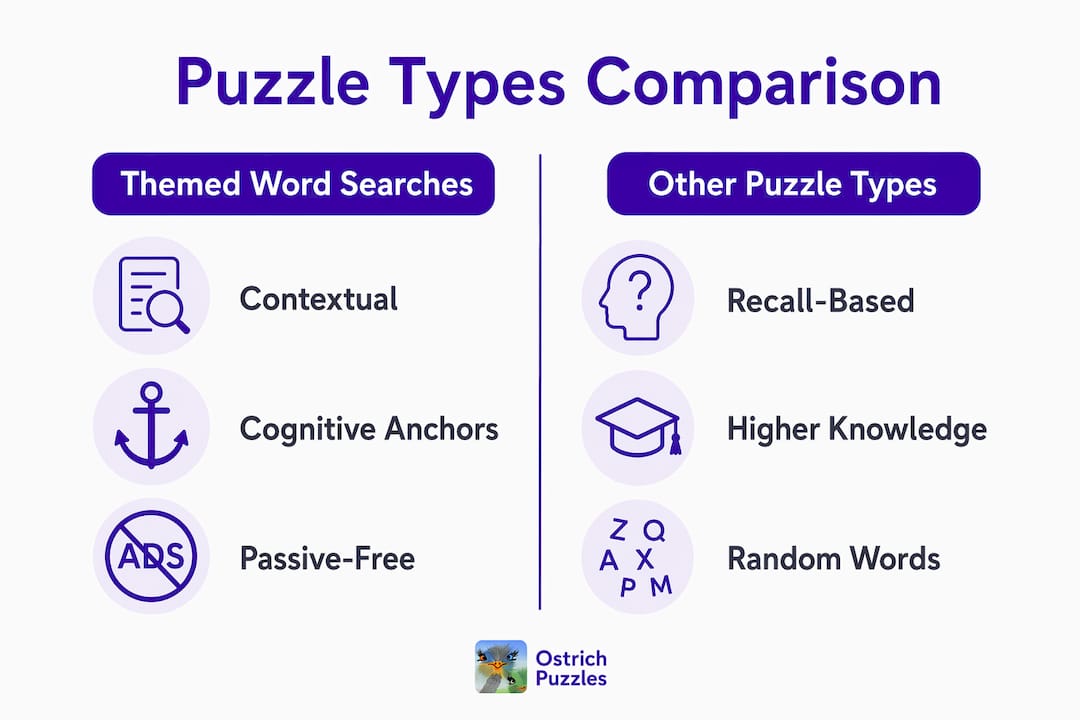
Crossword puzzles demand that the solver recall a word from a clue, which requires a higher level of prior knowledge and places the activity firmly in the "retrieval practice" category. That is valuable, but it is also high-stakes for learners who are still building vocabulary. A student who does not know the word simply cannot complete the square.
Themed word searches flip this dynamic. The visual and spatial skills required to find a word in a grid do not depend on prior recall. Seniors with early memory challenges, ESL learners at the beginner level, and young children all find the format accessible because success depends on careful looking, not on what you already know.
General word searches without a theme miss the cognitive scaffolding benefit entirely. Finding random words like "BLANKET," "JUPITER," and "CLARINET" in the same grid gives the brain no associative framework to work with. The theme is not decoration. It is the mechanism that makes the vocabulary stick.
What to look for when selecting or designing themed word searches
Choosing the right puzzle matters as much as choosing to use one. A poorly matched puzzle produces frustration, not learning.
- Match the theme to prior knowledge. A child who has never studied space will struggle with a "Constellations" puzzle. Themes that resonate with existing knowledge create effective cognitive scaffolds and improve both motivation and success rates. Start with familiar topics like animals, food, or seasons before moving to academic content.
- Check word length against reading level. Words longer than eight letters are difficult for early readers to hold in working memory while scanning. For grades K-2, keep words to four to six letters. For grades 3-5, six to eight letters works well.
- Avoid overly dense grids. Poorly designed puzzles with dense grids can harm young learners by creating visual overwhelm. A 10x10 grid with 10 words gives enough white space for a beginner to track their progress without losing their place.
- Look for multiple difficulty versions. The most effective themed puzzle books include the same vocabulary list at three or four difficulty levels. Elite Word Search notes that a single theme like "Solar System" can generate four puzzle versions for different skill levels, which makes one book useful across a wide age range.
- Consider print quality for young users. Clear, high-contrast fonts and generous letter spacing reduce visual fatigue. This matters more for younger children and for learners with visual processing differences.
Pro Tip: For home use, a children's activity book that combines themed word searches with other puzzle types gives children variety while keeping the learning consistent. Rotating formats prevents boredom and exercises different cognitive skills within the same session.
Key takeaways
Themed word searches deliver measurable educational benefits because the theme itself functions as a cognitive scaffold, not just a label.
| Point | Details |
|---|---|
| Theme drives retention | Unified vocabulary topics activate prior knowledge and build associative memory clusters. |
| Non-failable format reduces anxiety | Every word is findable, making the activity accessible for anxious, ESL, and diverse learners. |
| Pre-teaching use boosts comprehension | Introducing puzzles before lessons primes recognition and reduces decoding time during instruction. |
| Scalable difficulty supports inclusion | The same theme at multiple grid sizes lets mixed-ability groups work together without singling anyone out. |
| Design quality determines effectiveness | Grid density, word length, and theme relevance must match the learner's age and reading level. |
Why I think we underestimate what a good themed puzzle actually does
I have spent years looking at what genuinely holds a child's attention when screens are not an option, and themed word searches keep coming up in ways that surprise me. The research on orthographic memory and cognitive scaffolding is solid, but the real story is what happens in the room. A child who refuses to practice spelling will sit with a "Dinosaurs" puzzle for twenty minutes without complaint, and when they stand up, they have spelled "Triceratops" and "Brachiosaurus" correctly multiple times without knowing they were practicing.
What I find most interesting is how the theme changes the experience for adults too. A "Culinary Terms" puzzle is not the same cognitive exercise as a random word grid. You are building a mental map of a subject while you search, which is why puzzle enthusiasts find themed collections genuinely more satisfying than generic ones. The word search book format works precisely because a well-curated theme gives the solver a sense of mastery over a topic, not just a completed grid.
My honest observation after watching this space is that the biggest mistake parents and educators make is treating themed word searches as filler. They are not. Used before a lesson, they are a priming tool. Used during transitions, they are an attention reset. Used at home, they are one of the few activities that genuinely competes with a screen on engagement while delivering something a screen rarely does: a finished, tangible result the child produced themselves.
— Mark
Explore themed word search books from Munkterproducts
Munkterproducts offers a curated selection of handcrafted word search books designed for children and adults, with themes that span holidays, nature, science, and more. Each book is built with age-appropriate vocabulary and clear print quality, so parents can hand one to a child and walk away knowing the activity is both safe and genuinely educational.

Whether you are an educator looking for classroom-ready resources or a parent searching for a screen-free activity that actually holds attention, the themed puzzle books at Munkterproducts are designed with learning in mind. Postage is included, ordering is straightforward, and the range covers multiple difficulty levels so one book can grow with your child.
FAQ
What is the educational value of themed word searches?
Themed word searches build vocabulary recognition, orthographic memory, and sustained attention by requiring active letter-sequence scanning within a unified topic. The theme provides cognitive scaffolding that helps learners connect new words to existing knowledge.
How do themed word searches differ from regular word searches?
A themed puzzle groups all vocabulary around one subject, which activates prior knowledge and builds associative memory. A general word search with unrelated words provides visual scanning practice but no semantic reinforcement.
Are themed word searches suitable for children with learning differences?
The non-failable format makes themed word searches particularly accessible for children with test anxiety, attention challenges, or learning differences. Every word exists in the grid, so the activity carries no evaluative pressure.
How should educators use themed word searches in the classroom?
Educators get the most value by using themed puzzles as pre-teaching primers before a unit, as independent station activities during rotations, and as low-pressure vocabulary reviews at the end of a lesson.
What age range benefits most from themed word search activities?
Themed word searches are effective from early elementary through adulthood, including seniors and ESL learners. Grid size, word length, and theme complexity should be matched to the learner's reading level and attention span for best results.