

If you want the answer right now: start with A Psalm for the Wild-Built, Becky Chambers's Wayfarers series, The Murderbot Diaries, and Project Hail Mary. Each delivers a different flavor of hope. One is cozy comfort. One is engineering optimism. One is gentle, reluctant humanity from a robot who'd rather not deal with feelings. Read any of them and you'll close the book calmer than you opened it.
TL;DR:
- Hopeful sci-fi books emphasize collective effort, kindness, and resilience, portraying futures worth fighting for rather than just escapism or grim dystopias.
- Major titles like Becky Chambers's series, Martha Wells's Murderbot, and Andy Weir's Project Hail Mary exemplify different hopepunk substyles, from cozy to engineering optimism.
- The genre often features themes of community, slow-paced resilience, technology for care, and vulnerability as strength, reflecting real-world issues like climate change and social trust.
- Series are flexible in reading order, with standalone books like A Psalm for the Wild-Built offering accessible entry points for new readers.
- Readers should match book tone and length to their mood, and be aware that hopepunk stories present optimism rooted in human agency, cooperation, and steady effort.
Table of Contents
- What Are Hopecore Sci-Fi Books, Exactly?
- Finding Hopeful Sci-Fi by Mood, Not Just Plot
- How to Pick the Right Uplifting Sci-Fi Book for You
- Why Trust This List: Munkterproducts' Curation Approach
- Hopecore vs. Hopepunk vs. Optimistic Sci-Fi: What's the Difference?
- Where Hopepunk and Hopecore Sci-Fi Actually Came From
- The Themes That Show Up Again and Again in Hopecore Fiction
- How Hopecore Sci-Fi Talks About Real-World Problems
- Hopecore vs. Solarpunk vs. Utopian Fiction
- Reading Order and Series Advice for Hopecore Fans
- An Editor's Note on Why This Genre Matters Right Now
- Munkterproducts' Own Hopeful Fiction: The Noah Series
- Sources
What Are Hopecore Sci-Fi Books, Exactly?
Hopecore sci-fi books (often called hopepunk in literary circles) are stories where the future is portrayed as worth fighting for, emphasizing that people choose to act with care and cooperation as a core element, rather than simply having a happy ending bolted onto a grim plot. It's a worldview baked into the storytelling itself.
Below, you'll find ten titles that earn a spot on any credible hopecore shelf, chosen for mood fit, thematic optimism, and how easy they are to actually get your hands on.
-
A Psalm for the Wild-Built by Becky Chambers. A tea monk and a wandering robot travel the wilderness of a moon that gave half its land back to nature, asking each other what people are even for. It's hopeful because nobody is in danger, nothing explodes, and the biggest conflict is an existential question asked kindly over campfire tea. Best for a quiet night when you want your brain to slow down.
-
The Long Way to a Small, Angry Planet (Wayfarers, Book 1) by Becky Chambers. A patchwork crew on a tunneling ship crosses the galaxy together, and the plot is really just an excuse to watch them take care of each other. It's hopeful because found family beats blood family every time here, and difference is treated as a feature, not a threat. Best for a long weekend when you want full immersion in a found-family world. F(r)iction's roundup of hopepunk fiction repeatedly flags Chambers's work as the genre's clearest modern touchstone.
-
All Systems Red (The Murderbot Diaries, Book 1) by Martha Wells. A security android hacks its own governor module, gains free will, and mostly just wants to watch soap operas in peace, but ends up protecting the humans it's assigned to anyway. It's hopeful because competence and reluctant loyalty turn out to be their own kind of love language. Best for a commute read; the novellas clock in short enough to finish in a couple of sittings.
-
Project Hail Mary by Andy Weir. A lone astronaut wakes up with amnesia on a solo mission to save Earth from a dimming sun, and solves the problem through relentless, joyful trial and error. It's hopeful because it treats human ingenuity, and eventually interspecies cooperation, as the actual hero of the story. Best for readers who want their optimism delivered through math and duct tape rather than sentiment.
-
A Closed and Common Orbit (Wayfarers, Book 2) by Becky Chambers. An AI illegally installed in a synthetic body has to learn how to pass as human while grieving the ship she used to be. It's hopeful because it treats identity and recovery as things you build slowly, with help. Best for readers who loved Book 1 and want a quieter, more introspective follow-up.
-
Record of a Spaceborn Few (Wayfarers, Book 3) by Becky Chambers. Generations after leaving a dying Earth, a fleet of homesteader ships wrestles with what their culture means now that planets are an option again. It's hopeful because it takes ordinary, unglamorous community life seriously as something worth preserving. Best for a slow weekend deep dive rather than a single sitting.
-
The Galaxy, and the Ground Within (Wayfarers, Book 4) by Becky Chambers. A handful of strangers get stranded together at a rest stop during a planetary crisis and end up trading stories instead of panicking. It's hopeful because it argues that strangers, given the chance, default to kindness. Best for readers who want a standalone entry point into the series without committing to all four books.
-
Network Effect (The Murderbot Diaries, Book 5) by Martha Wells. The first full-length Murderbot novel raises the stakes while keeping the sardonic, found-family core intact. It's hopeful because loyalty here isn't programmed, it's chosen, repeatedly, by a character who insists it isn't. Best for readers already hooked on the earlier novellas and ready for a longer ride.
-
To Be Taught, If Fortunate by Becky Chambers. Four astronauts on a deep-space research mission wrestle with what humanity owes the worlds it explores. It's hopeful because it swaps conquest for curiosity as the default posture toward the unknown. Best for a single evening; it's a novella you can finish before bed.
-
Semiosis by Sue Burke. Human colonists on an alien planet slowly learn to communicate, and eventually partner, with a sentient plant species instead of exploiting it. It's hopeful because it imagines first contact going right through patience rather than force. Best for readers who want communal, generational optimism with real stakes attached.
Finding Hopeful Sci-Fi by Mood, Not Just Plot
Hopeful sci-fi isn't one flavor. It splits into substyles, and matching the substyle to your mood matters more than matching the plot.
- Cozy comfort: low stakes, slow pace, gentle stories. A Psalm for the Wild-Built and To Be Taught, If Fortunate lead here. Watch for short chapters and minimal violence. Ideal for bedtime reading.
- Engineering optimism: problem-solving protagonists who treat obstacles as puzzles, not tragedies. Project Hail Mary is the clearest example, and Quillette's analysis ties Weir's work directly to a strain of "radical optimism" built on competence and curiosity. Best for a commute or a plane ride, since the momentum carries you.
- Communal or utopian: stories where the whole point is a group figuring out how to live well together. Record of a Spaceborn Few and Semiosis fit here. Expect slower pacing and higher sentimentality. Best saved for a deep-dive weekend.
- Rom-com or feel-good hopepunk: interpersonal warmth carries the plot more than any external threat. The Long Way to a Small, Angry Planet leans this way.
Pro Tip: If you only have twenty minutes before bed, grab a novella. Save the Wayfarers series or Murderbot's full-length entries for a weekend where you can actually sink into them.
How to Pick the Right Uplifting Sci-Fi Book for You
Skip the long reviews. Run through this checklist instead:
- Decide how much "hopeful" you actually want. Some books are gentle throughout; others earn their hope after a rough middle stretch. If you want zero anxiety, stick with A Psalm for the Wild-Built over anything with a ticking-clock plot.
- Match length to your bandwidth. A novella like All Systems Red solves a bad day in ninety minutes. A series like Wayfarers rewards a longer commitment with a deeper payoff.
- Pick your optimism style. Want a character solving problems with their hands and their brain? Go engineering optimism. Want a group of people slowly building something together? Go communal.
- Watch for false advertising. Some books marketed as "hopeful" are really just grimdark stories with a redemptive final chapter. If a synopsis leans hard on trauma, siege warfare, or a body count before mentioning any resolution, it's probably not hopecore.
- Consider reading format. Ebooks work for quick novella binges; paperbacks make more sense for a series you'll want on a shelf afterward.
Why Trust This List: Munkterproducts' Curation Approach
Munkterproducts curates and sells books because storytelling that leaves readers feeling better than they started is worth building a catalog around, not just an afterthought. Every title on this list was chosen against three filters: does the mood match what it claims, does the theme carry genuine optimism rather than a token happy ending, and is it realistically available to readers shopping in the UK. That's the same standard applied to Munkterproducts' own original fiction, including the Noah series discussed further down.
Hopecore vs. Hopepunk vs. Optimistic Sci-Fi: What's the Difference?
"Hopecore" and "hopepunk" get used almost interchangeably, and for most reading purposes, that's fine. Hopepunk was coined as the tonal opposite of grimdark: instead of assuming cruelty is the default and kindness is naive, hopepunk insists that kindness, community, and softness are acts of resistance worth defending. Hopecore is the internet-era shorthand for the same idea, often applied more broadly to media that simply makes you feel better about the future.
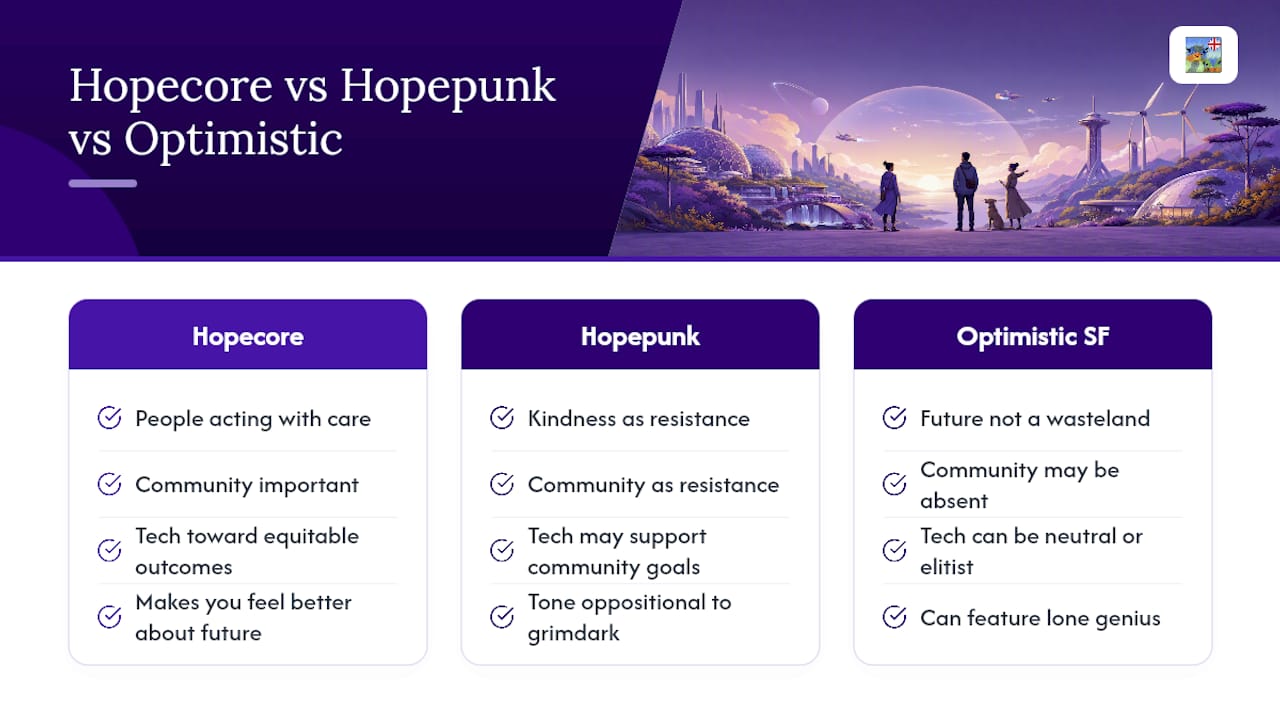
General "optimistic sci-fi" is the wider umbrella. It just means the future portrayed isn't a wasteland. A story can be optimistic and still be cold, individualistic, or driven by a lone genius saving the day through sheer brilliance. Hopecore and hopepunk narrow that down: the hope has to come from people choosing to act with care, usually together. Researchers describing this strain of fiction have pointed to human agency and technology used toward equitable outcomes as the defining traits, not just a happier ending.
That's why Project Hail Mary, which is optimistic but built around one very determined astronaut, still qualifies as hopecore. The turning point of the book hinges on cooperation rather than individual heroics.
Where Hopepunk and Hopecore Sci-Fi Actually Came From
The term "hopepunk" traces back to a 2017 blog post by author Alexandra Rowland, written partly as a reaction to grimdark fantasy's dominance and partly as a response to a cultural moment that felt exhausting. The idea caught on fast among writers and readers who were tired of stories where cynicism was treated as the mature, realistic default.
Science fiction had flirted with optimism before that, of course. The 1970s and 80s produced utopian and solarpunk-adjacent work, and Golden Age sci-fi often leaned hopeful about technology's potential. But hopepunk as a named movement is younger and more deliberate. It emerged partly as pushback against a wave of dystopian fiction that dominated bestseller lists through the 2010s, and partly as a genuine literary response to real-world anxiety about climate change, political division, and burnout.
Becky Chambers's 2014 debut, The Long Way to a Small, Angry Planet, predates the term but is widely credited with proving there was an audience hungry for exactly this kind of story: low-conflict, character-driven, generous toward its cast. By the time "hopepunk" had a name, Chambers already had the blueprint. The subgenre's more recent growth reflects a broader cultural argument that fiction can imagine functional futures worth working toward, not just cautionary ones worth avoiding.
The Themes That Show Up Again and Again in Hopecore Fiction
Hope alone doesn't make a story hopecore. The tone comes from a specific set of recurring themes that show up across the subgenre.
Community is the biggest one. Nearly every hopecore book puts a found family or a working collective at its center, whether that's Chambers's spaceship crews or Wells's Murderbot slowly, grudgingly accepting that its human clients matter to it. Resilience shows up too, but it's a quieter kind than you'll find in war epics. It's the resilience of showing up the next day and doing the unglamorous work again.

Activism and agency matter as well, though rarely in the form of a single dramatic uprising. Hopecore protagonists tend to solve problems through steady, collective effort rather than a lone chosen one defeating a villain. Semiosis is a good example: peace with an alien species comes from generations of patient diplomacy, not a single triumphant battle.
There's also a recurring theme of technology as a tool for care rather than domination, a repair drone, a communication protocol, a life-support system, treated as something built to help rather than exploit. And almost universally, these books treat vulnerability as strength. Characters admit fear, ask for help, and change their minds, and the story rewards them for it rather than punishing them.
How Hopecore Sci-Fi Talks About Real-World Problems
Hopecore books rarely ignore the problems we're actually facing. Climate anxiety, loneliness, burnout, and distrust in institutions show up constantly, just filtered through a lens that insists these problems are solvable if people work together.
A Psalm for the Wild-Built is set on a moon where humans deliberately ceded half the land back to wilderness, a direct response to real anxieties about environmental overreach. Record of a Spaceborn Few wrestles with what community means once the original crisis (a dying Earth) is generations in the past, which mirrors real conversations about long-term climate adaptation and cultural memory.
This isn't accidental. Commentators covering the genre's rise have argued that optimistic science fiction historically motivates real technological and social ambition rather than just describing it, functioning as a kind of blueprint rather than mere escapism, a point made directly in The Verge's interview with novelist Allen Steele. Readers frequently turn to this genre specifically when they're feeling overwhelmed by real-world news, which is part of why threads asking for optimistic sci-fi recommendations tend to get long, enthusiastic replies. It functions as a rehearsal space for imagining collective solutions, not a denial that problems exist.
Hopecore vs. Solarpunk vs. Utopian Fiction
These three overlap constantly, and readers often shelve them together, but the emphasis differs.
Solarpunk is specifically about environmental and technological aesthetics: renewable energy, green architecture, and sustainable design woven into the story's world-building. The hope is baked into the setting itself. Utopian fiction is broader and older, describing an ideal or near-ideal society, sometimes with a critical or satirical edge about how that society actually functions underneath the surface.
Hopecore cares less about the setting's technology and more about the characters' behavior within it. A hopecore story can be set somewhere imperfect, even dangerous, and still qualify, as long as the people in it choose kindness, cooperation, and care as their default response. Murderbot's world isn't remotely utopian. Corporations exploit workers, and the security state is oppressive. But the story is hopecore because of how the characters treat each other despite that backdrop.
Think of it this way: solarpunk answers "what should the world look like," utopian fiction answers "what should society's rules be," and hopecore answers "how should people treat each other while getting there."
Reading Order and Series Advice for Hopecore Fans
Most hopecore series are more forgiving about reading order than typical sci-fi, since plot rarely hinges on tight continuity.
The Wayfarers series can technically be read in any order since each book follows different characters, though publication order (Long Way, then A Closed and Common Orbit, then Record of a Spaceborn Few, then The Galaxy, and the Ground Within) gives the most satisfying emotional build. If you want the gentlest entry point, start with The Galaxy, and the Ground Within, since it's fully standalone.
The Murderbot Diaries should be read in publication order starting with All Systems Red. The novellas build character growth sequentially, and Network Effect assumes you already know the earlier books' emotional stakes.
For a first hopecore read overall, A Psalm for the Wild-Built remains the easiest entry: short, self-contained, and immediately clear about its tone. If that hooks you, its sequel A Prayer for the Crown-Shy continues the story directly. Project Hail Mary stands alone with no series commitment required, which makes it a safe pick if you're not ready to invest in multiple books yet.
An Editor's Note on Why This Genre Matters Right Now
Optimistic sci-fi isn't escapism so much as rehearsal. It hands you a working model of people cooperating well, and that's worth borrowing from on a hard week. Keep one of these on your nightstand for exactly that reason.
— Mark
Munkterproducts' Own Hopeful Fiction: The Noah Series
If this list has you craving more stories built on quiet resilience and human connection, Munkterproducts publishes its own original science fiction alongside its curated book catalog: the Noah series. These novels sit comfortably in hopecore territory, favoring character-driven stakes and a belief that people figure things out together over spectacle for its own sake.

To be upfront: this is Munkterproducts' own fiction, published and sold directly rather than an outside pick like the titles above. If you're building a hopecore shelf and want to support small-press storytelling in the same tradition as Chambers and Wells, the Noah series is worth a look. For readers who like to journal their reactions to what they read, Munkterproducts also sells a travel journal sized to slip into a bag alongside your current paperback, useful for jotting down favorite lines or tracking your reading mood by book. Paperback editions suit readers who want a permanent shelf copy; check the product page for current format availability before you order.
Sources
- Science Fiction and Thoughtful Optimism: A Manifesto (ASU CSI)
- 7 Sci-Fi Hopepunk Books to Improve Your Day (F(r)iction)
- Allen Bain on Coyote and why we need optimistic science fiction now more than ever | The Verge
- Infinite Ingenuity: Project Hail Mary and Andy Weir (Quillette)