

Puzzles can produce reliable relaxation by creating structured, low-pressure attention that reduces physiological arousal. For quick daily calm, a pocket puzzle book or small jigsaw kit works well. For sustained relaxation, themed activity books covering crosswords, sudoku, word searches, story puzzles, or coloring hybrids tend to deliver more. The people who benefit most:
- Adults who dislike seated meditation but need a mental off-switch
- Busy professionals looking for a screen-free wind-down
- Caregivers who need short, self-contained breaks
- Older adults who want cognitive engagement alongside their calm
Table of Contents
- How do puzzles reduce stress? Evidence, mechanisms, and expert views
- Which puzzle types support relaxation, and who benefits most?
- How to build a simple daily puzzle routine for relaxation
- How to choose a puzzle or activity book for relaxation
- Munkterproducts' curated picks for relaxation
- Key Takeaways
- Why physical puzzle books deserve more credit than they get
- Munkterproducts puzzle books: browse and buy
- Research sources and further reading
How do puzzles reduce stress? Evidence, mechanisms, and expert views
The core mechanism is what clinicians call structured engagement: puzzles occupy attention just enough to crowd out intrusive thoughts, without demanding the kind of effortful focus that creates its own stress. That middle ground between passive distraction and formal meditation is where the relaxation effect lives.
When the challenge level matches your current capacity, puzzles can trigger a flow-like state that lowers heart rate and quiets mental chatter. Each small piece placed or clue solved releases a dopamine signal tied to incremental progress, which is why puzzling feels rewarding even in short sessions. Neuropsychologists and psychologists list stress reduction, mood boost, improved focus, patience, and mindfulness among puzzle benefits.
The longitudinal evidence is encouraging, with one important caveat. A Protect trial of 19,000 participants found that daily word-puzzle engagement (even as little as two minutes daily) correlates with preserved cognitive function in older adults. But a 2018 NIH-linked jigsaw study found that completing roughly 3,600 pieces over 30 days produced no clinically relevant cognitive improvement versus other leisure activities. Short-term, low-volume puzzling is not a quick fix. Benefits scale with consistency and appropriate difficulty, not with occasional marathon sessions.
Key mechanisms at a glance:
- Attentional anchoring: the puzzle gives your mind a concrete, non-threatening task
- Incremental progress: small wins build positive affect without pressure
- Soft focus: you stay alert but not tense, a state that reduces cortisol
- Tactile engagement: handling physical pieces or turning pages adds a grounding sensory layer
Which puzzle types support relaxation, and who benefits most?
Different formats suit different people, schedules, and goals. Here is a practical breakdown:
- Small jigsaws (24–100 pieces): Ideal for a 10–15 minute break. Low cognitive load, high tactile satisfaction. Adults under acute stress often reach for kids' puzzle kits precisely because the low piece count removes frustration risk. Good for travel and caregiver breaks.
- Standard jigsaws (300–1,000 pieces): Better for longer evening sessions (45–90 minutes). The extended engagement deepens the flow state. Best for people with dedicated table space and uninterrupted time.
- Crosswords: High verbal engagement, moderate cognitive load. Excellent for cognitive reserve in older adults. A 10–20 minute crossword before bed works as a screen-free wind-down.
- Sudoku: Pure logic, no language needed. Very portable. Suits people who want a clean mental challenge with a definite end point. Good for commutes and lunch breaks.
- Word searches: Low cognitive load, highly repetitive in a soothing way. The scanning motion is almost meditative. Strong fit for people with anxiety who need gentle, low-stakes engagement. Munkterproducts' artistic word search books add a visual layer that makes the activity feel more like browsing art than solving a test.
- Themed activity books (story-driven or hybrid): Combine narrative context with puzzle tasks, which sustains interest across longer sessions. Story-driven puzzle formats work especially well for creative hobbyists who want more than a grid.
- Adult coloring and puzzle hybrids: Coloring activates the same soft-focus state as jigsaws. Hybrid books that mix coloring pages with word games or spot-the-difference tasks keep sessions varied and prevent the boredom that breaks a habit.
Dr. Graham Niblo, a neuropsychologist, puts it plainly: puzzles teach patience and resilience by pulling you into a state of sustained, interested attention. That attention is the mechanism, regardless of format.
How to build a simple daily puzzle routine for relaxation
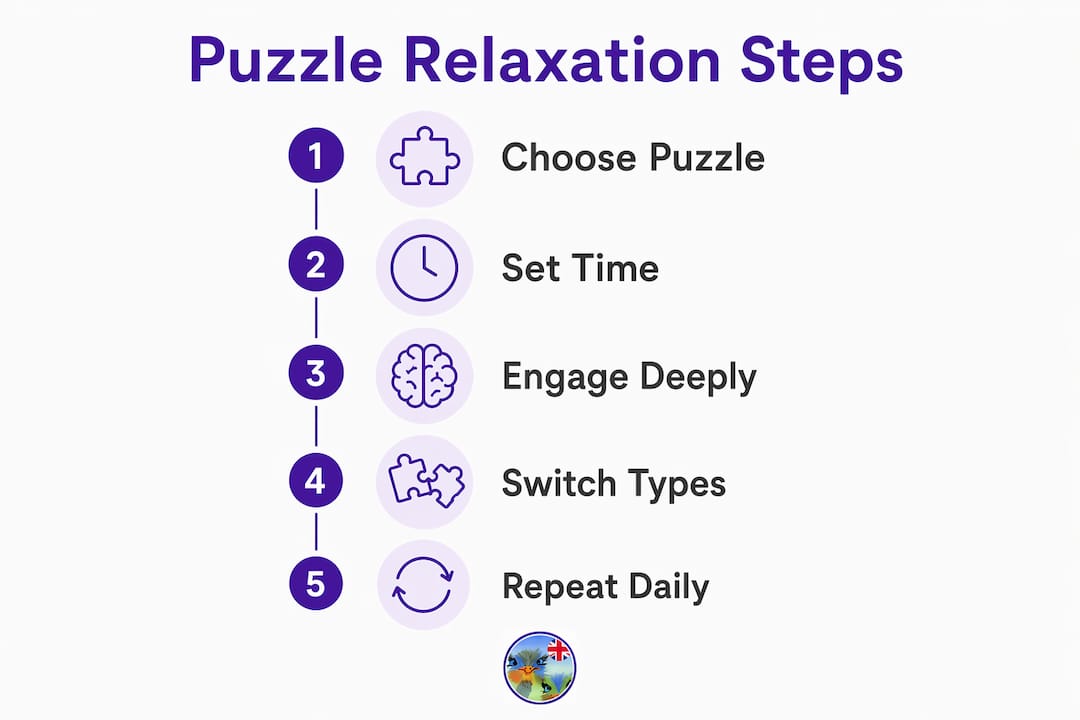
A consistent 10–30 minute daily session beats an occasional two-hour marathon. Here is a routine that works:
- Pick a short block. Morning coffee, lunch break, or the 20 minutes before sleep are natural anchors. Attach the habit to something you already do.
- Set a low-pressure goal. "Finish this page" or "place 20 pieces" rather than "complete the whole puzzle." Removing the finish-line pressure is what keeps it relaxing.
- Prepare a comfortable space. Good lighting, a flat surface, and no phone notifications. A puzzle tray or clipboard keeps a book puzzle portable.
- Engage without a timer running in your head. Let the session end naturally when you feel settled, not when a clock says so.
- Stop before frustration. The dopamine loop breaks the moment a puzzle feels like a chore. Put it down, return later.
Pro Tip: When you hit a wall on one puzzle type, switch formats rather than pushing through. Two minutes of a word search after a stuck crossword clue resets attention better than staring at the same grid.
Daily consistency matters more than session length. Even two minutes of word puzzles daily has shown up in longitudinal trials as meaningful for cognitive health, as demonstrated by the Protect trial with 19,000 participants. Pairing a puzzle session with gentle background music or a short walk beforehand can deepen the relaxation effect by lowering baseline arousal before you even open the book.
How to choose a puzzle or activity book for relaxation
Not every puzzle book is built for calm. A few things to check before you buy:
- Difficulty level: Choose one step below your comfort zone for relaxation purposes. A puzzle that challenges you is engaging; one that stumps you is stressful.
- Session granularity: Does each page or section feel completable in one sitting? Books with self-contained puzzles per page are better for short daily sessions than books with one giant puzzle spread across many pages.
- Solution keys: Non-negotiable for relaxation use. Checking an answer and moving on keeps momentum; hunting for a solution online breaks the calm.
- Paper and print quality: Thin paper bleeds ink and feels cheap. For physical puzzle books, heavier stock holds up to repeated handling and feels more satisfying.
- Portability: A spiral-bound or softcover book fits in a bag. Loose-piece jigsaws need a flat surface. Match the format to where you actually plan to use it.
- Theme and imagery: Enjoyment predicts adherence. A word search built around topics you genuinely find interesting will hold your attention longer than a generic grid.
- Price and perceived value: A well-made $12–$18 activity book that you use daily for three months is better value than a $40 puzzle set you open twice.
A complete guide to puzzle-book formats can help you match format to use case before you commit.
Watch out for: puzzles with misleading difficulty labels, poorly printed pieces that look identical under low light, and books with no solution pages. These are the formats most likely to turn a relaxation session into a frustration spiral.
Munkterproducts' curated picks for relaxation
Munkterproducts designs its puzzle and activity books with calm in mind: heavier paper stock, clear print, included solutions, and themes chosen for sustained interest rather than novelty shock. Here are six picks matched to specific relaxation goals:
- Best for quick calm: Artistic word search books. One page per session, nature or travel themes, solution key at the back. Ideal for a 10-minute lunch break. Word search benefits go beyond the grid.
- Best for bedtime wind-down: Adult coloring and puzzle hybrids. Low cognitive load, tactile engagement, no wrong answers. Spiral-bound so it lies flat in bed.
- Best for travel: Pocket-sized sudoku or crossword books. Softcover, tear-out pages, fits in a carry-on pocket. Self-contained puzzles mean no lost pieces.
- Best for creative engagement: Themed activity books with story-driven puzzles. Combines narrative interest with puzzle tasks across 60–80 pages. Good for a weekend afternoon.
- Best for brain training: Crossword and mixed-puzzle activity books. Moderate cognitive load, varied formats per session, solution pages included.
- Best for family use: Holiday and educational activity books. Designed for parents and children to work through together, with age-appropriate difficulty on each page.
Browse the full range and order directly at munkterproducts.com.
Key Takeaways
Puzzles reliably support relaxation through structured engagement, and daily consistency with a physical puzzle book is the most practical route to lasting benefits.
| Point | Details |
|---|---|
| Consistency beats intensity | Daily sessions of 10–30 minutes outperform occasional long sessions for both calm and cognitive benefit. |
| Short-term limits are real | The 2018 NIH-linked study found 3,600 pieces over 30 days produced no measurable cognitive gain, so habit formation matters. |
| Match difficulty to mood | One step below your comfort zone keeps puzzles relaxing; too hard creates stress rather than relieving it. |
| Choose what you enjoy | Enjoyment predicts adherence; a themed book you love will be used far more than a generic grid. |
| Munkterproducts picks | Curated puzzle and activity books with heavier paper, solution keys, and relaxation-focused themes available at munkterproducts.com. |
Why physical puzzle books deserve more credit than they get
The wellness conversation around puzzles tends to focus on apps and digital games, which misses something real. A physical puzzle book removes the notification layer entirely. You cannot be interrupted by a badge or a banner. The tactile act of turning a page, marking a grid with a pencil, or fitting a piece into place engages the hands in a way a touchscreen never does, and that sensory grounding is part of why puzzling works as active mindfulness for people who cannot sit still in meditation.
The other thing people underestimate is the role of theme. A word search built around topics you genuinely find interesting holds attention differently than a generic grid. That sustained, interested attention is the mechanism behind the relaxation effect. Choosing a book whose theme you actually care about is not a preference detail. It is the variable most likely to determine whether you build a daily habit or abandon the book after a week.
The evidence also suggests that tile-based games share some of the same calming mechanisms as puzzles. Research on why tile games calm the mind points to the same structured-engagement pathway, which reinforces the broader principle: any activity that gives your mind a concrete, low-stakes task to focus on can produce the soft-focus state that lowers arousal.
Munkterproducts puzzle books: browse and buy
Stress relief should not require a subscription, a screen, or a complicated setup. Munkterproducts offers handcrafted puzzle and activity books shipped directly to your door, with postage included on orders. Each book is designed for real daily use: heavier paper that holds up to pencil and pen, clear print that does not strain your eyes in low light, and solution keys so you never get stuck without a way forward.

Whether you want a pocket sudoku book for your commute or a themed activity book for a weekend wind-down, the range covers every session length and relaxation style. Single-book purchases are a low-commitment way to find your format before buying a set. Browse the full collection and place your order at munkterproducts.com.
Research sources and further reading
- Can't Meditate? Here's Why You Should Try Jigsaw Puzzles Instead — Forbes; clinical mechanisms of puzzling as an anxiety-reduction and meditation alternative.
- Study on jigsaw puzzle usage and cognitive outcomes (2018) — PMC/NIH; longitudinal trial finding that low-volume short-term puzzling does not yield measurable cognitive improvement.
- Just two minutes of puzzling a day can boost your brain health — Yahoo Health; Protect trial (19,000 participants) on daily word puzzles and cognitive preservation.
- Stressed Out? Try Putting Together a Kids' Puzzle — Time; popular reporting on micro-session use and active mindfulness through physical puzzles.
- The Meditative Power of Puzzling: Attention, Regulation, and Quiet Cognition — Marisa Markowitz, LCSW; clinical perspective on structured engagement and emotional regulation.
- 7 Psychological Benefits of Doing Puzzles, According to a Psychologist — AOL; neuropsychologist commentary on dopamine, mood, and stress reduction through puzzling.