

TL;DR:
- Storytelling rewires how individuals interpret their lives by organizing experiences into meaningful narratives. It reduces symptoms of anxiety, depression, and trauma while enhancing feelings of control and agency through various structured techniques. However, storytelling should be practiced thoughtfully and with professional support when facing severe distress or trauma.
Storytelling does something remarkable that most people never expect: it doesn't just help you express feelings, it actually rewires how you understand your entire life. When you put your experiences into a narrative, whether through writing in a journal, sharing with others, or creating art, you start to see patterns you couldn't see before. Research and clinical practice increasingly confirm that working with your personal story can reduce symptoms of anxiety, depression, and trauma, while also helping you feel more in control of where your life is headed. This article breaks down the real psychology, the research evidence, the practical methods, and the honest cautions you need to make informed choices about storytelling as a wellness tool.
Table of Contents
- How storytelling changes the way we understand our lives
- What the research says: Real benefits (and boundaries) of storytelling in mental health-of-storytelling-in-mental-health)
- How to practice storytelling for mental well-being: Tools and tips
- Key cautions: When storytelling might not help (or could even harm))
- Our take: Why storytelling is powerful but best used thoughtfully
- Looking to explore storytelling for your own growth?
- Frequently asked questions
Key Takeaways
| Point | Details |
|---|---|
| Storytelling builds meaning | Narrative work transforms how we understand challenges and strengths, helping us feel more empowered. |
| Mental health benefits proven | Research links storytelling to lower trauma, depression, anxiety, and self-stigma, especially in group or guided formats. |
| Practice safely | Not everyone benefits; storytelling must fit personal readiness, especially during times of crisis or high distress. |
| Multiple methods work | Writing, journaling, digital stories, and art all offer ways to apply storytelling for well-being. |
| Support matters | Professional or peer guidance and the right resources can make narrative work safer and more impactful. |
How storytelling changes the way we understand our lives
Storytelling isn't just venting or remembering. It's a specific mental act that transforms your relationship with your own experiences. When you tell a story about what happened to you, you're not simply replaying events. You're organizing them, assigning them cause and effect, deciding what they mean. That act of organizing is where the mental health impact begins.
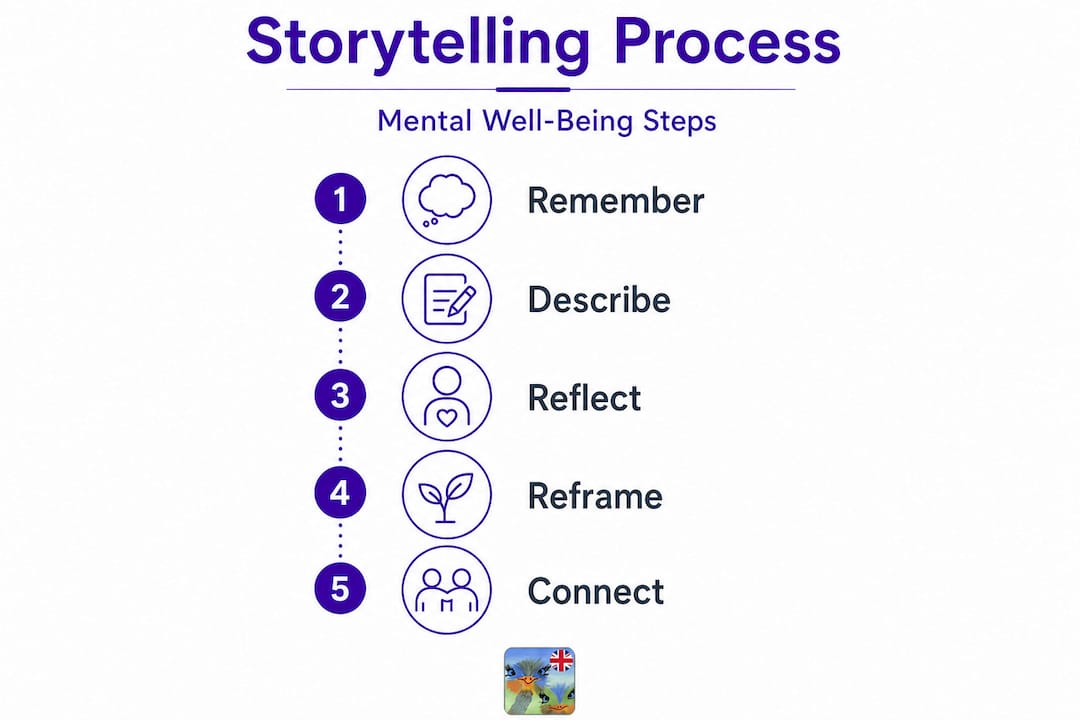
Psychologists and therapists who work with narrative methods often describe this as meaning-making. Instead of carrying a heap of disconnected, distressing memories and feelings, you start building a coherent narrative that gives those experiences context. Narrative work in mental health is commonly framed as shifting people from problem-saturated stories toward more agency-based "preferred" stories, helping them externalize problems rather than treating problems as who they are.
That last point deserves emphasis. When you say "I am an anxious person," anxiety is you. When you say "anxiety has been following me lately," anxiety is something separate you can examine, challenge, and change. This externalizing process is one of the most practically powerful tools narrative therapy offers.
Here's a quick look at the core storytelling mechanisms that support mental health:
| Mechanism | What it does | Common format |
|---|---|---|
| Externalizing problems | Separates identity from the problem | Written narrative, spoken story |
| Re-authoring | Builds a new preferred life story | Journaling, guided writing |
| Witnessing | Strengthens social connection and validation | Group storytelling, letters |
| Meaning-making | Organizes and contextualizes experiences | Art-based storytelling, poetry |
Common storytelling techniques people use for mental wellness include:
- Guided journaling: Structured prompts that direct your narrative toward growth-focused themes
- Expressive free writing: Unstructured writing that allows whatever needs to come out to surface
- Oral storytelling: Sharing personal stories in supportive group settings
- Art-based storytelling: Drawing, collage, or visual metaphor to tell your story when words feel inadequate
- Story-driven journaling: A structured approach that bridges creative expression with self-discovery
"The stories we tell about ourselves are not fixed accounts of the past. They are active, living documents that can be revised, expanded, and rewritten with greater wisdom and compassion."
This flexibility is exactly why narrative approaches have spread across clinical psychology, community mental health programs, and personal wellness practices worldwide.

What the research says: Real benefits (and boundaries) of storytelling in mental health
With foundational understanding in place, we can now turn to what rigorous research has uncovered about the effects of storytelling for mental health.
The evidence base is growing fast, but it's also nuanced. Not all storytelling interventions produce the same outcomes, and the research makes this very clear.
What research consistently supports:
A systematic review found that across multiple narrative-focused interventions for people with mental disorders, symptoms were generally reduced across trauma, depression, anxiety, and self-stigma, though "positive mental health" outcomes like flourishing or life meaning were less consistently assessed in studies. This is an important distinction. Storytelling interventions often reduce what's bad more reliably than they build up what's good.
Group-based settings show particular promise. A recent pilot study confirmed that narrative group interventions are feasible in community psychiatry settings, with participants showing measurable improvements in life satisfaction. Group formats add a layer of social validation that solo journaling simply can't replicate, which matters enormously for people who feel isolated in their struggles.
Here's how different storytelling formats compare in their documented effects:
| Format | Strongest evidence | Weaker or mixed evidence |
|---|---|---|
| Individual narrative therapy | Trauma, PTSD, depression | Long-term maintenance |
| Group narrative therapy | Life satisfaction, self-stigma | Scalability, access |
| Expressive writing | Short-term mood, processing | Sustained behavior change |
| Digital storytelling | Knowledge, attitude shifts | Actual health behavior change |
Where evidence gets more complicated:
Digital storytelling has attracted significant research attention as a scalable wellness tool. However, digital storytelling interventions show more consistent results for changing knowledge and attitudes about mental health than for producing downstream behavior changes. This means that watching or creating a digital story might help you understand depression better without necessarily changing how you manage it day to day.
Key takeaways from the research, summarized plainly:
- Storytelling works best when it's structured and guided rather than purely spontaneous
- Trauma, anxiety, and depression symptoms respond most consistently to narrative methods
- The social element of group storytelling appears to amplify benefits
- Positive mental health outcomes need more rigorous measurement in future research
- Combining storytelling with other wellness practices (therapy, physical care, connection) produces better results than storytelling alone
You can also explore how books and personal wellness intersect, since reading and narrative immersion contribute their own distinct mental health benefits alongside active storytelling practice.
How to practice storytelling for mental well-being: Tools and tips
Now, let's move from research to actionable strategies you can apply in your own life. The good news: you don't need to be in therapy to benefit from narrative practices. You do need intention, consistency, and a few practical tools.
Step-by-step ways to get started:
- Choose your format. Start with what feels least intimidating. If blank pages feel overwhelming, use a prompted journal. If words don't come easily, try drawing your story or recording a voice note.
- Set a container. Decide in advance how long you'll write or create. Fifteen to twenty minutes is enough to access meaningful material without spiraling.
- Name the problem as a character. Try externalizing a current challenge. Instead of "I am overwhelmed," write "Overwhelm showed up today and here's what it was doing." This small shift creates psychological distance and insight.
- Find your preferred story. After describing the problem, ask yourself: "Is this the only version of my story? What's another way I could see this?" Write that version too. Both matter.
- Use digital or creative formats. If you prefer screens, digital platforms and apps offer structured storytelling prompts that can guide you through narrative exercises. As noted by research on digital health interventions, these tools are most effective when used with clear intention.
- Build a storytelling ritual. Consistency deepens the practice. A three-day-a-week commitment to fifteen minutes of reflective writing produces more benefit than an occasional two-hour session.
You can also build your skills through structured formats like a storytelling workflow for creativity, which can be adapted from children's frameworks into powerful adult self-reflection practices.
Pro Tip: Keep a "story evidence file." Whenever you notice yourself acting in line with your preferred story (being brave, setting a boundary, showing up despite fear), write it down. Over time, this file becomes powerful proof that your preferred story is real and growing.
Tips for deepening your practice without overwhelm:
- Don't aim for polished writing. Raw and honest is far more useful than perfect
- If you feel emotionally flooded, stop and ground yourself before continuing
- Pair written storytelling with using journaling as storytelling to build a sustainable, self-aware practice
- Share your stories selectively. Not every piece needs an audience, but the right witness can be transformative
Key cautions: When storytelling might not help (or could even harm)
Before you dive deeply into storytelling for wellness, it's important to pause and recognize where caution is critical. Narrative work is genuinely powerful. That power cuts both ways.
Storytelling activates memory, emotion, and self-reflection. For most people in stable conditions, that activation is productive. For others, it can increase distress rather than ease it. Research and clinical experience confirm that narrative processes can be destabilizing for individuals if they intensify distress or blur grounding, which is why clinicians treat narrative work as something requiring tailoring to a person's symptom severity and readiness for emotionally activating material.
Situations where extra caution (or professional support) is strongly advised:
- Active suicidal ideation or crisis states
- Severe dissociation or difficulty staying grounded in the present
- Recent acute trauma where emotional regulation is still fragile
- Psychotic symptoms or reality-testing difficulties
- Very early stages of recovery from substance use or eating disorders
These aren't absolute prohibitions. They're signals that storytelling work, if pursued, needs to happen in a supported clinical environment rather than solo.
Pro Tip: If you notice that a storytelling session consistently leaves you feeling worse for more than thirty minutes afterward, that's important information. Consider working with a therapist trained in narrative methods before continuing.
Storytelling also isn't a replacement for medication, crisis intervention, or evidence-based structured therapy when those are indicated. If you're building your well-being toolkit, exploring books that build self-esteem can be a lower-intensity way to engage with narrative themes when direct personal storytelling feels too intense.
Our take: Why storytelling is powerful but best used thoughtfully
Here's something we rarely see said clearly in wellness content: most resources dramatically overpromise what storytelling can do. They frame it as a natural, always-accessible healing tool that anyone can use at any time. The research and clinical wisdom tell a more honest, more interesting story.
Storytelling works. It genuinely reduces distress and helps people build meaning, connection, and agency. But the most exciting finding we've come across is actually about how narrative thinking operates even inside highly structured clinical approaches. A systematic review and meta-analysis found that in CBT-based treatments, adding a narrative assessment component was associated with a lower risk of suicide attempts. That's not a soft, feel-good outcome. That's a hard clinical indicator. It suggests narrative processes contribute real value even when they're embedded inside structured, evidence-based therapy rather than practiced as a standalone activity.
What that tells us is this: storytelling doesn't have to be a separate "creative wellness" practice set apart from clinical care. It can be a thread woven through whatever approach you're already using, whether that's therapy, journaling, reading, or creative arts.
Our honest view is that the opportunity is in personalization. Storytelling works best when you match the format, intensity, and frequency to where you actually are right now, not where you'd like to be or where you think you should be. Someone in acute distress needs different narrative support than someone exploring personal growth from a stable baseline. Neither is wrong. Both deserve tools that fit.
The story-driven journaling guide we recommend reflects this philosophy: meeting people where they are and building narrative skills progressively, with real structure and genuine purpose.
Looking to explore storytelling for your own growth?
If this article sparked a real interest in using storytelling as part of your wellness practice, the next step is getting your hands on tools that are built specifically for this kind of intentional self-work.

At MunkterProducts.com, you'll find a curated range of journaling and creative expression tools designed to support exactly this kind of meaningful, structured storytelling. From self-help journals and planners to coloring books that use creative expression for confidence and emotional wellness, there's something for every stage of your narrative journey. Whether you're just beginning to explore your story or deepening a long-standing practice, the right physical tools make a real difference in building consistency and intention.
Frequently asked questions
What types of mental health conditions benefit most from storytelling?
Storytelling is especially effective for reducing symptoms linked to trauma, depression, anxiety, and self-stigma, as confirmed by systematic reviews of narrative interventions across multiple mental health populations.
Is digital storytelling as effective as traditional narrative therapy?
Digital storytelling works well for boosting awareness and shifting attitudes, but digital mental health interventions show more mixed results when it comes to producing lasting behavioral change compared to in-person therapy.
When should storytelling be avoided in mental health work?
Storytelling should be paused or supervised during severe crisis, acute trauma, or when a person isn't ready for emotionally activating material, since narrative processes can intensify distress rather than relieve it for some individuals.
How does storytelling support self-esteem and positive change?
By helping people externalize problems and construct more empowering accounts of their lives, narrative meaning-making shifts identity away from problem-saturated stories and toward agency-based preferred stories that reinforce strength and possibility.