

TL;DR:
- Books are increasingly recognized as valuable tools for improving mental health, emotional resilience, and physical well-being. Different formats like self-help, fiction, poetry, and creative activities support wellness through mechanisms such as psychoeducation, empathy-building, emotional expression, and attention restoration. Research shows that regular reading, especially six or more books annually, leads to long-lasting mental and physical health benefits, making books a cost-effective complement to traditional therapy.
Most people think of books as entertainment or academic tools. That view is changing fast. A growing body of research now links regular reading to measurable gains in mental health, emotional resilience, and even physical wellbeing. Whether you reach for a self-help guide, a novel, a poetry collection, or a guided coloring book, the act of reading does something powerful to the brain and body. This guide breaks down the science behind books and wellness, explores which formats work best for different goals, and gives you practical steps to build a reading-based wellness routine that actually sticks.
Table of Contents
- What is bibliotherapy and how do books support wellness?
- What does the evidence say? Measured impacts of reading on mental and physical health
- Exploring different book types: From self-help to creative activities for wellness
- Caveats, controversies, and tips for using books safely for wellness
- Our view: Why books deserve a bigger role in wellness routines
- Next steps: Explore creative wellness solutions
- Frequently asked questions
Key Takeaways
| Point | Details |
|---|---|
| Books aid emotional wellness | Reading self-help, fiction, and creative books can reduce stress and support mental health goals. |
| Guidance boosts benefits | Matching the right book type and using facilitator support increases positive outcomes. |
| Read for lasting impact | Consistent reading—even as little as six books per year—shows measurable wellness advantages. |
| Choose formats wisely | Paper and audiobooks are more effective than digital formats for mental and cognitive gains. |
What is bibliotherapy and how do books support wellness?
Bibliotherapy sounds clinical, but the idea is simple. It means using books intentionally to support emotional and mental health. The practice dates back to ancient Greece, where libraries were inscribed with phrases like "medicine for the soul." Today, therapists, librarians, and wellness coaches use it as a structured tool.
Bibliotherapy involves using books for therapeutic effects, including self-help, fiction, poetry, and creative activities like guided journaling and coloring books to promote wellness. That is a broad definition, and intentionally so. Different book types work through different mechanisms, and understanding those mechanisms helps you choose the right format for your needs.
Here is a quick look at how each major book type supports wellness:
- Self-help books deliver psychoeducation, teaching readers evidence-based skills like cognitive behavioral therapy (CBT) techniques for managing anxiety or depression.
- Fiction builds empathy and social connectedness by placing readers inside other people's experiences and perspectives.
- Poetry offers a compressed emotional vocabulary that helps readers name and process difficult feelings.
- Guided journals support narrative identity reconstruction, helping you reframe your personal story in healthier ways.
- Coloring and activity books restore attention and reduce cortisol through focused, repetitive creative tasks.
The mechanisms behind bibliotherapy include psychoeducation from self-help books teaching CBT skills, attention restoration via immersive reading, empathy and social connectedness from fiction and shared reading, narrative identity reconstruction, and emotional regulation through expressive writing and journaling.
These are not soft, feel-good theories. They map onto well-established psychological frameworks. Attention restoration theory, for example, explains why immersive reading lowers stress hormones. Narrative identity theory explains why journaling can shift how you see yourself over time.
Exploring educational self-help books that teach these skills directly is one of the most efficient ways to start. If you want a broader understanding of how books for self-improvement work across different life areas, that context helps you make smarter choices.
You can also explore poetry therapy as a standalone practice if you find that poetry resonates more than structured self-help.
| Book type | Primary wellness mechanism | Best for |
|---|---|---|
| Self-help | Psychoeducation, skill building | Anxiety, depression, habits |
| Fiction | Empathy, social connection | Loneliness, emotional growth |
| Poetry | Emotional processing | Grief, identity, expression |
| Guided journal | Narrative identity, reflection | Clarity, self-awareness |
| Coloring/activity | Attention restoration, calm | Stress, focus, relaxation |
Pro Tip: Research consistently shows that paper books and audiobooks outperform digital reading for cognitive and emotional benefits. If wellness is your goal, favor physical formats over screens whenever possible.
What does the evidence say? Measured impacts of reading on mental and physical health
With the basics of bibliotherapy in mind, let's examine what studies actually show about the mental and physical outcomes of reading.
The evidence is stronger than most people realize. Bibliotherapy reduces stress and anxiety, and avid readers report higher positive feelings, better self-rated health, and stronger cognitive performance. Public library visits are even linked to reduced dementia risk and lower social isolation. These are not minor effects.
Here are some of the most striking findings from recent research:
- Readers who consume 6 or more books per year consistently report better emotional states and cognitive sharpness compared to non-readers.
- Meta-analyses confirm bibliotherapy is effective for depression, with effects lasting up to 3 years and comparable to therapist-led treatments.
- Self-help reading programs for mild to moderate depression show effect sizes similar to short-term counseling.
- Regular readers show measurably lower rates of cognitive decline as they age.
Statistic to know: Bibliotherapy effects for depression last up to 3 years in follow-up studies, making it one of the most durable low-cost mental health interventions available.
The physical health angle is often overlooked. Reading for as little as 30 minutes a day has been associated with lower blood pressure and reduced heart rate in stress-response studies. The body responds to a good book the same way it responds to meditation: the nervous system downshifts.

For lifelong learners, the cognitive maintenance benefits are especially compelling. Reading for personal growth across a wide range of topics keeps neural pathways active and supports what researchers call "cognitive reserve," which is the brain's ability to resist decline.
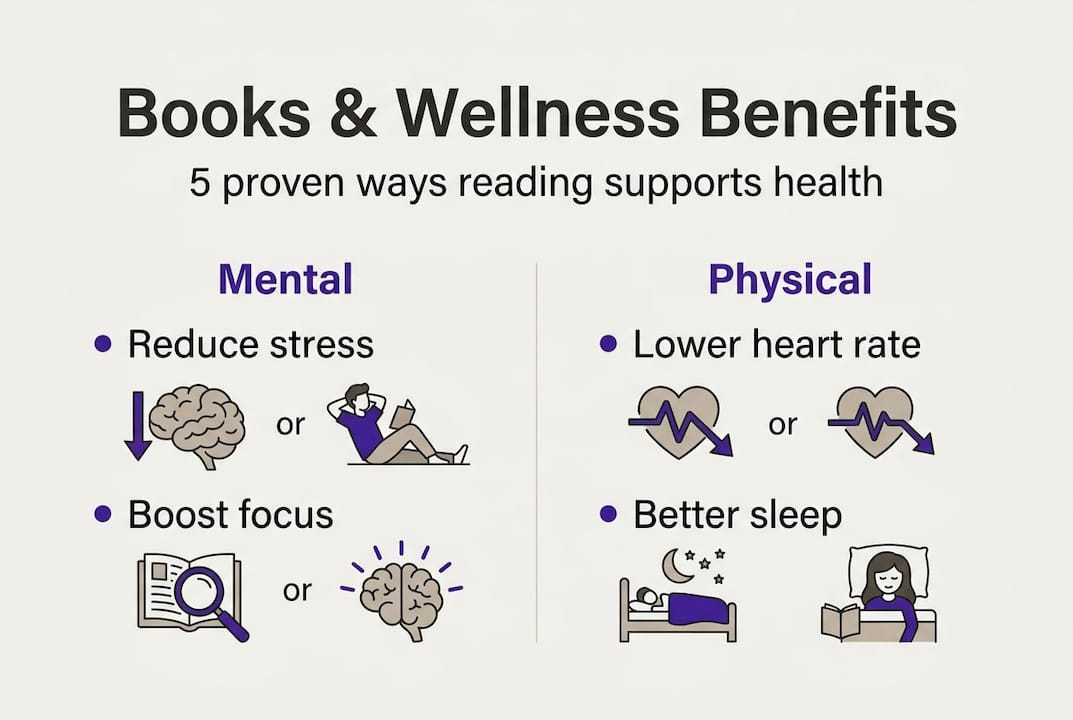
Building habits for regular readers matters too. The benefits compound over time. A reader who finishes 10 books a year for 10 years is not just 10 times better off than someone who reads one book. The cumulative effect on empathy, vocabulary, stress tolerance, and self-knowledge is exponential.
| Wellness outcome | Evidence strength | Key finding |
|---|---|---|
| Reduced anxiety | Strong | Bibliotherapy on par with CBT for mild cases |
| Depression relief | Very strong | Effects last up to 3 years |
| Cognitive maintenance | Moderate to strong | Library visits linked to lower dementia risk |
| Social connectedness | Moderate | Fiction readers show higher empathy scores |
| Physical stress reduction | Emerging | 30 min/day linked to lower blood pressure |
Exploring different book types: From self-help to creative activities for wellness
Given these measurable wellness impacts, it is important to choose the right type of book experience for your needs.
Books support wellness via bibliotherapy for self-help enthusiasts through CBT skills and depression relief, for lifelong learners through cognitive maintenance and longevity correlations, and for those in creative activities through journaling prompts for reflection and coloring for calm.
Here is a practical numbered guide to matching book type to wellness goal:
- For anxiety and stress: Start with a structured CBT-based self-help book. These teach you to identify thought patterns and interrupt them. The skill transfer is real and measurable.
- For loneliness or empathy building: Pick literary fiction with complex characters. The more you inhabit another perspective, the stronger your real-world social skills become.
- For processing grief or difficult emotions: Try poetry collections or guided poetry journals. Short, dense language gives you words for feelings that resist ordinary sentences.
- For self-awareness and clarity: Use a structured guided journal. Prompts that ask specific questions produce more insight than blank-page journaling. Explore journaling for self-discovery to find formats that fit your style.
- For relaxation and focus: Reach for a mindful coloring book. The repetitive, low-stakes nature of coloring activates the same neural pathways as mindfulness meditation without requiring any prior practice.
Creative activity books are especially underrated. Many people assume they are only for children, but creative activity books designed for adults tap into the same playful, present-moment attention that makes mindfulness so effective for stress.
Pro Tip: Match your book format to your current energy level. When you are exhausted, a coloring book or light fiction restores attention without demanding effort. When you are energized and motivated, a structured self-help workbook delivers the most skill-building value.
Caveats, controversies, and tips for using books safely for wellness
Before you add a stack of books to your wellness toolkit, let's discuss important considerations to keep your experience positive, safe, and evidence-based.
Not every book works for every person, and the wellness benefits of reading are sometimes overstated. Self-help is effective for some but shows no consistent personality change or social cognition benefits from fiction alone. Some books may cause harm if they are triggering, and bibliotherapy is most effective when matched to reader needs with some guidance.
Here are the most important caveats to keep in mind:
- Triggering content is real. Books that deal with trauma, eating disorders, or self-harm can worsen symptoms for vulnerable readers. Know your sensitivities before picking up a book on those topics.
- Self-help is not a cure-all. It works best for mild to moderate conditions. For serious depression, anxiety disorders, or trauma, books are an adjunct to professional care, not a replacement.
- Fiction's empathy benefits are real but limited. The research does not support the idea that reading fiction alone produces lasting personality change.
- Guided programs outperform solo reading. Library-led bibliotherapy groups and therapist-recommended reading lists consistently produce better outcomes than random self-selection.
"Guided self-help and librarian-led programs are most effective when matched to reader needs."
The safest approach is to treat books as one layer of a broader wellness strategy. Pair your reading with educational self-help resources that are evidence-based, and consult a professional if you are managing a diagnosed condition. Books are powerful, but they work best when used thoughtfully.
Our view: Why books deserve a bigger role in wellness routines
With the evidence and tips in mind, let's step back and share why we believe books, especially creative and guided books, are an underutilized wellness resource.
The wellness industry spends enormous energy promoting apps, supplements, and subscription services. Books rarely make the highlight reel. That is a mistake. A well-chosen guided journal or coloring book costs less than one therapy session and can be used daily for months. The return on investment is remarkable.
What most wellness articles miss is the cumulative effect of diverse, enjoyable reading over time. It is not about reading the "right" book once. It is about building a reading identity, a habit of reaching for books across formats and moods. Fiction one week, a guided journal the next, a coloring session on a hard Tuesday afternoon.
We also think the creative formats get unfairly dismissed as lightweight. They are not. The calm that comes from 20 minutes with a coloring book is neurologically real. Personal growth through books happens across all formats, not just the serious ones. Combining guided creative activities with a reading community or book club supercharges the social connectedness benefits that research consistently highlights.
Next steps: Explore creative wellness solutions
If you are ready to go from understanding to action, explore these resources for your wellness journey.
At MunkterProducts.com, we curate journals, coloring books, activity sets, and educational resources designed specifically for people who want to use books as a genuine wellness tool. Every product is chosen with intentionality and quality in mind.

Whether you are looking for a structured guided journal to build self-awareness, a beautifully designed creative wellness book to unwind after a long day, or educational book options that teach practical mental health skills, you will find something that fits your goals. Start with one format, commit to it for 30 days, and notice the difference a single book can make.
Frequently asked questions
What kind of books are best for improving mental health?
Self-help books focused on CBT, guided journals, and creative activity books like coloring are most effective, especially when matched to your specific wellness goals rather than chosen at random.
How many books should I read a year to see benefits?
Reading 6 or more books per year is the threshold where measurable wellness and cognitive benefits consistently appear in research studies.
Are audiobooks as effective as paper books for wellness?
Paper and audiobooks outperform digital reading formats for cognitive and emotional benefits, making them the better choice when wellness is your primary goal.
Can reading replace therapy for mental health issues?
Books work best as an adjunct to professional therapy, not a replacement. They are highly effective for mild conditions but should complement professional care for anything more serious.
Are there risks or downsides to using books for wellness?
Some books may trigger difficult emotions in vulnerable readers, so guidance and careful selection matter. When in doubt, consult a professional before diving into heavy therapeutic content alone.