
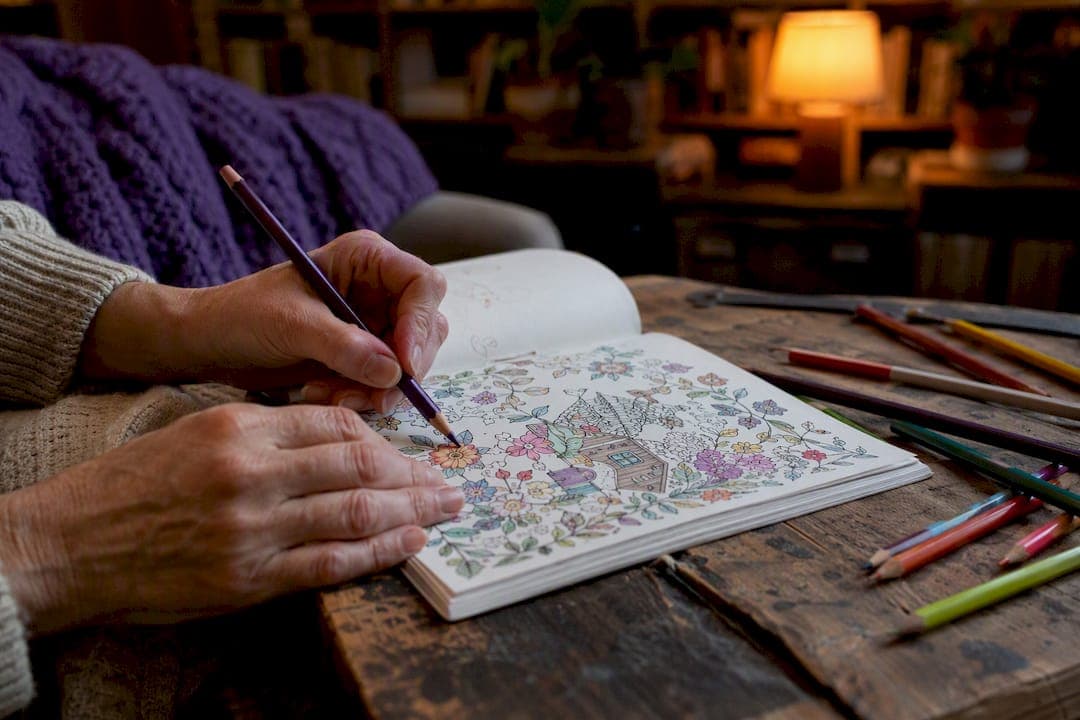
Coloring boosts creativity by pulling your attention away from anxious, scattered thinking and into a flow state where new ideas surface more easily. The fastest way to feel this is to sit down for five to ten minutes with a single colored pencil, pick a small mandala or repeating pattern, and color one section at a time in slow, breath-paced strokes: inhale for the stroke down, exhale for the stroke up.
Two things happen while you do this. Research on flow states suggests that the narrow attentional focus coloring creates is the same mental gear shift that lets ideas connect in the background. And practically, most people notice that once they set the pencil down, an idea they'd been stuck on for days suddenly has an opening. That's not a coincidence. It's the whole point of this practice.
Key Takeaways
Mindful coloring boosts creativity most reliably when specific techniques, like gradation and limited palettes, are combined with short, intentional, timed sessions.
| Point | Details |
|---|---|
| Technique beats duration | Gradation coloring produced a significantly higher creativity score increase compared to the control group, far more than free coloring alone. |
| Flow needs about 20 minutes | Short sessions around 20 minutes are enough to trigger the flow state linked to better post-session problem-solving. |
| Constraints drive invention | Limiting yourself to three or four colors forces creative substitutions instead of default choices. |
| Match design to mood | Simple bold pages suit anxiety, mandalas suit focus, and gradation challenges suit patient, exploratory moods. |
| Start with the right tools | Munkterproducts curates coloring books, journals, and starter-kit-friendly paper stock designed to support layering and gradation practice. |
Table of Contents
- How Does Coloring Boost Creativity, According to Research?
- Which Coloring Techniques Actually Build Creative Thinking?
- What Are Good Session Structures for Creative Coloring?
- What Materials Actually Support Creative Coloring?
- Why Trust This Guide on Coloring and Creativity?
- [Creative Projects That Turn Coloring Into New Ideas include various interactive activities that enhance inventive thinking, such as those found in imagination-building activities kids can try today.](#creative-projects-that-turn-coloring-into-new-ideas-include-various-interactive-activities-that-enhance-inventive-thinking-such-as-those-found-in-imagination-building-activities-kids-can-try-todayhttpsblogg45-hero-castcomblogimagination-building-activities)
- How Do You Build Coloring Into a Daily Creative Routine?
- What Psychological Barriers Block Creativity, and How Does Coloring Help?
- An Editorial Take on Making Coloring Actually Work for Creativity
- Where to Find Coloring Books Built for This Kind of Practice
- Sources
How Does Coloring Boost Creativity, According to Research?
The clearest evidence comes from two different directions: journalism synthesizing expert opinion, and a controlled study measuring the effect directly.
HuffPost's reporting on coloring and the brain found that short coloring sessions, often around 20 minutes, can trigger a flow-like state that improves creative problem-solving once the session ends. That timing matters. It's short enough to fit into a lunch break, long enough to actually shift your mental state.
A pretest-posttest study measured a substantial average increase in creativity scores among participants using gradation coloring techniques, compared to a smaller increase in the control group.
That gap is the strongest piece of evidence in this space. The study on coloring and artistic creativity isolated gradation, the technique of gradually shifting a color's intensity across a shape, as the variable that mattered. Random or flat coloring didn't produce the same jump.
What's actually happening in your brain during a session like this comes down to a few overlapping mechanisms:
- Attentional narrowing. Your focus collapses onto the boundary of the shape you're coloring, which quiets the mental chatter that normally blocks new associations.
- Rhythmic motor activity. The repetitive hand movement works similarly to walking or knitting, both known to loosen up associative thinking.
- Reward feedback. Watching a page fill in gives your brain small, frequent hits of completion, which sustains attention longer than a blank page ever could.
- Lowered cortisol. A practical guide on creative expression through coloring points out that mindful coloring reduces cognitive overload and activates a relaxation response, which is the physiological groundwork flow needs to happen at all.
Which Coloring Techniques Actually Build Creative Thinking?
Coloring for creativity isn't the same as coloring to zone out. The techniques that generate the biggest creative gains all share one trait: they force a decision.
- Gradation. Instead of filling a shape with one flat color, plan a gradual shift from light to dark, or from one hue into an adjacent one, across the shape. This is the exact technique behind that 41.6% creativity jump, and it works because you can't do it on autopilot. Every stroke requires a judgment call about pressure and blending.
- Limited palette. Pick three or four colors before you start and refuse to use anything outside that set. Constraints like this push your brain toward inventive substitutions instead of reaching for the "correct" color, which is precisely the kind of problem-solving that carries over into other creative work.
- Emotion-color mapping. Before you color a page, ask what you're feeling and assign a color to it, then let that emotional logic guide your choices instead of realism. This isn't therapy fluff. It's a direct way to practice symbolic, expressive decision-making, which is a core creative muscle.
- Circulism and light layering. Advanced colorists build depth using tiny circular strokes layered lightly instead of pressing hard for solid coverage. Complementary-color shading, using a color's opposite on the wheel instead of black, produces richer, more dimensional shadows.
Pro Tip: Start a gradation exercise with your lightest color and build up gradually. Adding a dark tone too early flattens the effect and makes blending nearly impossible to fix.
Once these techniques feel familiar, coloring book journaling is a natural next step: pairing a finished page with a few lines about what you noticed while making it often surfaces the idea the session was quietly working on.
What Are Good Session Structures for Creative Coloring?
Three time blocks cover most situations, from a stressed five minutes at your desk to a full weekend afternoon.
- The 5-minute rapid spark. Grab one color, pick a small repeating shape, and color with breath-paced strokes: inhale down, exhale up. When the timer goes off, jot one word that describes what came to mind. Don't judge it yet.
- The 20-minute flow builder. Choose a mandala or medium-complexity page, restrict yourself to three colors, and put your phone in another room. This window lines up with the flow-state timing HuffPost's reporting describes, and it's long enough to notice your thoughts loosening.
- The 45-minute exploratory session. Take on a gradation challenge across a more detailed page, experiment with layering, and leave the last five minutes for reflection: what surprised you, what you'd try differently, what idea showed up uninvited.
A few things make any of these more effective:
- Set an intention before you start, even something as simple as "I want to notice what my mind does when it's not trying."
- Resist narrating the session to someone else mid-way through. That intentional framing appears to deepen the benefit rather than dilute it.
- Keep a short log, just a sentence or two after each session, noting any idea that surfaced. Patterns show up fast once you're tracking them.
Structured pages like mandalas tend to calm an anxious mind more reliably than free-form drawing, since the built-in symmetry gives wandering thoughts something to hold onto instead of spiraling.
What Materials Actually Support Creative Coloring?
Colored pencils beat markers for this kind of practice, mainly because their slower application forces you to slow down, which is exactly the mental state you're trying to build. Markers are faster and bolder, which is fine for quick color-blocking, but they don't reward the layering and blending that gradation and circulism depend on.
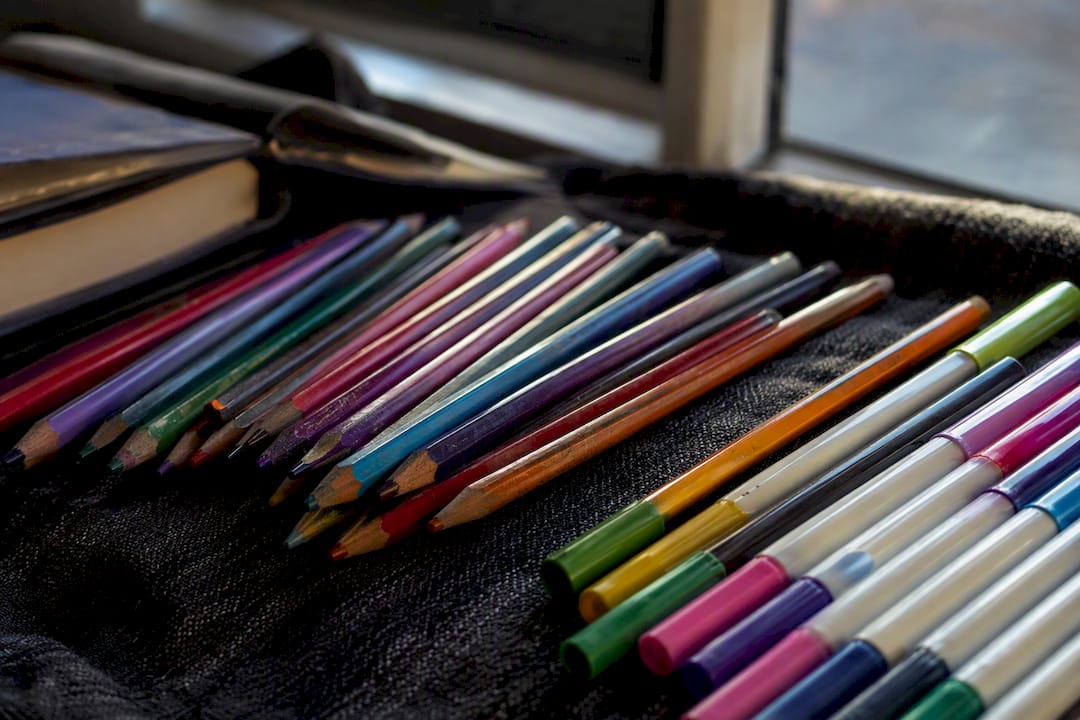
Look for pencils with a soft, waxy or oil-based core (Prismacolor and Faber-Castell Polychromos are two widely used options) since they blend more smoothly than harder student-grade sets. Paper matters more than people expect: anything under 120gsm will bleed and buckle under layered color, so look for at least 150 to 200gsm with a slight texture, which holds pigment better than smooth printer paper.
A simple starter kit covers you for almost everything above:
- A 24 to 36 color pencil set with a mix of warm and cool tones for palette constraints
- A pencil sharpener and a kneaded eraser for cleanup
- A blending stump or two for smoothing gradation transitions
- A colorless blender pencil to soften harsh edges without adding pigment
Munkterproducts curates coloring books and journals built with paper stock that actually holds up to this kind of layering, which is worth checking before you buy a book designed for markers and try to gradate on it. Our guide on choosing adult coloring themes breaks down which designs suit which mood.
Why Trust This Guide on Coloring and Creativity?
This piece pulls from a published creativity study, expert-sourced journalism, and practitioner technique guides, not just opinion. Munkterproducts has spent years curating coloring books, journals, and puzzle collections specifically for adults using creative play as a stress-relief and personal-development tool, which shapes how these recommendations get made.
Constraints like a limited palette or a single-color meditation don't restrict creativity. They redirect it, forcing your brain to find inventive solutions inside a smaller box instead of freezing in front of unlimited options.
Author Mark has covered the practical side of this space extensively, including how coloring book ideas get developed and sell and what the science says about adult coloring and stress. Munkterproducts' catalog itself, built around curated coloring books, journals, and puzzles rather than mass-produced templates, reflects that same close attention to paper quality and design complexity.
Creative Projects That Turn Coloring Into New Ideas include various interactive activities that enhance inventive thinking, such as those found in imagination-building activities kids can try today.
Coloring doesn't have to stay inside the lines of relaxation. A few project formats turn a coloring session into a genuine idea-generation tool.
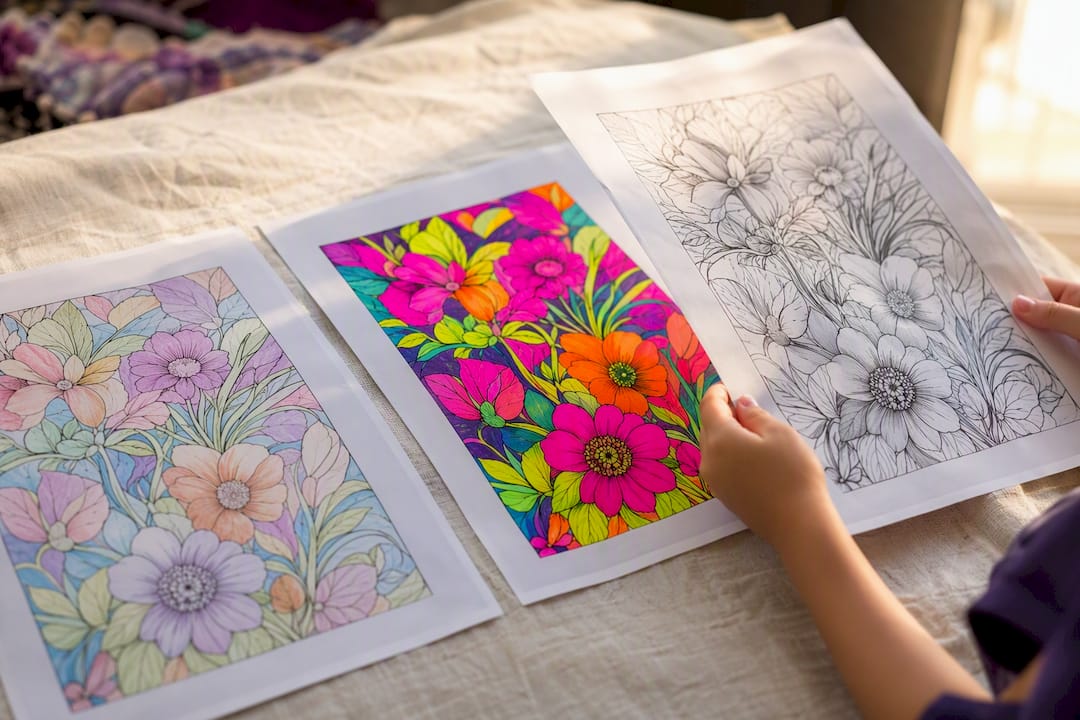
The blank-page remix. Take a finished coloring page and photocopy it before adding color. Color the same design three different ways, once realistic, once using emotion-color mapping, once with a wildly limited two-color palette. Comparing the three afterward often reveals a design instinct you didn't know you had.
The story page. Choose a page with several distinct elements (a scene with multiple characters or objects works best) and assign each element a backstory before coloring it. This turns a passive activity into a narrative exercise, which is useful if you're stuck on writing or storytelling projects elsewhere in your life.
The mood board swap. Pull three colors from something unrelated (a photo, a piece of fabric, a memory) and force yourself to build an entire page's palette from just those three. This is where limited-palette constraints and emotion-color mapping overlap, and it's one of the more reliable ways to break a creative rut because the constraint comes from outside your usual habits.
The progression project. Color the same design once a week for a month, changing one technique each time: flat color, then gradation, then circulism, then complementary shading. Watching your own skill compound over four weeks builds the kind of creative confidence that carries into other work entirely.
How Do You Build Coloring Into a Daily Creative Routine?
The habit that sticks isn't the 45-minute session, it's the 5-minute one you can do without thinking twice. Anchor it to something you already do daily: right after your morning coffee, at the start of a lunch break, or as a wind-down before closing your laptop.
Keep the barrier to entry low. A pencil case and a half-finished book on your desk gets used; one buried in a drawer doesn't. If mornings are chaotic, try a coloring break as a transition ritual between meetings instead, since even three or four minutes resets attentional fatigue enough to matter.
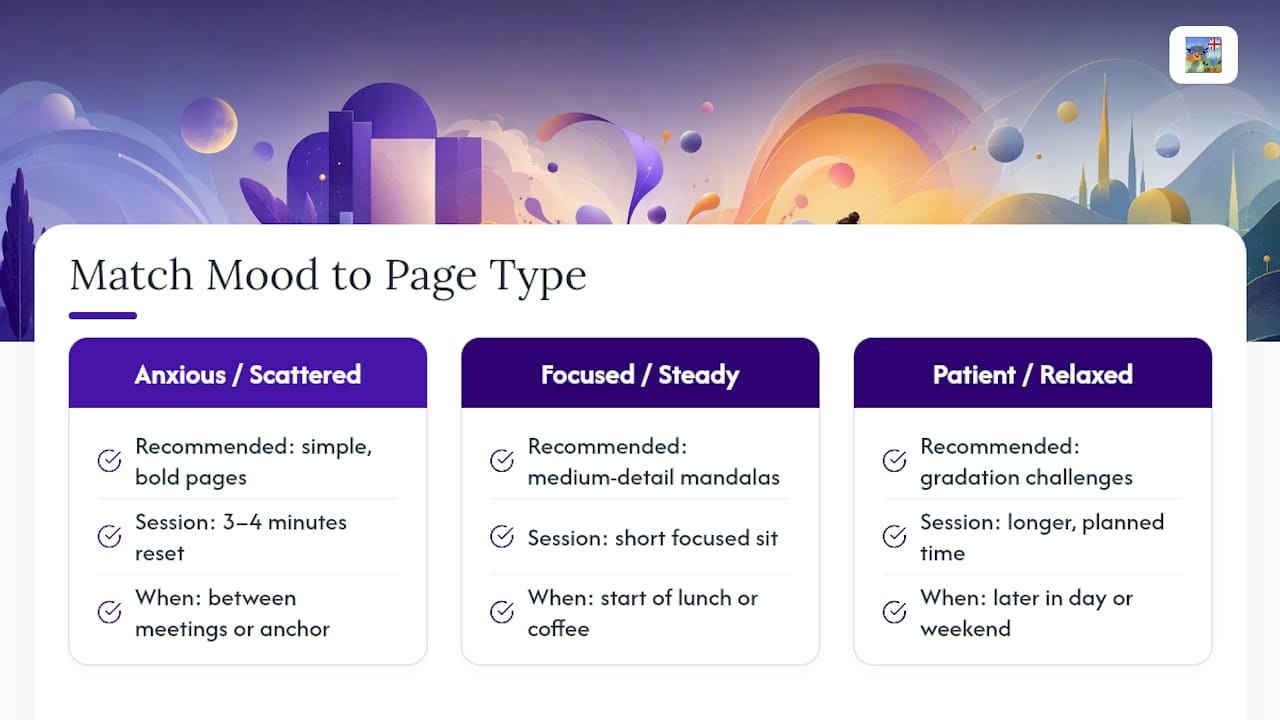
Match the session to your mental state rather than forcing intensity you don't have. Simple, bold pages work best when you're anxious or scattered. Medium-detail mandalas suit a focused, steady mood. Save gradation challenges for when you actually have the patience to plan a color transition, usually later in the day or on a weekend.
The weekly rhythm matters more than any single session. Three short sessions a week, tracked in a simple log, build the pattern-recognition that lets you notice when an idea surfaced during or right after coloring. Once you see that pattern once or twice, the habit tends to hold itself together.
What Psychological Barriers Block Creativity, and How Does Coloring Help?
Perfectionism is probably the biggest one. The fear of "getting it wrong" freezes a lot of people before they start any creative project, and coloring sidesteps that fear almost completely because the lines are already drawn for you. There's no blank-page terror, just decisions about color.
Judgment, both self-directed and imagined from others, is close behind. A limited-palette exercise or emotion-color mapping session has no "correct" answer to fail at, which quietly retrains the part of your brain that expects creative work to be graded.
Mental fatigue is a third barrier that gets less attention than it deserves. When you're cognitively depleted, generating anything original feels impossible. This is where coloring's rhythmic, repetitive motion earns its keep. It occupies just enough of your attention to quiet overthinking without demanding the executive effort that writing or problem-solving from scratch requires.
And then there's simple avoidance, the tendency to skip creative practice altogether because it feels indulgent or unproductive. Framing a coloring session as a structured five-minute practice, with a clear technique and a stated intention, makes it easier to treat as legitimate work rather than something to feel guilty about.
An Editorial Take on Making Coloring Actually Work for Creativity
Most advice on adult coloring treats it as a relaxation tool and stops there, as if calm and creativity were the same thing. They're not. Calm is the precondition; creativity is what you do with it once you're there. The research on gradation techniques backs this up directly: it wasn't coloring itself that drove the creativity gain, it was a specific technique that demanded planning and judgment.
That's the piece conventional advice on coloring for creativity keeps skipping. "Just color, it's therapeutic" is true but incomplete. If you want the creative upside and not just the stress relief, you need constraints, technique, and intention layered on top of the basic act. A blank mandala colored on autopilot won't do much for your next big idea. A gradation challenge with a limited palette, done with a clear intention, is a different exercise entirely.
If there's one thing to prioritize first, it's this: pick one technique, not five. Master gradation or limited-palette work before layering in emotion-mapping or circulism. Creative confidence builds in that order, not all at once.
— Mark
Where to Find Coloring Books Built for This Kind of Practice
Munkterproducts is the source for coloring books that actually hold up to the techniques in this guide, curated rather than mass-produced, with paper stock chosen for layering and blending instead of quick marker use. 
The catalog runs from mandala-focused books suited to flow-building sessions, to artistic word search and puzzle collections for a lighter creative break, to journals designed for pairing a colored page with reflection notes. If gradation and layering are where you want to build skill, look for books with clean line work and enough white space to plan a color transition instead of packed, tiny sections that force flat fills.
Browse the curated coloring books and journals to find a starter kit or a themed book that matches whichever technique you're ready to practice next, and check the product notes for paper weight before you buy if layering is your priority.
Sources
- How Coloring Benefits Your Brain | HuffPost Life
- Coloring as an activity for the development of artistic creativity in early childhood
- Creative Expression Through Coloring. Daily Calm Guide