
Standing in a bookstore aisle or scrolling through endless online listings, you pick up a book that looks great. Colorful cover, fun title, good reviews. But then the doubt creeps in: is this actually right for my child right now? Will it hold their attention, match where they are developmentally, or spark a genuine love of reading? You are not alone in that uncertainty. Research consistently shows that the right book at the right time can shape a child's literacy, empathy, and curiosity for years. This guide walks you through exactly how to match books to your child's age, interests, and learning goals, so every pick feels intentional.
Table of Contents
- Understanding your child's developmental stage
- What makes a great children's book? Key features to consider
- Using tools and methods: Making book selection easier
- Special considerations: Gifted readers, emotional readiness, and rereading
- Print vs digital books: Which is best for your child?
- Take the next step: Find the perfect books for your child
- Frequently asked questions
Key Takeaways
| Point | Details |
|---|---|
| Match books by age | Choose books that fit your child's developmental stage and emotional readiness. |
| Prioritize engagement | Look for engaging stories, diverse characters, and emotional themes over reading level numbers. |
| Use proven selection tools | Apply frameworks like PICK and the 3-Finger Rule to pick books with confidence. |
| Balance print and digital | Combine print for comprehension and digital for vocabulary to support your child's growth. |
| Support special needs | Gifted or advanced readers need books that challenge but also respect their emotional readiness. |
Understanding your child's developmental stage
Every child moves through predictable cognitive and emotional milestones, and the books that resonate most are the ones that meet them exactly where they are. A board book that delights a nine-month-old will bore a five-year-old. A chapter book that thrills a third-grader may overwhelm a kindergartner. The gap between "reads well" and "is ready for this" is wider than most parents expect.
Age-specific book recommendations by developmental stage show that infants benefit most from high-contrast images, simple repetitive text, and tactile features like textured pages. Toddlers and preschoolers thrive with stories centered on emotions, friendships, and everyday routines. School-age children, roughly six to twelve, are ready for more complex plots, moral dilemmas, and characters who face real challenges.
Here is a quick reference to guide your selections:
| Age range | Book type | Key features |
|---|---|---|
| 0 to 12 months | Board books, cloth books | High contrast, simple images, few words |
| 1 to 3 years | Picture books | Repetition, rhythm, familiar themes |
| 3 to 5 years | Story picture books | Emotions, social situations, simple plots |
| 6 to 8 years | Early chapter books | Short chapters, relatable characters |
| 9 to 12 years | Middle grade novels | Complex themes, longer narratives |
Before you shop, it also helps to run through an activity book checklist to confirm a book supports your child's current learning goals. A few key things to look for at each stage:
- Infants: Sensory engagement, bold visuals, caregiver interaction prompts
- Toddlers: Repetitive phrases, simple cause and effect, familiar objects
- Preschoolers: Emotional vocabulary, social scenarios, predictable story arcs
- Early readers: Decodable words, short sentences, humor and adventure
- Tweens: Diverse characters, moral complexity, relatable peer situations
What makes a great children's book? Key features to consider
Not every well-reviewed book is the right book. Quality in children's literature goes beyond a catchy title or a famous author's name on the cover. The best books work on multiple levels at once.
Rhyme, repetition, and rhythm are not just fun. They are neurological tools. When children hear patterns in language, their brains build stronger phonemic awareness, which is the ability to recognize and manipulate sounds in words. That skill is foundational for reading. Books that use these devices consistently give young readers a real head start.
Illustrations and diversity play a role in comprehension that 80 to 90 percent of experts emphasize. Illustrations should invite a child to linger, point, and ask questions. Overly busy or digitally cluttered artwork can actually distract from the story rather than support it. And books that reflect your child's own world, while also offering windows into lives different from theirs, build empathy in a way that no worksheet ever could.
Emotional resonance often matters more than academic complexity. A book that makes a child feel seen, laugh out loud, or ask "why did that happen?" is doing more developmental work than a book that simply introduces new vocabulary. For seasonal engagement, holiday activity books are a great way to combine emotional connection with interactive learning. Older children who are ready to stretch their imagination may also benefit from science fiction books for families, which build critical thinking alongside storytelling skills.
Pro Tip: Before buying, read the first two pages aloud. If the rhythm feels natural and the images invite questions, it is likely a strong pick for your child.
Understanding how publishing shapes reading culture can also help you identify which books are crafted with genuine educational intent versus those designed purely for commercial appeal.
Using tools and methods: Making book selection easier
Once you know what to look for, a few practical frameworks can make the actual choosing process much faster and more reliable. You do not need to be a reading specialist to use these tools effectively.
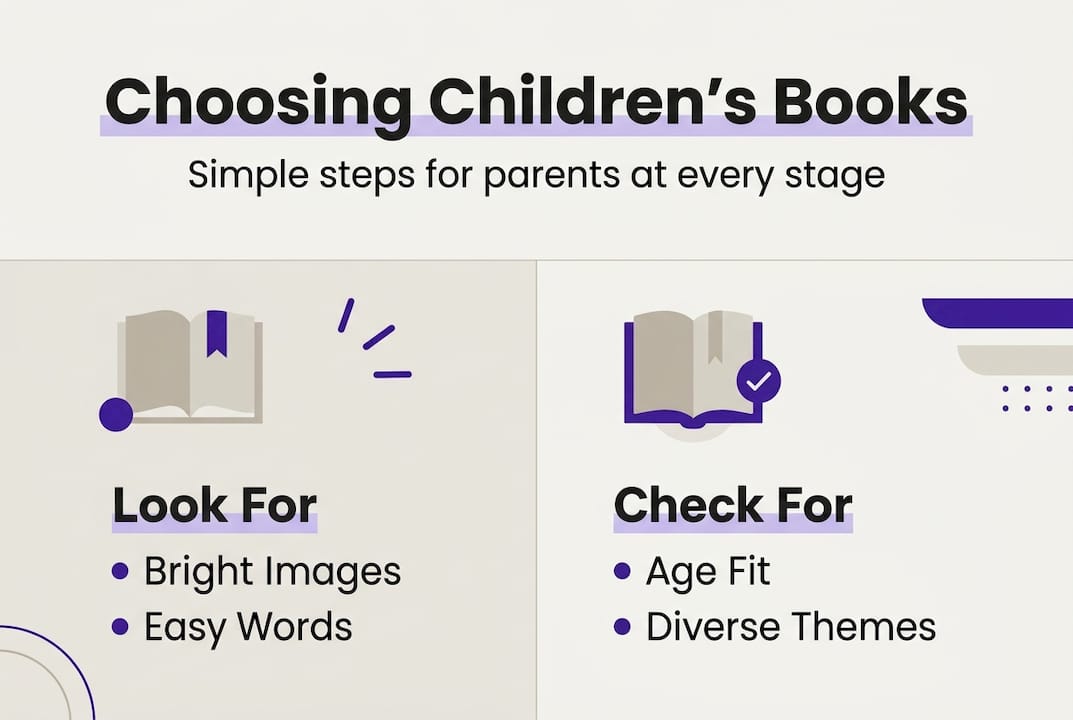
The PICK method and 3-Finger Rule are two of the most recommended approaches for parents selecting books for children ages three to nine. Here is how each one works:
- Purpose: Why are you choosing this book? Pleasure, learning, emotional support?
- Interest: Does your child show genuine curiosity about the topic or characters?
- Comprehend: Can your child understand most of the text without frustration?
- Knowledge: Does the book add something new without overwhelming existing understanding?
The 3-Finger Rule is even simpler. Open to a random page and have your child read it. For every word they do not know, hold up a finger. Three fingers up means the book is probably too hard right now.
| Tool | Best for | How to use |
|---|---|---|
| PICK method | All ages | Evaluate purpose, interest, comprehension, knowledge |
| 3-Finger Rule | Ages 5 to 10 | Count unknown words on one page |
| Lexile levels | Ages 6 and up | Match numeric score to child's tested reading level |
| Librarian consult | Any age | Ask for personalized recommendations based on interests |
Age stickers and grade-level labels are a starting point, not a verdict. A child reading above grade level may still need books that match their emotional maturity, not just their decoding ability. Building strong reading habits early makes the selection process feel natural over time. For parents focused on long-term growth, pairing fiction with educational books for growth creates a well-rounded reading diet.
Pro Tip: Your local librarian is one of the most underused resources in children's literacy. A five-minute conversation about your child's interests can yield a reading list that no algorithm can match.
Special considerations: Gifted readers, emotional readiness, and rereading
Some children read years ahead of their peers. That is exciting, but it comes with a real challenge that many parents underestimate. Reading ability and emotional readiness do not always develop at the same pace.
"A gifted child may decode a book written for teenagers, but that does not mean they are ready to process its themes of loss, violence, or complex moral failure."
Gifted children need content that matches their emotional level as well as their reading level. A ten-year-old reading at a high school level still benefits most from books written for their age group in terms of emotional content. The goal is to challenge without exposing them to themes they lack the life experience to process.
Do not underestimate the power of rereading, either. When a child asks to read the same book for the fifth time, that is not boredom or lack of imagination. It is active learning. Each reread builds fluency, deepens comprehension, and reinforces vocabulary in context. Encouraging this habit is one of the simplest things you can do to support literacy development.
For reluctant readers, the key is finding books that feel like a reward, not an assignment. Exploring a storytelling workflow for creativity can also help children connect more deeply with narratives, making reading feel like an adventure rather than a chore.
- Gifted readers: Prioritize emotional appropriateness over reading level alone
- Reluctant readers: Choose high-interest, low-pressure formats like graphic novels or activity books
- Sensitive children: Preview content for themes around loss, conflict, or fear
- Rereaders: Celebrate the habit and introduce companion books in the same series or style
Print vs digital books: Which is best for your child?
This question comes up constantly, and the honest answer is: it depends on what you are trying to achieve. Both formats have real strengths, and the research is more nuanced than most headlines suggest.
Digital shared reading slightly boosts vocabulary in young children, particularly when interactive features are used alongside adult involvement. However, print books consistently outperform digital formats for comprehension, especially when a caregiver reads alongside the child. The physical act of turning pages, pointing to pictures, and sitting together creates a bonding experience that a tablet screen simply cannot replicate.
| Format | Strengths | Best use case |
|---|---|---|
| Comprehension, bonding, focus | Daily reading routines, bedtime stories | |
| Digital | Vocabulary, accessibility, portability | Travel, supplemental reading, interactive learning |
| Hybrid | Combines both benefits | Balanced weekly reading plan |
Screen time management matters most for children under five. For this age group, any digital reading should involve an adult actively participating, not just supervising. For older children, a hybrid approach works well. Use print for core reading time and digital formats for on-the-go access or interactive exploration. Exploring digital and print book options side by side can help you find the right balance for your family. Understanding book formats in e-commerce also helps you make smarter purchasing decisions when shopping online.
Pro Tip: For children under three, skip the e-reader entirely. The tactile experience of a board book, combined with your voice and presence, is the most powerful early literacy tool available.
Take the next step: Find the perfect books for your child
You now have a clear, research-backed framework for choosing books that genuinely fit your child's stage, interests, and emotional readiness. The next step is putting it into practice with curated titles that do the heavy lifting for you.

At MunkterProducts.com, you will find a thoughtfully selected range of children's books, activity books, and educational titles designed to match exactly the kind of intentional selection this guide describes. Whether you are looking for a tactile board book for a toddler or an engaging activity book for a school-age child, the collection is built with developmental value in mind. Start with the activity book checklist to identify what your child needs right now, then browse titles that check every box. Postage is included, and the process is straightforward, so finding the right book has never been easier.
Frequently asked questions
How can I tell if a book is appropriate for my child's age?
Check whether the book aligns with your child's developmental stage and interests, and always preview the content for emotional appropriateness before purchasing.
Is it better to buy print or digital children's books?
Digital boosts vocabulary in young children, but print supports deeper comprehension and caregiver bonding, so a mix of both formats works best for most families.
What should I do if my child wants to read the same book repeatedly?
Encourage it. Rereading builds fluency and confidence, and repeated reading is recognized as a genuine literacy-building habit worth celebrating.
How can I support a gifted or advanced reader?
Offer books that match both their reading ability and their emotional readiness, steering clear of themes that are too mature for their life experience.
Do reading labels or stickers accurately rate children's books?
Age labels are a starting point but should not be your only guide. Your child's interest level and comprehension are far more reliable indicators of the right fit.