

Choose 120–160 pages for light planners, 160–192 pages for typical bullet-journalers, and 192–224 for heavy creatives who fill spreads daily. Multi-notebook systems (separate work, gratitude, and idea journals) usually do better with several 96 to 128 page volumes than one giant book. The real tradeoff is weight and cost versus how long a single journal lasts, and many handcrafted options are built across most of these ranges already.
TL;DR:
- Most bullet journals are designed with 96, 160, or 192 pages due to signature printing limitations, balancing cost, durability, and user needs.
- Heavier paper weights, such as 160 GSM, limit the maximum page count to around 160 pages, while lighter paper allows for more pages but may compromise bleed resistance.
- Light users typically need a 96-page journal for a year, while moderate users benefit from 160 to 192 pages, and heavy creatives should consider 224 or more pages.
- Using fewer pages than needed results in early replacement, whereas too many can lead to unused pages and reduced portability.
- Refillable systems offer flexibility but require careful initial planning for page count and binding, especially to avoid higher shipping costs or awkward feels.
Table of Contents
- How to Calculate Your Journal Page Count
- Why Do Journals Come in 96, 160, or 192 Pages?
- How Paper Weight and Binding Change What You Actually Get
- Quick Page-Count Templates for Common Journal Types
- Designing a Custom Journal Without Overpaying
- Does Page Count Affect How Long a Journal Lasts You?
- Can You Add or Remove Pages Later?
- Matching Page Count to How You Actually Write
- How Munkterproducts Thinks About Page Count
- Find the Right Page Count at Munkterproducts
- Sources
How to Calculate Your Journal Page Count
A page and a sheet aren't the same thing. One sheet of paper folded and bound produces two pages, front and back, and almost every page-count figure you see on a product listing already counts both sides. That distinction matters when you're doing your own math, because if you only write on the right-hand page and skip the back, your effective capacity is cut in half.
The formula is simple:
- Track how many pages you actually fill in a typical month.
- Multiply that by the number of months you want one journal to last.
- Add 10 to 20 pages for front matter (index, key, future log).
- Add a small buffer, maybe 5 to 10%, for spreads you didn't plan on.
Three examples show how differently this plays out. A minimal user jotting a few notes a week uses roughly 5 pages a month, so a year of journaling needs about 60 pages plus front matter, meaning a 96-page notebook comfortably covers 12 months with room left over. A typical planner running daily entries, a habit tracker, and a monthly spread lands closer to 10 to 15 pages a month; that's 120 to 180 pages a year, which is exactly why 160 and 192-page journals dominate store shelves. A heavy user who journals daily, sketches, and keeps collections can burn through 20 or more pages a month, pushing annual use past 240 pages, so either a 224 to 251-page volume or two smaller books make more sense than one oversized brick.
Decorative spreads eat pages faster than people expect. A single hand-lettered habit tracker or a two-page mood board can consume what would otherwise be four or five days of plain notes, so community math on pages-used-per-month tends to run higher for anyone doing visual bullet journaling versus someone using short, functional entries.
Why Do Journals Come in 96, 160, or 192 Pages?
Notebooks aren't printed one page at a time. Printers assemble books from signatures, folded and stitched blocks of paper, and those blocks almost always come in multiples of 16 or 24 pages. That's why you rarely see a retail journal with an odd total like 137 pages: the printing equipment isn't set up to produce it efficiently, and a custom count that breaks the signature math usually costs more per unit.
That manufacturing rhythm is why the same handful of numbers keep showing up across brands:
- 96 pages — common in slim daily planners and pocket notebooks.
- 128 pages — a middle-ground option for light bullet journaling.
- 160 pages — one of the most frequent counts for standard planners.
- 192 pages — widely considered a sweet spot for durability and cost.
- 224 pages — aimed at heavier users who want fewer refills.
- 251 pages — near the top end for thick, long-life journals.
Most popular bullet-journal brands land somewhere between roughly 124 and 249 pages, and printer-driven signature math explains why 192 shows up so often: it sits at a point where paper cost, binding strength, and spine thickness all balance out. Ask for 175 pages instead and you're often paying a premium for a custom run that doesn't divide cleanly into standard signature blocks.
How Paper Weight and Binding Change What You Actually Get
Page count on a label doesn't tell the whole story. A journal's thickness and weight depend on both page count and paper GSM; heavier paper means fewer pages fit comfortably. Heavier paper resists ink bleed and ghosting better, which matters if you use brush pens or watercolors, but it also means fewer pages fit into a spine that's still comfortable to hold. Brand comparisons show this pattern clearly: heavier 160 GSM lines tend to cap out around 160 pages, while lighter 80 to 100 GSM notebooks routinely reach 200 or more.
Binding matters just as much:
- Saddle-stitch (folded and stapled) works fine for thin booklets under roughly 64 pages, but it can't handle bulk.
- Perfect bound or sewn binding handles 96 to 250+ pages and is the standard for most planners and bullet journals.
- Spiral or wire-o binding lets a notebook lie flat at any page count and tolerates higher page totals without cracking the spine, though it adds bulk in a bag.
A hardcover journal past 200 pages gets heavy fast, and that weight has a real cost once it leaves the shelf: crossing common postal weight thresholds pushes shipping into a higher bracket. Designers often choose a page count near a certain threshold to balance shipping cost and journal feel.
Pro Tip: Before committing to a high GSM paired with a high page count, ask for (or make) a small mock-up: write with your actual pens on the intended paper and check both bleed-through and how the spine sits when it's full. A notebook that looks great on paper can still feel awkward once it's bound at 250 pages.
Quick Page-Count Templates for Common Journal Types
Matching a use case to a number gets easier once you've seen the math worked out. These three templates cover most shoppers.
- Travel or pocket journal. Light use on the road, maybe 3 to 6 pages a week for notes, sketches, and trip logs. Over a two-week trip that's roughly 6 to 12 pages, so a compact 120-page travel journal comfortably covers several trips before it's full.
- Weekly planner or standard bullet journal. At 10 to 15 pages a month, you're looking at 120 to 180 pages for a full year. That range is exactly why 160-page journals sell so consistently, and it lines up with how most annual bullet-journal use gets tracked by planner communities.
- Artist or heavy creative use. Thicker sketch paper takes up physical space faster, so a 192-page sketch journal in heavier stock often holds less content than a 192-page lined notebook. Budget closer to 20+ pages a month and expect to refill two to three times a year even with a 224-page book.
Pick the template closest to your habits, then round up to the nearest common retail count rather than hunting for an exact custom match.
Designing a Custom Journal Without Overpaying
If you're designing your own journal rather than buying off the shelf, reserve real estate before you finalize a page count. Set aside pages for an index, a key or legend for your symbols, a couple of future-log spreads, a short introduction, and a few blank end pages for notes you didn't plan for. Planner communities generally recommend 10 to 20 pages of front matter alone, on top of whatever you calculated for daily use.
Before locking in a final spec, run three quick checks:
- Pen test. Write and sketch on the actual paper stock with your usual pens to catch bleed-through early.
- Spine mock-up. Bind a sample signature at the intended thickness to see how it opens and lies flat.
- Postage check. Anything much past 200 pages in a hardcover starts crossing weight brackets that raise shipping cost.
That's part of why 192 to 200 pages functions as a practical upper limit for most consumer-facing journals: past that, you're paying more to ship a book that may outlast the reader's patience for filling it.
Pro Tip: Match your signature size and cover material to the page count you actually want, not the other way around. A heavy leather cover paired with a thin 96-page interior wastes durability on a book that'll be full in a month.
Does Page Count Affect How Long a Journal Lasts You?
Page count and lifespan aren't the same thing, but they're closely linked. A 96-page journal used daily might last two months; the same book used for occasional notes could stretch past a year. Satisfaction tends to drop off at both extremes: too few pages and you're shopping for a replacement before you've settled into a rhythm, too many and the book feels like a commitment you never finish.
Community feedback on bullet-journal brands points to a consistent preference for durability over frequent swapping. Most users would rather carry a slightly thicker book that survives the full year than replace a thin one every few months, which explains why 160 to 192-page lines outsell both the very slim and the very thick options.
There's a psychological piece too. An unfinished journal with 80 blank pages left can feel like an obligation, while a journal that runs out right as a new year or project begins feels like a clean, satisfying close. If you tend to abandon notebooks partway through, a slightly smaller page count that you'll actually finish beats a larger one that sits half empty on a shelf. Matching page count to realistic habits, not aspirational ones, is what makes a journal last the way it's supposed to.
Can You Add or Remove Pages Later?
Refillable systems solve the guessing game by letting you adjust volume as you go. Ring-bound and disc-bound planners (the kind using loose leaf inserts) let you add blank pages when you're running low or pull out finished months to keep the active book thin. That flexibility comes at a cost in durability and feel: ring mechanisms add bulk, can snag, and rarely match the smooth, flat-writing experience of a sewn or perfect-bound journal.
Fixed-binding journals, the kind most bullet-journalers and handcrafted planner buyers choose, don't offer that flexibility, so getting the page count right up front matters more. If you're between sizes, sizing up slightly costs less in the long run than realizing at month nine that you're out of room and starting a second book mid-project, which fragments your notes across two volumes.
A middle path some hobbyists use: keep one refillable system for reference material and collections that need to stay flexible, and pair it with a fixed, higher page-count journal for the daily entries you'll never need to reorganize. That split avoids the main downside of both formats.
Matching Page Count to How You Actually Write
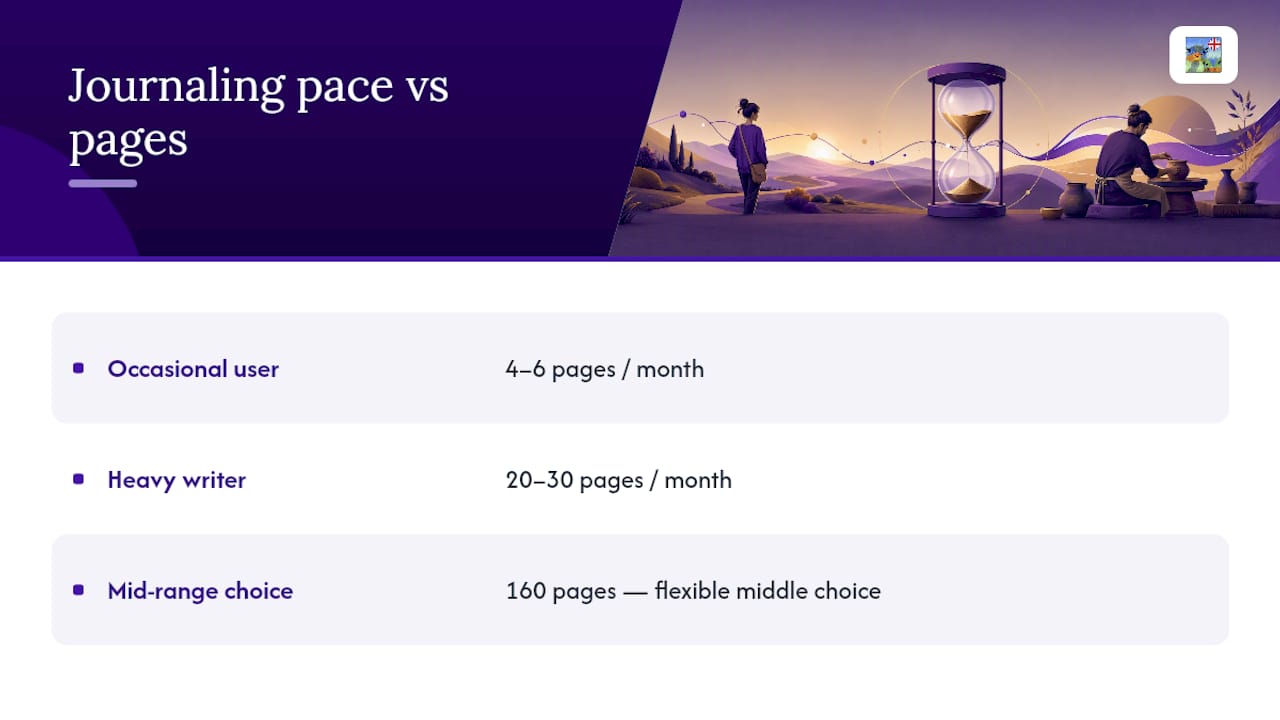
Someone who journals daily with long entries has fundamentally different needs than someone who jots a few lines a week, and the gap between those two habits is bigger than most first-time buyers expect. A heavy writer filling a full page most days can use 20 to 30 pages a month without even including trackers or collections, which means a 192-page journal might only last six or seven months.
Occasional note-takers sit at the opposite end. Someone journaling two or three times a week with short entries might use 4 to 6 pages a month, stretching a 96-page notebook well past a year. The mistake most gift buyers make is assuming everyone needs the thickest option available; for someone new to journaling or unsure if the habit will stick, a smaller 96 or 120-page book is far less intimidating to start and finish than a 250-page tome.
The safest approach if you don't know someone's habits yet: pick a mid-range count around 160 pages. It's forgiving enough for both a light user (who'll have room to spare) and a moderate one (who'll fill it close to on schedule), without the commitment weight of a 224-page-plus volume.
How Munkterproducts Thinks About Page Count
Handcrafted journals live or die on the details most shoppers never see: how a signature sits once it's sewn, whether a cover material holds up at 160 pages versus 200, whether a spine still opens flat after months of daily use. That craft-level attention is what shapes the page-count ranges Munkterproducts builds around, rather than picking a number and working backward.
Readers who want to go deeper into the mechanics behind that process can look at the Creative Bookbinding Guide: DIY Techniques and Pro Tips or the step-by-step book journaling guide for a closer look at how page count interacts with actual reading and writing habits.
— Mark
Find the Right Page Count at Munkterproducts
Some providers offer alternatives to generic office-supply notebooks, with lines built around specific page-count designs rather than mass-produced defaults. If you're a light traveler, the 120-page travel journal hits the compact-use template exactly. If you're shopping for a themed gift instead of a plain planner, the Anime Beauty line applies the same handcrafted approach to a more decorative page count.

Some sellers include postage in the price to avoid surprise fees at checkout, even for heavier, higher-page-count books. Browse the current lineup and match a journal to the page count your habits actually call for, not the one that happened to be on the shelf.
Sources
- How Many Pages Does a Bullet Journal Have? — Sweet PlanIt
- How Many Bullet Journals Do You Need a Year? - The Hobby Scheme
- The Ultimate Guide to Notebook Page Numbers — LionPaper iStyle