
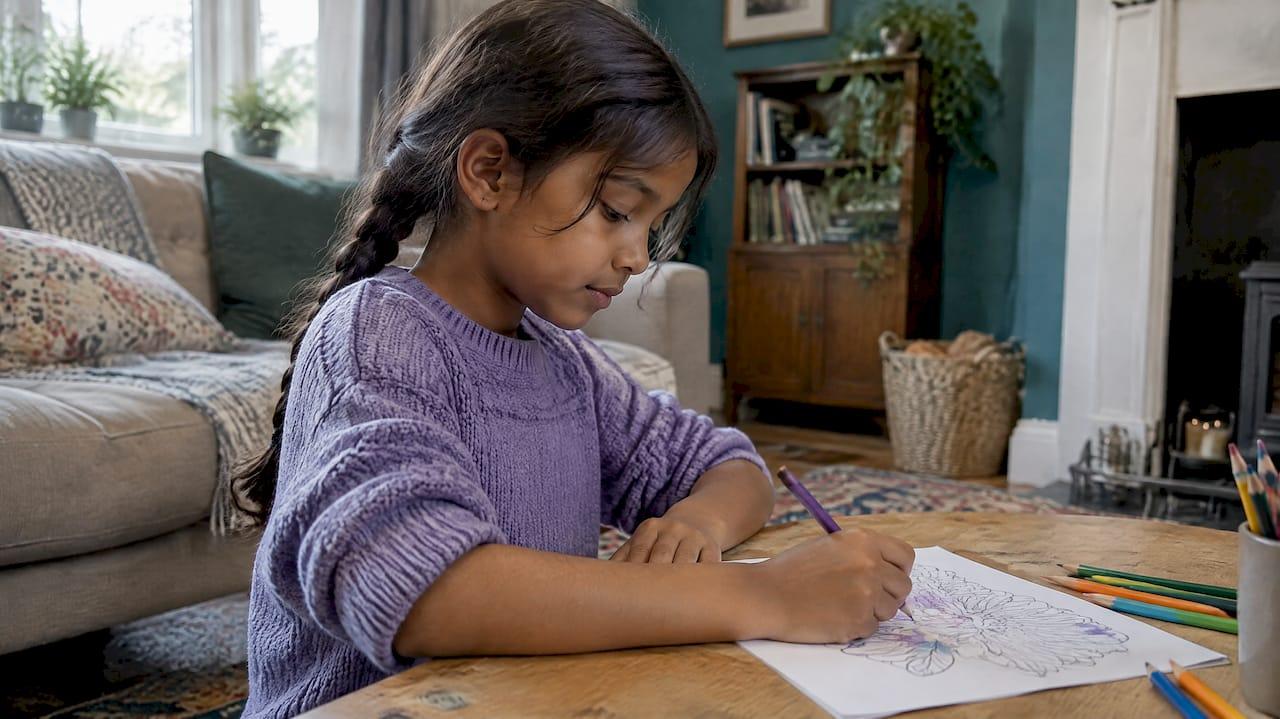
Mindfulness coloring is ordinary coloring with one change: the child is invited to notice what is happening while they color, such as the feel of the pencil, the colors they pick and their breathing, instead of rushing to finish the picture. You need a printed page, some pencils or crayons and about ten minutes. Our children's colouring books at Munkterproducts are made for exactly this kind of unhurried time at the table, and the rest of this guide shows you how to turn any page into a calm, focused activity.
TL;DR
- Mindful coloring means paying gentle attention to the present moment while coloring. The page and the pencils stay the same, and only the attention changes.
- A 2018 study of 152 children found lower test anxiety and higher mindfulness after a short mindful coloring activity.
- Pair coloring with simple breathing: in for 3, hold for 3, out for 3, or in for 4 and out for 4.
- Patterned pages such as mandalas give children a ready-made structure. Free drawing suits children who like to invent.
- Keep it short, keep it kind and never grade the result.
Table of Contents
- What mindful coloring is, and how it differs from ordinary coloring
- What the research says
- Choosing the right page for your child
- Four mindful coloring activities to try
- Add a breathing count
- How to run a session at home
- Adapting the activity to age and ability
- Our view on mindful coloring
- Find a book to color together
- FAQ
- Sources
What mindful coloring is, and how it differs from ordinary coloring
Most coloring is done for fun, for creativity or to pass the time, and the child's attention is usually on the finished picture. Mindful coloring adds intentional awareness. According to a foundation that works with creative wellbeing, the biggest difference is the intentional attention, not the page or the supplies, and children can be encouraged to notice colors, sensations, breathing and feelings without being expected to sit perfectly still.
That last point matters for parents. Mindfulness here does not mean silence, stillness or a blank mind. It means "what is my hand doing, what do I see, how does my body feel right now?" A fidgety seven-year-old who hums while shading a fish can be perfectly mindful.
In schools, mindfulness is often described in even simpler words: focusing on the present and paying attention to little things. The BBC Children in Need brain-break cards use that definition and suggest keeping the activities handy for moments when a child needs to settle or feel calm.

What the research says
The evidence is encouraging and still modest in scale, so it is best read as support for a gentle daily habit rather than a cure for anything.
- Test nerves. A 2018 Canadian study of 152 children (average age 10.38) found a significant drop in test anxiety and a rise in state mindfulness after a mindful coloring activity done before a spelling test.
- Structure helps some children. The same paper's authors suggest that filling in the repeating shapes of a mandala gives focused attention similar to other forms of meditation. They also note that a blank page can feel hard for some children, who feel they must invent the structure themselves.
- Boys and girls may differ. An earlier 2015 study of 52 children (average age 10.92) saw anxiety fall in both a mandala group and a free-coloring group. Boys reported the larger drop with free coloring, and girls benefited only in the mandala condition. The sample is small, so treat this as a hint: offer both kinds of page and see what your child reaches for.
- Daily practice. A 2026 study in India of 60 school-going children found that 30 minutes of guided mandala coloring a day for two weeks reduced stress scores and improved concentration.
- Breathing is the common thread. A 2025 systematic review of mindfulness-based art work with children and teenagers found that breathing exercises were the most common mindfulness activity across 25 studies, ahead of guided imagery and self-awareness activities.
The takeaway for a family: coloring gives the hands something to do, and a breathing cue gives the mind something to follow. Together they make a small, repeatable calming routine.
Choosing the right page for your child
The pages that suit mindful coloring are not the busiest or the most colorful. Look for these qualities.
Pages with a repeating pattern
Mandalas, stars, waves, scales and leaves invite a rhythm: fill one shape, move to the next, repeat. That rhythm is what makes the activity soothing. If your child is older or enjoys detail, grown-up mandala pages can work too. Our mandala colouring books are made for unwinding with intricate patterns and uplifting affirmations, which makes them a good choice when a parent wants to sit down and color alongside the child.
Pages with a story or a feeling
Younger children often settle more easily with a subject they love: an animal, a season, a favorite place. Our children's colouring books include themed collections, seasonal holiday activity books and Colour and Learn titles, so a calm moment can also carry a little learning. If educational pages are what you are after, our guide to educational coloring books that boost kids' learning explains what to look for.
Plain pages for free drawing
Some children push back against a printed pattern. For them, a blank page and a single instruction works well, such as "draw your breath" (see below). A notebook from our journals and notebooks range gives them a place to draw freely, then keep what they make.
Four mindful coloring activities to try
Each activity below comes from school or children's charity resources used in UK classrooms and homes. Read the instructions aloud in a quiet voice and join in yourself.
1. Pen goes for a walk
The BBC Children in Need cards suggest letting a pen "go for a walk" across the paper, making loops and lines. Then the child colors the shapes it created while breathing gently and noticing how the pen feels in their hand. There is no wrong picture, which is the point.
2. Draw your breath
In a school wellbeing guide from Abbey Park School, children place a pen on the paper, focus on their breath and draw it as one continuous line without lifting the pencil. Then they notice how the line changes when they take slow, calm breaths. A booklet from Merrymount adds a twist: trace each in-breath in one color and each out-breath in another, so the page becomes a picture of the breathing.
3. Feelings color hunt
Children's Health Scotland's #BECALM Wednesday page offers a color hunt: match colors to feelings, for example blue for calm, yellow for happy and red for excited, then draw the items you find. At home, you can do the same with a coloring page. Ask, "Which color feels like today?" and let your child fill the page with it. It is a gentle way to talk about emotions without making it a conversation about emotions.
4. Star breathing
The same Scottish charity page describes Star Breathing, developed with the Teapot Trust. A child traces the outline of a star with a finger, breathing in at the blue dots, holding at the green dots and breathing out along each line. Afterward they decorate the star with soothing colors and keep it in a pocket, school bag or sensory kit as a calming tool. Draw your own star on a notebook page if you do not have a template.
Add a breathing count
Breathing is what turns coloring into a mindfulness practice, so a short count helps. These are the patterns the school resources use:
| Technique | Count | Source |
|---|---|---|
| Triangle breathing | In for 3, hold for 3, out for 3 | Merrymount booklet |
| Square breathing | In for 4, hold for 4, out for 4, pause for 4 | Abbey Park School |
| Longer out-breath | In for 3, out for 5 | BBC Children in Need |
| Belly breath | In for 4, out for 4, saying "up" and "down" | Borris NS |
The belly breath card from Borris National School in Ireland has a child lie down with a small stuffed animal on the tummy and watch it rise and fall. It explains that deep diaphragmatic breathing slows the heart rate and triggers a relaxation response, and it is suitable from age three. For a child who finds counting hard, a Glow Scotland (Aberdeenshire) breathing activities sheet offers games such as Tummy Balloon, where a hand on the tummy feels an imaginary balloon inflate on the in-breath and deflate on the out-breath, ending with a playful "pop".
You do not need all of these. Pick one count, use it for a week and let your child choose whether to breathe before, during or after coloring.
How to run a session at home
Here is a simple routine that takes about ten to fifteen minutes.
- Set the scene. Clear the table, switch off the screen and put out a small choice of pencils or crayons. Fewer choices make it easier to settle.
- Start with three breaths. Use whichever count suits your child's age. Younger children like the belly breath with a toy.
- Invite, never instruct. Say, "Let's see how the pencil feels today" instead of "Stay in the lines."
- Ask sensory questions while you color. What color are you picking next? Is the pencil light or heavy on the paper? Can you feel your shoulders?
- Notice, then finish. When the time is up, take one more slow breath together. Ask what they noticed, not whether the picture is good.
- Keep the page. A finished page on the fridge, or in a notebook, becomes a quiet reminder of the calm.
The common mistakes are expecting silence, correcting the coloring and turning it into a reward or punishment. If your child resists, shorten the session to five minutes or try it side by side, with you coloring in your own book. Children copy calm more readily than they follow instructions.
If you would like a five-minute idea for yourself while they color, these mindfulness art exercises are quick to try. Our own guide to mindfulness activities for adults is another place to start.
Adapting the activity to age and ability
Children differ, so the same page will not suit everyone. These adjustments keep the activity within reach.
- Ages 3 to 5. Use large, simple shapes and chunky crayons. Keep to two or three minutes and lean on the belly breath with a toy, as the Borris NS card does from age three.
- Ages 6 to 8. Add a count of three or four and a feelings color hunt. Short sessions of five to ten minutes work well.
- Ages 9 to 12. Mandalas, star breathing and drawing your own pattern suit this group, which is also the age range in the 2018 and 2015 studies above.
- Teens. Offer a more detailed page, or a notebook for doodling. Teens tend to prefer an activity they can own, so leave the choice to them.
- Different abilities. If holding a pencil is tiring, try thicker crayons, a slanted surface or finger tracing as in Star Breathing. If counting is hard, replace numbers with a word such as "up" and "down". If your child has a diagnosed anxiety condition or sensory needs, ask their doctor or school's special needs coordinator how to fit the activity into their wider support.
Our view on mindful coloring
Every book in our shop is an original work, and I make them because I believe a printed page can slow a child down in a way a screen rarely does. A child with a pencil and a page of shapes to fill gets to choose colors, work at their own speed and finish something with their hands.
When parents ask us which book to choose, we point them to pages with a clear pattern or a subject the child already loves, and we suggest sitting down to color beside them. That shared ten minutes is where the mindfulness happens, more than in any single page.
Our children's colouring books, seasonal holiday activity books and Colour and Learn titles are designed to give families that time. Postage is included in the price, wherever you live.
Mark
Find a book to color together
If you would like printed pages ready for a calm, screen-free routine, browse our children's colouring books, which include seasonal holiday activity books and Colour and Learn collections. Postage is included in the price. Because every title is an original work by author Mark Terry, you are choosing from a thoughtfully designed catalog, not a pile of repeated pages.

For a child who likes puzzles, our activity and puzzle books offer another quiet, focused pastime, and our word search books suit older readers who like to hunt for words while the house winds down. For ideas on coloring as a grown-up, see our guide to step-by-step adult coloring.
FAQ
How long should a mindful coloring session last?
Five to fifteen minutes suits most children. The 2026 Indian study used 30 minutes a day, but that was guided school practice with older children. At home, stop while your child is still enjoying it so they come back willingly.
Do I need a special mandala or "mindfulness" coloring book?
No. The foundation article above says the difference lies in the intentional attention, not in the page or supplies. Patterned pages such as mandalas can make it easier to settle, but any page your child enjoys works if you add a breathing cue and a few noticing questions.
Can mindful coloring help with test or school nerves?
One 2018 study of 152 children found lower test anxiety after a short mindful coloring activity before a spelling test. It is a calming routine worth trying, not a treatment. If your child's worries are frequent or strong, speak to your GP or the school's pastoral team.
What if my child won't sit still?
That is fine. Mindfulness does not require stillness. Shorten the session, let them stand at the table or color beside you, and use a movement-based game like Squeeze the Lemon, where they tense and release their hand muscles, before they start.
Sources
- Mindful Coloring vs. Regular Coloring, Healing Through Creativity Foundation
- Evaluating the effectiveness of a mindfulness coloring activity for test anxiety in children, 2018
- Effectiveness of a classroom mindfulness coloring activity for test anxiety in children, 2015
- Effectiveness of Mindfulness-Based Mandala Colouring, Young Nurses Journal of Research, 2026
- Mindfulness-Based Art Interventions for Promoting Child and Adolescent Mental Health, Mindfulness, 2025
- Mindfulness: Take a Brain Break Activity Cards, BBC Children in Need
- Weekly Wellbeing, Abbey Park School
- Mindfulness booklet, Merrymount
- #BECALM Wednesday, Children's Health Scotland
- Keep on Singing, Borris NS
- Breathing Activities, Glow Scotland Aberdeenshire
- Five Minute Mindfulness Art Exercises for Beginners