

How journaling supports mental health and emotional wellness

Journaling works. Not as a cure, not as a replacement for therapy, but as a tool that genuinely shifts how your brain handles stress, anxiety, and emotional overload. The core mechanism is straightforward: putting emotions into words moves them from the reactive part of your brain to the part that reasons and problem-solves. That translation alone can reduce anxiety, improve mood, and help you make sense of experiences that feel overwhelming in your head.
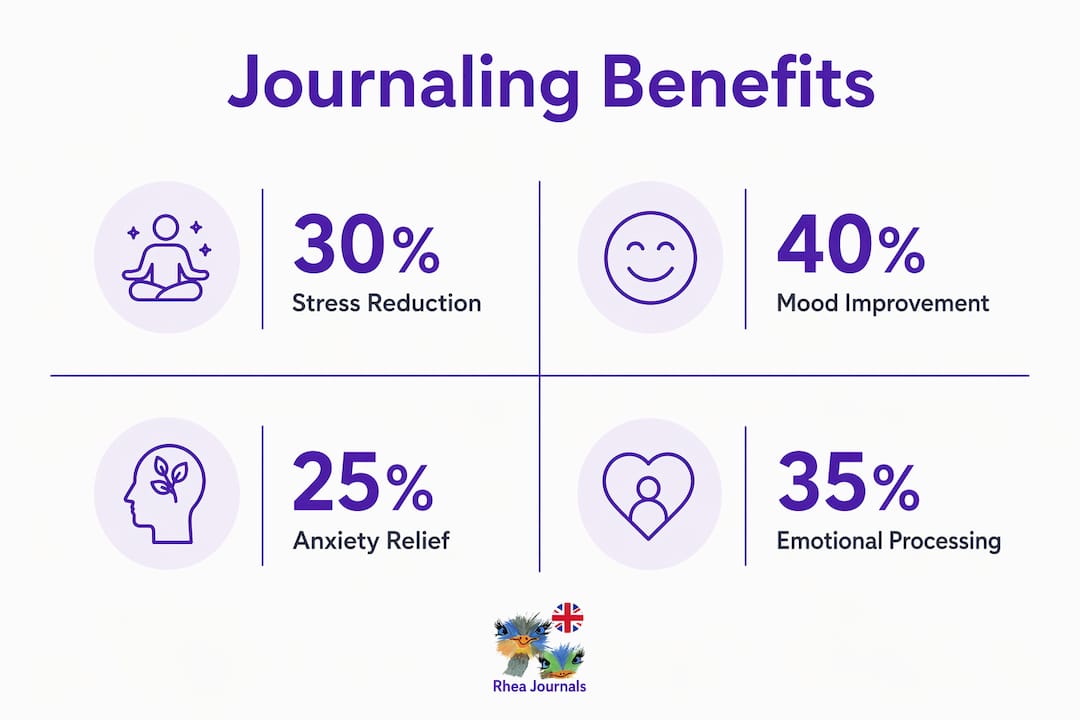
The benefits of journaling span several areas:
- Anxiety reduction: Writing about worries offloads anxious thoughts, freeing up mental resources for focus and decision-making.
- Mood improvement: Recording three positive things daily can measurably lift mood and build resilience over time.
- Stress relief: Regular writing helps lower blood pressure and reduce physiological stress markers.
- Emotional clarity: Journaling reveals thought patterns and emotional triggers that are hard to spot in the moment.
- Immune function: James Pennebaker's research linked expressive writing to improved immune response alongside psychological benefits.
Three main techniques drive most of these outcomes: expressive writing (free-form exploration of deep thoughts and feelings), gratitude journaling (recording specific things you appreciate), and worry journaling (containing anxiety to a scheduled writing window). Each targets a different mental health challenge, which is why matching the technique to your goal matters.
Table of Contents
- What the science actually says about journaling and mental health
- How journaling helps you manage anxiety, depression, and emotional challenges
- Expert guidance for getting the most out of journaling
- Common mistakes that undermine journaling's mental health benefits
- Munkterproducts journals are built for this kind of practice
- Key Takeaways
What the science actually says about journaling and mental health
The research base here is real, though not without nuance. A systematic review and meta-analysis published in PMC examined 20 peer-reviewed randomized controlled trials covering PTSD, anxiety disorders, and depression. The findings showed that journaling interventions produced a statistically significant greater reduction in patient health measure scores compared to control groups, with stronger effects observed in anxiety and PTSD subgroups.
Key finding: 68% of intervention outcomes in that meta-analysis were effective, supporting journaling as a legitimate adjunct therapy across a broad range of mental health conditions.
Pennebaker's foundational expressive writing research, developed in the late 1980s, showed that writing about your deepest thoughts and feelings across multiple short sessions improves immune function (https://www.simplypsychology.com/articles/journaling-for-mental-health), reduces depressive symptoms, and decreases physician visits. His work established that the act of writing itself, not just talking or thinking, produces measurable psychological and physical changes.
The brain science behind this is equally compelling. Writing about emotions reduces amygdala activity and engages the prefrontal cortex, the part of the brain responsible for rational thought and emotional regulation. In people who worry chronically, the brain produces a sharp negative signal when errors occur, and this signal is amplified by anxiety. Expressive writing reduces that signal, which means fewer mental resources get consumed by background worry.
| Journaling technique | Primary benefit | Evidence base |
|---|---|---|
| Expressive writing | Trauma processing, immune function, depression relief | Pennebaker's RCT research; PMC meta-analysis |
| Gratitude journaling | Mood improvement, resilience, reduced negativity bias | Positive psychology studies; Sanford Health clinical data |
| Worry time journaling | Anxiety containment, reduced free-floating worry | CBT research; Harvard Health expressive writing study |
| Cognitive restructuring journaling | Correcting distorted thoughts, reducing emotional reactivity | CBT-based journaling protocols |
One honest caveat: the meta-analysis flagged high heterogeneity across studies and noted that most participants received limited instruction. The researchers concluded that better outcomes are likely when journaling is taught properly, not just assigned.
How journaling helps you manage anxiety, depression, and emotional challenges
Journaling's practical power in emotional wellness comes from what it forces you to do: slow down and translate a feeling into language. That process alone interrupts the automatic emotional reactions that drive anxiety and low mood.
For anxiety specifically, scheduled worry journaling is one of the most effective techniques. You set aside 15–20 minutes at a fixed time each day to write out your worries, then close the journal and redirect your attention. CBT research shows this confines anxiety to a designated window rather than letting it bleed into the whole day. The key is the boundary: worry time only works when you commit to stopping.
Gratitude journaling targets a different problem. Anxiety and depression both amplify negativity bias, the brain's tendency to weight bad experiences more heavily than good ones. Writing three specific, reasoned things you are grateful for daily, not vague statements but concrete reasons, measurably counters that bias. Dr. Jeffrey Leichter, a licensed clinical psychologist at Sanford Health, notes that recording three good things daily for 14 days produced reductions in depressive symptoms comparable to antidepressants for mild to moderate depression.
Journaling also works well alongside therapy. Between sessions, it captures thought patterns, emotional reactions, and behavioral triggers that are easy to forget by the time you sit down with a therapist. That record gives both you and your therapist more to work with. For mindfulness practice, a guided journal format can provide structure when open-ended writing feels too loose.
- For depression: Daily gratitude or positive affect journaling shifts attention away from rumination.
- For anxiety: Worry time journaling and expressive writing reduce the cognitive load of chronic worry.
- For trauma: Expressive writing across multiple sessions helps process difficult memories at a manageable pace.
- For self-esteem: Reflective journaling builds self-awareness and helps identify personal strengths over time.
Pro Tip: If you find yourself writing the same anxious thoughts in circles, shift to a third-person perspective. Writing "she is worried about X because..." instead of "I am worried about X" creates psychological distance and reduces emotional reactivity, a technique backed by research on analytical journaling.
Expert guidance for getting the most out of journaling
Consistency beats intensity every time. Dr. Leichter's clinical observation is direct: short daily sessions of introspective or gratitude writing yield better long-term emotional benefits than occasional marathon entries. Ten to twenty minutes is enough. The goal is a sustainable habit, not a cathartic event.
Structure matters more than most people expect. Unstructured venting feels productive but often is not. Writing without a goal or analytical frame tends to keep you circling the same negative thoughts rather than processing them. A few practical ways to add structure without making journaling feel like homework:
- Set a clear prompt before you start ("What triggered my anxiety today, and what was I actually afraid of?").
- Use a time limit. Fifteen minutes with a timer prevents sessions from spiraling.
- End each entry with one sentence about what you want to do differently or what you noticed.
- Match your technique to your current challenge: expressive writing for processing difficult events, gratitude journaling for low mood, worry journaling for anxiety.
Integrating journaling with professional care is worth planning deliberately. If you are in therapy, bring your journal or share specific entries. The role of journals in mindfulness practice is also well-documented: writing after meditation or a breathing exercise can deepen the reflective state you have already created.
Pro Tip: Schedule your journaling at the same time each day, ideally morning or early evening. Attaching it to an existing habit, like after your morning coffee or before your evening wind-down routine, dramatically improves follow-through. Pairing it with a calming environment, as outlined in resources like this Sunday sanctuary guide, can make the habit genuinely enjoyable rather than another task.
Common mistakes that undermine journaling's mental health benefits
The biggest misconception about journaling is that any writing helps. It does not. Venting without structure, writing the same fears repeatedly without reflection, or using journaling as a substitute for professional care can all backfire.
- Unstructured venting reinforces rumination. Psychologists warn that writing without analytical reflection traps people in negative thought loops rather than resolving them. If your entries read like a complaint log with no shift in perspective, the practice is likely maintaining anxiety rather than reducing it.
- Journaling is not therapy. Clinical guidance is clear: journaling complements professional treatment but cannot replace it for serious conditions like PTSD, major depression, or OCD. If symptoms are severe, journaling should be one tool among several, not the primary intervention.
- Short-term discomfort is normal, but prolonged distress is a signal. Expressive writing can temporarily feel worse before it feels better. Studies show some people feel more upset immediately after writing but significantly improved weeks later. If distress persists or intensifies, scale back the intensity or work with a therapist on pacing.
- Inconsistency kills the benefit. Journaling once a week during a crisis and then stopping is less effective than a modest daily practice. The cumulative effect of regular writing is what produces lasting change.
- Perfectionism kills the practice. There is no correct way to journal. Grammar, spelling, and sentence structure are irrelevant. The moment journaling feels like an assignment you can fail, the psychological safety that makes it work disappears.
Munkterproducts journals are built for this kind of practice
If you are ready to start journaling for your mental health, the physical journal you use matters more than people think. A well-designed journal removes friction and makes the habit easier to sustain.

Munkterproducts offers a curated range of self-help journals, planners, and guided notebooks designed specifically for people who want structure without rigidity. Whether you are drawn to gratitude journaling, expressive writing, or a daily reflection format, there is a format in the catalog that fits. Every order ships with postage included, so there is no barrier between you and starting. Browse the full journal collection and find the format that matches where you are right now.
Key Takeaways
Journaling produces real, measurable mental health benefits when practiced consistently with structure and matched to a specific goal.
| Point | Details |
|---|---|
| Evidence is solid | A PMC meta-analysis found journaling produced a statistically significant greater reduction in mental health measure scores for a majority of outcomes, with stronger effects observed in anxiety and PTSD subgroups. |
| Structure beats venting | Unstructured emotional venting reinforces rumination; analytical or prompted writing produces genuine processing and relief. |
| Consistency over intensity | Short daily sessions of 10–20 minutes yield better long-term outcomes than occasional long entries, per clinical psychologist Dr. Jeffrey Leichter. |
| Complement, not replace | Journaling works best alongside therapy, capturing thought patterns between sessions rather than substituting for clinical care. |
| Munkterproducts | Offers guided journals and self-help notebooks designed to support structured daily journaling for mental wellness. |